Brahms: Symphony No. 3 in F major, Op. 90

Prices shown exclude VAT. (UK tax is not payable for deliveries to United States.)
See Terms & Conditions for p&p rates.

Brahms: Symphonies Nos. 1-4 (Complete)

Brahms: Symphonies Nos. 1-4 (Complete)


This special 3 CD-box features the four Symphonies by Johannes Brahms, performed by the Chamber Orchestra of Europe, under Paavo Berglund.

Paavo Berglund (1929–2012) is considered to be one of the most acclaimed Finnish conductors of the last few decades. This highly praised symphony cycle is re-released in honour of his memory.

The Chamber Orchestra of Europe, hailed as one of the finest ensembles in the world, has released over 100 recordings with the world’s leading conductors and soloists, winning several prestigious awards.

Present day performances of Brahms symphonies with smaller string forces are rare, but there is evidence that the size of orchestra in Brahms’s time was not fixed and, indeed, Brahms’s own orchestra in Meiningen performed his fourth symphony with almost the same forces as are used on this recording.

Released or re-released in last 6 months

Ondine - ODE12292T

(CD - 3 discs)

$16.75

(also available to download from $31.50)

In stock - usually despatched within 1 working day.

Brahms: Symphonies Nos. 1-4

Brahms: Symphonies Nos. 1-4


Brahms:

Academic Festival Overture, Op. 80

Tragic Overture, Op. 81

Variations on a theme by Haydn for orchestra, Op. 56a 'St Anthony Variations'

Symphonies Nos. 1-4 (Complete)


During recent years Andrew Manze has become one of the most inspiring conductors of his generation. Since 2006 he has been the principle conductor of the Helsingborg Symphony Orchestra in Sweden, who celebrated their 100th birthday in February.

It is with this orchestra that Andrew Manze conducts a wonderful new interpretation of the Brahms Symphonies, recorded in SACD sound. Accompanying the complete Symphonies are the Haydn Variations, Tragic Overture and Academic Overture.

“this proves a release of distinctive character and many rewards...Although Manze has come from the 'period performance' movement, there is absolutely nothing pedantic in the readings he secures from his modern-instrument players...There are many instances of fresh thinking in his approach - and of fresh feeling.” BBC Music Magazine, July 2012 ****

“With swift, flowing tempi and minimal vibrato, Manze's Brahms is lithe, clear and bold. His pulse within movements will be too flexible for some tastes, but much is organic-sounding and he is generally convincing.” Classical Music, 5th May 2012 ***

“These Brahms performances...suggest that Manze has brought an added subtlety and beauty to the orchestra's string-playing...The Haydn Variations and the Academic Festival Overture are both finely done. Elsewhere what we have is work in progress, not only for the orchestra...but also for Manze himself. Awash with insights and excitements though his readings are, he has yet to bring these within the fold of a settled vision.” Gramophone Magazine, July 2012

“Manze’s performances are quite outstanding. His interpretations are taut without being over-driven; at the same time he is sensitive to the emotional ebbs and flows of Brahms’ music, and his management of transitions is masterly.” MusicWeb International, July 2012

“You don't often find freshness and innovation in performances of the Brahms symphonies, but Manze's take is wholly individual: they burst with life, by turns wistful, yearning, sharp-edged and blisteringly incisive...Manze's vision provides more than an "early music" approach to Brahms: this is the composer reinvented for the 21st century.” The Observer, 6th May 2012

Super Audio CD

Format:

Hybrid Multi-channel

CPO - 7777202

(SACD - 3 discs)

$37.75

(also available to download from $25.50)

In stock - usually despatched within 1 working day.

Brahms: Symphonies Nos. 1-4 (Complete)

Brahms: Symphonies Nos. 1-4 (Complete)


New York born David Zinman is one of the most internationally recognized conductors of his generation & is the chief conductor & artistic director of the Tonhalle Orchestra Zurich. This cycle of the complete Brahms Symphonies (Symphonies 1-4) was recorded during April 2010 in Tonhalle, Zurich, which is famous because of its superb accoustic qualities. The symphonies will be released as a ltd edition 3CD deluxe hard cover book with a 40 page booklet including extensive liner notes & illustrations of rare material.

“there is an unusually cogent feel to this cycle...they represent a kind of mainstream Brahms, utterly devoid of mannerism and interpretational quirks, with a fine central European orchestra playing at the top of its game...RCA/Sony’s lavish presentation is a luxury item encasing deluxe performances.” Sunday Times, 25th September 2011

“All the clarity and technical finesse that made their Mahler performances so refreshing are evident in these performances; there's no doubt the orchestra really has risen up the international pecking order under Zinman's direction.” The Guardian, 29th September 2011

“Zinman’s Brahms, again with the Zurich Tonhalle Orchestra but this time recorded live, makes fewer nods to period style than his Beethoven. It’s a warm, genial Brahms, as one might expect of a septuagenarian who describes the symphonies as “a perfect blending of spontaneity and intellect”.” Financial Times, 1st October 2011 ***

“These are splendid performances, passionately felt and never losing sight of the architecture. The orchestra under David Zinman is on top form. I like his choice of tempos - alert and dynamic throughout the fast movements, never too slumberous in the slow.” BBC Music Magazine, December 2011 ****

“the orchestra's playing for Zinman...impressively renews the time-honoured Austro-German tradition of Karajan and Klemperer...No non-vibrato, period-instrument revisionism here! Instead there's a firm-toned, glowing power which, in the passages like the great horn-tune in the First Symphony's finale, is seriously enthralling...As close to a definitive set of these masterworks as you'll find - and in fabulous modern recorded sound.” Classic FM Magazine, December 2011 *****

“conductor and orchestra rise to greatness in the Fourth Symphony. Elsewhere, they provide the kind of trenchant, well-grounded Brahms performances which have been common currency in Middle Europe since the composer's own time...Zinman is meticulous in his observation of Brahms's dynamic markings. This makes for some interesting articulation but it can also dislocate the line and disrupt the pulse...[in the Fourth] Zinman takes a less pedantic view of the markings.” Gramophone Magazine, December 2011

RCA - 88697933492

(CD - 3 discs)

$35.00

In stock - usually despatched within 1 working day.

Brahms - Symphonies Nos. 1-4 & Alto Rhapsody

Brahms - Symphonies Nos. 1-4 & Alto Rhapsody


Brahms:

Symphonies Nos. 1-4 (Complete)

Recorded Milan, 20th & 24th March 1959

Orchestra Sinfonica di Milano della RAI

Alto Rhapsody, Op. 53

Recorded Torino, 23rd January 1959

Marga Hoffgen (contralto)

Orchestra Sinfonica e Coro di Torino della RAI

Symphony No. 4 in E minor, Op. 98

Recorded Stuttgart, 11th September 1958

Radio-Sinfonieorchester Stuttgart


Celibadache demanded very high standards and rehearsed in great detail. He liked broad tempi, and the works of Beethoven, Brahms, Bruckner and Tchaikovsky were his core repertory. The recordings date from 1958-1959 and the sound is superb.

“combines high energy levels with the expected arching lines...this new reissue also includes a sensitively sung Alto Rhapsody with Marga Höffgen” Gramophone Magazine, April 2010

Andromeda - ANDRCD9053

(CD - 3 discs)

$18.25

In stock - usually despatched within 1 working day.

Brahms: Symphonies Nos. 1-4 (Complete)

Brahms: Symphonies Nos. 1-4 (Complete)


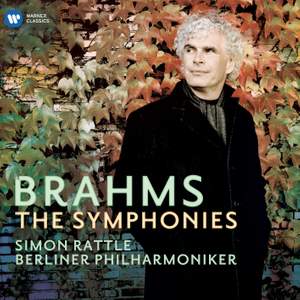
The name of Simon Rattle had not been closely associated with the works of Johannes Brahms so it was even more rewarding when his first Brahms recording with the Berliner Philharmoniker, Ein deutsches Requiem, won critical accolades and both Grammy and Classic FM/ Gramophone awards. Now Sir Simon and the Orchestra have committed to disc the complete Brahms symphonies, recorded in concert at Berlin’s Philharmonie in the autumn of 2008. In the words of Die Zeit, “Simon Rattle has finally dared to tackle Brahms with the Berliner Philharmoniker. He combines Furtwängler’s monumentality with Karajan’s beautiful sound.”

The Brahms symphonies concerts drew praise from the German critics: “The fourth symphony was an ecstatic apotheosis of what current orchestral playing, quick reactions and scarcely sketched annotations can get out of this work which has long since become a classic. Especially the Passacaglia finale was a finely-dosed wonder of sound refinement and harmonic finesse. Rattle appears to have finally conquered his difficult Berliners.” (Die Welt)

Stephen Johns, Vice President of A&R, EMI Classics, commented, “We are extremely pleased to be able to present Sir Simon Rattle and the Berliner Philharmoniker in this major new recording of the complete Brahms Symphonies - music that lies at the very core of the orchestra's repertoire and reputation. With the combination of Sir Simon's vision and iconoclastic approach, and the orchestra's remarkable technique and unique sound, these new performances should prove a new milestone in the history of recordings of these works, and a valuable addition to the growing catalogue of Sir Simon and the Berlin Philharmonic.”

Discussing the Brahms symphonies performances and recordings Sir Simon agreed that Brahms is very much at the centre of the Berliner Philharmoniker’s sound and style of playing. “Of course, the works were newly minted when the Orchestra was [being born] – in the first three years of the Orchestra’s history, they played all of them.” He also described the particular sound of Brahms, “steeped in the German ethos, the idea of the forests and the sound of horns coming from a distance, even the forest colours” and confirmed that performing these works with the Berliner Philharmoniker, which has been hailed as the world’s greatest Brahmsian orchestra “gives you a possibility of colours that you have almost nowhere else. … I can say to this orchestra, ‘I need a different sound’ and the sound changes immediately.” Brahms loved musicians with individual ways of phrasing, even when these were apparently contradictory – he loved the playing of the violinist Joseph Joachim, for example, who used almost no vibrato and that of the clarinettist Richard Mühlfeld, who played with much more vibrato than any clarinettist before or since – “There was no one way of performing.” Bearing this in mind, Sir Simon and the Orchestra have approached the symphonies anew, trying things they had never done before. At the end of the first movement of the Second Symphony, for example, Sir Simon asked the Orchestra’s principal horn, Stefan Dohr, about the possibility of trying a stingendo at the end of the big horn solo. “And Stefan not only took it and ran with it, but actually wanted to do much more than I had originally intended. He did it and it makes a moment of crisis rather than a moment of peace. And that’s wonderful.”

In his review of the Berliner Philharmoniker/Simon Rattle’s performance of Brahms’s Symphony No. 3 at the BBC Proms in September 2008, Andrew Clark of the Financial Times commented that Simon Rattle had spent most of the past six years attempting to drag the Berliner Philharmoniker into the 21st century, making the Orchestra “more versatile … more aware of its function in the community, more alert to a younger generation. But in this most dynamic of conductor-orchestra partnerships, the partner who has changed most is Rattle” as he has grown to value the Orchestra’s fabulous musicianship and tradition even more than before. “The evidence was there in Brahms’s Third Symphony, the most beautiful performance of this work I have heard, radiating a profundity that was not lost on a rapt Proms audience.”

Simon Rattle’s association with EMI dates back to the 1970s and has resulted in many award-winning and ground-breaking releases. Previous critically acclaimed recordings with the Berliner Philharmonker encompass works by Bruckner, Brahms, Holst, Shostakovich, Prokofiev, Schoenberg, Richard Strauss, Schubert, Mahler and Debussy. Their release of Holst’s The Planets won ‘Classical Recording of the Year’ at the Classical Brit Awards. Their Berlioz Symphonie fantastique/La mort de Cléopatre disc won an Excellentia award from Pizzicato, the Luxemburg-based European classical music magazine and, most recently, their recording of Stravinsky’s Symphony of Psalms won a Grammy award in the ‘Best Choral Performance’ category.

“[The September 2008] Proms performance [of Symphony No. 3] was manifestly Brahmsian in its warmth, lyrical flow and structural coherence. It was manifestly from Berlin in its richness of timbre and soloistic allure … But it was also manifestly Rattle in its flexibility of tempo and adherence to the score.” (Financial Times)

“Simon Rattle has clearly forged a deep bond with the Berlin Philharmonic during his tenure, and the playing is never less than superb, with every section of the orchestra ideally responsive. If any one aspect should be singled out it must be the horn-playing, both solo and as a body, which is gloriously expressive, most movingly of all throughout Symphony No. 2.” BBC Music Magazine, October 2009 *****

“if you’re looking for Romantic depth and sheer beauty of tone, then you’ve come to the right band. In fact, there are moments where a particular theme is so achingly lovely that you almost forget to breathe” Charlotte Gardner, bbc.co.uk, 9th September 2009

“For all-round technical and musical expertise, it is difficult to fault these mellifluous performances. Very satisfying.” Classic FM Magazine, October 2009 ****

“Where Harnoncourt rather underplays the First Symphony, giving it a decorous Schumannesque feel, Rattle's reading is one in which the inwardness and charm of the exquisitely realised inner movements offset the breadth and lyric power of the surrounding drama. ...in the Third... we hear... exquisitely quiet string- and horn-playing - the inner movements rich in beauty and quiet foreboding... Rattle's finely moulded direction sustains the discourse.” Gramophone Magazine, Awards Issue 2009

“Rattle's account of the Second Symphony has a wonderfully relaxed good humour about it, with the Berlin Phil's fabulous horn section adding lustre to the climaxes, and a finale that positively overflows with high spirits. Much of the Third is equally fine, by turns spaciously expressive and tautly rigorous.” The Guardian, 18th September 2009 ****

“there are no gimmicks, only an impressive fidelity to the score...In sum, a revelation, which rewards repeated listening.” The Observer, 20th September 2009

EMI - 2672542

(CD - 3 discs)

$26.00

In stock - usually despatched within 1 working day.

Brahms: Symphonies Nos. 1-4 (Complete), etc.

Brahms:

Symphonies Nos. 1-4 (Complete)

Academic Festival Overture, Op. 80

Tragic Overture, Op. 81


“[On Brahms' Third Symphony] Many conductors come to grief in the Third Symphony's first movement, but Sawallisch is a wise and experienced practitioner, and he steers a confident course through the music's various potential pitfalls” Gramophone Magazine

“[On Brahms' Fourth Symphony] it is ardent, uniquely imaginative in its faithful response to Brahms's markings, far-sighted and focused.” Gramophone Magazine

EMI Triples - 5009132

(CD - 3 discs)

$12.75

In stock - usually despatched within 1 working day.

Brahms: Symphony No. 1 in C minor, Op. 68, etc.

Beethoven:

Coriolan Overture, Op. 62

Leonore Overture No. 2, Op. 72a

Brahms:

Symphony No. 1 in C minor, Op. 68

Symphony No. 2 in D major, Op. 73

Symphony No. 3 in F major, Op. 90

Symphony No. 4 in E minor, Op. 98

Variations on a theme by Haydn for orchestra, Op. 56a 'St Anthony Variations'

Hungarian Dance No. 1 in G minor

Hungarian Dance No. 3 in F major

Hungarian Dance No. 10 in F major


“Perhaps the historic choice (1948-52) and a fine example of Furtwängler's incandescent art: the Fourth positively drips with tragedy.” Gramophone Classical Music Guide, 2010

EMI Références - 5655132

(CD - 3 discs)

$16.50

In stock - usually despatched within 1 working day.

Brahms - Complete Symphonies

Brahms - Complete Symphonies


Brahms:

Symphonies Nos. 1-4 (Complete)

Academic Festival Overture, Op. 80

Tragic Overture, Op. 81

Variations on a theme by Haydn for orchestra, Op. 56a 'St Anthony Variations'


“Any fears that Nikolaus Harnoncourt's Brahms will be quirky, provocative or abrasive can be dispelled. There are interpretative novelties (freshly considered articulation and clarified counterpoint) and the Berlin strings project a smooth, curvaceous profile. Harnoncourt makes a beeline for the brass, and the horns in particular. The live recordings have remarkable presence and are mostly cough-free.
The First Symphony's opening Un poco sostenuto seems a trifle soft-grained but the pounding basses from bar 25 are beautifully caught and the first-movement Allegro is both powerful and broadly paced. The Andante sostenuto slow movement is both limpid and conversational, with trance-like dialogue between oboe and clarinet and sparing use of vibrato among the strings.
Harnoncourt makes real chamber music of the third movement, though he drives the trio section to a fierce climax, and the finale's first accelerating pizzicatos are truly stringendo poco apoco – the excitement certainly mounts, but only gradually.
The Second Symphony's first movement is relatively restrained. Harnoncourt's strategy is to deliver a sombre exposition and a toughened development. Again, the slow movement is fluid and intimate, with some tender string playing. The third movement's rustling trio is disarmingly delicate and the finale, tightly held, keenly inflected and heavily accented: the coda threatens to break free and the effect is thrilling.
First impressions of the Third suggest a marginal drop in intensity, yet the first movement's peroration is so powerful that there's a retrospective suspicion that all the foregoing was mere preparation. The middle movements work well but the rough-hewn, flexibly phrased finale really makes the performance.
Like the Third, the Fourth opens with less import than some of its older rivals, yet the development intensifies perceptibly, the recapitulation's hushed piano dolce opening bars are held on the edge of a breath and the coda is recklessly headstrong. The slow movement has some heartfelt moments, the top-gear Scherzo is quite exhilarating and the finale, forged with the noble inevitability of a Baroque passacaglia.
Ultimately, Harnoncourt delivers a fine and tragic Fourth.
Harnoncourt's Brahms is the perfect antidote to predictability and interpretative complacency.”
Gramophone Classical Music Guide, 2010

“Under Harnoncourt the music's gently descending lines truly glow [in the Third], distinctively but never conspicuously, and the gradual 'dying away' is beautifully handled” Gramophone Magazine, Awards Issue 2012

Teldec - 0630131362

(CD - 3 discs)

$16.50

In stock - usually despatched within 1 working day.

Brahms: Complete Symphonies

Brahms: Complete Symphonies


anon.:

God Save The Queen

Brahms:

Symphonies Nos. 1-4 (Complete)

Tragic Overture, Op. 81

Variations on a theme by Haydn for orchestra, Op. 56a 'St Anthony Variations'


“The concerts recorded here preserve the two legendary occasions in the autumn of 1952 when in a Brahms cycle at the Royal Festival Hall Toscanini conducted the Philharmonia Orchestra, then only six years old but already the front runner among London orchestras. The recording itself, now legendary, has generated pirated versions, but never before has the original made by EMI, under the supervision of Walter Legge, been officially released. Testament's remastering is a revelation. This new set brings the clearest of demonstrations that the RCA recordings of Toscanini and the NBC Symphony Orchestra made during the last years of his life (including his Brahms cycle of the very same 12-month period) give only an imperfect picture of a conductor who at the time, and for a generation or so previously, was almost universally counted the greatest in the world. That reputation has been eroded over the years, but this issue may help to put the record straight.
Take for example the quite different NBC version of No 3 that he recorded in New York barely a month after this performance: as Alan Sanders says in his note, a 'rhythmically staid recording which entirely lacked the lyricism and eloquence of the Philharmonia performance'.
His description points to the marked contrasts, not only in No 3 but in all four symphonies.
Whereas the New York performances, resonant and superbly drilled, have a hardness and rigidity, with the dynamic contrasts ironed out, thus eliminating pianissimos (partly a question of recording balance), the Philharmonia's consistently bring a moulding of phrase and subtlety of rubato which bears out the regular Toscanini instructions to 'Sing!'. And in contrast with most Toscanini recordings, the hushed playing is magical. The New York players, by comparison, seem to have forgotten how to respond to the finer subtleties of this notorious taskmaster among conductors. The extra flexibility of the Philharmonia performances over the NBC has an interesting effect on tempo too. Whereas in No 1 the NBC speeds of 1951 are faster, not just than those of the Philharmonia but of the 1941 NBC performance, in the other three symphonies the Philharmonia timings tend to be a degree quicker, notably in No 3, where for example the Andante flows far better.
Walter Legge fought hard to get these live recordings officially released – now we can understand why.”
Gramophone Classical Music Guide, 2010

Testament - SBT3167

(CD - 3 discs)

$46.50

In stock - usually despatched within 1 working day.

Brahms: Complete Symphonies & Tragic Overture

Brahms: Complete Symphonies & Tragic Overture


Brahms:

Symphonies Nos. 1-4 (Complete)

Tragic Overture, Op. 81


GGramophone Magazine

Re-issue of the Month - June 2013

Released or re-released in last 6 months

King Records - KKC2028

(CD - 3 discs)

$43.75

Usually despatched in 2 - 3 working days.

Page: 

 1   2   3   4   5   6   7   8   9   10   11   12   13   14   15   16   17   18 

 Next >>

Copyright © 2002-13 Presto Classical Limited, all rights reserved.