Prices shown exclude VAT. (UK tax is not payable for deliveries to United States.) See Terms & Conditions for p&p rates. | |  | Wagner Heroines
2013 sees a series of Wagner reissues on Eloquence from complete operas and highlights to Wagner singer portraits and even an audiobook! This is a 31-year retrospective (1956 – 1987) of great Wagner singing on Decca and Deutsche Grammophon featuring fourteen extracts from nine operas with seven great singers. Wagner’s heroines make for some of the most pivotal moments in his operas and this anthology highlights almost every aspect of his women – suspicious and inflexible (Fricka, here taken from a recital recording by Regina Resnik), redeeming (Elisabeth and Brünnhilde), passionate (Sieglinde), transfigured (Isolde). We hear the great voices of Joan Sutherland (who sang a number of Wagnerian roles before establishing her incomparable reputation in the bel canto repertoire), her idol, Kirsten Flagstad (here singing Kundry), Flagstad’s Scandinavian successor Birgit Nilsson (in two of the greatest opera scenes – Isolde’s Liebstod and Brünnhilde’s Immolation), and at the start of this recording, the splendidly Italianate singing of Susan Dunn as Elisabeth and Sieglinde. The illuminating notes on the music and the singers are by Wagner scholar Peter Bassett and the booklet includes a photo gallery of the singers. | 
| | | (Sorry, download not available in your country) | In stock - usually despatched within 1 working day. |
|
|
| |  | Opera 2013
Artists include Natalie Dessay, Maria Callas, Diana Damrau, Janet Baker, Joyce DiDonato, Philippe Jaroussky and Roberto Alagna
A glittering selection of operatic highlights and arias, featuring great composers and artists who are all celebrating significant anniversaries in 2013. | 
| | | In stock - usually despatched within 1 working day. |
|
|
| |  | The Essential Wagner
Hildegard Behrens, Jessye Norman, Helga Dernesch, Cheryl Studer, Birgit Nilsson (sopranos), Marjana Lipovsek, Christa Ludwig (mezzos), Siegfried Jerusalem, Jon Vickers, Nicolai Gedda, Ben Heppner (tenors), Dietrich Fischer-Dieskau (baritone), Kurt Moll (bass) Bernard Haitink, Klaus Tennstedt, Herbert von Karajan, Andre Cluytens, Sir Adrian Boult The best-loved and most popular works by Richard Wagner, performed by the world’s leading artists, in an accessible format at budget price. | | | In stock - usually despatched within 1 working day. |
|
|
| |  | The Very Best of Jessye Norman
If anyone may lay claim to the title of prima donna assoluta of the late 20th century, it is surely Jessye Norman. She is one of the great communicators. Whether in the intimate setting of the Wigmore Hall in London, or the huge space of the Metropolitan Opera House, New York, she can give each listener the sense that her song is directed straight at them. Jessye Norman was born in Augusta, Georgia, in 1945. She studied at Howard University, the Peabody Conservatory and the University of Michigan. In 1968 she won the Munich International Music Competition, and this led to an invitation to sing in Berlin at the Deutsche Oper, where she made her debut as Elisabeth in Wagner's Tannhäuser. After that her career blossomed and she went on to conquer the world’s greatest opera houses including La Scala in Milan and the Metropolitan in New York. One of her greatest triumphs in New York was in 1982, in Robert Wilson's Great Day in the Morning, and in 1989 she was invited to sing the Marseillaise for the 14 July celebrations in the Place de la Concorde. The music on these CDs presents a cross-section of Jessye Norman's repertory, in German and French opera, in Lieder and mélodie, in oratorio and even operetta. Since Wagner's Tannhäuser provided Jessye Norman with her first stage role, it is appropriate to begin with two arias from that opera. Senta's ballad from Der fliegende Holländer tells the story of the Flying Dutchman, who is condemned to sail the seas for eternity unless he can find a woman who will remain faithful unto death. The Wesendonck- Lieder were composed by Wagner in 1857–8 as a tribute to Mathilde Wesendonck, the wife of his friend Otto; particularly in 'Im Treibhaus' and 'Träume', they look forward to Tristan und Isolde. The three Schubert songs, and the solo from Brahms's German Requiem, bring the German part of the programme to a rapturous conclusion. From Offenbach’s Les Contes d’Hoffmann Jessye Norman sings the role of Giulietta, a Venetian courtesan, who ruins the hero, Hoffmann, by urging him to take part in a duel, and then in a symbolic gesture demands from him the ultimate sacrifice – the gift of his reflection. 'The face that launched a thousand ships' – Helen of Troy in La Belle Hélène – is another kind of temptress, and shows the full extent of Norman's comic gifts. In the song cycles by Ravel and Poulenc we glimpse a different side of the artist. La Fraîcheur et le feu was composed in 1950 for the baritone Pierre Bernac, Poulenc's greatest interpreter; in the 1960s, Bernac gave many master-classes covering the whole world of French song, and Jessye Norman was one of his students. The poems set are entitled Vue donne vie (‘Sight gives life'), but Poulenc asked the author, Paul Eluard, to give him a new title for the song-cycle. 'Unis la fraîcheur et le feu' is the opening line of the fifth song: 'Unite the coolness and the fire'. That is exactly what Jessye Norman has always done, and – in Bernac's words – she has done it with 'profound humanity'. | | | In stock - usually despatched within 1 working day. |
|
|
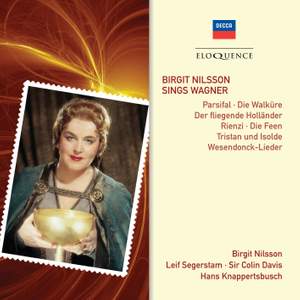
| |  | Birgit Nilsson sings Wagner
Wagner: | Schlafst du, Gast? Ich bin's! (from Die Walküre) Helge Brilioth (Siegmund) Orchestra of the Royal Opera House, Covent Garden, Leif Segerstam Dies alles – hab’ ich nun geträumt? (from Parsifal) Helge Brilioth (Parsifal), Norman Bailey (Amfortas) Orchestra of the Royal Opera House, Covent Garden, Leif Segerstam Gerechter Gott! (from Rienzi) London Symphony Orchestra, Sir Colin Davis Johohoe! Traft ihr das Schiff im Meere an 'Senta's Ballad' (from Der fliegende Holländer) The John Alldis Choir & London Symphony Orchestra, Sir Colin Davis Weh mir, so nah (from Die Feen) London Symphony Orchestra, Sir Colin Davis Wesendonck-Lieder (5) London Symphony Orchestra, Sir Colin Davis Tristan und Isolde: Prelude to Act 1 Wiener Philharmoniker, Hans Knappertsbusch Wie lachend sie mir Lieder singen (from Tristan und Isolde) Grace Hoffmann (Brangäne) Wiener Philharmoniker, Hans Knappertsbusch Tristan und Isolde: Prelude & Liebestod Wiener Philharmoniker, Hans Knappertsbusch |
Birgit Nilsson. Richard Wagner. It was an operatic marriage made in heaven that lasted for over twenty years and, thanks to recordings, continues to thrill music lovers around the world. She sang her first Wagnerian part in Stockholm. It was Senta in Der fliegende Holländer. It was greeted rapturously and throughout her long career it was for her Wagner and Strauss roles that she was most noted. Many of the greatest recordings of music dramas and operas by these composers have featured her, and many appear on Decca. However, she also made two Wagner records for Philips – one with Leif Segerstam in 1974 of extended scenes from Walküre and Parsifal, another, in 1972, with Colin Davis of the Wesendonck-Lieder and extracts from Der fliegende Holländer, Rienzi and the little-known early Wagner opera, Die Feen (The Fairies). Also included are scenes from Tristan und Isolde, one of her great calling cards and of which she made at least two live recordings, one studio recording with Georg Solti, and another of scenes (with Grace Hoffman as Brangäne) with Hans Knappertsbusch. Nilsson’s voice had the clear, silvery sound that seems to be characteristic of Scandinavian singers. It was rock solid, encompassed over two octaves, and was perfectly even, top to bottom. It was also enormous. Especially in the upper part of the voice it could take on a laser-like quality that simply sliced through the densest orchestral sound and speared listeners to the backs of their seats. That meant the great moments of a Wagnerian opera were truly monumental – a surging orchestra and a soprano who dominated everything, combined into an overwhelming climax as Wagner must have heard in his dreams. Here is a snapshot of some of those great moments, captured on record, and bringing together three complete LPs – two made for Philips (Segerstam, Davis) and one for Decca (Knappertsbusch). “Her Kundry, in the most crucial scene of the opera, is lulling, sensuous, the menace more sinister because it is not revealed in any hardness of tone or phrasing … It is an immensely subtle performance, a proper reconciliation of great vocal gifts with an intelligent understanding of the most difficult moment of the most difficult of all operas. […] a showpiece for Miss Nilsson's great powers” Gramophone Magazine (Parsifal, Walküre) “Even allowing for the fact that these were demonstration records when they first appeared, the sound on this CD is astonishing in its lifelike presence and its warmth. As nobody has surpassed Knappertsbusch to this day as a Wagner conductor in the inevitable sweep and grandeur of his direction […] What glorious singing Nilsson gives us; full throated in the great passage, “O blinde Augen!”, which she ends with an electrifying top B natural, producing another (no mere glancing at the note) on "lacht" just before her thrilling singing of the curse.” Gramophone Magazine (Tristan und Isolde) | | | In stock - usually despatched within 1 working day. |
|
|
| |  | Gré Brouwenstijnsings arias by Beethoven, Verdi, Wagner & Weber
The Dutch soprano Gré Brouwenstijn has long been held in the highest esteem within her own country, and within a circle of vocal connoisseurs, for the fearless vibrancy of her approach to the great hochdramatisch soprano roles, without ever compromising the standards and ideals of vocal beauty: hers is a voice of great strength and flexibility, fully able to meet the challenge of projecting both the scale and drama of Wagner’s heroines while also inhabiting their more intimate confessions. Brouwenstijn made precious few recordings – most of what is left to us now derives from private tapes or radio archives of live performances – but this compilation of two studio sessions (from 1954 and 1956) catches her in her vocal prime. The big numbers from Wagner’s early dramas (Tannhäuser, Lohengrin, Der fliegende Holländer) are included, as well as Wagner’s own leaping-off points in Beethoven (‘Ah, perfido!’) and Weber (Der Freischütz). To finish, there’s a selection of mature Verdi, including ‘Tu che la vanità’ (Don Carlo) and ‘Pace, pace, mio Dio!’ (La forza del destino). This is an unmissable release for anyone in love with the art of the soprano voice. Includes appreciation of Brouwenstijn by the writer and opera director Mike Ashman. “One of the great vocal artists of the 1950s and 1960s, Brouwenstijn didn't have a great voice, but was passionate, intense and equally convincing in Wagner and Verdi.” BBC Music Magazine, February 2012 ***** “Vibrant in 'Dich teure Halle', with a quick flicker in the voice, she presents an imaginative, inward 'Allmächt'ge Jungfrau'...She is also sensitive in the first part of 'Einsam in trüben Tagen'...and then nicely introduces a fuller tone as the aria proceeds. She injects passion into the two arias from La Forza del destino.” International Record Review, December 2011 | | | In stock - usually despatched within 1 working day. |
|
|
| |  | Dokumente einer Sängerkarriere: Maud Cunitz
The German soprano Maud Cunitz was a legendary leading singer, who was completely dedicated to the ensemble of her opera house. She was self-critical and self-confident enough to never attempt a role to which she was unsuited. | | | Usually despatched in 2 - 3 working days. |
|
|
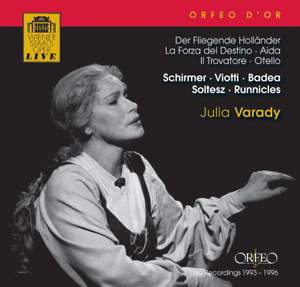
| |  | Julia Varady sings Opera Arias
Live Recordings 1993-1996 “Best of all is her Desdemona, in extracts from Otello in May 1996 conducted by Donald Runnicles. The confrontation from Act 3 with Giuseppe Giacomini as Otello has the authentic feel of the theatre, and the "Ave Maria" (no "Willow Song") makes a beautiful conclusion.” Gramophone Magazine, November 2007 | | | Usually despatched in 3 - 4 working days. |
|
|
| |  | Great Wagnerian Scenes
Recorded 1948-53 | | | Usually despatched in 2 - 3 working days. |
|
|
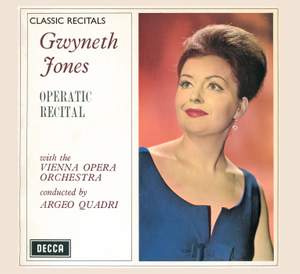
| |  | Gwyneth Jones – Operatic Recital
First international release on CD | | (Sorry, download not available in your country) | |
|
|
| |
|