All recordingsPrices shown exclude VAT. (UK tax is not payable for deliveries to United States.) See Terms & Conditions for p&p rates. | |  | Turina: Danzas fantásticas
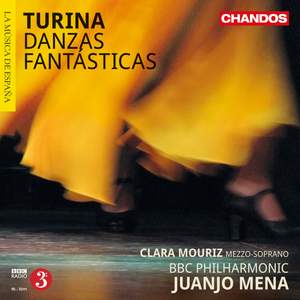
This disc forms part of our ongoing Spanish Music series, performed by the BBC Philharmonic and its Chief Conductor, Juanjo Mena. Here the focus is on the orchestral works of the composer Joaquín Turina, one of the two leading Spanish composers of the twentieth century, the other being Manuel de Falla. Turina was a prolific composer, who in his sixty-seven years wrote more than one hundred works, in which he explored a wide range of classical genres, from symphonic music, solo piano pieces, and vocal works to ballet scores and chamber music. Most of these show the influences of traditional Andalusian music and folk tunes, often conveying feelings of rapture and immense exaltation, while also owing a debt to a range of French composers. Turina lived in Paris from 1905 to 1914, and during this time, while taking composition lessons from Vincent d’Indy and getting to know Maurice Ravel and Claude Debussy, he absorbed certain aspects of the French style. These influences are particularly evident in Danzas fantásticas and Sinfonia sevillana. While both these works are heavily inspired by the sights and sounds of Turina’s native Seville, they also display hints of French impressionism, inevitably calling Debussy to mind. Turina was as thrilled by the sound and style of Andalusian folk singers as he was by folksong itself, and in terms of his songs, Poema en forma de canciones (Poem in the form of songs), originally for voice and piano, is probably the best known work. Here, as in ‘Farruca’ from Triptico, the orchestra and conductor are joined by the Spanish mezzo soprano Clara Mouriz for truly idiomatic performances. Ritmos (Rhythms) was written originally as a ballet, which never reached the stage; nevertheless it proved brilliantly effective in the concert hall. The score itself does not relate to any specific scenario, but follows a progression, which Turina himself described as ‘a gradual journey from darkness into light’. The Saeta is the only work on this disc in which Turina completely steps away from the influences of folk tune-inspired Andalusian dance rhythms. This is a beautifully written devotional song ‘in the form of a Salutation to the Virgin of Hope’. “Juanjo Mena’s performances are perfectly judged, the rhythms sprung with ineffable lightness and the textures clear...As an introduction to an unfairly neglected composer, this disc couldn’t be bettered. It’s also very nicely recorded.” The Arts Desk, 9th March 2013 “The three vocal items here are novelties...They are sung with ravishing sweetness of tone by Clara Mouriz, who sounds born to sing them...Mena's accounts of the Danzas, Ritmos and Sinfonia stand up well against some strong competition. The orchestra's playing and Chandos's sumptuous sound place this new disc in the front rank.” Gramophone Magazine, April 2013 “Turina’s highly rhythmic and vivid coloration combined with his passionate approach invariably produce steamy evocations of baking Spanish sunshine. With infectious enjoyment Mena and the BBC Phil ideally capture the expressive mood of these joyous scores.” MusicWeb International, 2nd May 2013 | 
| | | (also available to download from $10.75) | In stock - usually despatched within 1 working day. |
|
|
| |  | Bizet - Suites
Bizet's Carmen was misunderstood at its premiere in 1875. The Opera-Comique was a place where respectable families could be entertained, and where virginal daughters could be introduced to blameless sons with marriage in mind. No one expected to see uncouth gypsies, dirty smugglers and vulgar cigarette girls on its stage, let alone unvarnished human passions and murder, as Bizet so vividly portrayed them in Carmen! This 2CD set brings together Ansermet's complete Bizet stereo recordings for Decca, are good-natured and piquant without being showy for showiness's sake. The 'rural' element of so much of the music in the Bizet suites is emphasised and in L'Arlesienne, Ansermet ensures that the Provence sun and starlight shine clearly through the music's textures. Likewise, his approached to the early Symphony is summery and there is an unpressured willingness to give the symphony space in which to breathe. Nothing is forced, and melodies are allowed to come into happy bloom. Joaquin Turina was born in Seville, the city in which most of Carmen is set, so he could hardly avoid composing 'Spanish music'. Turina's Danzas fantasticas are more abstract and less stereotypical than some of the other Spanish repertory Ansermet recorded, but they require no less of a visceral response. Ansermet's languid, sensual, intoxicating, and sometimes even sinister reading of this score, brilliantly captured by Decca's engineering team, remains a standard by which other recordings should be judged. | | | In stock - usually despatched within 1 working day. |
|
|
| |  | Turina: Danzas Fantasticas
Joaquín Turina was born in Seville on 9 December 1882 and died in Madrid on 14 January 1949. It was while studying with Vincent d’Indy in Paris that he first met, under the aegis of his elder, the composer Isaac Albéniz, his fellow Andalusian Manuel de Falla. Though they remained lifelong friends, Falla became part of the cosmopolitan European scene while Turina, though he spent most of his life in Madrid, remained the quintessential Sevillian. His fairly modest output, mostly of chamber and piano music with a few unsuccessful ventures on to the stage, includes five works originally composed for orchestra. Four of them are heard here; only missing is the early Evangelios Op.12. All these pieces are to a greater or lesser extent imbued with the folk music of Spain and reminiscences of Seville in particular. The Sinfonía sevillana of 1920 immediately won first prize in a composing competition and has some claim to be the greatest Spanish symphony. Like most of Turina’s music, the work is suffused with flamenco dance forms (petenera, zapateado, garrotín), used here to evoke the atmosphere of the city. Antonio de Almeida draws dancing sunlight from his orchestra, and also contributes an absorbingly well-informed booklet note. | 
| | | Usually despatched in 2 - 3 working days. |
|
|
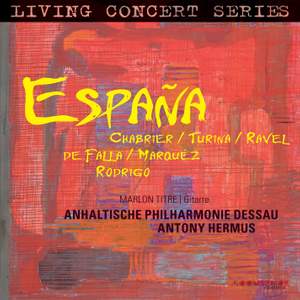
| |  | España
Anhaltische Philharmonie Dessau, Antony Hermus | | | Usually despatched in 2 - 3 working days. |
|
|
| |  | Danzas Fantásticas
West Australian Symphony Orchestra, Jorge Mester | | | Usually despatched in 2 - 3 working days. |
|
|
| |  | Halle Favourites – Volume 2
Chabrier: | España Free Trade Hall, Manchester 2 January 1954 | Grieg: | Two Elegiac Melodies, Op. 34 Free Trade Hall, Manchester 9 – 10 August 1957 stereo Peer Gynt Suite No. 1, Op. 46 Free Trade Hall, Manchester 9 – 10 August 1957 stereo | Lehár: | Gold und Silber Walzer, Op. 79 Free Trade Hall, Manchester 5 April 1952 | Sibelius: | Valse Triste, Op. 44 No. 1 Free Trade Hall, Manchester 29 June 1957 stereo | Suppe: | Die schöne Galathée Overture Free Trade Hall, Manchester 11 February 1954 | Turina: | Danzas fantásticas, Op. 22 Free Trade Hall, Manchester 19 December 1951 | Waldteufel: | Les Patineurs - Valse, Op. 183 Free Trade Hall, Manchester 3 May 1957 |
The performances on this disc, recorded between 1951 and 1957, represent Sir John Barbirolli and the Hallé in party mood – most of the pieces, at any rate, for you can’t raise much of a laugh with Valse triste or Elegiac Melodies. J.B. had a natural flair for lighter music. He adored the tunes, he admired the orchestration and craftmanship, and he relished the chance it gave him and his players to let their hair down and – why not? – show off a bit. Franz Lehár's name was first made, in 1902, with the concert waltz Gold-und-Silber (Gold and Silver) which he wrote for the Princess Metternich-Sandór’s Gold and Silver Ball. Soon it was being played everywhere, and no wonder. It marvellously captures the feel of a great ball. J.B. liked to conduct it at the Hallé Balls held in the 1950s, sometimes with a balloon tied to his baton. But he never treated the music in a cavalier fashion. He regarded it as a great piece which deserved the best from him and his players. As Richard Osborne has written in his biography of Karajan: “If all Sir John Barbirolli’s recordings were lost except that of Lehár’s Gold and Silver waltz, there would be reason enough to say ‘Now, there was a conductor’.” This performance was recorded in April 1952. J.B. recorded the waltz again in May 1957 (released on ‘Viennese Night‘ SJB1037) and also in 1966 (released on ‘Glorious John‘ SJB1999). Turina's Danzas fantásticas date from 1920 and are exactly what their title implies. The recording, in January 1952, was the first to be made commercially in the rebuilt Free Trade Hall, Manchester. Emil Waldteufel composed over 250 dances, particularly waltzes, so it’s no surprise that his Skaters’ Waltz (Les Patineurs) Opus 183, should have become one of the most famous examples of its kind, heard in many arrangements but never so effectively as in its own orchestration. Incidentally, he wrote an España in 1886 which is sometimes confused with Chabrier’s as perhaps he intended it to be! The Elegiac Melodies by Grieg are transcriptions for strings of two of the 12 songs in his Op.33. Their titles, Heart’s Wounds and Last Spring, tell us all we need to know about these poignant pieces, so magically conducted here by J.B. when he recorded them in August 1957 at the same session as the First Suite from the incidental music to Ibsen’s extraordinary play Peer Gynt. | | | Usually despatched in 4 - 5 working days. |
|
|
| |  | Turina Orchestral Music
| | | Usually despatched in 8 - 10 working days. |
|
|
| |  | The Music of Turina and Debussy
| | | Usually despatched in 4 - 5 working days. |
|
|
| |  | Turina - Piano Music Volume 1
“Jordi Masó is one of Spain’s leading pianists.” MusicWeb International | | | (also available to download from $6.00) | Usually despatched in 2 - 3 working days. (Available now to download.) |
|
|
| |  | Turina: Sinfonia Sevillana
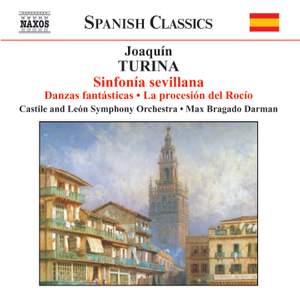
Castile & León Symphony Orchestra, Max Bragado Darman “Turina was a gentle man who, like Segovia, placed high value on beauty and clarity of thought, and responded to 'programmatic' images; the portrayal of profound tragedy had no place in his music. Although he tried harder than his contemporaries to write in the conventional musical forms, his Sinfonía sevillana is a poetic and colourful tone poem rather than a symphony, a French-influenced depiction of aspects of the city of his birth. Ritmos was conceived as a ballet but was never performed as such – present-day choreographers please note! The Danzas fantásticas range from the quietly poetic to the energetic, and relate to quotations from José Más's novel Laorgía. Two dances, the Aragonese jota and the Andalusian farruca, frame a dream-like evocation of elements of Andalusian melody and dance rhythm of the Basque zortziko. More specifically focused is La procesión del Rocío, a charming picture of the annual festival procession in the village of El Rocío. Turina's skill and sensitivity in the art of orchestration shines throughout this programme, as does that of the Castilla y Léon Symphony Orchestra in extracting every good feature the music offers. The recording is clear, with a believably spacious acoustic. There are other recordings of these works, but none that brings them all together – or exceeds the quality of these performances. An outstanding issue.” Gramophone Classical Music Guide, 2010 | | | (also available to download from $6.00) | Usually despatched in 2 - 3 working days. (Available now to download.) |
|
|
| |
|