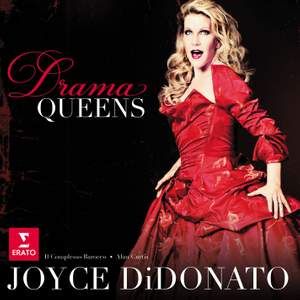
All recordingsPrices shown exclude VAT. (UK tax is not payable for deliveries to United States.) See Terms & Conditions for p&p rates. | |  | Joyce DiDonato: Drama QueensRoyal Arias from the 17th and 18th Centuries
Crowned with a Grammy Award for her last album, Diva, Divo, Joyce DiDonato joins conductor Alan Curtis and Il complesso barocco for Drama Queens, an electrifying programme of royal arias from the 17th and 18th centuries, composed by figures as famous as Handel and Vivaldi and as little known as Orlandini and Porta. As DiDonato says: “High drama, profound emotion, fearless vocal writing, time-stopping passages, historical significance and real discovery ... What more could I ask for?” The impact achieved by Joyce DiDonato with her last Virgin Classics album, Diva, Divo, was summed up by her triumph at the 2012 Grammy Awards in February: victor in the Classical Vocal Solo category, the ‘Yankee Diva’ also became the first classical singer to perform live at the Grammy ceremony, receiving a standing ovation for her spectacular rendition of the final rondo from Rossini’s La Cenerentola. Enterprising as ever, DiDonato now presents a new themed recital, conceived in partnership with Alan Curtis, who also conducted her Virgin Classic recordings of Handel’s Ariodante and Radamisto and her duet recital Amore e Gelosia with Patrizia Ciofi. Drama Queens sees DiDonato portraying a parade of royal personages in a diversity of challenging situations and extreme states of mind. “For me, this is my most exciting recording project to date,” says Joyce DiDonato,” because it is everything I deeply adore about the world of opera: high drama, profound emotion, fearless vocal writing, time-stopping passages, historical significance and real discovery. What more could I ask for? “I wanted to return to this genre of music I love so deeply: the free, mysterious, profoundly moving world of Baroque opera, but to do it in the grandest fashion – from the throne of royalty! Each of the characters is a queen (or a sorceress, which equals queen in this fantastical world) ... Well, we have allowed one princess, because the aria is completely unknown and it is simply too beautiful to be left out: ‘Madre diletta, abbracciami’ by Giovanni Porta [c1675-1755]. “What more could a singer ask for than to indulge in the antics of rage and bliss, despair and jubilation, heartbreak and true love?” she continues. “It will be an extraordinary journey, thanks to these larger-than-life characters, and I fully expect to learn a lot about myself along the way.” Conductor and musicologist Alan Curtis explains that: “Our Drama Queens are a motley group. Our idea was to cultivate extremes, to gather arias that show larger-than-life emotions. They range from noble, but sultry seductiveness, through the hysterically happy to vindictive despair and royal rage. The musical styles are also as varied as possible.” The arias range in period from the dawn of opera, Monteverdi and Cesti, to lesser-known works by Gluck and Haydn. “We also include some little-known music by Reinhard Keiser [1674-1739], notably an aria with an amazing five-part accompaniment for solo bassoons, without strings,” adds Curtis. (Joyce DiDonato describes it as “an aria of jealousy, suspicion and torment with the bassoon and voice chasing each other.”) Alan Curtis continues: “Two flashy arias by Giuseppe Orlandini [1676-1760] come from an opera about the great Jewish Queen Berenice, thought to be lost, but found in a California library ... But we have not totally excluded well-known works either. There is Joyce's beloved ‘Sposa son disprezzata’, a YouTube favourite, which most people know in the version for Princess Irene, the rejected bride in Vivaldi's Tamerlano. But it was actually taken by Vivaldi from an earlier opera by Geminiano Giacomelli [1692-1740], where it was sung by a male character and performed by the famous castrato Farinelli. Another Farinelli aria we include comes from an early serenata by Hasse; he sang in drag as one of the greatest drama queens of all time – Cleopatra! And, of course, we include everybody's favourite Cleopatra aria: Handel's ‘Piangerò la sorte mia’, from Giulio Cesare.” “Coloratura runs are lightning fast, angry declamations hurled like thunderbolts — and limpid laments meltingly cooed. I don’t like DiDonato when she gets too shouty or adds “expressive” pitch-bends. But it’s all compellingly theatrical. Great choice, too, with familiar Handel mingled with rare jewels” The Times, 3rd November 2012 **** “an anthology of suitably impassioned royal roles from Baroque operas, their emotional scope ranging from the giddy flush of love evoked by her tremulous coloratura and swooning fades as Berenice in Orlandini's "Da torbida procella", to the self-sacrifice of Porta's Ifigenia, rendered with such poised nobility” The Independent, 10th November 2012 **** “DiDonato and Alan Curtis...have unearthed some Baroque rarities. Instead of Handel's Berenice, we have Orlandini's Berenice, whose 'Da torbida procella' is an ideal fit for DiDonato's spitfire fioritura.” BBC Music Magazine, Christmas 2012 **** “DiDonato produces her most emotionally moving and sensitively embellished singing in 'Madre diletta'...Wonderfully sung, passionately played and programmed intelligently - an exemplary recital.” Gramophone Magazine, January 2013 “DiDonato caresses the plaintive lines of Piangero la sorte mia with the intensity of Bartoli, and brings a mordant, witchy edge to Ma quando tornerai...There’s sprightly support from Alan Curtis’s Italian period band. DiDonato’s fans won’t be disappointed.” Sunday Times, 13th January 2013 “In the slow-moving 'Lasciami pinagere' .DiDonato's timbre is at its most beautiful, her phrasing eloquent, the trills not distracting the smooth flow of the musical line...The virtuosity needed to triumph over the swift scalework is coruscatingly supplied by DiDonato...Alan Curtis's Complesso Barocco's partnership is invaluable...This is a treasure of a disc, for the music, the orchestra and Joyce DiDonato.” International Record Review, February 2013 | | | In stock - usually despatched within 1 working day. |
|
|
| |  | Royal Handel
Sandrine Piau, Topi Lehtipuu, Patricia Petibon, Robert Expert, Bernarda Fink, Maria Bayo, Lucy Crowe, Richard Croft, Karina Gauvin, Marie-Nicole Lemieux, Deborah York & Sara Mingardo ‘Zadok the priest and Nathan the prophet anointed Solomon King. And all the people rejoiced and said: God save the King! Long live the King! May the King live for ever! Alleluia! Amen.’ These words were sung by the combined choirs of the Chapel Royal and Westminster Abbey at the coronation of King George II of England on 11 October 1727. The impact of the first choral entry after a long instrumental introduction is so unforgettable that since then the anthem 'Zadok the Priest' has been sung at the Unction of each new British sovereign. The event thus marked a consecration of sorts for its composer, born Georg Friedrich Händel in 1685 at Halle in Saxony and transformed into George Frideric Handel, British subject, by Act of Parliament dated 20 February of that same year 1727. He was to enjoy his most lasting success with a work devoid of action and dramatic protagonists, which set out the very basis of Christian doctrine in words drawn entirely from the Bible: 'Messiah', given its first performance in Dublin in 1742.The grandeur and sublime simplicity of the ‘Hallelujah Chorus’ so moved King George II that he rose from his seat; ever since then, it has been the tradition in Britain for the audience to stand for this movement. Handel's 'Largo' is now synonymous with Harrods' adverts, 'Zadok' has prefaced many a Royal or sporting ceremony and, most recently, millions watched the Royal Jubilee Pageant flotilla sail down the Thames to the 'Water Music' in an inglorious downpour. “From a flute sonata movement to Mozart's respray of Messiah, Naive's Royal Handel anthology is eclectically sourced and regally dispatched.” BBC Music Magazine, December 2012 **** “suitably majestic renditions of classic pieces by first-rate performers from across Europe” The Independent, 1st September 2012 **** | | | Usually despatched in 3 - 4 working days. |
|
|
| |  | Baroque Voices 26 - Handel: Opera Seria
An anthology devoted to the Handelian prima donna that features arias composed over more than two decades for some of the greatest divas of the time. Sandrine Piau’s recital, recorded in 2004, illustrates the rich hedonism of Handel’s vocal style. | | | Usually despatched in 3 - 4 working days. |
|
|
| |  | Handel - Opera SeriaArias
“Sandrine Piau and Christophe Rousset have been consistently stylish and perceptive Handelians together. Their musical flair and dramatic intelligence is marvellously captured here, and they have chosen arias that explore the full range of Handel's genius. The experience starts with the spectacular 'Scoglio d'immota fronte', and the subsequent sequence weaves through wonderful contrasts. It's hard to capture the full dramatic sense and vivid personality of Handel's opera characters in a studio recital, yet they hit the bullseye every time, bringing out Cleopatra's despair, Rodelinda's eloquent grief for her apparently deceased husband, the heartbroken sorceress Melissa in Amadigi di Gaula, Deidamia's distress at losing Achilles to the Trojan war, and Partenope's gorgeous charisma. Although some da capo sections stray a little too far from Handel's notation for the comfort of scholars, they all enhance the drama of the text, and each cadenza, showing panache and taste, is a breath of fresh air. The playing of Les Talens Lyriques is a model of clarity, vitality and theatrical wit. It was an inspired decision to close the recital with the sublime understatement of 'Son qual stanco', featuring a heartbreaking cello solo by Atsushi Sakaï. Rousset and Piau achieve the perfect synthesis of elegance, extravagance and emotion. This is may be the finest recital of Handel arias ever recorded.” Gramophone Classical Music Guide, 2010 | | | (also available to download from $10.50) | Usually despatched in 3 - 4 working days. (Available now to download.) |
|
|
| |
|