All recordingsPrices shown exclude VAT. (UK tax is not payable for deliveries to United States.) See Terms & Conditions for p&p rates. | |  | Sergiu Celibidache conducts Liszt, Brahms & Ravel
Sergiu Celibidache was one of the truly unique, unconventional conductors of the 20th century. When Furtwängler was banned from conducting after the Second World War, Celibidache restructured the Berlin Philharmonic Orchestra and conducted it until Furtwängler’s return. However, after Furtwängler’s death in 1954 and the subsequent appointment of Herbert von Karajan as his successor, Celibidache’s relations with the orchestra were broken off. Over the ensuing years, up to the moment that he took on the Munich Philharmonic in 1979, Celibidache never tied himself to a single orchestra for any length of time. Instead he led a truly nomadic existence as a restless artist. He seldom travelled to musical centres such as Vienna. His concert with the Vienna Symphony Orchestra from October 1952, now released in its entirety by Orfeo thus offers interesting insights into a time when Celibidache still seemed to be weighing up his options. In Brahms’s First Symphony he comes across as more urgent in his tempi than was the case with the conductor we know from later years and from his later recordings. However, he was already outstanding in his sense of tone colour and in his ability to get his orchestral musicians truly to listen to one another. This is evident in 'Les Préludes'at the beginning of the concert, and above all in the 'Concerto for the Left Hand', played by none other than Robert Casadesus. With his pianistic refinement, French clarity and aristocratic command, it was not surprising that Casadesus became the interpreter of this work. In his collaboration with the Vienna Symphony Orchestra under Sergiu Celibidache, he succeeded in exemplary fashion in maintaining the tension throughout that is characteristic of this concerto, and in making the most of the grotesque nature of many of its episodes. A fascinating encounter between two great musicians. | 
| | | In stock - usually despatched within 1 working day. |
|
|
| |  | Bolero - The Best of Ravel
Ravel: | Boléro Berliner Philharmoniker, Herbert von Karajan Jeux d'eau Martha Argerich (piano) Alborada del gracioso (orchestral version) London Symphony Orchestra, Claudio Abbado Ma Mère l'Oye: excerpts Martha Argerich, Mikhail Pletnev (pianos) Daphnis et Chloé - Suite No. 2 Boston Symphony Orchestra, Claudio Abbado Tzigane Augustin Dumay (violin), Maria Joao Pires (piano) Piano Concerto in G major: Adagio assai Martha Argerich (piano) London Symphony Orchestra, Claudio Abbado Le Tombeau de Couperin: Toccata Jean-Yves Thibaudet (piano) La Valse Boston Symphony Orchestra, Seiji Ozawa Gaspard de la nuit: Ondine Ivo Pogorelich (piano) Pavane pour une infante défunte Philharmonia Orchestra, Carlo Maria Giulini Rapsodie Espagnole Berliner Philharmoniker, Herbert von Karajan Berceuse sur le nom de Fauré Augustin Dumay (violin), Maria Joao Pires (piano) Introduction & Allegro for Harp, Flute, Clarinet and String Quartet Osian Ellis (harp) Melos Ensemble Violin Sonata in G major: 2. Blues Shlomo Mintz (violin), Yefim Bronfman (piano) Piano Concerto in D major (for the left hand) Claudio Abbado |
The best of Ravel, Ravel's greatest hits - they're all here on 2 CDs packed to the brim, containing all of Ravel's most memorable tunes. Inevitably, the focus is on the immortal Bolero, beloved of the film industry. Ravel famously considered it to be his masterpiece, but claimed it had no music in it - an opinion with which many would take leave to disagree. La Valse extends the theme of dance, the Rhapsodie espagnole the theme of Spanishry and exoticism, while the compilation ends with a flavour of jazz as exemplified in the Blues movement from the Violin Sonata and the Concerto for piano, left hand (which in the 1930s the famous pianist Alfred Cortot dared to play using both hands, incurring the composer's wrath). | | | (Sorry, download not available in your country) | In stock - usually despatched within 1 working day. |
|
|
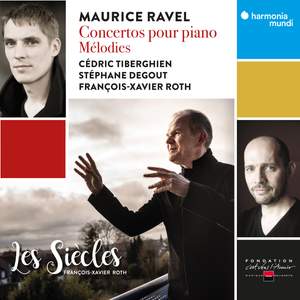
| |  | Ravel: Piano Concertos
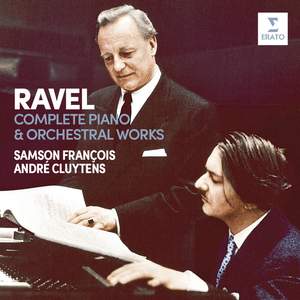
“François’s record of the Left-Hand Concerto is played with tremendous vitality and spirit. Its attractions are further enhanced by a splendidly detailed and sonorous recording.” Gramophone Magazine | | | In stock - usually despatched within 1 working day. |
|
|
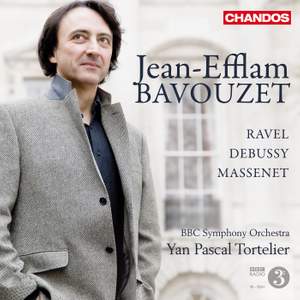
| |  | Jean-Efflam Bavouzet plays Ravel, Debussy & Massenet
The exclusive Chandos artist Jean-Efflam Bavouzet is a master of this repertoire. This is his second concerto recording for the label, after his survey of the complete piano concertos by Bartók (CHAN10610) which was released in September to high acclaim and voted ‘Orchestral Choice of the Month’ by the magazine BBC Music. Bavouzet’s complete recording of the piano music by Debussy also scooped awards from BBC Music and Gramophone, which wrote: ‘This could well be the finest and most challenging of all Debussy piano cycles.’ On this new release, Bavouzet is accompanied by the BBC Symphony Orchestra and Yan Pascal Tortelier, a conductor steeped in the French tradition and utterly at home in this repertoire. The result is a totally idiomatic performance of these French masterpieces for piano and orchestra. Ravel’s light and brilliant Piano Concerto in G major is the intriguing result of a merging of classical models with the idioms and harmonies found in the popular jazz music of his day. At the time of composing this concerto, Ravel had just returned from his travels in the USA and the work is heavily influenced by the jazz music that he encountered there. However, in the second movement Mozart takes precedence, the piano’s theme closely modelled on the slow movement of his Clarinet Quintet; and Saint-Saëns’s sparkling semi-quavers fill the finale. The first performance of this work, given by Marguerite Long in Paris, was a great success, as was the European tour that followed. Another central piece is Ravel’s Piano Concerto for the Left Hand. The work was commissioned by Paul Wittgenstein, a concert pianist who had lost his right arm during the First World War. Although at first Wittgenstein did not take to its jazz-influenced rhythms and harmonies, he grew to like the piece. Speaking of the Concerto, Ravel said that he had been determined to make it sound ‘no thinner’ than one for both hands and noted that in the middle of the piece ‘innumerable rhythmic patterns are introduced which become increasingly compact’ and that ‘this pulsation increases in intensity and frequency’ before the various elements ‘contend with one another until they are brusquely interrupted by a brutal conclusion’. Also featured on this disc is Debussy’s Fantaisie for Piano and Orchestra. Debussy was a highly self-critical composer and disowned or withdrew several of his early works; this piece was one of them. It was composed in 1889 – 90, and its premiere was scheduled, under Vincent d’Indy, almost as soon as the score was completed, but withdrawn by Debussy just as it was being put into rehearsal. The first performance did not take place until after Debussy’s death in 1918. Although the Fantaisie is the lone piano concerto by a composer regarded as one of the greatest among those who wrote for the piano, it remains one of Debussy's least frequently performed works even now. The work shows the influences of Fauré and Franck, and the piano does not figure as a solo instrument in the conventional concerto sense but rather as an equal partner with the orchestra, although the conventional three movements are still present. Completing the disc in a unique manner are six pieces for solo piano by Massenet. Most famous for his operas and suites for orchestra, Massenet wrote a quantity of very charming piano pieces, of which Jean-Efflam Bavouzet has selected some of the best. The music is typical of its composer – highly tuneful, richly textured, and utterly compelling – and conjures an atmosphere which only a Frenchman could achieve. “As he did in his performance of the Concerto for the Left Hand at the Proms in the summer, Bavouzet undervalues its growling intensity...He's much more at home in the glitter of the G major concerto, with his elegant, delicately tinted playing and Tortelier's deft accompaniments” The Guardian, 28th October 2010 *** “It is the particular mix that makes this disc so appealing...Albeit that the Fantaisie is an early work that Debussy himself seems to have shunned, this performance relishes its colour and élan.” The Telegraph, 5th November 2010 **** “The ebullient French pianist Bavouzet scales the heights in this splendid and generous CD with the BBC Symphony Orchestra...The G major bounces along, though, with reflective asides not forgotten. In the Concerto for Left Hand, Bavouzet winningly balances the grandiose and jazzy.” The Times, 13th November 2010 **** “the interpretations catch the ear with their blend of subtle phrasing, polish and unanimous zest...A group of charming solo piano miniatures by Massenet complements and at times connects with the styles of Debussy and Ravel, and Bavouzet plays them beautifully.” Gramophone Magazine, December 2010 “[Bavouzet] turns in a performance of the Fantaisie that illuminates this uneven yet magical work like no other. As to the Ravel concertos, I have no hesitation in saying these are the greatest performances I have ever heard. The G major is a sharp as a razor, achingly lyrical when required and, above all, fun...The 'Left Hand', helped by Tortelier's incisive conducting is simply awe-inspiring.” Classic FM Magazine, January 2011 ***** “Bavouzet’s G major concerto is the best since Michelangeli’s 50 years ago: it has style, verve, poetry and balance...they pull off a wonderfully propulsive Left Hand Concerto, full of pizzazz, spontaneity and arresting insights.” Financial Times, 14th January 2011 **** “Bavouzet's accounts of the two Ravel Piano Concertos are very special, quite wonderfully atmospheric, indeed magical; the delicacy and finesse of the pianism are dazzling...This is simply one of the finest records of French piano music in the catalogue.” Penguin Guide, 2011 edition | | | (also available to download from $10.50) | In stock - usually despatched within 1 working day. |
|
|
| |  | Ravel: Complete Works for Piano
| | | In stock - usually despatched within 1 working day. |
|
|
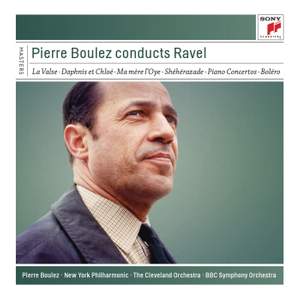
| |  | Boulez conducts Ravel
| | | In stock - usually despatched within 1 working day. |
|
|
| |  |
'In the Left Hand Concerto, Claire Chevallier’s technique fully matches her musicianship. Whatever recordings you may have of these works, this disc is a must, balancing opulence against clarity in the orchestral sound and respecting the diamond-hard construction on which Ravel lavished so many sleepless nights.' Roger Nichols - BBC Music Magazine “…the left Hand Concerto Claire Chevallier does not match Krystian Zimerman's brilliance and drive. The point is, she is not trying to. Her interpretation… is more lyrical and reflective and at times more sheerly beautiful - in fact much closer to that of Ravel's chosen interpreter Jacques Février. Whatever recordings you may have of these works, this disc is a must, balancing opulence against clarity in the orchestral sound and respecting the diamond-hard construction on which Ravel lavished so many sleepless nights.” BBC Music Magazine, October 2006 ***** “…the perfect showcase for period instruments from early in the 20th century. …the 1905 Erard piano used in the Left-Hand Concerto, with its rather clangy, clattering tone, gives extra clarity to the flourishes in the piano part. With Claire Chevallier a most sensitive soloist, very French in style, the piano is the more clearly defined over the highly original, generally low-lying orchestration, growling up from nowhere at the start.” Gramophone Magazine, October 2006 | | | In stock - usually despatched within 1 working day. |
|
|
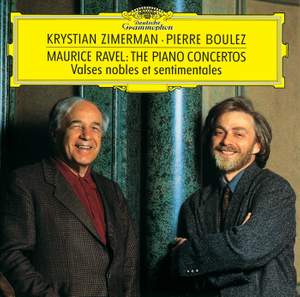
| |  | Ravel - Piano Concertos
“Zimerman's pianism is self-recommending. His trills in the first movement of the G major Concerto are to die for, his passagework in the finale crystalclear, never hectic, always stylish. For their part Boulez and the Clevelanders are immaculate and responsive; they relish Ravel's neon-lit artificiality and moments of deliberate gaudiness. That goes equally for the Valses nobles, which have just about every nuance you'd want, and none you wouldn't. The recording is generous with ambience, to the point where some orchestral entries after big climaxes are blurred. Otherwise detail is razor-sharp and one of the biggest selling-points of the disc. Zimerman's humming may be a slight distraction for some listeners, especially in the Left-Hand Concerto, where you may not be always convinced that the LSO knew quite what it was supposed to do with the long notes of the main theme, and where there's a slight lack of tension in exchanges between piano and orchestra. There again, had the G major Concerto not been so wonderful those points might not have registered at all, for this is playing of no mean distinction. In the Left- Hand Concerto, Zimerman's phenomenal pianism sets its own agenda and brings its own rich rewards.” Gramophone Classical Music Guide, 2010 | | | In stock - usually despatched within 1 working day. |
|
|
| |  |
Prix de l'Académie du disque français Award | | | In stock - usually despatched within 1 working day. |
|
|
| |  |
| | | In stock - usually despatched within 1 working day. |
|
|
| |
|