All recordingsPrices shown exclude VAT. (UK tax is not payable for deliveries to United States.) See Terms & Conditions for p&p rates. | |  | Schubert: Schwanengesang
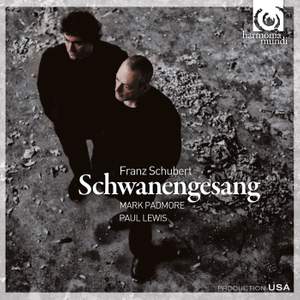
The eighteen songs included in this recording of Schwanengesang all belong to the last three years of Schubert’s life. The earliest of them, Am Fenster, was written in March 1826, while the last, Die Taubenpost, was finished only a few weeks before his death on 19 November 1828. Fourteen of them, seven by Ludwig Rellstab, six by Heinrich Heine and one by the Vienna government official and journalist J.G. Seidl, were published by Tobias Haslinger in May 1829 under the umbrella title Schwanengesang (‘Swan Song’) and are often performed as a complete cycle. Of these, Am Fenster, Der Wanderer an den Mond (both Seidl) and Herbst (Rellstab), were not included in the original publication of Schwanengesang. Auf dem Strom, with obbligato horn, dates from the previous year, 1827, but was first performed on 26 March 1828, marking the first anniversary of Beethoven’s death. The horn plays a significant melodic role in the setting, opening the piece, providing interludes between the verses, and duetting with the solo tenor voice. It was recorded in 1991 by Peter Schreier and András Schiff, with Radovan Vlatković, at the Decca Winterreise sessions, but owing to the playing time of the CD, Auf dem Strom did not appear. This is the recording’s first release. “One of the greats. The most of all Schreier's Schwanengesang recordings, and with a previously unpublished performance of 'Auf der Strom' as a bonus.” BBC Music Magazine, March 2013 ***** “This is a wonderful disc by any standard. Indeed, the partnership of Schreier and Schiff [is] a masterstroke of Decca … [Schreier’s] performances of the Heine settings … have become so anguished as to expose every nerve end in their depiction of lost love, and Schiff's realization of the piano's role seconds the singer's probings perfectly. […] This is really a 'must' for any Lieder collection.” Gramophone Magazine, February 2013 “One of the most compelling recordings ever of Schwanengesang … The recording is vividly real.” Penguin Guide *** | | | (Sorry, download not available in your country) | In stock - usually despatched within 1 working day. |
|
|
| |  | Schubert: Partsongs, Auf dem Strom & Der Hirt auf dem Felsen
Schubert: | Gebet (Du Urquell aller güte) D815 (Fouqué) Viola Tunnard (piano) Elizabethan Singers, Louis Halsey Nachthelle, D892 (Seidl) Viola Tunnard (piano) Elizabethan Singers, Louis Halsey Gott in der Natur D757 (Kleist) Viola Tunnard (piano) Elizabethan Singers, Louis Halsey Jünglingswonne, D983 Viola Tunnard (piano) Elizabethan Singers, Louis Halsey Ständchen 'Zögernd leise', D920/921 Viola Tunnard (piano) Elizabethan Singers, Louis Halsey Der Gondelfahrer, D809 Viola Tunnard (piano) Elizabethan Singers, Louis Halsey Psalm 23 'Gott ist mein Hirt', D706 Viola Tunnard (piano) Elizabethan Singers, Louis Halsey Gott im Ungewitter, D985 Viola Tunnard (piano) Elizabethan Singers, Louis Halsey Chor der Engel, D440 Viola Tunnard (piano) Elizabethan Singers, Louis Halsey Auf dem Strom, D943, Op. post. 119 Robert Tear (tenor), Neill Sanders (horn) & Lamar Crowson (piano) Der Hirt auf dem Felsen, D965 (Von Chezy / Muller) Suzanne Danco (soprano), Gervase de Peyer (clarinet) & Guido Agosti (piano) Die Forelle, D550 Suzanne Danco (soprano), Gervase de Peyer (clarinet) & Guido Agosti (piano) Gretchen am Spinnrade, D118 Suzanne Danco (soprano), Gervase de Peyer (clarinet) & Guido Agosti (piano) Der Musensohn, D764 (Goethe) Suzanne Danco (soprano), Gervase de Peyer (clarinet) & Guido Agosti (piano) Du bist die Ruh D776 (Rückert) Suzanne Danco (soprano), Gervase de Peyer (clarinet) & Guido Agosti (piano) |
Two distinguished soloists – soprano Suzanne Danco and tenor Robert Tear – contribute to this disc of Schubert songs. Both of the composer’s ‘obbligato’ songs (Der Hirt auf dem Felsen and Auf dem Strom) are included, as are five of Schubert’s most popular Lieder in recordings by Danco previously unreleased on CD. But at the centre of this recital is a selection of Schubert’s Partsongs. Their origins lie in the vital demand for this kind of music in the context of the social life of Vienna during the composer’s lifetime. The male-voice quartet was a staple feature in the city’s concert halls, but even more so in the homes of the cultured middle-classes. Much of Schubert’s writing for this medium is in an ‘unbuttoned’ mood, providing material for friendly gatherings. Even so, we find among these partsongs for men’s or mixed voices, many which carry the unmistakable stamp of his genius – the gorgeous Ständchen, or the tranquil, other-worldly Nachthelle. “Schubert's secular choruses are among his least-known works, so a warm welcome for these charismatic performances of music beautiful enough to make you cry.” BBC Music Magazine, November 2012 ***** “This disc most delightfully extends the small number of Schubert's part-songs that has been recorded and these beautifully sung performances, very well recorded, capture the intimate spirit of music written primarily for friendly gatherings […] Robert Tear sings his part with lovely tone […] A contralto solo part woven into Ständchen is beautifully sung by Helen Watts […] this lovely disc gave me intense pleasure” Gramophone Magazine (Partsongs) “Der Hirt auf dem Felsen is marvellously clean and instrumental in execution” Gramophone Magazine (Danco) | | | (Sorry, download not available in your country) | In stock - usually despatched within 1 working day. |
|
|
| |  | Schubert: Schwanengesang
Tenor Mark Padmore and pianist Paul Lewis conclude their acclaimed Schubert triptych with this revelatory account of Schwanengesang, the third and last of the great Schubert cycles, collected and published after the composer’s death. Auf dem Strom for tenor, horn & piano, and the gently hopeful song Die Sterne complete the programme. “Tempos are generally slow and the emotional atmosphere introspective, imbuing even something as superficially cheerful as Ständchen with melancholy. Occasionally, as in Der Atlas, one longs for more power and colour than Padmore’s light bright tenor can authentically provide, but this is a performance of undeniable musical integrity.” The Telegraph, 2nd September 2011 **** “Padmore’s very English tenor voice, so clean in articulation, so carefully coloured, penetrates these songs of love’s despair with memorable clarity. Subtlety, too...More than before, singer and pianist seem joined at the hip in thought and deed...Lewis spins his own poetry, whispering with the breezes, trotting his hoofs, whatever words and music indicate.” The Times, 22nd September 2011 **** “This is a wonderful recording, two supreme Schubertians working in perfect harmony. Odd as it might sound, I think that this disc is valuable above all for Paul Lewis's stupendous playing. Not only has he the technique - no mean feat, with some of Schubert's accompaniments - but he is also, with Mitsuko Uchida, one of the greatest Schubertians of our time. He has clearly immersed himself in these songs to an impressive degree” BBC Music Magazine, November 2011 **** “Padmore's silvery, keen-edged tenor, grace of phrase and sensitivity to mood and verbal nuance are ideal [in Liebesbotschaft]; and how affectionately Lewis's left hand sings in gentle colloquy with the voice...In its fine balance of subtlety and devastating emotional directness, this is certainly a Schwanengesang in the Schreier-Schiff class, its attractions enhanced by the "bonus" items.” Gramophone Magazine, Awards Issue 2011 “His feeling for words, their meaning and expression form the bedrock of this performance, as Schubert himself would have wanted. The intensity of communication here flows from the ideal marriage of verbal and musical articulation, complex and rich in their relationship, with singer and pianist united as selfless matchmakers between poetry and music” Classic FM Magazine, November 2011 ***** | | | In stock - usually despatched within 1 working day. |
|
|
| |  | Ophélie: Lieder et Mélodies
Marianne Fiset (soprano), Louis-Phillipe Marsolais (horn) & Michael McMahon (piano) Soprano Marianne Fiset is one of Canada’s most talented young singers. In 2009 she was one of the artists awarded the title “Révélation Radio-Canada Musique”. From Franz Schubert to Canadian composer Denis Gougeon, the music on this CD invites us into a poetic world of heartfelt fervour and natural beauty. The CD includes works by Gounod, Berlioz, Donizetti and Richard Strauss. | | | (also available to download from $10.50) | In stock - usually despatched within 1 working day. |
|
|
| |  | Schubert - The WandererLieder and Fragments
Schubert: | Viola, D786 (Schober) Pilgerweise D789 (Schober) An die Musik D547 New Track Auf der Bruck, D853 Tiefes Lied D876 Der liebliche Stern, D861 (Schulze) Der Wanderer, D649 (Friedrich von Schlegel) Fülle der Liebe D854 (F von Schlegel) Wiedersehn D855 (A W von Schlegel) Vom Mitleiden Maria D632 (Schlegel) Im Walde D708 Der Schmetterling D633 Harfenspieler I 'Wer sich der Einsamkeit ergibt', D478 Harfenspieler II 'An die Türen will ich schleichen, D479 Harfenspieler III 'Wer nie sein Brot mit Tränen ass', D480 Die Sterne, D939 (Leitner) Der Winterabend (Es ist so still), D938 Der Unglückliche, D713 Totengräbers Heimwehe D842 (Craigher) Auf dem Strom, D943, Op. post. 119 with Timothy Brown (horn) Ständchen 'Horch! Horch! die Lerch!', D889 New Track Lachen und Weinen, D777 New Track An die Laute D905 New Track Der Tod und das Mädchen, D531 New Track Pflicht und Liebe D467 (Gotter) Allegretto, D900 in C minor Piano Fragments (From Schubert: Piano Sonata D958 – 094638432128) Lebensmuth, D937 Piano Fragments (From Schubert: Piano Sonata D958 – 094638432128) Allegretto, D346 in C major Piano Fragments (From Schubert: Piano Sonata D958 – 094638432128) Johanna Sebus (Fragment), D728 Andantino, D348 in C Major Piano Fragments (From Schubert: Piano Sonata D958 – 094638432128) Abschied von der Erde, D829 |
Two musical titans in the classical world, British tenor Ian Bostridge and Norwegian pianist Leif Ove Andsnes, both major EMI Classics artists, are brought together once again in a 2CD compilation celebrating their great contribution and commitment to Schubert for the label. As well as featuring specially selected lieder and piano fragments from their critically acclaimed Bostridge / Andsnes Schubert Sonata and Lieder series, the album also includes five newly recorded lieder never previously released by Bostridge. Their partnership was described by The Times as "one of the most inspired of record-company matchmakings: the two musicians really do test and try each other at every turn, as well as being mutually supportive…” Firmly established in the opera house, concert hall and recital room, and much sought after internationally as one of the finest of his generation of tenors, Ian Bostridge is today one of the leading Schubert lieder interpreters, repertoire that he openly states as his first love. Ian’s passion for lieder dates back to early studies at his school in England. Ian explains: ‘I had a wonderful German teacher at my school who got me into German lieder and that has been the thing that has really made me a musician – the lieder.’ “An attractive compilation from EMI's 2001-02 series of Schubert Lieder and piano music. Here, it's predominantly Lieder, with just three piano fragments; but with both artists at their relaxed and creatively focused best.” BBC Music Magazine, December 2008 **** “...from Bostridge you have intelligent word painting, effortless sense of line, langorous phrasing, and a vocal quality that is as sonorous in the upper register as it is mellow in the lower. Andsnes more than accompanies, he pushes the beauty and depth of the piano writing to the fore, whilst never unbecomingly stealing the show.” Charlotte Gardner, bbc.co.uk, 11th July 2008 “Ian Bostridge is one of the most effective Schubert voices in Europe today” The Times | | | In stock - usually despatched within 1 working day. |
|
|
| |  | Jana Büchner: Thoughts of Love
Lewy: | Freundschaft oder Liebe, Op. 7 | Mendelssohn: | Neue Liebe, Op. 19a No. 4 Auf Flügeln des Gesanges, Op. 34 No. 2 Andres Maienlied (‘Hexenlied') Op. 8/8 | Mendelssohn, Fanny: | Warum sind denn die Rosen so blass, Op. 1 No. 3 (Text: Heinrich Heine) Dämmrung senkte sich von oben (Text: Johann Wolfgang von Goethe) Nacht ist wie ein stilles Meer | Mozart: | Dans un bois solitaire, K308 Das Traumbild, K.530 Als Luise die Briefe, K520 Das Veilchen, K476 Fragment in E flat major, K. 307b (reconstructed by John Humphries): Allegro Abendempfindung an Laura, K523 | Schubert: | Rastlose Liebe, D138 Du bist die Ruh D776 (Rückert) Lachen und Weinen, D777 Erster Verlust, D226 (Goethe) Nähe des Geliebten, D162 Auf dem Strom, D943, Op. post. 119 Lied der Delphine, D857 No. 1 |
Jana Büchner (soprano), Hans-Pieter Fieber (horn) & Eckhart Sellheim & Britta Wideranders (piano) Jana Büchner’s selection of lieder traces the evolution of the song from Mozart and Schubert all the way through to Hensel and Mendelssohn. The works deal with the joys and sufferings of love, hence “Thoughts of Love”. Included are lieder with horn obligato and Lewy’s song (1802 - 1881) is thought to be a premiere recording. | | | Usually despatched in 2 - 3 working days. |
|
|
| |  | Schubert: Die Schöne Müllerin & Auf dem Strome
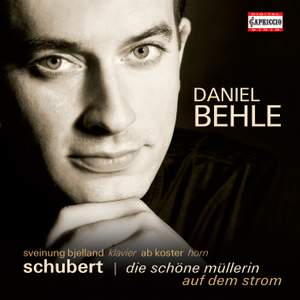
On this CD, the young tenor Daniel Behle interprets some of the best known Lied repertoire. “Behle surprises with a force and energy that puts him far ahead of many fellow tenors and makes them seem bloodless by comparison – and he doesn’t lack nuances.” MusicWeb-International | | | (also available to download from $10.50) | Usually despatched in 2 - 3 working days. (Available now to download.) |
|
|
| |  | O, du Schoner Hornerklang
Luc Bergé (horn), Jan Michiels (fortepiano/piano), Marcel Ponseele (oboe) & Yves Saelens (tenor) A party of outstanding musicians joins Luc Bergé, the acclaimed horn soloist of the l'Orchestre des Champs Elysées, on this record to celebrate the beauties of the classic and romantic horn. A specific instrument is used for each work of this gourmet menu.The main course is definitely the lesser known work, Reinecke's delightful trio. | | | Usually despatched in 4 - 5 working days. |
|
|
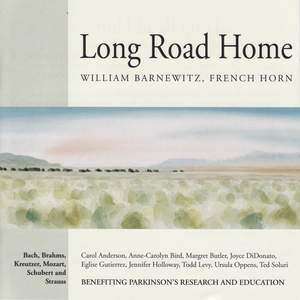
| |  | Long Road Home
Bach, J S: | St Matthew Passion, BWV244: Mache dich, mein Herze, rein arranged Barnewitz Ursula Oppens (piano) | Brahms: | Wiegenlied, Op. 49 No. 4 (Lullaby) arranged Barnewitz/Oppens Ursula Oppens (piano) | Kreutzer, K: | Das Mühlrad Joyce DiDonato (mezzo), Carol Anderson (piano) | Mozart: | Quintet for Piano and Winds in E flat, K452 Margaret Butler (oboe), Todd Levy (clarinet), Ted Soluri (bassoon), Ursula Oppens (piano) Lungi da te, mio bene (from Mitridate, Rè di Ponto, KV87) Eglise Gutierrez (soprano), Carol Anderson (piano) | Schubert: | Auf dem Strom, D943, Op. post. 119 Anne-Carolyn Bird (soprano), Carol Anderson (piano) | Strauss, R: | Andante for Horn and Piano in C major Ursula Oppens (piano) Alphorn, Op. 29 Jennifer Holloway (soprano), Carol Anderson (piano) |
Composers develop their own voice and personality; singers develop their own vocal character and colour. This beautiful and unusual recital disc by Bill Barnewitz, principal horn of the Milwaukee Symphony Orchestra, explores the voice of a special instrument and of a particular musician. Bill offers chamber works which feature the horn either as a solo personality or integrated into an ensemble. There are songs in which the horn is included, in its own right, as a partner to the voice. Bill also performs two of his own transcriptions in which the horn replaces the singer, taking on both the original voice part and the text. Throughout, Bill, like an operatic interpreter, assumes a variety of roles and uses the full expressive resources of his instrument to bring a variety of personalities to life. Long Road Home is a passionate and personal project for Bill Barnewitz. In 2001, he was diagnosed with Parkinson’s Disease, not, in his own words, “a welcome event in my life.” As he has adjusted to the permanence of his affliction, he has met others coping with the disease, found many who are working in support capacities such as research, education and cure, and many more who want to help. Long Road Home is a collaboration of those in the latter group, fellow-musicians and friends who have devoted themselves to this project, to make an enjoyable recording that also raises money to support a worthy cause. Recorded in Stieren Hall, Santa Fe Opera, Santa Fe, New Mexico, USA, August 2006 and at the Milwaukee Youth Arts Center, Milwaukee, Wisconsin, USA, November 2006 “Bill Barnewitz's platonically beautiful reading of the long horn melody in the second movement was the signal event in a performance that took the high road to big emotional impact.” Milwaukee Journal Sentinel | | | Usually despatched in 4 - 5 working days. |
|
|
| |  | The Age of Gold
| | | Usually despatched in 3 - 4 working days. |
|
|
| |
|