All recordingsPrices shown exclude VAT. (UK tax is not payable for deliveries to United States.) See Terms & Conditions for p&p rates. | |  | Debussy - Dramatic works & ballet music
This volume of Debussy’s dramatic works and ballet music is dedicated, by and large, to ‘rarities’ by the composer. Few of Debussy’s works have divided critical opinion more than Le Martyre de Saint Sébastien, banned as it was by the Archbishop of Paris six days before its premiere. The beautiful, rarefied Six Épigraphes Antiques were orchestrated by Ernest Ansermet himself and both the Egyptian-based Khamma and La Boîte à joujoux, a ballet based on the secret life of toys, are very rare indeed. Trifle though it might be, the Marche écossaise receives its first release on CD – significant, given the conductor recorded it only once. | | | In stock - usually despatched within 1 working day. |
|
|
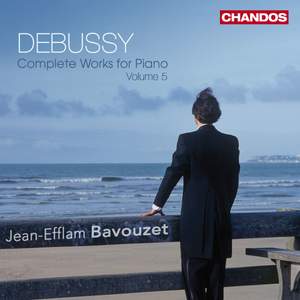
| |  | Debussy - Complete Works for Solo Piano Volume 5Debussy Transcriptions – 3 Ballets
Jean-Efflam Bavouzet reaches the climax of his multi award-winning complete works for piano, with an album of solo piano transcriptions of three ballets from the same period. Sir Charles Stanford subjected all music to what he called a ‘piano test’: if it didn’t stand up to being played on the piano, then it wasn’t to be taken seriously. In the case of Debussy, all the French composer’s scores went through a notational stage which, if not specifically designed for piano, could be given a reasonably accurate performance on that instrument. Where ballets were concerned, obviously the choreographer had to rehearse the dancers to the accompaniment of a piano score that conformed to the rhythms and structure of the final orchestral product. The three piano versions recorded here were therefore intimately related to both the compositional and production processes. Khamma stems from a commission in 1910 for an Egyptian ballet, originally entitled Isis. The project was troubled from the start when Debussy refused to reduce the orchestra from 90 to 40 players. He never heard the work, which was first given its concert performance in 1924. Bavouzet writes, ‘I discovered almost by chance in a Parisian music store, a version for piano of Khamma. This had previously escaped me so what was my surprise when I saw the richness and originality! The virtuosity required is much more subtle than the more obvious. It must give the illusion of more perfect sound levels corresponding to each specific instruments group.’ In the midst of the negotiations over Khamma, Debussy wrote his second ballet, Jeux. Jeux is a highly complex and incomprehensible piece for two hands. Bavouzet notes, ‘In several places what Debussy wrote in the reduction for solo piano is really unplayable. The text is so thin and poor that a small part of the richness of the orchestral version is realised. It was indeed this frustration that prompted me to write some years ago, a version for two pianos today published by Durand. But for this disc I had to make a version for two hands to do justice to the score. I can say that this is probably one of the most difficult works that I have played.’ Two months after the Jeux premiere, Debussy began work on his last ballet, La boîte à joujoux, based on an illustrated children’s story. Debussy embraced the plot, busy ‘extracting secrets from [his daughter] Chouchou’s old dolls and learning to play the side drum’. Within a month the first tableau was done, and he claimed he had ‘tried to be straightforward and even “amusing”, without pretentiousness or pointless acrobatics.’ The following month the piano score was complete. Jean-Efflam concludes, ‘In my opinion the transcriptions can offer greater clarity and organisation of musical discourse. Young conductors have told me that they understood the score of Jeux better after hearing the version for two pianos… for those who do not know these three ballets in their orchestral version, this disc may give them the curiosity to explore the works further.’ “This series has been as much an exploration of the mind of Debussy as a traversal of the works themselves. Bavouzet combines a probing intellect with a sensuality of touch that is enthralling. …a remarkable achievement…” Gramophone Magazine, November 2009 “The work’s prismatic inventiveness and its way of seeming at once discontinuous and a breathless sweep do not need instrumental colour to be forcefully registered, as Bavouzet demonstrates. His accounts of all three pieces are graphic and meticulous.” Sunday Times, 22nd November 2009 *** “In all three works, Bavouzet's exceptional control, variation of touch and keyboard colour regularly provide new insights, so that he conjures up the evasive, mutable world of Jeux in a way that seems almost as convincing as the composer's own exquisitely dappled scoring.” The Guardian, 19th November 2009 **** “it’s a musical adventure for everyone, and Bavouzet has more than achieved what he set out to do. Anyone familiar with Debussy’s shimmering orchestral colouration will recognise it translated into piano form, and anyone who isn’t will find their imaginations filling in the blanks.” Charlotte Gardner, bbc.co.uk, 17th November 2009 “Such vivid colours, such superbly voiced textures and such flair, nuance and richness of atmosphere, who needs orchestras?” Classic FM Magazine, December 2009 “Debussy playing does not come any better than this” Penguin Guide, 2011 edition | | | (also available to download from $10.50) | In stock - usually despatched within 1 working day. |
|
|
| |  | Debussy - Orchestral Works 2
“A great rarity here is Khamma. This and the two Rhapsodies are underrated and, although there are alternative versions of all these pieces, none is more economically priced. The performances are sympathetic and authoritative” Penguin Guide, 2011 edition | | | In stock - usually despatched within 1 working day. |
|
|
| |  | Charles Koechlin: Magicien Orchestrateur
Sarah Wegener (soprano) & Florian Hoelscher (piano) Radio-Symphonieorchester Stuttgart des SWR, Heinz Holliger The latest release in this globally acclaimed series features Koechlin’s orchestations of works by Debussy, Fauré, Chabrier and Schubert, all of which are world premere recordings. He was able to craft an intoxicating range of colours into every score. “brilliant orchestrations” BBC Music Magazine, September 2012 **** “The performances by the Stuttgart Radio Symphony Orchestra are beautifully poised and refined, with an audible relish for Koechlin's instrumental magic.” Gramophone Magazine, October 2012 “Those who regards Koechlin as purveyor of the complex and ambitious are in for a treat.” International Record Review, June 2012 | | | (also available to download from $10.50) | Usually despatched in 2 - 3 working days. (Available now to download.) |
|
|
| |  | Debussy: Piano Music Volume 1
Michael Korstick is a distinguished master of late French Romantic, Impressionist and Post-French music. This is the first volume in a new series dedicated to the solo piano works of Debussy. The series includes many world premiere recordings. “atmosphere, tonal colouring, acute observation of the score, subtle characterisation and, not least, a beautiful recorded sound...Altogether an auspicious start to the cycle.” Gramophone Magazine, August 2012 | | | (also available to download from $10.50) | Usually despatched in 2 - 3 working days. (Available now to download.) |
|
|
| |  | Debussy: Prélude à l’après-midi d’un faune
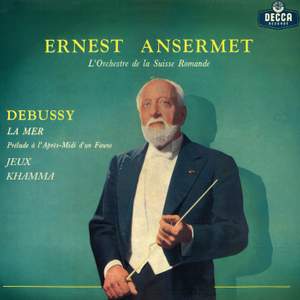
Ernest Ansermet (1883–1969) made a series of recordings (with great producers such as Ray Minshull and others) of music by Debussy in the late 1950s and early ’60s that were second to none. Today, these interpretations are still considered a yardstick by which others are judged. Ansermet worked closely with many of the leading composers of the day, especially Ravel and Stravinsky as he was conductor of Diaghilev’s Ballets Russes from 1915 to 1923. He met Debussy in 1917 to discuss revisions to the Nocturnes, and gave what can be considered authentic performances of the composer’s works with his recently established Orchestre de la Suisse Romande. Ansermet was an outspoken and forward-looking man. His recordings are famed for their clear authoritative tone, and his sensitivity and awareness in recording Debussy. “Khamma is a rarity; hardly ever performed in theatre or concert hall, this is probably its first recording.” Gramophone Magazine, October 1965 “Truly he had to work with an orchestra whose playing was less polished and not so homogenous as more famous European groups, but the sounds he created, with the aid of the Decca engineers, have a vividness that I find
compulsive … The Prélude à l’après-midi d’un faune begins and closes impressively.” Gramophone Magazine, September 1985 | | | Usually despatched in 2 - 3 working days. |
|
|
| |  | Debussy: Orchestral Works Volume 4
The fourth volume in Naxos’s highly praised series of Debussy’s Orchestral Works presents music drawn from three of his theatrical ventures and from one of his Prix de Rome entries. The prelude, fanfares and four symphonic fragments from Le Martyre de Saint Sébastien were taken for concert performance from Debussy’s incidental music for Gabriele D’Annunzio’s scandalous mystery play. While rarely heard today, the ‘danced legend’ Khamma, set in ancient Egypt, and incidental music for Shakespeare’s King Lear, provide suitably atmospheric music, as do the Cortège et air de danse from The Prodigal Son, the cantata which gained Debussy the Prix de Rome in 1884. “Played like this, with every phrase pulsating with life-enhancing radiance and choreographic intensity, these magical scores caress the senses as rarely before...Märkl is a master Debussyan, who captures the magical half-lights of these scores with a rare instinct for colour and texture.” Classic FM Magazine, November 2010 ***** “Märkl refuses to settle for the familiar Symphonic Fragments [from Saint Sébastien], and includes additional numbers from the second and third acts in a performance that is austere and raunchy by turns...Its companion piece is the 1912 "danced legend" Khamma...The Orchestre de Lyon play it handsomely” The Guardian, 9th September 2010 **** “While [Khamma is] well played here, it is overshadowed by the much more confident Martyrdom of St Sebastian, in which the music’s sensuous colouring shows Debussy inspired, the orchestral playing echoing his finesse.” The Telegraph, 25th September 2010 **** | | | (also available to download from $6.00) | Usually despatched in 2 - 3 working days. (Available now to download.) |
|
|
| |  | Claude Debussy: Orchestral Works
Marylene Dosse (piano) Ensemble Vocal "Psallette de Lorraine“ Serge Dangain (clarinet) Jacques Navadic (narrator) Jean-Marie Londeix (saxophone) Katerina Zlatnikovca (dulcimer) Luxemburg Radio Orchestra, Louis de Froment | | | Usually despatched in 4 - 5 working days. |
|
|
| |  | Debussy: Complete Works for Orchestra
| | | (also available to download from $24.00) | Usually despatched in 2 - 3 working days. (Available now to download.) |
|
|
| |  | Debussy - Ochestral Works
| | | Usually despatched in 4 - 5 working days. |
|
|
| |
|