All recordingsPrices shown exclude VAT. (UK tax is not payable for deliveries to United States.) See Terms & Conditions for p&p rates. | |  | Edda Moser singt Mozart
| | | In stock - usually despatched within 1 working day. |
|
|
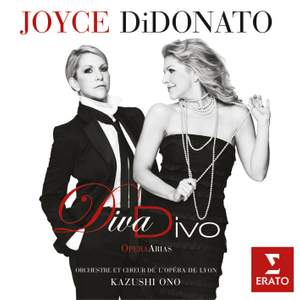
| |  | Joyce DiDonato: Diva, Divo
Bellini: | Ascolta! Se Romeo t'uccise un figlio...La tremenda ultrice spada (from I Capuleti) Edgaras Montvidas (tenor), Nabil Suliman (baritone) | Berlioz: | La Damnation de Faust: D'amour l'ardente flamme Roméo et Juliette, Op. 17: Premiers transports que nul n'oublie | Gluck: | Se mai senti spirarti sul volto (from La clemenza di Tito) | Gounod: | Faites- lui mes aveux (from Faust) | Massenet: | Je suis gris! Je suis ivre! (from Chérubin) Allez, laissez-moi seul...Coeur sans amour, printemps sans roses (from Cendrillon) Ô frêle corps.... Chère Cypris (from Ariane) | Mozart: | Giunse alfin il momento... Deh, vieni, non tardar… (from Le nozze di Figaro) Ecco il punto...Non più di fiori vaghe catene (from La clemenza di Tito) Voi che sapete (from Le nozze di Figaro) | Rossini: | Contro un cor (from Il barbiere di Siviglia) Edgaras Montvidas (tenor) Nacqui all'affanno, al pianto...Non più mesta (from La Cenerentola) Elena Semenova (soprano), Pascale Obrecht (mezzo), Edgaras Montvidas (tenor), Nabil Suliman (baritone), Paolo Stupenengo (bass) | Strauss, R: | Sein wir wieder gut (from Ariadne auf Naxos) |
Joyce DiDonato celebrates the rich dramatic variety of the mezzo-soprano voice in this collection of arias for different characters – of both sexes – from a single opera, or from different operatic treatments of the same story. Joyce DiDonato’s capacity for characterisation is as astounding as the range and flexibility of her voice. As her Virgin Classics recitals of Handel and Rossini have proven, she can charm and touch as a good girl, seduce and seethe as a bad girl, and slip believably into the trousers of a hero. As Opera News said of the Rossini disc, ‘Colbran, The Muse’: “With her sure sense of line and colour, DiDonato takes possession of the repertory, mining every musical and vocal gesture to inhabit each character confidently … Her theatrical sense is magnificent. Musically and dramatically, the disc is perfection.” This new collection showcases DiDonato’s multi-faceted art – and the wealth of opportunities open to a mezzo-soprano – by presenting her as different characters, both male and female, from the same opera or from different musical treatments of the same story. As DiDonato explains: “This recital celebrates the vast and fabulous world of the mezzo-soprano. Aside from the obvious Toscas or Cio-Cio Sans, I've never regretted the length of my vocal cords! I have the privilege and unmitigated joy of playing boys and young men, as well as girls and grown women … It’s an exploration of the human palette of emotions. “I wanted to find a way to show this duality on disc, while highlighting some of the composers I'm most passionate about, such as Mozart, Bellini, Berlioz, Rossini, and Massenet. In exploring this idea, the possibility became clear for telling different sides of some of the most familiar tales which have served as inspiration for operatic legends: Cinderella, Faust, Romeo and Juliet … I've always thought of myself as a storyteller, and with this particular disc, I can showcase that side of me as never before. I'm ready to play!” The programme features several roles that DiDonato has sung on stage – such as Rossini’s Cenerentola (it was the character’s gentle, then exuberant ‘Nacqui all’affanno’ that launched her international career at Plácido Domingo’s Operalia competition, and subsequently at La Scala), Bellini’s Romeo and Mozart’s Cherubino. The ‘flip sides’ of those characters are roles that have not featured in her repertoire: the Prince from Massenet’s Cendrillon (a lavish treatment of the Cinderella story more likely to bring DiDonato in the title role – as at Santa Fe in 2006 and, in 2011, at Covent Garden); the Nurse from Berlioz’s Roméo et Juliette, and both Chérubin (from Massenet’s ‘sequel’ to Le nozze di Figaro) and Susanna. The Figaro connection continues with an excerpt from Il barbiere di Siviglia (Rosina, of course, later becomes Countess Almaviva), while other operas on the programme, from the Renaissance to late Romanticism, include La clemenza di Tito (Sesto and Vitellia), Faust, La Damnation de Faust, Mefistofele, Orphée et Eurydice, Orfeo and Orphée aux Enfers. Accompanying Joyce DiDonato in this tour de force is the Orchestre de l'Opéra National de Lyon under the company’s Principal Conductor Kazushi Ono, another artist who successfully embraces an extraordinary diversity of musical idioms. As John von Rhein wrote in Gramophone: “In complete control vocally, Joyce DiDonato is … consumed by the character. She embodies whomever she’s playing and whatever emotional situation she is evoking.” “It's playful, as well as an ideal vehicle for her glorious mezzo voice in which the most fiendish coloratura ornaments and trills sound effortless.” The Observer, 30th January 2011 “I can find nothing but praise...This recording gives enormous pleasure in rare as well as familiar repertoire...the mezzo invariably finding the right colour for each portrayal...Perhaps the best thing about this recital is that everything DiDonato sings sounds spontaneous, as if the character her- or himself were actually experiencing it for the first time.” International Record Review, March 2011 “she is steadily terrific: technically secure, nimble and clean in her flourishes and roulades, always alert to dramatic nuance. Nor do we lack variety. First, a swaggering, tipsy aria for Cherubino from the luxuriously coloured Chérubin (Massenet again). Then we jump to Mozart’s Susanna, intimate and tender in The Marriage of Figaro. So it goes: jolting, fascinating, entertaining.” The Times, 11th February 2011 **** “[This collection] draws together paired arias of male and female roles from the same story...the youthful Siebel's declaration of love for Marguerite, from Gounod's Faust, receives an anachronistic response from Berlioz's La Damnation de Faust. Clever stuff.” The Independent, 11th February 2011 *** “DiDonato’s is a five-star voice, perhaps the finest lyric mezzo before the public today...Ono’s Lyons orchestra and chorus give her voice luxury support, and her growing army of fans won’t be disappointed.” Sunday Times, 20th February 2011 **** “[DiDonato] underlines what has been increasingly obvious from her stage appearances – she is a consummate professional” Financial Times, 11th February 2011 **** “DiDonato's tone and phrasing catch a genuine male authority in the first entry of Bellini's Capuleti Romeo...Cendrillon and the (to Anglophones) rare Ariane are utter, and quite dark, delights. Elsewhere the Mozart is enjoyed and well negotiated - the lower colouring makes Susanna sound mature and knowing.” Gramophone Magazine, April 2011 “Proof of DiDonato's consummate musicianship is everywhere here...For sheer beauty of tone, legato that defies gravity and singing that restores your faith in human nature, listen last of all to what Joyce DiDonato does with Berlioz's 'D'amour l'ardente flamme'. Diva or Divo, this is the real thing.” BBC Music Magazine, April 2011 ***** “Listening to DiDonato depict both [Cherubino and Susanna]...brings home just how deeply this singer can inhabit character...The American mezzo delivers this ambitious, imaginative programme with intelligence, musicality, vocal brilliance and immense charm. There's some lovely playing from the Lyon Opera Orchestra too.” Classic FM Magazine, May 2011 ***** BBC Music Magazine
Opera Choice - April 2011 |
| | | In stock - usually despatched within 1 working day. |
|
|
| |  | Mozart: Opera & Concert Arias
| | | In stock - usually despatched within 1 working day. |
|
|
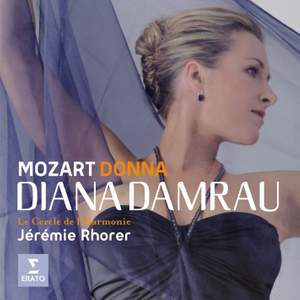
| |  | Diana Damrau - DonnaMozart opera and concert arias
Mozart: | Vorrei spiegarvi, oh Dio! K418 No, che non sei capace, K419 Senti l’eco, ove t’aggiri (from La finta semplice) Martern aller Arten (from Die Entführung aus dem Serail) Durch Zärtlichkeit und Schmeicheln (from Die Entführung aus dem Serail) Ach, ich fühl's (from Die Zauberflöte, K620) Crudele? Ah no, mio bene! ... Non mi dir, bell'idol mio (from Don Giovanni) In quali eccessi ... Mi tradì quell'alma ingrate (from Don Giovanni) Giunse alfin il momento... Deh, vieni, non tardar… (from Le nozze di Figaro) E Susanna non vien! … Dove sono i bei momenti (from Le nozze di Figaro) Al destin che la minaccia (from Mitridate, rè di Ponto) S’altro che lagrime (from La clemenza di Tito) Ecco il punto...Non più di fiori vaghe catene (from La clemenza di Tito) |
Diana Damrau (soprano) Le Cercle de l’Harmonie, Jérémie Rhorer In her second recording as an exclusive Virgin Classics artist Diana Damrau interprets concert and operatic arias by Mozart in a programme which displays her virtuosity and impressive vocal range. Indeed Diana Damrau’s new recital shows she can sing practically all of Mozart’s notably varied soprano roles – ranging from the bravura (Donna Anna, Konstanze, Donna Elvira…) via the more serious (Pamina) to the lighter soprano (generally soubrette roles such as Susanna, Blonde…). From her first recording everyone noted her outstanding Queen of the Night – here she is Pamina (in New York’s Met last Fall, Diana Damrau alternated the two roles with brio). She is also Susanna and the Contessa (Le Nozze di Figaro), Konstanze and Blonde (Die Entführung), Donna Anna and Elvira (Don Giovanni), Servilia and Vitellia (La Clemenza di Tito), pairing major soprano roles within the operas, and concert arias. As for her first recital, ‘Arie di bravura’, French conductor Jérémie Rhorer, who is rapidly gaining international recognition, directs his French period-instrument ensemble Le Cercle de l’Harmonie “Diana Damrau's intelligently planned and superbly executed recital… I can’t remember when I last enjoyed a Mozart recital of this kind so much.” BBC Music Magazine, December 2008 ***** “…Jérémie Rhorer draws tangy, rhythmically lively playing from his period band. "Taste", "fire", "flexibility", "sweetness", "grace of execution" - these were the qualities especially prized in singers of Mozart's day. On this showing Damrau, like Lucia Popp before her, has them all.” Gramophone Magazine, March 2009 | | | In stock - usually despatched within 1 working day. |
|
|
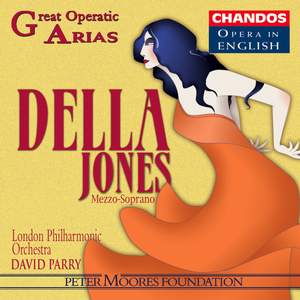
| |  | Great Operatic Arias 7 - Della JonesSung in English
Bellini: | Deh! Con te li prendi ... Mira,o Norma (from Norma) Sung in English as 'Take my children, take them with you...See, O Norma' Anne Mason (Adalgisa) | Bishop, H R: | Home, Sweet Home | Donizetti: | Leonora, taci! (from La Favorita) Sung in English as 'Leonora, be silent!' Il segreto per esser felici (from Lucrezia Borgia) Sung in English as 'Oh the secret of life, you may hear it' | German: | O peaceful England (from Merrie England) | Handel: | Dove sei, amato bene? (from Rodelinda) Sung in English as 'Art thou troubled?' Frondi tenere e belle ... Ombra mai fù (from Serse) Sung in English as 'May the Fates be kind...Under thy shade' | Mozart: | Ecco il punto...Non più di fiori vaghe catene (from La clemenza di Tito) Sung in English as 'Now is the moment...No bridal garlands' | Ponchielli: | Voce di donna o d'angelo (from La Gioconda) Sung in English as 'Voice that consoles me' | Rossini: | Di tanti palpiti (from Tancredi) Sung in English as 'Tell me, my beating heart' Ai capricci della sorte (from L'Italiana in Algeri) Sung in English as 'All the changes in my fortune' Andrew Shore (Taddeo) Je rends à votre amour (from Guillaume Tell) Sung in English as 'My brave new son, to you' Mary Plazas (Jemmy), Anne Mason (Hedwige) Io sono docile (from Il barbiere di Siviglia) Sung in English as 'I can be so demure' Per lui che adoro from L'Italiana in Algeri Sung in English as 'All for the pleasure' Peter Wedd (Lindoro), Andrew Shore (Taddeo), Simon Bailey (Mustafa) |
| | | (also available to download from $10.50) | In stock - usually despatched within 1 working day. |
|
|
| |  | Mozart: Opera Arias
| | | Usually despatched in 4 - 5 working days. |
|
|
| |  | Frederica von Stade sings Mozart & Rossini Arias
Remastered Quadro Recording (RQR) | | | Usually despatched in 2 - 3 working days. |
|
|
| |  | The Munich Roles of Julia Varady
Recorded 1975-1992 “the most versatile, committed and technically assured lyric-dramatic soprano of the 20th century’s final quarter.” Gramophone Magazine | | | Usually despatched in 3 - 4 working days. |
|
|
| |  | Mozart: Arias
Mozart: | Non so più cosa son, cosa faccio (from Le nozze di Figaro) Voi che sapete (from Le nozze di Figaro) Chi sà, chi sà qual sia, K582 E amore un ladroncello (from Così fan tutte) Alma grande e nobil core K578 Vedrai, carino (from Don Giovanni) Giunse alfin il momento... Deh, vieni, non tardar… (from Le nozze di Figaro) Parto, parto, ma tu ben mio (from La Clemenza di Tito) Ecco il punto...Non più di fiori vaghe catene (from La clemenza di Tito) Deh, per questo istante solo (from La Clemenza di Tito) Ch'io mi scordi di te?... Non temer, amato bene, K505 |
“Mozart wrote some of his most appealing music for the mezzo-soprano voice with the roles of Cherubino and Susanna in Le nozze di Figaro, Dorabella in Così fan tutte and Zerlina in DonGiovanni each boasting at least one memorable aria. Alongside these this disc includes a handful of concert arias including Ch'io mi scordi di te? which was written for the farewell performance of the great mezzo Nancy Storace with Mozart playing the concertante piano role. Here with as innate an interpreter of Mozart's piano writing as András Schiff and a voice so remarkably selfassured as Cecilia Bartoli's the electricity of that first, historic performance seems almost to be recreated. And, here as elsewhere, György Fischer directs the splendid Vienna Chamber Orchestra with disarming sensitivity while the recording is wonderfully warm and vibrant. Cecilia Bartoli boasts a voice of extraordinary charm and unassuming virtuosity: her vocal characterisations would be the envy of the finest actresses and her intuitive singing is in itself a sheer delight. But she also brings to these arias a conviction and understanding of the subtleties of the language which only a native Italian could. Listen to the subtle nuances of 'Voi che sapete', the depth of understanding behind Dorabella's seemingly frivolous 'E'amore un ladroncello'; these aren't mere performances, but interpretations which cut to the very soul of the music. No Mozart lover should be without this CD.” Gramophone Classical Music Guide, 2010 | | | (Sorry, download not available in your country) | Usually despatched in 8 - 10 working days. |
|
|
| |  | Edda Moser: Complete Lieder & Arias
Beethoven: | Abscheulicher! Wo eilst du hin? (from Fidelio) | Brahms: | Es träumte mir (No. 3 from Acht Lieder und Gesänge, Op. 57) Die Mainacht, Op. 43 No. 2 Ständchen, Op. 106 No. 1 Von ewiger Liebe, Op. 43 No. 1 | Gluck: | Divinités du Styx (from Alceste) | Handel: | Ah crudel! (from Rinaldo) | Mozart: | Ecco il punto...Non più di fiori vaghe catene (from La clemenza di Tito) O zittre nicht (from Die Zauberflöte) Der Hölle Rache kocht in meinem Herzen (from Die Zauberflöte) Martern aller Arten (from Die Entführung aus dem Serail) Non mi dir (from Don Giovanni) Tutte nel cor vi sento (from Idomeneo) Popoli di Tessaglia! - Io non chiedo, eterni Dei, K316 Ma che vi fece, o stelle...Sperai vicino il lido, K368 Agnus Dei (from Coronation Mass) Vesperae Solennes de Confessore, K339: Laudate Dominum | Pfitzner: | An die Mark, Op. 15, No. 3 Venus Mater, Op. 11 No. 4 Verrat 'Die Wasserlilie kirchert leis' ', Op. 2 No. 7 Unter den Linden, Op. 24 No. 1 Ich und du, Op. 11 No. 1 Sonst, Op. 15, No. 4 | Schumann: | Frauenliebe und -leben, Op. 42 Spanische Liebeslieder Op. 138 (selection) Spanisches Liederspiel, Op. 74 Sologesänge aus Friedrich Rückerts Minnespiel, Op. 101 | Strauss, R: | Brentano Lieder Op. 68, Nos. 1-6 Die Nacht, Op. 10 No. 3 Vier Lieder Op. 27 Es gibt ein Reich (from Ariadne auf Naxos) | Wagner: | Dich, teure Halle (from Tannhauser) | Weber: | Ozean, du Ungeheuer (from Oberon) | Wolf, H: | Mignon I 'Heiß mich nicht reden' (No. 5 from Goethe-Lieder) Mignon II 'Nur wer die Sehnsucht kennt' (No. 6 from Goethe-Lieder) Mignon III 'So lasst mich scheinen' (No. 7 from Goethe-Lieder) Mignon IV 'Kennst du das Land' (No. 9 from Goethe-Lieder) |
Edda Moser and EMI-Electrola – a special chapter in the history of recorded music.Two passions mark this longstanding cooperation: a love of opera – especially of Mozart–, and of the intimate art of Lieder singing. Talking to Thomas Voigt and Holger Wemhoff, Edda Moser recalls these “moments of musical bliss” in the recording studio and on the stage. With the two interviews, Edda Moser’s tribute to Mozart and the CD premières of five Lieder albums plus her aria recital, this edition paints a many-faceted and personal portrait of the great soprano. | 
| | | In stock - usually despatched within 1 working day. |
|
|
| |
|