All recordingsPrices shown exclude VAT. (UK tax is not payable for deliveries to United States.) See Terms & Conditions for p&p rates. | |  | Tudor Masters: Byrd & Gibbons
Gibbons Anthems
| | | In stock - usually despatched within 1 working day. |
|
|
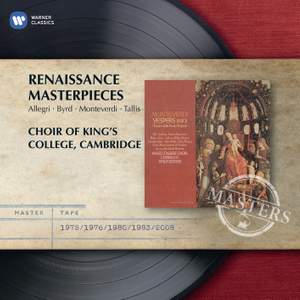
| |  | Renaissance Masterpieces
This disc features some of the best-loved works of the 16th and 17th centuries, sung by the Choir of King’s College, Cambridge. The choir has a rich and long-standing tradition of singing this repertoire, and these recordings also present distinguished soloists who began their musical career as King’s choral scholars, such as Charles Brett, Robert Tear, Martyn Hill and Gerald Finley. | | | In stock - usually despatched within 1 working day. |
|
|
| |  | Byrd: Masses for Three, Four & Five Voices
Highly acclaimed performances of all three Byrd Masses at super budget price by the UK's most acclaimed cathedral choir, that of Christ Church Oxford. ‘The performances are in the traditional English cathedral manner but are of high quality, the music’s flowing lines bringing poise and serenity’ Penguin Guide | | | In stock - usually despatched within 1 working day. |
|
|
| |  | The Feast of St Peter at Westminster Abbey
Another fascinating collection from Westminster Abbey, recreating a particular liturgical period. This disc contains music one might hear if visiting the Abbey on its patronal feast, that of St Peter the Apostle, which falls on 29 June. The programme broadly follows the structure of the three major choral services of the Anglican tradition, all of which can in turn be traced back to the worship familiar in the pre-Reformation period when the Abbey was a Benedictine monastery: Matins (or Morning Prayer); Eucharist (Mass); and Evensong (Evening Prayer). The two principal musical elements are William Byrd’s Mass for five voices, and, linking the morning and evening Offices, four movements from Charles Villiers Stanford’s Service in B flat. Also featured is Walton’s choral masterpiece The Twelve. The Abbey choir sings with its usual full-throated joy, expertly directed by James O’Donnell. “Stanford’s Te Deum and Jubilate from his B flat Service have become comparative rarities, and they make a terrific impact here, organ and choir combining with exultant, spine-tingling resonance...This is cathedral choral singing at its finest and most inspiring.” The Telegraph, 28th July 2010 “This music for Westminster Abbey's patron, St Peter, offers a nimble, not to say ecumenical chance to unite contrasting choral works on one disc...The choir sounds best in Stanford's quintessentially Anglican Service in B flat and in Walton's The Twelve (1965)...Its flamboyant organ part and fugal "Twelve as the winds and the months" finale are intriguing and uplifting.” The Observer, 8th August 2010 “this glorious disc from Hyperion celebrat[es] what the Abbey choir is all about...The centrepiece of the disc is Byrd's glorious Mass for five voices, superbly delivered in the performance of outstanding clarity and sensitivity under James O'Donnell.” International Record Review, September 2010 “The musicians of Westminster Abbey are in top form. Crisp phrasing, firm control of line and lumionous colours create many fine moments, notably in the Palestrina and in Byrd's Gloria. Under organist Robert Quinney, the transcribed Bach Sinfonia sweeps along to a heady climax.” BBC Music Magazine, November 2010 *** “A sumptuous banquet of choral delight awaits the hungry listener, laid out in three carefully balanced courses, to be savoured slowly, the whole programme sung (and played) with superlative skill” Gramophone Magazine, Awards Issue 2010 | | | In stock - usually despatched within 1 working day. |
|
|
| |  | The Tallis Scholars sing William Byrd
“England has never produced a greater composer than William Byrd. His music for the Anglican Church has been sung without interruption since the 16th century. In stark contrast his Catholic music was not heard for over 300 years. This selection compares the formal public style of Byrd’s Anglican works like The Great Service with the plangent intimacy of his Masses and motets.” Peter Phillips Recorded in the Church of St John at Hackney and in Tewkesbury Abbey “This will delight fans of Byrd and this choir. Compelling performances (especially Ave verum) and a resonant if slightly distant sound. Some pieces though (the Mass a 5) have a surface, rather than inner, drive.” BBC Music Magazine, January 2008 **** | | | In stock - usually despatched within 1 working day. |
|
|
| |  | The Essential Tallis Scholars
| | | In stock - usually despatched within 1 working day. |
|
|
| |  |
| | | In stock - usually despatched within 1 working day. |
|
|
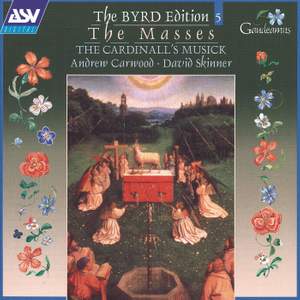
| |  | Byrd Edition Volume 5 - The Masses
These intimate, dark, mystical settings are creations of great feeling, expressing the sorrow of deprivation. All three masses reach an intensity rarely equalled in Renaissance times, and culminating in Agnus Dei settings which are among the most poignantly beautiful in all music. These will remain definitive performances for many years to come. Each mass in preceded by an organ Fantasia. Suprisingly there is only one other modern issue currently to present all three masses on a single CD. “The singing is technically polished, the tuning faultless and the overall sonority rounded and rich.” Choir & Organ “This is incomparable music by one of the great est English composers and it was high time for someone to take a fresh look at these works in the light of more recent research and of changing attitudes to performance practice. Byrd had composed his three settings of the Ordinary of the Mass in troubled times for the small recusant Catholic community that still remained in England in spite of persecution. The settings would have been sung, in all probability, during festive, albeit furtive, celebrations of the old time-honoured Roman liturgy, in private chapels in the depths of the country, at places such as Ingatestone, the seat of Byrd's principal patron, Sir John Petre. Andrew Carwood has recorded them in the Fitzalan Chapel of Arundel Castle, a small but lofty building with a clear resonance that enables the inner voices of the part-writing to come through straight and clean. It hasn't the aura of King's College Chapel, but is probably easier to manage than, say, Winchester Cathedral or Merton College Chapel. Carwood uses two voices to a part in all three Masses. In comparison with rival recordings he's alone in selecting high voices for the three-part Mass, transposed up a minor third, which introduces a note of surprising lightness and grace. He, too, is alone in taking the initiative of using an allmale choir for the four-part Mass – alto, tenor, baritone, bass. This close, low texture, together with the transposition down an augmented fourth, adds a fitting sense of gravity to the performance. In particular, it heightens the poignancy of such passages as the 'dona nobis pacem' in the AgnusDei, with its series of suspensions in the drooping phrases leading to the final cadence. That dimension of understanding is precisely what this recording by The Cardinall's Musick so keenly demonstrates. Theirs is a simplicity of style that belies simplistic criticism. Vibrato is used sparingly: 40 years on, some listeners might consider its constant use by a King's Choir of the late 1950s almost too overpowering. Carwood chooses his tempos with care, avoiding the modern tendency to speed everything up inordinately. The interesting historical note on the whole background is a good pointer to what the listener may experience as the music unfolds.” Gramophone Classical Music Guide, 2010 | | | In stock - usually despatched within 1 working day. |
|
|
| |  |
| | | (also available to download from $6.00) | In stock - usually despatched within 1 working day. |
|
|
| |  |
| | | In stock - usually despatched within 1 working day. |
|
|
| |
|