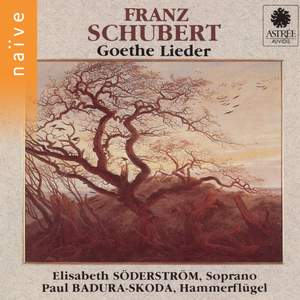
All recordingsPrices shown exclude VAT. (UK tax is not payable for deliveries to United States.) See Terms & Conditions for p&p rates. | |  | Schubert: Goethe Songs
Schubert: | Am Flusse D160 (Goethe) Schäfers Klagelied, D121 (Goethe) Meeres Stille, D216, Op. 3 No. 2 (Goethe) Heidenröslein, D257 Jägers Abendlied, Second Setting, D368 Sehnsucht, D123 Die Liebe (Klarchens Lied), D210 Trost in Tränen, D120 Rastlose Liebe, D138 Nähe des Geliebten, D162 Der Fischer, D225 (Goethe) Erster Verlust, D226 (Goethe) Der König in Thule, D367 Harfenspieler I 'Wer sich der Einsamkeit ergibt', D478 Harfenspieler II 'An die Türen will ich schleichen, D479 Harfenspieler III 'Wer nie sein Brot mit Tränen ass', D480 An Schwager Kronos, D369 An Mignon D161 Ganymed, D544 (Goethe) An die Entfernte, D765 (Goethe) Versunken D715 (Goethe) An den Mond, D259 (Goethe) Der Musensohn, D764 (Goethe) Auf dem See, D543 (Goethe) Geistes-Gruss, D142 |
| | | In stock - usually despatched within 1 working day. |
|
|
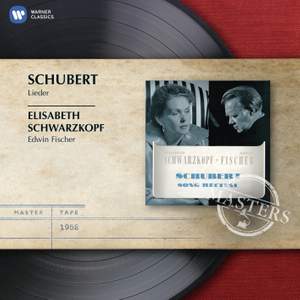
| |  | Schubert: Lieder
Schubert: | An die Musik D547 Im Frühling, D882 Wehmut, D772 (Collin) Ganymed, D544 (Goethe) Das Lied im Grünen, D917 Gretchen am Spinnrade, D118 Nähe des Geliebten, D162 Die junge Nonne, D828 An Sylvia, D891 Auf dem Wasser zu singen, D774 Nachtviolen D752 (Mayrhofer) Der Musensohn, D764 (Goethe) |
“Schwarzkopf and Fischer make a magical partnership, with even the simplest of songs inspiring intensely subtle expression from singer and pianist alike. Fischer left few records more endearing than this, and Schwarzkopf’s colouring of word and tone is masterly.” Penguin Guide | | | In stock - usually despatched within 1 working day. |
|
|
| |  | Schubert - Lieder
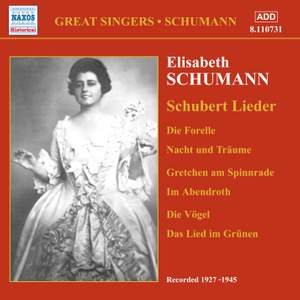
Schubert: | An den Mond, D193 Suleika I, D720 Im Abendrot, D799 Sei mir gegrüsst! D741 (Rückert) Die Forelle, D550 Heimliches Lieben D922 (Klenke) Der Sänger am Felsen, D482 Thekla, D595 (Schiller) An die Sonne D270 Aus 'Diego Manzanares', Ilmerine D458 Nacht und Träume, D827 Frühlingsglaube, D686 Die Blumensprache D519 (Platner) Nähe des Geliebten, D162 An die Nachtigall, D497 Liane, D298 (Mayrhofer) Das Madchens Klage, D191 (Schiller) Nachtviolen D752 (Mayrhofer) Marie D658 (Novalis) Lambertine, D301 (Stoll) Die Männer sind méchant, D866 No. 3 |
SONY BMG Masterworks is delighted to present the debut solo album by soprano Elizabeth Watts. Born in 1979, Elizabeth has already garnered an impressive list of accolades, including reaching the final and winning the prestigious Rosenblatt Recital Song Prize at the 2007 Cardiff Singer of the World Competition, winning the Kathleen Ferrier Prize in 2006, the MIDEM Classique Award for Outstanding Young Artist Award in 2007, and has also been selected for BBC Radio 3’s New Generation Artists Scheme. “…Watt's youthful, radiant delivery, with no flaws in technique that I can hear, fits many of the Lieder like a glove.” BBC Music Magazine, January 2009 **** “Hailed as a singer to watch after winning the 2006 Kathleen Ferrier Award and the 2007 Cardiff Song Prize, Elizabeth Watts makes her CD debut with this refreshingly unhackneyed Schubert programme. Perennial soprano favourites – DieForelle, Nacht und Träume, Frühlingsglaube, Suleika – are not shunned. But Watts has alighted on some rarely aired gems. How often in recital do we hear the agitated scena-in-miniature AusDiego Manzanares; or the playfully charming paean to spring Die Blumensprache; or the Novalis setting Marie, where sacred and profane blur in a song of exquisite, rarefied grace? A voice in its first, radiant freshness is always to be cherished in Schubert. Watts is a thoughtful interpreter, too, alive to mood and atmosphere, colouring her tone in response to a darkening of the harmony in, say, Sei mir gegrüsst. Crucially, she also brings a measure of innocence and simplicity – not quite the same thing as artlessness – to many of these songs, allied to a technical mastery that allows her to spin a rapt, unblemished line in Nacht und Träume. Encouraged by Vignoles's buoyant accompaniment, she makes an engaging story-teller in Die Forelle, with an unexaggerated touch of indignation at the angler's treachery; and she sings the mildly salacious refrain song Die Männer sind méchant with just the right wide-eyed mock-pathos. Quibbles? Well, in one or two songs, including the opening An den Mond, Watts struck me as overly languid. She treats Nähe des Geliebten as an elegiac litany, where, say, Janet Baker, choosing a more mobile tempo and finding greater variety from verse to verse, sings it as a passionate avowal of love. Watts also emphasises melancholy over excited anticipation in Frühlingsglaube and Suleika. Here and elsewhere, Watts under-exploits the expressive potential of German consonants. That said, highlights are lovely performances of Nachtviolen – the high tessitura effortlessly negotiated – or the Mozartian barcarolle Liane: just two songs among many where the vernal purity of Watts's tone and the grace of her phrasing are priceless assets.” Gramophone Classical Music Guide, 2010 “A voice in its first, radiant freshness is always to be cherished in Schubert. Watts is a thoughtful interpreter, too, alive to mood and atmosphere… Crucially, she also brings a measure of innocence and simplicity - not quite the same thing as artlessness - to many of these songs, allied to a technical mastery that allows her to spin a rapt, unblemished line in "Nacht und Träume".” Gramophone Magazine, February 2009 | | | In stock - usually despatched within 1 working day. |
|
|
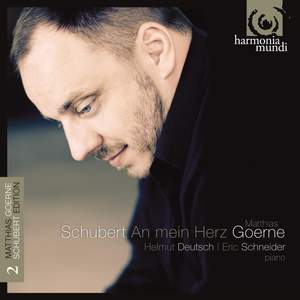
| |  | Schubert Lieder Volume 2: An Mein Herz
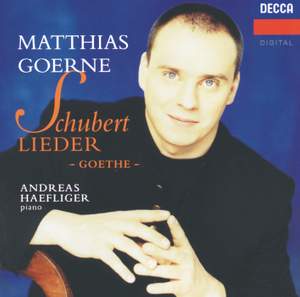
Schubert: | Der Jungling und der Tod, D545 (Spaun) Das Lied im Grünen, D917 Die Herbstnacht (Wehmut) D404 (Salis-Seewis) Ins stille Land, D403 Abschied von der Harfe D406 (Salis-Seewis) Drang in die Ferne, D770 An Mein Herz D860 Der Wanderer, D649 (Friedrich von Schlegel) Über Wildemann D884 (Ernst Schulze) Klage D371 Am Bach im Fruhling, D361 An die Laute D905 Des Fräuleins Liebeslauschen, D698 Augenlied, D297 (Mayrhofer) Du bist die Ruh D776 (Rückert) An die Musik D547 An eine Quelle D530 (Claudius) Der Sänger am Felsen, D482 Abschied von der Harfe D406 (Salis-Seewis) Liedesend, D473 (Mayrhofer) Das Heimweh, D456 (Winkler) Auf der Donau, D553 (Mayrhofer) Wie Ulfru fischt, D525 (Mayrhofer) Die Sternennacht D670 (Mayrhofer) Ruckweg, D476 (Mayrhofer) Geheimnis, D491 (Mayrhofer) Gondelfahrer, D808 Abendstern, D806 Der Sieg D805 (Mayrhofer) Nachtstück, D672 (Mayrhofer) Auflösung, D807 Heiss mich nicht reden, D877/2 Nur wer die Sehnsucht kennt, D877/4 An Mignon D161 Harfenspieler I 'Wer sich der Einsamkeit ergibt', D478 Am Flusse D160 (Goethe) Nähe des Geliebten, D162 Der Fischer, D225 (Goethe) Auf dem See, D543 (Goethe) Wonne der Wehmut D260 (Goethe) Willkommen und Abschied, D767 |
Matthias Goerne has received worldwide praise for his warm, fluid baritone and his profound interpretations. Highly respected as a Lieder singer, he is a frequent guest at renowned festivals and prestigious venues like the Carnegie and Wigmore Halls. From 2008 to 2011, Matthias Goerne will perform and record Schubert on 11 CDs for harmonia mundi and important venues all over the world will present the complete series of Schubert recitals with Matthias Goerne in their coming seasons. This second volume speaks of death, of the 'Wanderer', and of the relationship between Schubert and his poets . . . For this occasion the singer has called on two travelling companions who have left a lasting artistic impression on the world of lieder: Eric Schneider and Helmut Deutsch. Helmut Deutsch's career as a song accompanist began with Irmgard Seefried; he spent twelve years in an intensive collaboration with Hermann Prey, and has been the partner of many other celebrated singers. Eric Schneider has appeared notably with Christine Schäfer, Matthias Goerne, Christiane Oelze and Stephan Genz. He is a regular guest with these partners at the Schwarzenberg Schubertiade, Salzburg Festival and the Tanglewood Summer Music Festival. “Goerne… and Schneider offer grave and solemn performances of Goethe's Mignon and Harper songs, before ending on a higher note, celebrating the eternal joy of love in 'Willkommen and Abschied'.” BBC Music Magazine, February 2009 **** “Battered by Bryn Terfel dramatics, the ears cried out for a pure dose of lieder from a master of the craft. Matthias Goerne… seems to own a different shade of baritonal colour for every syllable Schubert wrote. The voice is sweet and serene, even at fff, and
the shifts that Goerne applies to the changing of seasons and the fickleness of love are done with enviable delicacy. More reticent than Fischer-Dieskau or Thomas Quasthoff to bend a line for expressive
emphasis, when Goerne takes a liberty the effect is breath stopping… T his is not an album to gorge at one go. Take it two songs a night before bedtime, and it might see you through to the end of recession.” Norman Lebrecht, Evening Standard CD of the Week “Goerne used to record for Decca, but it apparently had no interest in his 12-volume Schubert compendium, so the less ruthlessly commercial Harmonia Mundi comes to the rescue, for which the France-based company deserves the highest praise. From a vocal point of view, few male singers,
even Fischer-Dieskau, command such a rich palette of colours as Goerne does here…he goes where Dieskau never ventured: he includes two of Mignon's songs, Heiss' mich nicht reden and Nur wer die Sehnsucht kennt, as well as the Harper trilogy… In the middle Harper song, Mayrhofer's
Nachtstück and Nähe des Geliebten (Nearness of the Beloved), Goerne approaches the sublime and captures perfectly the wry wit of Goethe's sly dig at water-nymphery, Der Fischer, in which the surprise encounter of an angler with a "moist woman" is wryly underlined by Schubert. Luxury
support from Deutsch and Schneider sets the seal on an outstanding issue.” Sunday Times Classical CD of the Week “This promises to be a landmark series, up there with Hans Hotter and Fischer-Dieskau.” The Observer “Here elegy, fatalism and death-longing predominate and in such repertoire Goerne's mellow, darkly rounded timbre, expressive diction and care – rare in Lieder singers today – for a true, 'bound' line are well nigh ideal. Even at the most anguished fortissimo, his tone never grows harsh or hectoring. Perfectionism like Goerne's has inevitably provoked charges of over-calculation. Some might protest at the ultra-slow tempo for Du bist die Ruh. Yet Goerne's beauty of tone and phrasing (founded on seemingly superhuman reserves of breath), and a rapt intensity that rises to spiritual radiance in the final verse are mesmerising. At a more conventional tempo, he sings An die Musik as a simple, sincere confession of faith, with affectionate touches of rubato (and how eloquently Helmut Deutsch's left hand duets with the voice). Elsewhere Goerne's unsentimental tenderness can illuminate little-known songs that seem ordinary on the printed page – Abschied von der Harfe, say, or the quasi-operatic lament Der Sänger amFelsen. He even appropriates, successfully, two of Mignon's songs, giving one of the most desolate and – in the central section – disturbed performances of Nur wer die Sehnsucht kennt you will hear. True to form, Goerne makes an uncommonly melancholy serenader in An die Laute and DesMädchens Liebeslauschen, which never smiles. Yet he can lighten up, as in the story-telling of DerFischer and Wie Ulfru fischt. Like Deutsch on the first disc, Eric Schneider fully matches Goerne in acumen and command of colour, not least in a performance of Nachtstück of mingled grandeur, mystery and compassionate gentleness.” Gramophone Classical Music Guide, 2010 “Goerne's virtuoso vocal sculpting draws you into the inner landscape of each song, his warm, expressive baritone shaping detail often understated by lesser artists. This promises to be a landmark series, up there with Hans Hotter and Fischer-Dieskau.” The Guardian, 12th October 2008 | | | In stock - usually despatched within 1 working day. |
|
|
| |  | Schubert: | Moments Musicaux (6), D780, Op. 94 An die Musik D547 Im Frühling, D882 Wehmut, D772 (Collin) Ganymed, D544 (Goethe) Das Lied im Grünen, D917 Gretchen am Spinnrade, D118 Nähe des Geliebten, D162 Die junge Nonne, D828 An Sylvia, D891 Auf dem Wasser zu singen, D774 Nachtviolen D752 (Mayrhofer) Der Musensohn, D764 (Goethe) |
Recorded 1950 (moments musicaux) and 1952 (lieder) “Fischer's luminous, unfussily truthful, sober yet supple, and above all supremely elevated pianism is the perfect foil to Schwarzkopf's eye-lash-fluttering vocal acuity.” BBC Music Magazine, October 2005 | | | In stock - usually despatched within 1 working day. |
|
|
| |  | Jana Büchner: Thoughts of Love
Lewy: | Freundschaft oder Liebe, Op. 7 | Mendelssohn: | Neue Liebe, Op. 19a No. 4 Auf Flügeln des Gesanges, Op. 34 No. 2 Andres Maienlied (‘Hexenlied') Op. 8/8 | Mendelssohn, Fanny: | Warum sind denn die Rosen so blass, Op. 1 No. 3 (Text: Heinrich Heine) Dämmrung senkte sich von oben (Text: Johann Wolfgang von Goethe) Nacht ist wie ein stilles Meer | Mozart: | Dans un bois solitaire, K308 Das Traumbild, K.530 Als Luise die Briefe, K520 Das Veilchen, K476 Fragment in E flat major, K. 307b (reconstructed by John Humphries): Allegro Abendempfindung an Laura, K523 | Schubert: | Rastlose Liebe, D138 Du bist die Ruh D776 (Rückert) Lachen und Weinen, D777 Erster Verlust, D226 (Goethe) Nähe des Geliebten, D162 Auf dem Strom, D943, Op. post. 119 Lied der Delphine, D857 No. 1 |
Jana Büchner (soprano), Hans-Pieter Fieber (horn) & Eckhart Sellheim & Britta Wideranders (piano) Jana Büchner’s selection of lieder traces the evolution of the song from Mozart and Schubert all the way through to Hensel and Mendelssohn. The works deal with the joys and sufferings of love, hence “Thoughts of Love”. Included are lieder with horn obligato and Lewy’s song (1802 - 1881) is thought to be a premiere recording. | | | Usually despatched in 2 - 3 working days. |
|
|
| |  | Schubert: Lieder
Schubert: | Ave Maria, D839 Ganymed, D544 (Goethe) Kennst du das Land (Mignons Gesang), D321 Heiss mich nicht reden, D877/2 So lasst mich scheinen, D877 No. 3 Nur wer die Sehnsucht kennt, D877/4 Liebhaber in allen Gestalten, D558 Heidenröslein, D257 Nähe des Geliebten, D162 Die Forelle, D550 Auf dem Wasser zu singen, D774 Im Abendrot, D799 Ständchen 'Horch! Horch! die Lerch!', D889 Du bist die Ruh D776 (Rückert) Gretchen am Spinnrade, D118 Gretchens Bitte D564 (Goethe) Der Hirt auf dem Felsen, D965 (Von Chezy / Muller) (with clarinet) Sharon Kam (clarinet) |
“Barbara Bonney’s Schubert recital is clear-eyed, simple and eloquent” BBC Music Magazine | | | Usually despatched in 4 - 5 working days. |
|
|
| |  | Schwarzkopf sings Schubert Lieder
Beethoven: | Ah! Perfido, Op. 65 Recorded 20th September, 1954 in Watford Town Hall Philharmonia Orchestra, Herbert von Karajan Abscheulicher! Wo eilst du hin? (from Fidelio) Recorded 20th September, 1954 in Watford Town Hall Philharmonia Orchestra, Herbert von Karajan | Schubert: | An die Musik D547 Im Frühling, D882 Wehmut, D772 (Collin) Ganymed, D544 (Goethe) Das Lied im Grünen, D917 Gretchen am Spinnrade, D118 Nähe des Geliebten, D162 Die junge Nonne, D828 An Sylvia, D891 Auf dem Wasser zu singen, D774 Nachtviolen D752 (Mayrhofer) Der Musensohn, D764 (Goethe) Litanei auf das Fest Allerseelen, D343 Recorded 9th and 10th January, 1954 in EMI Abbey Road Studio 1 Gerald Moore (piano) Ungeduld (No. 7 from Die schöne Müllerin, D795) Recorded 9th and 10th January, 1954 in EMI Abbey Road Studio 1 Gerald Moore (piano) |
Recorded 4th - 7th October, 1952 in EMI Abbey Road Studio 1A “These studio sessions don’t really compare well with recordings of Schwarzkopf's live recitals - the voice can, at times, sound tired and over-studied - but there's a magnificent 'Abscheulicher!' from Fidelio.” BBC Music Magazine, December 2008 *** “a magical partnership, with even the simplest of songs inspiring intensely subtle expression from singer and pianist alike. Though Fischer's playing is not immaculate, he left few records more endearing than this, and Schwarzkopf's colouring of word and tone is masterly.” Penguin Guide, 2010 edition **** | | | (also available to download from $9.00) | Usually despatched in 2 - 3 working days. (Available now to download.) |
|
|
| |  | Schubert: Lieder Collection
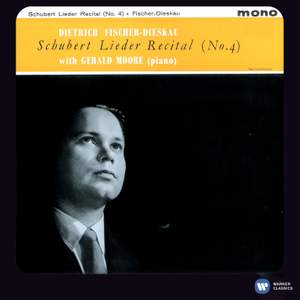
Schubert: | An die Musik D547 An Schwager Kronos, D369 Nähe des Geliebten, D162 Erlkönig, D328 Ganymed, D544 (Goethe) Wandrers Nachtlied II 'Über allen Gipfeln ist Ruh', D768 Jägers Abendlied, Second Setting, D368 Prometheus, D674 (Goethe) Liebesbotschaft, D957 No.1 Der Atlas, D957 No. 8 Ihr Bild, D957 No. 9 Die Stadt, D957 No. 11 Am Meer, D 957 No. 12 Die Taubenpost, D965A (D957 No. 14) |
Recorded Köln 1954 | | | Usually despatched in 3 - 4 working days. |
|
|
| |  | Schubert, Mendelssohn & Strauss - Lieder
Recorded 1980 | | | Usually despatched in 3 - 4 working days. |
|
|
| |
|