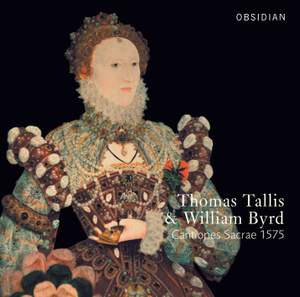
In 1575 'Thomas 'Tallis then an 'aged man', and his pupil and friend William Byrd, who was in his mid to late 30s, paid tribute to Elizabeth 1 by selecting 17 motets each for their Cantiones Sacrae ('Sacred Songs'), the first major printed collection of music to be published in England.
Many of these works have since become staple in the repertoire of church and chamber choirs throughout the world.
This is the first recording to present the Cantiones in their entirety, by the same group of singers, and in the composers' original order of publication.
“Contrasts abound: Byrd’s florid three-section Tribue Domine is almost Marian in its vastness, while Tallis’s hymn setting O nata lux de lumine is brevity itself...The dozen singers perform expressively and blend beautifully throughout, while Skinner, who adopts a commonsense approach to pitch standards, injects passion into every note.” Sunday Times, 30th January 2011 ****
“They use solo voices throughout, mixed voices with a fairly open sound that brings with it more vibrato than we are used to hearing in such music nowadays...That results in performances that are refreshingly free of self-indulgence. Some of the big Byrd pieces in particular are very good indeed.” Gramophone Magazine, March 2011
“The prevailing mood is penitential, but the pieces are never dull; there's much delight to be had in listening to the way the individual voice parts weave in and out...Skinner gets his singers to bring [the false relations] out so that they send shivers down your spine...[He] shapes the music extremely well.” Classic FM Magazine, March 2011 ****
“Homophonic passages impress with their splendour, enriched here by the chestnut hues of basses William Gaunt and Robert Macdonald. The clarity of line lays bare the ingenuity of counterpoint, no matter how thick the texture becomes - a formidable achievement in Byrd's 'double imitation' motets.” BBC Music Magazine, March 2011 ***
“This is the first time the Cantiones Sacrae has been recorded complete and 'in the original order intended by the composers themselves'...An auspicious beginning to a mighty undertaking.” International Record Review, May 2011