Schumann: Violin Sonata No. 2 in D minor, Op. 121

This page lists all recordings of Violin Sonata No. 2 in D minor, Op. 121, by Robert Schumann (1810-56) on CD, SACD, DVD & download (MP3 & FLAC). Generally, more recent releases are listed first, but with priority given to those that are in stock.

Recommendations

Chamber Choice
May 2008
Critics' Disc of the Year
December 2010
Disc of the Month
June 2009

All recordings

Prices shown exclude VAT. (UK tax is not payable for deliveries to United States.)
See Terms & Conditions for p&p rates.

Ulf Hoelscher plays Schumann & Szymanowski

Ulf Hoelscher plays Schumann & Szymanowski


Schumann:

Violin Sonata No. 1 in A minor, Op. 105

Violin Sonata No. 2 in D minor, Op. 121

Szymanowski:

Mythes, Op. 30

Romance in D major, Op. 23


Ulf Hoelscher (violin) & Michel Beroff (piano)

EMI Electrola Collection - 6020912

(CD)

$11.50

In stock - usually despatched within 1 working day.

Schumann: The Violin Sonatas

Schumann: The Violin Sonatas


Schumann:

Violin Sonata No. 1 in A minor, Op. 105

Violin Sonata No. 2 in D minor, Op. 121

Violin Sonata No. 3 in A minor, WoO 27


Ulf Wallin (violin) & Roland Pöntinen (piano)

Robert Schumann's three Sonatas for violin and piano were all composed between 1851 and 1853, and have suffered from neglect like other works from this period in the composer's life.

Here the performers are Ulf Wallin and Roland Pöntinen: a team who recorded their first disc for BIS in 1991, and whose partnership has been described as 'masterfully cultivated ensemble playing' on ClassicsToday.com.

Wallin's credentials in Schumann are firmly established, after his recently released recording of the violin concerto, the Fantasy and the arrangement for violin of the cello concerto has been met with considerable critical acclaim.

“he captures ideally the turbulence of the First Sonata, so reminiscent of the sound world of the First Piano Trio, and the irresistable drive of the Second Lebhaft. The balance with the piano of Roland Pontinen seems natural” Gramophone Magazine, May 2012

“one of the most compelling accounts of the Second Sonata that I've ever heard. In lesser hands, this work's outer movements can so easily sound relentless and even monotonous...Here, however, Wallin and Pontinen extract the maximum variety of expression and articulation out of the material, almost as if they are restoring the vibrant colours to an ancient painting.” BBC Music Magazine, June 2012 *****

Super Audio CD

Format:

Hybrid Multi-channel

BIS - BISSACD1784

(SACD)

$17.00

(also available to download from $10.75)

In stock - usually despatched within 1 working day.

Schumann: Sonatas

Schumann: Sonatas


Bach, J S:

Partita for solo violin No. 2 in D minor, BWV1004: Chaconne

Transcription by Schumann

Schumann:

Violin Sonata No. 1 in A minor, Op. 105

Daniel Sepec (violin)

Violin Sonata No. 2 in D minor, Op. 121

Daniel Sepec (violin)

Gesänge der Frühe (5), Op. 133


Daniel Sepec (violin), Andreas Staier (piano Erard)

After his earlier Hommage à Bach album, played on the same 1837 Érard piano he uses here, Andreas Staier is joined by Daniel Sepec in a programme of considerably later works by Schumann. However, these two violin sonatas and the Gesänge der Frühe of 1853 show no retreat from the composer's ideal: here too, ‘the poet speaks' . . .

“Though Daniel Sepec's tone tends to astringency, his bowing is beautifully fluid, especially in the Second Grand Sonata. As accompanist and soloist, Staier is spellbinding. In works that seem about to topple over with ideas, fantasy is rooted in the most assured craftsmanship.” The Independent on Sunday, 8th August 2010

“Sepec and Staier give a fine performance, and the translucent tone of the 1837 piano by Pierre Erard...is even better suited to the Gesänge der Frühe...There's much to enjoy in the violin sonatas, too” BBC Music Magazine, September 2010 ****

Harmonia Mundi - HMC902048

(CD)

$17.75

In stock - usually despatched within 1 working day.

Schumann: Violin Sonatas Nos. 1–3

Schumann: Violin Sonatas Nos. 1–3


Schumann:

Violin Sonata No. 1 in A minor, Op. 105

Violin Sonata No. 2 in D minor, Op. 121

Violin Sonata No. 3 in A minor, WoO 27


Ilya Gringolts (violin) & Peter Laul (piano)

‘Ilya Gringolts is a fine advocate for both works, combining brilliance and idiomatic sensitivity’ Gramophone (Arensky/Taneyev) March 09

Ilya Gringolts first release for ONYX.

Gringolts won the 1998 International Violin Competition ‘Premio Paganini’, and was given two awards for the youngest ever competitor to reach the finals, and for the best interpretation of the Paganini Caprices.

He studied at the Julliard School with Perlman and Delay, and is one of 12 young artists selected by the BBC for the highly successful and prestigious New Generation Artists scheme.

His recordings for Hyperion have been praised and he already has a Gramophone Award to his credit for his Taneyev Chamber Music recording with Pletnev, Repin, Imai and Harrell.

He is in demand with major orchestras world-wide.

“Ilya Gringolts's dark, smoky violin tone suits the introspection of the three works perfectly. He and pianist Peter Laul do not attempt to impose themselves on the music...but instead seek out the moments when Schumann's individuality and lyrical invention are most obvious.” The Guardian, 1st July 2010 ***

“Ilya Gringolts and Peter Laul give a poetic, animated performance of the Sonata No 1 in A minor that makes Schumann’s lack of enthusiasm for the piece all the more inexplicable...[they] embrace its strangeness with flair.” Sunday Telegraph, 4th July 2010

“Gringolts and Laul make a strong case for this bittersweet music...they have an intimate rapport and innate feeling for the undemonstrative yet deeply emotional content of this glorious music, providing three of the most live-withable accounts of these masterpieces in recent recording history.” Sunday Times, 4th July 2010 ****

“Gringolts, one of the most inspirational violinists around today, plays with panache and sensitivity, his partnership with pianist Peter Laul reaching heady heights in the slow movement of the second sonata, the most Janus-faced of all.” Financial Times, 10th July 2010 ***

“Gringolts shapes the music admirably well throughout” BBC Music Magazine, September 2010 ****

Onyx - ONYX4053

(CD)

$17.00

In stock - usually despatched within 1 working day.

Philippe Graffin plays Schumann

Philippe Graffin plays Schumann


Schumann:

Violin Concerto in A minor, Op. 129 (arranged from the Cello Concerto)

Deutsche Radio Philharmonie Saarbrücken Kaiserslautern, Christoph Poppen

Violin Sonata No. 2 in D minor, Op. 121

with Claire Désert (piano)

Schumann, Clara:

Romances (3), Op. 22

with Claire Désert (piano)


Violinist Philippe Graffin’s second recording for Onyx sees him partnered once again by pianist Claire Désert, in Schumann’s highly charged second violin sonata and the delightful 3 Romances by Clara Schumann, composed for Joseph Joachim.

The concerto is a rarity – not the D minor violin concerto op. posth, but the composer’s arrangement of his much-loved cello concerto op.129.

Unusual and intelligent programming from Philippe Graffin, who is rapidly gaining a reputation as one of the most insightful and inquisitive violinists of our time.

“Most of [the transcription] works well enough...and there are even one or two gains...Graffin makes a very appealing case for it...Clara Schumann's Three Romances are much more than salon sweetmeats, and Graffin and Claire Désert play them elegantly and with feeling.” BBC Music Magazine, November 2010 ****

Onyx - ONYX4062

(CD)

$17.00

In stock - usually despatched within 1 working day.

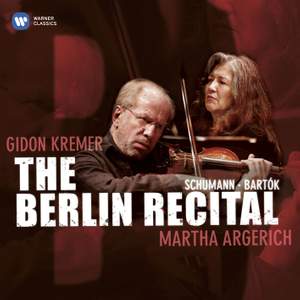
Martha Argerich & Gidon Kremer - Live in Berlin

Martha Argerich & Gidon Kremer - Live in Berlin


Bartók:

Sonata for Solo Violin, BB 124, Sz. 117

Violin Sonata No. 1, BB 84, Sz. 75

Kreisler:

Liebesleid

encore

Schön Rosmarin

encore

Schumann:

Violin Sonata No. 2 in D minor, Op. 121

Kinderszenen, Op. 15


Martha Argerich (piano) & Gidon Kremer (violin)

EMI Classics is pleased to announce the release of a joint recital by the legendary pianist Martha Argerich and Gidon Kremer, one of today’s most original and compelling violinists. The concert was recorded live at Berlin’s Philharmonie in December 2006. The repertoire features Schumann’s Sonata for Violin and Piano No. 2 in D minor and Kinderszenen, as well as Bartók’s Sonata for Violin and Piano No. 1 and Sonata for Solo Violin. Two encores, Fritz Kreisler’s Liebesleid and Schön Rosmarin round out the release.

“A summit of two musical giants,” wrote the Abendzeitung München, reviewing the concert. “They are chamber music’s dream couple […] The way they communicate musically cannot be surpassed by any other current duo” said the Münchner Merkur. The Neue Zürcher Zeitung summed up the concert with the words “chamber music is alive.”

Interviewed in the film, Gidon Kremer muses about his decades-long partnership with Martha Argerich: “The paradox is that, even though we are not a couple in love, we speak an intimate language through our music of the kind that is usually only spoken between couples in love. It is even possible that, through our music, we can become even more closely entwined than a couple in love can be.”

At first sight, Robert Schumann and Béla Bartók might not appear to have much in common. Schumann represented the German romantic tradition and favoured rich, full harmonies, while Bartók sought to escape from that sound world, his music tending toward “extremes of delicacy or sparseness, or of complexity or roughness, as his vision dictates.” Yet the two composers do have much in common: both were pianist-composers in whose output their own instrument retains a central place yet both had the ambition to reach out and embrace every musical genre; both Schumann and Bartok maintained a strong interest in music education and both promoted the status of music in the wider cultural sphere.

Schumann’s second sonata, in D minor Op. 121, composed in 1851, was dedicated to Ferdinand David, the dedicatee of Mendelssohn’s E-minor Violin Concerto. After Schumann’s death, the sonata was often performed by Joseph Joachim with the composer’s wife, Clara, at the piano. Kinderszenen dates from 1838, a period in which Schumann concentrated on music for solo piano. Kremer comments, “I love listening to Martha from backstage. I love the way she masterfully recreates the fragility of Schumann’s Kinderszenen. It is simply a heart-stopping experience.”

Bartók completed the first of his two violin and piano sonatas in December 1921 and the second the following year. He dedicated both to Jelly d’Arányi, a brilliant young violinist whose playing thrilled him and with whom he fell in love. In both sonatas Bartók treats the two instruments as independent but complementary – they do not share material, as the violin and piano would do in classical duo sonatas. In November of 1943, Bartók met Yehudi Menuhin when he came to play the First Sonata for him, prior to a performance. This meeting inspired the composer’s Sonata for Solo Violin, which Menuhin premiered at Carnegie Hall the following year. Although its structure is traditional and it recalls the first Bach solo sonata, having a fugue as a second movement and a fast triple-time finale, its constant rhythmic inventiveness gives the work a sense of improvisatory freedom.

“…for…the performances that make this Berlin concert absolutely indispensable are the two Bartók sonatas. The First Sonata… reaches fever pitch in the finale where Kremer swings in on a glissando and the two go hell for leather as one racy folk-style motif follows another. The first CD concludes with one of the finest ever recorded performances of Bartók's Solo Sonata, Kremer calling on his full repertoire of violinistic devices which include, in addition to the many called for in the score, a mastery of tonal colouring and a rhythmic grip that at times seem to transcend the limitations of the instrument.” Gramophone Magazine, June 2009

“…what the Bartók in particular offers over and above their fine previous version is a sense of music-making caught on the wing. …the playing here is spectacularly vivid and assured. …above all there is Argerich in Schumann's Kinderszenen. Since she has all but given up playing solo works in public, her admirers will want to seize the opportunity of hearing this performance shot through with characteristic spontaneity.” BBC Music Magazine, June 2009 ****

“The electricity of a live occasion surges through this recital of Bartók and Schumann, which Gidon Kremer and Martha Argerich gave at Berlin’s Philharmonie in December 2006.” The Telegraph, 10th June 2009 *****

“One of the greatest recitals I ever reviewed for this paper was given by the duo of Gidon Kremer and Martha Argerich and here they are some two decades later in another live recital from Berlin that shows them still at the height of their astounding powers. The coupling of Schumann and Bartók may seem odd, but both are dense, complex composers. Each player offers a solo as well as duos: the highlights are Argerich's solo, Schumann's Kinderszenen, full of the most aching, subtle rubato; and the duo's Bartók Violin Sonata No 1, with its hair-raising, stop-start finale - it's earthy and exciting. As a sugary reward, there are two delectable Kreisler encores.” The Observer, 3rd May 2009

“The excitement is irresistible and their account of the first Bartók sonata is exceptional, too, balancing rhythmic drive against rhapsodic expressiveness. Each of them also has a work to themselves. Kremer gives a fabulously assured account of Bartók's solo-violin Sonata, while Argerich plays Schumann's Kinderszenen.” The Guardian, 24th April 2009 *****

“There are dazzling moments here, such as Kremer's bravura tackling of Bartók's Sonata for Solo Violin, where the astringent harmonies, bordering on dissonance, of the opening Tempa di ciaccona give way gradually to the dissipated state of the lyrical Melodia and then the animated Presto.” The Independent ***

“Listening to Argerich, you pant for more from her: more concerts, more solo performances. But we handle endangered species with kid gloves. Except when we applaud — which the Berlin audience does, repeatedly.” The Times, 17th April 2009 ****

GGramophone Magazine

Disc of the Month - June 2009

EMI - 6933992

(CD - 2 discs)

$13.50

In stock - usually despatched within 1 working day.

Schumann & Brahms: Works for Clarinet and Piano

Schumann & Brahms: Works for Clarinet and Piano


Brahms:

Clarinet Sonata No. 1 in F minor, Op. 120 No. 1

Clarinet Sonata No. 2 in E flat major, Op. 120 No. 2

Schumann:

Romances (3), Op. 94

Violin Sonata No. 1 in A minor, Op. 105

Violin Sonata No. 2 in D minor, Op. 121


Fabio di Casola (clarinet), Alena Cherny (piano)

Recorded Radiostudio DRS Zurich 2006

Sony - 88697000252

(CD - 2 discs)

$19.50

In stock - usually despatched within 1 working day.

Schumann: Violin Sonatas Nos. 1 & 2

Schumann: Violin Sonatas Nos. 1 & 2


Schumann:

Romances (3), Op. 94

Violin Sonata No. 1 in A minor, Op. 105

Violin Sonata No. 2 in D minor, Op. 121


Anthony Marwood (violin), Susan Tomes (piano)

“The best performances of these pieces on disc” Gramophone Magazine

Hyperion - CDA67180

(CD)

$17.00

In stock - usually despatched within 1 working day.

Mendelssohn: Violin Concerto in E minor, Op. 64, etc.

Mendelssohn:

Violin Concerto in E minor, Op. 64

Schumann:

Violin Sonata No. 2 in D minor, Op. 121


Virgin - 5456632

(CD)

$15.75

In stock - usually despatched within 1 working day.

Schumann: Violin Sonatas Nos. 1-3

Schumann: Violin Sonatas Nos. 1-3

Recorded live at Wigmore Hall on 19 September 2010, 9 January and 15 May 2011


Schumann:

Violin Sonata No. 1 in A minor, Op. 105

Violin Sonata No. 2 in D minor, Op. 121

Violin Sonata No. 3 in A minor, WoO 27


Anthony Marwood (violin) & Aleksandar Madžar (piano)

Awarded the prestigious title of ‘Instrumentalist of the Year’ by the Royal Philharmonic Society in 2006, British violinist Anthony Marwood is internationally celebrated for his engaging and insightful performances. For Schumann’s three Violin Sonatas, he is joined by Aleksandar Madžar, recently praised by Classical Music Magazine as matchless ‘in terms of technique and interpretation’.

Considered by many to be the product of a tired mind hovering on the edge of insanity, these richly impassioned works are filled with restlessness, melancholy and fractured lyricism.

“These works are not universally admired but this duo give as convincing a performance as any, at once febrile and lyrical, the sound well balanced, the musical invention explored to the full.” The Observer, 26th May 2013

Released or re-released in last 6 months

Wigmore Hall Live - WHLIVE0059

(CD)

Normally: $11.75

Special: $11.00

Usually despatched in 3 - 4 working days.

Page: 

 1   2   3   4   5 

 Next >>

Copyright © 2002-13 Presto Classical Limited, all rights reserved.