All recordingsPrices shown exclude VAT. (UK tax is not payable for deliveries to United States.) See Terms & Conditions for p&p rates. | |  | Opera 2013
Artists include Natalie Dessay, Maria Callas, Diana Damrau, Janet Baker, Joyce DiDonato, Philippe Jaroussky and Roberto Alagna
A glittering selection of operatic highlights and arias, featuring great composers and artists who are all celebrating significant anniversaries in 2013. | 
| | | In stock - usually despatched within 1 working day. |
|
|
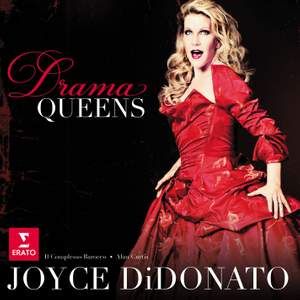
| |  | Joyce DiDonato: Drama QueensRoyal Arias from the 17th and 18th Centuries
Crowned with a Grammy Award for her last album, Diva, Divo, Joyce DiDonato joins conductor Alan Curtis and Il complesso barocco for Drama Queens, an electrifying programme of royal arias from the 17th and 18th centuries, composed by figures as famous as Handel and Vivaldi and as little known as Orlandini and Porta. As DiDonato says: “High drama, profound emotion, fearless vocal writing, time-stopping passages, historical significance and real discovery ... What more could I ask for?” The impact achieved by Joyce DiDonato with her last Virgin Classics album, Diva, Divo, was summed up by her triumph at the 2012 Grammy Awards in February: victor in the Classical Vocal Solo category, the ‘Yankee Diva’ also became the first classical singer to perform live at the Grammy ceremony, receiving a standing ovation for her spectacular rendition of the final rondo from Rossini’s La Cenerentola. Enterprising as ever, DiDonato now presents a new themed recital, conceived in partnership with Alan Curtis, who also conducted her Virgin Classic recordings of Handel’s Ariodante and Radamisto and her duet recital Amore e Gelosia with Patrizia Ciofi. Drama Queens sees DiDonato portraying a parade of royal personages in a diversity of challenging situations and extreme states of mind. “For me, this is my most exciting recording project to date,” says Joyce DiDonato,” because it is everything I deeply adore about the world of opera: high drama, profound emotion, fearless vocal writing, time-stopping passages, historical significance and real discovery. What more could I ask for? “I wanted to return to this genre of music I love so deeply: the free, mysterious, profoundly moving world of Baroque opera, but to do it in the grandest fashion – from the throne of royalty! Each of the characters is a queen (or a sorceress, which equals queen in this fantastical world) ... Well, we have allowed one princess, because the aria is completely unknown and it is simply too beautiful to be left out: ‘Madre diletta, abbracciami’ by Giovanni Porta [c1675-1755]. “What more could a singer ask for than to indulge in the antics of rage and bliss, despair and jubilation, heartbreak and true love?” she continues. “It will be an extraordinary journey, thanks to these larger-than-life characters, and I fully expect to learn a lot about myself along the way.” Conductor and musicologist Alan Curtis explains that: “Our Drama Queens are a motley group. Our idea was to cultivate extremes, to gather arias that show larger-than-life emotions. They range from noble, but sultry seductiveness, through the hysterically happy to vindictive despair and royal rage. The musical styles are also as varied as possible.” The arias range in period from the dawn of opera, Monteverdi and Cesti, to lesser-known works by Gluck and Haydn. “We also include some little-known music by Reinhard Keiser [1674-1739], notably an aria with an amazing five-part accompaniment for solo bassoons, without strings,” adds Curtis. (Joyce DiDonato describes it as “an aria of jealousy, suspicion and torment with the bassoon and voice chasing each other.”) Alan Curtis continues: “Two flashy arias by Giuseppe Orlandini [1676-1760] come from an opera about the great Jewish Queen Berenice, thought to be lost, but found in a California library ... But we have not totally excluded well-known works either. There is Joyce's beloved ‘Sposa son disprezzata’, a YouTube favourite, which most people know in the version for Princess Irene, the rejected bride in Vivaldi's Tamerlano. But it was actually taken by Vivaldi from an earlier opera by Geminiano Giacomelli [1692-1740], where it was sung by a male character and performed by the famous castrato Farinelli. Another Farinelli aria we include comes from an early serenata by Hasse; he sang in drag as one of the greatest drama queens of all time – Cleopatra! And, of course, we include everybody's favourite Cleopatra aria: Handel's ‘Piangerò la sorte mia’, from Giulio Cesare.” “Coloratura runs are lightning fast, angry declamations hurled like thunderbolts — and limpid laments meltingly cooed. I don’t like DiDonato when she gets too shouty or adds “expressive” pitch-bends. But it’s all compellingly theatrical. Great choice, too, with familiar Handel mingled with rare jewels” The Times, 3rd November 2012 **** “an anthology of suitably impassioned royal roles from Baroque operas, their emotional scope ranging from the giddy flush of love evoked by her tremulous coloratura and swooning fades as Berenice in Orlandini's "Da torbida procella", to the self-sacrifice of Porta's Ifigenia, rendered with such poised nobility” The Independent, 10th November 2012 **** “DiDonato and Alan Curtis...have unearthed some Baroque rarities. Instead of Handel's Berenice, we have Orlandini's Berenice, whose 'Da torbida procella' is an ideal fit for DiDonato's spitfire fioritura.” BBC Music Magazine, Christmas 2012 **** “DiDonato produces her most emotionally moving and sensitively embellished singing in 'Madre diletta'...Wonderfully sung, passionately played and programmed intelligently - an exemplary recital.” Gramophone Magazine, January 2013 “DiDonato caresses the plaintive lines of Piangero la sorte mia with the intensity of Bartoli, and brings a mordant, witchy edge to Ma quando tornerai...There’s sprightly support from Alan Curtis’s Italian period band. DiDonato’s fans won’t be disappointed.” Sunday Times, 13th January 2013 “In the slow-moving 'Lasciami pinagere' .DiDonato's timbre is at its most beautiful, her phrasing eloquent, the trills not distracting the smooth flow of the musical line...The virtuosity needed to triumph over the swift scalework is coruscatingly supplied by DiDonato...Alan Curtis's Complesso Barocco's partnership is invaluable...This is a treasure of a disc, for the music, the orchestra and Joyce DiDonato.” International Record Review, February 2013 | | | In stock - usually despatched within 1 working day. |
|
|
| |  | Handel: CleopatraArias from Giulio Cesare
At the Paris Opéra in early 2011, Natalie Dessay takes on a new starring role: Cleopatra in Handel’s Giulio Cesare, now the most popular of all the composer’s stage works. The many facets of the Egyptian queen – captured by Shakespeare in the phrase “infinite variety” – are depicted in a sequence of contrasting arias, both lyrical and brilliant, making the character a superb showcase for the French soprano’s talents as a singing actress. Conducting the impressive cast and the period-instrument orchestra Le Concert d'Astrée at the Opéra – and on this new recording of excerpts from Giulio Cesare – is Emmanuelle Haïm, who first collaborated with Dessay in the late 1990s; both artists were involved in a Paris production of Handel’s Alcina, Haïm as répétiteur (for William Christie) and Dessay in the sparkling role of Morgana. Since then, the two have developed a close working relationship which has produced a number of Virgin Classics recordings, including several works by Handel: cantatas (in a collection called Delirio), the Dixit Dominus and the oratorio Il trionfo del tempo e del disinganno, a recording which left the French magazine Diapason “looking forward to Emmanuelle Haïm’s next exciting Handelian adventure”. Dessay describes Haïm as the metteur en scène – the stage director – for her voice, while Haïm describes Dessay’s voice as “an exceptional instrument which can take on a thousand forms ... Its virtuosity and flexibility make you forget all the difficulties presented by the music.” Haïm goes on to say that: “Handel is the composer for the voice. He demands special qualities that Natalie possesses: an ability to create colours, to embody words in song and to let the imagination speak.” Reviewing Il trionfo del tempo e del disinganno, Le Monde de la Musique observed that “the virtuosity and rich palette of Le Concert d’Astrée enable Emanuelle Haïm to match the colours and tempo to the emotion expressed”, while the New York Times wrote that: “Ms. Haïm directs the superb Baroque orchestra Le Concert d'Astrée in a fleet, immaculate performance that dances among airy, profound and sensuous moods. The excellent quartet of singers is led by the radiant, bright voice of the soprano Natalie Dessay, whose rapturous Bellezza traverses innocence, defiance and penitence by way of some impressively agile coloratura. ’Tu del ciel ministro eletto', her spare, haunting final aria with plaintive violin accompaniment, is glorious.” In Britain, the The Sunday Times found that “Natalie Dessay dazzles in Beauty’s arias – she is gorgeous in the sublime penitential concluding number … With Haïm conducting with élan, this is the best available version of this glorious score.” “The performances are consistently attractive...Dessay's singing is never less than dazzling, and the stratospheric ornaments in the da capo of "Venere bella" are softly sensual.” Gramophone Magazine, March 2011 “Dessay's sheer skilfulness comes across unscathed, not least in the later big outpourings of suffering” BBC Music Magazine, March 2011 *** “Dessay proves a supreme vocal enchantress.” The Telegraph, 18th March 2011 **** “It is true that Dessay's vocal mechanism no longer works with the pearly fluidity of her younger self, but her artistry has never been more spellbinding...at her best Dessay is up there with the great Handelians, the most compelling Cleopatra in my experience since the unforgettable Valerie Masterson” International Record Review, April 2011 | | | In stock - usually despatched within 1 working day. |
|
|
| |  | Danielle de Niese - Handel Arias
The debut solo recording from Danielle de Niese, who became a star overnight after her stunning 'all singing, all dancing' performance as Cleopatra in Handel's Giulio Cesare at Glyndebourne in 2005. Danielle signs a selection of Handel arias from both famous and lesser-known works which showcase perfectly her extraordinary dramatic range and vocal abilities. “De Niese demonstrates good technical skills and a keen sense of character, but above all there's a strong artistic personality at work that enables her to make each statement her own.” BBC Music Magazine, March 2008 **** “When it comes to sorceresses, de Niese is splendid. The two arias for Medea in Teseo are well contrasted. "Dolce riposo" is a duet for voice and oboe over a pulsating string accompaniment, sung with an affecting gentleness, while "O stringerò nel' sen" is a fiery expression of jealousy. ” Gramophone Magazine, June 2008 “Her singing is utterly delectable and completely assured.” The New York Times “De Niese can certainly "sell" a number. She makes each of these arias an emotional journey, heightening the expression when the first section is repeated. Semele's "Myself I Shall Adore" becomes increasingly, and delightfully, dizzy, with narcissistic flights of ornamentation, while at the opposite end of the spectrum she suggests a new intensity of grief towards the end of Ginevra's "Il mio crudel martoro" ( Ariodante ), with a "soured" colouring on the key word "moro" - dying.
What makes me faintly uneasy is the less than even quality of de Niese's voice and her reluctance to sing either a true legato or a true pianissimo, though the ultra-close miking must take some of the blame here. Her bright, slender soprano, with its distinctive quick vibrato, has an attractive hint of smokiness in the middle register. Higher up, it can become thin and squally - I noticed this especially in her no-holds-barred performances of Cleopatra's "Da tempeste" and Morgana's "Tornami a vagheggiar" ( Alcina ).
Yet for all her vocal imperfections, De Niese brings each of these characters to vivid life.” The Times, 10th May 2008 | | | In stock - usually despatched within 1 working day. |
|
|
| |  | Great Handel Arias
| | | Usually despatched in 4 - 5 working days. |
|
|
| |  | Danielle de Niese: Diva
Danielle de Niese's new album Diva, features world premier recording Exsultate, Jubilate by Karl Jenkins, her trademark Handel and Mozart arias, a stunning duet with the mighty Bryn Terfel and Lucretia and Pace Non Trovo both stunning arrangements by Morgan Pochin. "an irresistible bundle of vocal fizz and sexual charisma" (Financial Times) “..there’s a charisma that seems to emanate from her voice itself … an extraordinarily powerful and bell-like soprano" (The Independent) “sexy, witty, compelling – at a level rarely seen on an opera stage” (New Statesman) “Her vocal and musical vitality shines out of every track” BBC Music Magazine, August 2010 **** “Their vocal virtues remain unaltered: clarity of attack, a fluidity across all registers, a voice full of sunshine and joy.” The Times, 23rd July 2010 ** “The young soprano displays impressive technical skills in her singing of florid music; scales and other passagework are immaculate in clarity and evenness, and they are blessedly innocent of aspirates and other easing devices.” Gramophone Magazine, September 2010 “[Jenkins's] brief setting of Exsultate Jubilate for de Niese is great fun, with chugging strings and excitable vocal line giving way to a more mellow middle section before returning to the 'A' section with some wildly exciting high B naturals.” International Record Review, September 2010 | | | Usually despatched in 2 - 3 working days. |
|
|
| |  | La Diva - Arias for Cuzzoni
Handel: | Scoglio d'immota fronte (from Scipione) V' adoro, pupille (from Giulio Cesare) Piangerò la sorte mia (from Giulio Cesare) Se pietà di me non senti (from Giulio Cesare) No, più soffrir non voglio (from Alessandro) Ombre piante, urne funeste (from Rodelinda) Ahi perche, giusto ciel (from Rodelinda) Or mi perdo di speranza (from Siroe, re di Persia) Mi lagnero tacendo (from Siroe, re di Persia) Torrente cresciuto (from Siroe, re di Persia) Fonti amiche (from Tolomeo, re di Egitto) Amante stravagante (from Flavio, re di Longobardi) Morte vieni (from Riccardo primo, re d’Inghilterra) Io te bacio (from Admeto, re di Tessaglia) |
Star soprano Simone Kermes has been hailed by Opera News as "The Queen of Baroque.” This CD presents her singing arias by Handel composed for his star soprano Francesca Cuzzoni. The release features two world premiere recordings of the alternate ‘Rodelinda’ arias. "Kermes's performances give nothing but pleasure." Gramophone “Her dizzying bravura in this selection of arias is breathtaking; she’s not afraid to take risks or sacrifice beautiful sound to create dramatic colour and interest when needed. Her limpid, expressive high notes are cushioned by the splendid Lautten Compagney.” Classic FM Magazine, July 2009 ***** | | | Usually despatched in 4 - 5 working days. |
|
|
| |  | Handel Gold
Handel: | Samson: Let the bright seraphim Kiri Te Kanawa (soprano), Crispian Steele-Perkins (trumpet) English Chamber Orchestra, Barry Rose Lascia la spina (from Il Trionfo del Tempo e del Disinganno) Cecilia Bartoli Les Musiciens du Louvre - Grenoble, Marc Minkowski Frondi tenere e belle ... Ombra mai fù (from Serse) Plácido Domingo Giuseppe Verdi SO Milano, Marcelo Viotti Tornami a vagheggiar (from Alcina) Joan Sutherland London Symphony Orchestra, Richard Bonynge Dopo notte (from Ariodante) Anne Sofie von Otter Les Musiciens du Louvre, Marc Minkowski Care selve (from Atalanta) Luciano Pavarotti Orchestra del Teatro Comunale di Bologna, Richard Bonynge V' adoro, pupille (from Giulio Cesare) Renée Fleming Orchestra of the Age of Enlightenment, Harry Bicket Ciel e terra armi di sdegno (from Tamerlano) Rolando Villazón Gabrieli Players, Paul McCreesh Ma che vuoi più da me (from Floridante) Joyce DiDonato Il Complesso Barocco, Alan Curtis Ah dolce nome! (from Muzio Scevola) Russell Oberlin The Baroque Chamber Orchestra, Thomas Dunn Jephtha: Waft her, angels, through the skies Nigel Robson English Baroque Soloists, John Eliot Gardiner Messiah: He was despised Kathleen Ferrier London Philharmonic Orchestra, Adrian Boult Coronation Anthem No. 1, HWV258 'Zadok the Priest' Choir of Westminster Abbey, The English Concert, Simon Preston Semele: Where'er you walk Bryn Terfel Scottish Chamber Orchestra, Charles Mackerras Hercules: Where shall I fly? Janet Baker English Chamber Orchestra, Raymond Leppard Joshua: Oh! had I Jubal's lyre Magdalena Kozena Venice Baroque Orchestra, Andrea Marcon Judas Maccabaeus: See, the conqu'ring hero comes! Academy & Chorus of St Martin in the Fields, Neville Marriner Judas Maccabaeus: Father of Heaven Grace Bumbry The Utah Symphony, Maurice Abravanel Solomon: Almighty pow'r Andreas Scholl Gabrieli Players, Paul McCreesh Semele: Myself I shall adore Danielle de Niese Les Arts Florissants, William Christie Messiah: The People that walked in darkness John Tomlinson The English Concert, Trevor Pinnock Piangerò la sorte mia (from Giulio Cesare) Teresa Berganza Orchestra of the Royal Opera House Covent Garden, Alexander Gibson Verdi prati (from Alcina) Fritz Wunderlich Cappella Coloniensis, Ferdinand Leitner Semele: Hence, Iris, hence away Marilyn Horne New Symphony Orchestra of London, Richard Bonynge Theodora: Angels, ever bright and fair Susan Gritton Gabrieli Players, Paul McCreesh Messiah: I know that my Redeemer liveth Sylvia McNair Academy of St. Martin in the Fields, Neville Marriner Messiah: Behold, I tell you a mystery... The trumpet shall sound Thomas Quasthoff Staatskapelle Dresden, Sebastian Weigle Messiah: Hallelujah Chorus The English Concert Choir, The English Concert, Trevor Pinnock |
| | | (Sorry, download not available in your country) | Usually despatched in 2 - 3 working days. |
|
|
| |  | Lynne Dawson: My Personal Handel Collection
| | | Usually despatched in 4 - 5 working days. |
|
|
| |  | Renata Scotto in Budapest
The magnificent artistry of one of opera’s greatest divas, presented in a live 1991 concert with orchestra. Color, stereo, 68 minutes, optional subtitles in English, French, German, Italian, and Spanish. All regions. | | | This item is currently out of stock at the UK distributor. You may order it now but please be aware that it may be six weeks or more before it can be despatched. |
|
|
| |
|