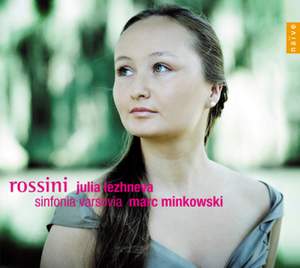
All recordingsPrices shown exclude VAT. (UK tax is not payable for deliveries to United States.) See Terms & Conditions for p&p rates. | |  | Julia Lezhneva sings Rossini
A star is born! The Russian soprano Julia Lezhneva is the vocal revelation that everyone is talking about. Still only 21, a protégée of Dame Kiri Te Kanawa and the winner of several major awards, Lezhneva makes her solo recital debut with a programme of arias by Rossini, a composer of whom is particularly fond. She is accompanied by the Sinfonia Varsovia conducted by its new artistic director Marc Minkowski. In 2007 Julia Lezhneva won the prestigious Elena Obraztsova International Competition for Young Opera Singers in St Petersburg, for which the judges included Teresa Berganza, Christa Ludwig and Eva Marton. She has sung opposite Juan Diego Flórez at the Rossini Opera Festival in Pesaro, and made her UK debut, aged 19, with the Royal Liverpool Philharmonic Orchestra conducted by Vasily Petrenko, also performing Rossini. Her London debut, introduced by Dame Kiri Te Kanawa, came at the 2010 Classical Brit Awards singing Elena’s Final Rondo from Rossini’s La Donna del Lago in the Royal Albert Hall. In October 2010 she confirmed her status as one of the world’s most exciting talents by winning the First International Opera Competition held at the Theatre des Champs-Elysees in Paris. Her performance in the recent Naïve recording of Vivaldi’s opera Ottone in Villa, conducted by Giovanni Antonini, has been praised to the skies by the international press. Her debut solo concerts at the 2010 Salzburg Festival with the Mozarteum Orchestra and Marc Minkowski likewise achieved extraordinary success. Minkowski has followed the young singer’s career closely; it was he who invited her in 2009 to take part in Bach’s B minor Mass, her first recording, and in summer 2011 she will sing the part of Fiordiligi under his baton in a new production of Mozart’s Così fan tutte at Salzburg. Despite her youth, Julia Lezhneva has a huge and extremely varied repertoire, ranging from the Baroque and bel canto styles to Romantic and contemporary music. “The 21-year-old Russian soprano — winner of Finland’s prestigious Mirjam Helin singing competition in 2009 — is clearly a name to watch. Hers is a bright, high soprano of limpid timbre and an easy coloratura technique” Sunday Times, 3rd April 2011 *** “She has attractively full tone in the lower middle, where much of the music lies, and she possesses the flexibility to negotiate exceedingly challenging coloratura...[Minkowski] should lead Rossini more frequently - his vigour, intelligence and sheer polish are most welcome here.” International Record Review, April 2011 “Lezhneva's voice is perfectly suited to a flamboyant coloratura piece such as "Tanti Affetti", from La Donna del Iago, with her tiptoeing trills teetering delicately along. But the standout here is "Assisa a' piè d'un salice...for which the liquid harp glissandi and subtle strings of the Sinfonia Varsovia provide the most delightful, sensitive setting.” The Independent, 29th April 2011 **** “Her sense of line is unquestionably superb, as is her technique: there are trills and staccatos here, the likes of which we hear all too rarely.” The Guardian, 5th May 2011 *** “there is real flair and talent here, with much of the coloratura neatly despatched, and some stylistic grace that is admirable...Minkowski and his Polish musicians are marvellous, especially in a knockout account of the Cenerentola overture.” BBC Music Magazine, June 2011 *** “a pure, pellucid soprano with an intriguing hint of mezzo plangency, fluent movement between the registers, and scintillating (if faintly aspirated) coloratura...this is a highly enjoyable debut recital, by turns affecting exhilarating, from a soprano of impressive accomplishment and still more exciting potential. Orchestral accompaniments are trim and alert” Gramophone Magazine, July 2011 “she delivers truly heart-stopping versions of the coloratura showpieces...Marc Minkowski's conducting is full of joie de vivre and sparkle too.” Classic FM Magazine, July 2011 *** “Lezhneva’s vibrant pyrotechnics during "Tanti affeti" from La donna del lago are as wittily entertaining as they are musically appropriate...There’s crisp support from the Warsaw chorus and effortless, gossamer-light orchestral backing. Remarkable indeed.” The Arts Desk, 26th June 2011 “she sings with pinpoint accuracy, real elegance and musicality, and the voice itself is warm and round and womanly and beautifully clean...there is a gorgeous relaxed feel to her singing...This lovely disc, neatly accompanied by Marc Minkowski and the Sinfonia Varsovia, is genuinely the herald of a special new voice.” Opera Now, September/October 2011 **** | | | (also available to download from $10.50) | In stock - usually despatched within 1 working day. |
|
|
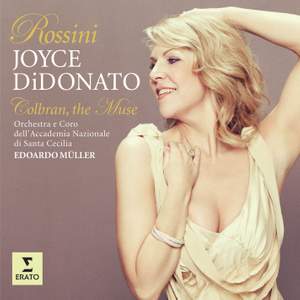
| |  | Rossini - Colbran, the MuseOpera arias
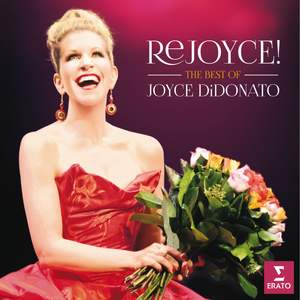
“A superstar in the Rossini repertory” Chicago Tribune After the success of her first Virgin Classics recital – Furore, arias by Handel – Joyce DiDonato turns to the composer whose heroines first brought her to international stardom: Gioacchino Rossini. “Is Joyce DiDonato the world's best Rossini singer?”, asked the New York magazine Opera News after the American mezzo sang the finale of La Cenerentola at Carnegie Hall in January 2009. “That title certainly seemed hers by sovereign right,” it continued; “Her phrasing was silky, her timbre rich and glowing, and her ornaments were impeccably stylish and utterly beguiling. Most impressive was DiDonato's combination of immaculate technical control with an air of wild, unstoppable joy. This was truly a moment to treasure from an artist who is at the very top of her game.” If La Cenerentola does not appear in this new recital, recorded in Rome in June, her other signature Rossini role holds a place of honour: she has been described by the UK’s Sunday Times as “the world’s reigning Rosina in Il barbiere di Siviglia”. In 2009 alone she sings the role in Vienna, London (to be recorded for DVD by Virgin Classics) and New York, and the role has also taken her to Paris, Amsterdam, Tokyo, Houston, San Francisco, Bologna and Rossini’s birthplace, Pesaro. Rossini’s two best-known comic operas proved essential in building the Kansas-born singer’s reputation over the last decade, but this recital focuses primarily on his serious works – although the tragic tensions do not perhaps run as consistently high as in DiDonato’s first Virgin Classics recital: Furore, the Handel programme released last year and described by The Daily Telegraph as “an exhilarating roller-coaster of a recital from a charismatic singing-actress”. This Rossini programme includes two arias from La donna del lago, which DiDonato is scheduled to sing over the coming seasons in Geneva, Paris, Milan and London. She takes the role of Elena, written for a soprano, but a great success in the 1980s for DiDonato’s idol, fellow high mezzo Frederica von Stade. The other arias on the CD were also all composed for soprano: they come from Otello, Semiramide, Armida, Maometto II and Elisabetta regina d'Inghilterra. DiDonato proved that she can triumph in music written for soprano with her recent complete recording of Handel’s Alcina and her debut last year in the role of Mozart’s Donna Elvira; the performances at London’s Royal Opera House prompted The Guardian to describe her as “the real star … singing her first Elvira and nailing even the topmost notes,” while The Daily Telegraph praised her performance in a similar vein: “The star of the show was … Joyce DiDonato, who sang Elvira with a style, sensitivity and bravura that outclassed everyone else on stage.” To return to Rossini and Rosina, the role for DiDonato’s debut at the Vienna State Opera in April 2009, the Wiener Zeitung had this to say: “She tossed off crystal-clear coloratura, presented a dark, secure low register, a confidently nuanced mid-range, bright and voluminous high notes – in short, everything that makes for great, modern bel canto style. She appears undaunted by the role's many technically tricky passages, and even more: she sang musically challenging variations on every repeated phrase, shaped every single bar with brio, and presented a psychologically multi-faceted characterisation with wildly joyful abandon.” “DiDonato is proving herself one of the most delightful artists of our time. She sings with a rare purity of tone, ease on the high Bs, an impressive degree of technical skill and lively powers of characterisation. She is invigoratingly precise in her placement, fluent in scale work and well furnished with staccati and trills. ...the difficult repertoire is sung with charm and mastery, and from all we read, their original exponent, to whom the recital is dedicated, is worthily honoured. Choral and orchestral work are equally stylish, and the short tenor solos by Lawrence Brownlee are a treat.” Gramophone Magazine, December 2009 “DiDonato’s pearly tone and easy coloratura make this difficult music sound effortless: she sports a more than acceptable trill, brilliant high staccato notes and long-breathed cantilena lines, prerequisites for a singer of the bel canto repertoire...This is outstanding Rossini singing by any standards, idiomatically accompanied.” Sunday Times, 22nd November 2009 **** “In everything she does, DiDonato convinces...There’s more on display than simple technical triumphs. Her clear diction, controlled breaths and phrasing, and the diversity of her emotional colouring always bring her characters to life and make each one an individual... Long live the yankeediva.” The Times, 20th November 2009 **** “A majestic display from first to last, DiDonato balancing precision and emotion.” The Independent, 20th November 2009 ***** “This is an artist who moves between registers with grace and skill, whose legato is seamless and whose tone is pearly. Indeed so creamy in 'D'amor al dolce impero', also from Armida, that you feel you could eat it on a spoon. Then there's that hushed quality to DiDonato's singing; a thrilling sensation that she's holding back, say at the beginning of 'Tanti affeti' from La donna del lago. Conductor Edoardo Müller is the perfect partner showing DiDonato off to her best advantage.” BBC Music Magazine, January 2010 ***** “This disc features some of the most authoritative bel canto singing that I have heard since Cecilia Bartoli emerged 20 years ago. Joyce DiDonato combines superb coloratura technique and clarity of tone with musical intelligence.” The Telegraph, 18th February 2010 ***** | | | In stock - usually despatched within 1 working day. |
|
|
| |  | Airs d'Operas Italiens
Donizetti: | Plauso! Voci di gioia (from Belisario) Sin la tomba e a me negata! (from Belisario) O desio della vendetta (from Belisario) No, piu salir non ponno ( from Parisina d’este) Ciel, sei tu in tal momento (from Parisina d’este) Ugo e spento (Parisina d’este) Fatal Goffredo!...Io l'udia ne' suoi bei carmi (from Torquato Tasso) Trono e corona (from Torquato Tasso) Lascia, Guido, ch'io possa vendicare (from Gemma di Vergy) Una voce al cor d'intorno...Egli riede? (from Gemma di Vergy) | Rossini: | Tanti affetti in tal momento (from La donna del lago) La donna del lago: Fra il padre, e fra l'amante O tu, del mio dolor (from Otello) Assisa a' piè d'un salice (from Otello) Deh calma, o ciel, nel sonno (from Otello) Stabat Mater: Inflammatus Armida: D'amor al dolce impero O patria...Di tanti palpiti (from Tancredi) L'ora fatal s'appressa ... Giusto ciel! (from L'Assedio di Corinto) | Verdi: | Ah! Non m'hanno ingannata!...Grave a core innamorato (from Un Giorno di Regno) Se de cadar la vedova (from Un Giorno di Regno) Qual prodigio!...Non fu sogno! (from I Lombardi) No, mi lasciate...Tu al cui sguardo onnipossente (from I due Foscari) Che mi rechi?... La clemenza! (from I due Foscari) Riposa. Tutte, in suo dolor vegliante (from Alzira) Da Gusman, su fragil barca (from Alzira) Alta pietade ogn'anima...Nell'astro che più fulgido (from Alzira) Liberamente or piangi (from Attila) Egli non riede ancora! (from Il Corsaro) Non so le tetre immagini (from Il Corsaro) Oh, cielo! Dove son'io!...Ah! dagli scanni eterei...Ah, dal sen di quella tomba (from Aroldo) |
| | | In stock - usually despatched within 1 working day. |
|
|
| |  | Montserrat CaballéA collection of Donizetti, Rossini & Verdi Rarities
Donizetti: | Plauso! Voci di gioia (from Belisario) No, piu salir non ponno ( from Parisina d’este) Ciel, sei tu in tal momento (from Parisina d’este) Ugo e spento (Parisina d’este) Fatal Goffredo!...Io l'udia ne' suoi bei carmi (from Torquato Tasso) Trono e corona (from Torquato Tasso) Lascia, Guido, ch'io possa vendicare (from Gemma di Vergy) Una voce al cor d'intorno...Egli riede? (from Gemma di Vergy) | Rossini: | Tanti affetti in tal momento (from La donna del lago) La donna del lago: Fra il padre, e fra l'amante O tu, del mio dolor (from Otello) Assisa a' piè d'un salice (from Otello) Deh calma, o ciel, nel sonno (from Otello) Stabat Mater: Inflammatus Armida: D'amor al dolce impero L'ora fatal s'appressa ... Giusto ciel! (from L'Assedio di Corinto) | Verdi: | Oh, cielo! Dove son'io!...Ah! dagli scanni eterei...Ah, dal sen di quella tomba (from Aroldo) Egli non riede ancora! (from Il Corsaro) Non so le tetre immagini (from Il Corsaro) Oh nel fuggente nuvolo (from Attila) Riposa. Tutte, in suo dolor vegliante (from Alzira) Da Gusman, su fragil barca (from Alzira) Alta pietade ogn'anima...Nell'astro che più fulgido (from Alzira) Qual prodigio!...Non fu sogno! (from I Lombardi) No...mi lasciate (from I due Foscari) No, mi lasciate...Tu al cui sguardo onnipossente (from I due Foscari) Ah! Non m'hanno ingannata!...Grave a core innamorato (from Un Giorno di Regno) Se de cadar la vedova (from Un Giorno di Regno) |
“Re-listening to these performances, one can understand why Caballe's career really took off...Her bel canto has a fine-spun purity, and in these excerpts of Verdi's early genius she conveys melodic freshness...there is both brilliance and beauty in plenty here.” Penguin Guide, 2010 edition *** | | | In stock - usually despatched within 1 working day. |
|
|
| |  | Cecilia Bartoli - A PortraitIncludes A Portrait of Cecilia Bartoli, Recording at La Fenice, Cecilia’s early years, The Rossini tradition, The performance of Mozart, A singing lesson & Looking to the future
| | | Usually despatched in 8 - 10 working days. |
|
|
| |  | Rossini Heroines
“This sparkling disc brings together a collection of arias Rossini composed for one of the great prima donnas of the 19th century, his wife, Isabella Colbran. It's tempting to wonder whether even she could match Cecilia Bartoli, one of the most luscious, most exciting voices in opera. All those dazzling chromatic runs, leaps, cadenzas and cascading coloraturas are handled with consummate ease. Throughout she sounds as if she's enjoying the music; there's always an engaging smile in the voice, although she's properly imperious in the extracts from Elisabetta and disarmingly simple in the prayerful 'Giusto ciel, in tal periglio' from Maometto II. The orchestral and choral forces provide a delightful intimacy, with some cheeky woodwind solos and fruity brass passages. The recording, produced at the Teatro La Fenice by Decca veteran Christopher Raeburn, favours the voices but gives it just enough distance to accommodate high Cs and astounding A flats at the bottom of the range. The orchestral perspective is changeable but satisfactory. For Rossini and Bartoli fans, this disc is a must.” Gramophone Classical Music Guide, 2010 | | | (Sorry, download not available in your country) | Usually despatched in 8 - 10 working days. |
|
|
| |  | Montserrat Caballé: Diva
Bellini: | Casta Diva (from Norma) Mira, o Norma (from Norma) Ah, non credea mirarti (from La Sonnambula) Dopo l'oscuro nembo (from Adelson e Salvini) Col sorriso d'innocenza (from Il Pirata) | Bizet: | L'amour est un oiseau rebelle 'Habanera' (from Carmen) | Catalani: | Ebben? Ne andrò lontana (from La Wally) | Charpentier, G: | Depuis le jour (from Louise) | Cilea: | Io son l'umile ancella (from Adriana Lecouvreur) | Delibes: | Lakmé: Dôme épais (Flower Duet) | Donizetti: | E sara in questi orribili momenti (from Roberto Devereux) Vivi ingrato (from Roberto Devereux) Com' e bello! (from Lucrezia Borgia) Dio Possente! Ah! Tu ben sai (from Gemma di Vergy) Maria Stuarda: Final Scene | Flotow: | The Last Rose of Summer (Martha) Martha! Herr! Sie lacht zu meinen Leiden (from Martha) | Giordano, U: | La mamma morta (from Andrea Chénier) | Gluck: | Divinités du Styx (from Alceste) | Heuberger: | O mon cher amant (from La Périchole) | Lehár: | Lippen schweigen (from Die Lustige Witwe) Warum hast du mich wachgeküßt? (from Friederike) | Leoncavallo: | Qual fiamma avea nel guardo!.... Hui! Stridono lassù (from I Pagliacci) Musette svaria sulla bocca viva (from La Bohème) | Lloyd Webber, A: | Wishing you were somehow here again (from The Phantom of the Opera) | Mascagni: | Voi lo sapete o mamma (from Cavalleria rusticana) | Massenet: | Il est doux, il est bon (from Hérodiade) Pleurez, mes yeux (Le Cid) | Mozart: | Sull' aria che soave zeffiretto (from Le Nozze di Figaro) Pa-pa-pa-pa-Papagena (from Die Zauberflöte) | Offenbach: | Barcarolle (from Les Contes d'Hoffmann ) | Ponchielli: | Suicidio! (from La Gioconda) È un anatema (from La Gioconda) | Puccini: | Si, mi chiamano Mimi (from La Bohème) O soave fanciulla (from La Bohème) Vissi d'arte (from Tosca) O mio babbino caro (from Gianni Schicchi) In questa reggia (from Turandot) Senza mamma, o bimbo (from Suor Angelica) | Rodrigo: | En Aranjuez con tu amor | Rossini: | Non si dà follia maggiore (from il Turco in Italia) Di tanti palpiti (from Tancredi) L'ora fatal s'appressa ... Giusto ciel! (from L'Assedio di Corinto) Tanti affetti in tal momento (from La donna del lago) Assisa a' piè d'un salice (from Otello) Armida: D'amor al dolce impero Serbami ognor (from Semiramide) Duetto buffo di due gatti (Comic Duet for Two Cats) | Saint-Saëns: | Mon cœur s'ouvre à ta voix (from Samson et Dalila) | Stolz, R: | Du sollst der Kaiser meiner Seele sein (from Der Favorit) | Verdi: | Ah! Non m'hanno ingannata!...Grave a core innamorato (from Un Giorno di Regno) Qual prodigio!...Non fu sogno! (from I Lombardi) Tu al cui sguardo onnipossente (from I due Foscari) Oh nel fuggente nuvolo (from Attila) Egli non riede ancora! (from Il Corsaro) Va, pensiero (from Nabucco) Vieni! t'affretta!…Or tutti sorgete (from Macbeth) Mercè, dilette amiche 'Bolero' (from I Vespri Siciliani) Oh, cielo! Dove son'io!...Ah! dagli scanni eterei...Ah, dal sen di quella tomba (from Aroldo) Libiamo, ne' lieti calici (from La Traviata) È strano! è strano!...Ah! fors è lui (from La traviata) Sempre libera (from La Traviata) Addio del passato (from La Traviata) Parigi, o cara (from La Traviata) Tacea la notte (from Il Trovatore) Pietà ti prenda del mio dolor (from Aida) Ecco l'orrido campo … Ma dall'arido stelo divulsa (from Un ballo in maschera) Ave Maria (from Otello) | Wagner: | Dich, teure Halle (from Tannhauser) |
This is a x6 CD budget-priced boxset, released to celebrate the 80th birthday & career of opera's last great diva, Montserrat Caballe. Contents: Disc 1 - Rossini & Donizetti. Disc 2 - Bellini & Verdi. Disc 3 - Verdi & Puccini. Disc 4 - Bizet & Wagner. Disc 5 - Operetta & Zarzuela. Disc 6 - Encores, Hits & Evergreens. | 
| | | In stock - usually despatched within 1 working day. |
|
|
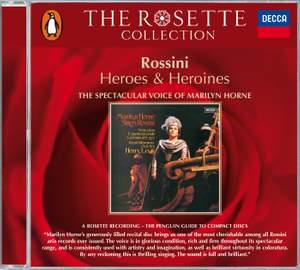
| |  | Marilyn Horne - The Complete Decca Recitals
Bach, J S: | Magnificat in D major, BWV243: Et exsultavit Magnificat in D major, BWV243: Esurientes implevit bonis Christmas Oratorio, BWV248: Schlafe, mein Liebster St Matthew Passion, BWV244: Erbarme dich Bist du bei mir, BWV508 | Beethoven: | Abscheulicher! Wo eilst du hin? (from Fidelio) | Bellini: | Lieto del dolce incarco…Se Romeo t'uccise un figlio (from I Capuleti e i Montecchi) | Bizet: | L'amour est un oiseau rebelle 'Habanera' (from Carmen) Près des remparts de Séville (Séguedille) (from Carmen) Adieux de l'hotesse Arabe Chanson d'Avril Vieille chanson Absence | Copland: | Old American Songs: excerpts | Debussy: | Trois chansons de Bilitis | Donizetti: | Deciso è dunque...le richezze (from La Figlia del Reggimento) | Falla: | Siete Canciones populares españolas | Gluck: | J'ai perdu mon Eurydice (from Orphée et Eurydice) Divinités du Styx (from Alceste) | Gounod: | Ô ma lyre immortelle (from Sapho) | Handel: | Messiah: O thou that tellest good tidings to Zion Messiah: I know that my Redeemer liveth Scacciata dal suo nido (from Rodelina) Dove sei, amato bene? (from Rodelinda) Vivi, tiranno, io t'ho scampato (from Rodelinda) | Mahler: | Rückert-Lieder (5 songs, complete) Lieder eines fahrenden Gesellen (4 songs, complete) Kindertotenlieder | Massenet: | Ces lettres! (from Werther) Va! Laisse couler mes larmes (from Werther) | Meyerbeer: | Ah, mon fils! (from Le Prophète) O prêtres de Baal (from Le Prophète) Nobles seigneurs, salut! (from Les Huguenots) | Mozart: | Parto, parto, ma tu ben mio (from La Clemenza di Tito) | Nin: | Villancico Castellano (from Villancicos Españolas) Jesus de Nazareth (from Villancicos Españolas) Villancico Asturiano (from Villancicos Españolas) Villancico Andaluz (from Villancicos Españolas) | Rossini: | Una voce poco fa (from Il barbiere di Siviglia) Assisa a' piè d'un salice (from Otello) Di tanti palpiti (from Tancredi) Bel raggio lusinghier (from Semiramide) Pronti abbiamo...Amici in ogni evento...Pensa alla patria (from L'Italiana in Algeri) Eccomi alfine in Babilonia (from Semiramide) Cruda sorte! Amor tiranno! (from L'Italiana in Algeri) Nacqui all'affanno, al pianto...Non più mesta (from La Cenerentola) L'ora fatal s'appressa ... Giusto ciel! (from L'Assedio di Corinto) Mura felici (from La donna del lago) Tanti affetti in tal momento (from La donna del lago) Non temer, d' un basso affetto (from Maometto II) | Saint-Saëns: | Printemps qui commence (from Samson et Dalila) Mon cœur s'ouvre à ta voix (from Samson et Dalila) | Schubert: | Im Frühling, D882 Nacht und Träume, D827 Die junge Nonne, D828 Fischerweise, D881 (Schlechta) | Schumann: | Die Lotosblume, Op. 25 No. 7 Aus den hebräischen Gesängen, Op. 25 No. 15 Die Kartenlegerin, Op. 31 No. 2 Abendlied, Op. 85 No. 12 | Strauss, R: | Schön sind, doch kalt die Himmelssterne, Op. 19, No. 3 Für fünfzehn Pfennige Op. 36 No. 2 Befreit, Op. 39 No. 4 | Thomas, Ambroise: | Connais-tu le pays (from Mignon) Me voici dans son boudoir 'Gavotte' (from Mignon) Elle est là! Près de lui! (from Mignon) | Verdi: | Stride la vampa (from Il Trovatore) Condotta ell’era in ceppi (from Il Trovatore) | Wagner: | Wesendonck-Lieder (5) | Wolf, H: | Auf einer Wanderung (No. 15 from Mörike-Lieder) Der Genesene an die Hoffnung (No. 1 from Mörike-Lieder) Mein Liebster hat zu Tische mich geladen (No. 25 from Italienisches Liederbuch) |
and traditional American folk songs
The great American mezzo-soprano Marilyn Horne celebrated her her 70th birthday in January 2004 and that year also marked 50 years since her professional debut. Horne’s debut in 1954 was in in Los Angeles. That same year her name and voice was brought to many more people than could ever hear her in the opera house through the 1954 film Carmen Jones in which she sang the dubbed voice of Dorothy Dandridge. Her Covent Garden debut was as Marie in Wozzeck (sung in English at that time) in 1964 – she had made her San Francisco debut in 1960 with the same role. It was with Joan Sutherland that Marilyn Horne found the perfect vocal partner and their performances in the great bel canto operas by Rossini, Bellini and Donizetti took the opera world by storm in the 1960s and early 1970s. By the time she retired in 1998, Marilyn Horne’s long and distinguished career embraced an enormous variety of operatic roles, as well as a wide variety of solo song ranging from Schubert, Schumann and Mahler through to modern American songs. Such a wide repertory was due to the sheer range of her voice and its remarkable flexibility, a voice that could sustain long lines of melody as well as negotiate the most florid vocal pyrotechnics. Marilyn Horne participated in a number of complete opera recordings (among them classic recordings of Norma and Semiramide with Joan Sutherland) for Decca and also made ten recital programmes. The complete recitals are now reissued in their entirety as a Collector Edition on 11 CDs and preserve the original sequence of music as presented on vinyl; the original LP cover art is reproduced for the CD sleeves. “When every single item brings wonderment it is impossible to single out one above the rest, and the recording is outstandingly vivid...her Rossini recital is one of the most cherishable among all Rossini records ever issued. The voice is in glorious condition, rich and firm throughout its spectacular range, and is consistently used with artistry and imagination, as well as brilliant virtuosity in coloratura. By any reckoning, this is thrilling singing.” Penguin Guide, 2011 edition | | | Usually despatched in 2 - 3 working days. |
|
|
| |
|