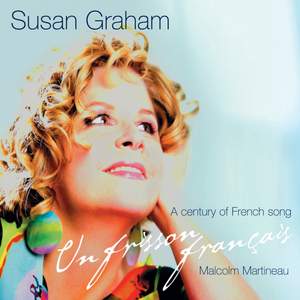
Prices shown exclude VAT. (UK tax is not payable for deliveries to United States.) See Terms & Conditions for p&p rates. | |  | Un Frisson Français - A century of French song
Undoubtedly ONYX’s highlight of the year is the first recital disc for 5 years by the great American mezzo Susan Graham. Beloved by audiences the world over, this outstanding recording is sure to be much in demand worldwide. The unique programme provides a celebration of French song in an unusual way – instead of groups of songs by several composers Susan has opted for a single song by 22 different composers from Bizet to Poulenc. This is the programme she and Malcolm Martineau her regular accompanist took on tour in the USA and Europe in 2007/2008. Reviews were unanimous “confirms Susan Graham as the ideal package she is” (Music Web) “resistance is futile” (New York Times); superb, exquisite (Chicago Tribune) Susan Graham is particularly at home in French repertoire, one of the few non-French singers recognised by the French themselves when they made her a Commandeur dans L’Ordre des Arts et des Lettres. Susan refutes the idea that all French vocal music sounds the same: "This programme has everything: loud, soft, high, low, fast, slow, romantic, acidic." Includes some surprises- Saint-Saëns’ Danse Macabre for example, known by everyone as a orchestral showpiece but in fact first written as a song, but hardly ever performed as such; and some favourites such as Hahn’s À Chloris and Canteloube’s Brezairola, but far more discoveries such as the gorgeous Psyché by Paladilhe and Bachelet’s ecstatic Chère Nuit. “With Susan Graham in radiant form and Malcolm Martineau not just an accompanist but an active partner in the project, "Un frisson français" offers a unique survey of French mélodie from the mid-19th century to the mid-20th: 22 songs… one composer. A rich collection in excellent sound: no one is likely to be disappointed.” Gramophone Magazine, November 2008 “The familiar here appears in unusual contexts and alongside a scattering of rarities. The performers are at one in their fluency, delicate rubato and avoidance of Anglo-Saxon archness, within an acoustic that combines intimacy and atmosphere.” BBC Music Magazine, November 2008 ***** “With Susan Graham in radiant form and Malcolm Martineau not just an accompanist but an active partner in the project, 'Un frisson français' offers a unique survey of French mélodie from the mid–19th century to the mid–20th: 22 songs…one per composer. Martineau describes the plan as a 'tasting menu', starting with Gounod, to whom he ascribes the launching of the genre of French mélodie. Even Ravel said that Gounod was 'the true founder of the mélodie in France' and his song 'Au rossignol' ('To the Nightingale') is included in the first of five sections – 'founding fathers', including Bizet, Franck, Lalo and Saint–Saëns. It is fascinating to hear the original version with piano of 'Danse macabre', Graham marvellously biting. Martineau describes the sequence as 'loosely chronological', and one beauty of the scheme is that rare and forgotten composers are included, such as Paladilhe and Bachelet who are represented in late–Romantic mélodies with night and nature dominating themes. The third group – including Ravel and Debussy – takes us into the 20th century. Especially fascinating is André Caplet's setting of 'Le corbeau et le renard' ('The Crow and the Fox') with elaborate piano accompaniment. Only rare songs are chosen for each composer and perhaps Martineau chose some of them for the colourful accompaniments, as in Chausson's fluttering accompaniment for his picture of the butterfly in 'Le papillon'. The fourth section has childhood as a common theme and the climactic section has only one song, much the longest, Poulenc's 'La dame de Monte-Carlo', to words by Jean Cocteau. It is like an encapsulated version of the operatic monodrama La voix humaine with the singer on the verge of a breakdown. A rich collection in excellent sound: no one is likely to be disappointed.” Gramophone Classical Music Guide, 2010 | | | In stock - usually despatched within 1 working day. |
|
|
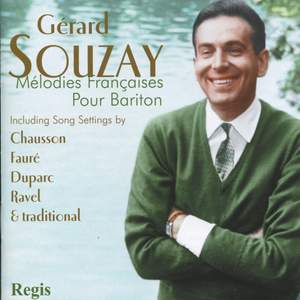
| |  | Melodies Francaises pour Bariton
Chausson: | Les Papillons, Op. 2 No. 3 (Gautier) Le temps des lilas Le Colibri, Op. 2 No. 7 (de Lisle) Le Charme, Op. 2 No. 2 (Silvestre) | Debussy: | Auprès de cette grotte sombre Mandoline (Verlaine) | Duparc: | Chanson triste L'Invitation au voyage | Fauré: | Cinq Melodies 'de Venise', Op. 58 Clair de Lune, Op. 46 No. 2 Après un rêve, Op. 7 No. 1 Au bord de l'eau, Op. 8 No. 1 (Prudhomme) Arpège, Op. 76 No. 2 (Samain) En sourdine, Op. 58 No. 2 (Verlaine) L'horizon chimérique, Op. 118 | Ravel: | Histoires naturelles (5) Don Quichotte à Dulcinée with Paris Conservatoire Orchestra, Eduoard Lindberg |
Recorded 1950-1954 “France's equivalent of Fischer-Dieskau sings Fauré, Duparc and Ravel with characteristic expressive elegance that transcends the rather elderly recordings.” BBC Music Magazine, May 2006 ***** | | | In stock - usually despatched within 1 working day. |
|
|
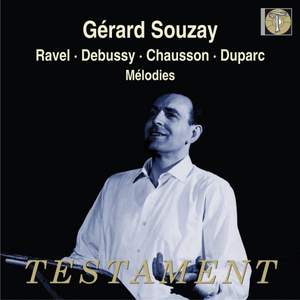
| |  | Gérard Souzay
Recorded 1951-55 | | | Usually despatched in 4 - 5 working days. |
|
|
| |  | Maria Bieshu: Opera Arias
Maria Bieshu (soprano) Symphonic Orchestra of the State Small Theatre of the USSR, Symphonic Orchestra of the State Academic of the Bolshoi Theatre of the USSR, Symphonic Orchestra of All-Union Radio and TV, Yuri Simonov, Boris Khaikin, Mark Elmer, Alexander Petukhov ADD | | | (also available to download from $10.50) | Usually despatched in 8 - 10 working days. (Available now to download.) |
|
|
| |  |
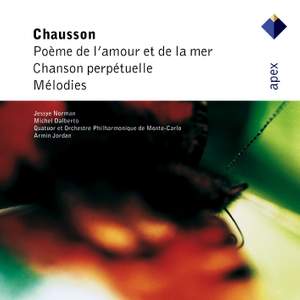
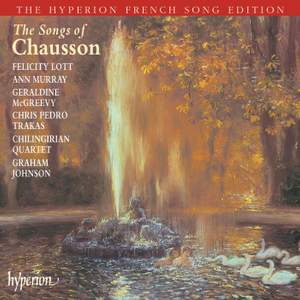
“The free-flowing late 19th-century Romanticism of Ernest Chausson overflows with colour and opulence. And if any voice was destined to match this music, it was that of Jessye Norman, whose account of Chausson's Poème de l'amour et de la mer has long been one of her most admired performances.
The appropriately French sound of the Monte Carlo orchestra conveys [the] complex web of emotions [of the Poème d'Amour] in all its subtle shades, matching the gloriously refulgent tone of the American soprano herself.” The Telegraph, 12th July 2008 | | | Usually despatched in 4 - 5 working days. |
|
|
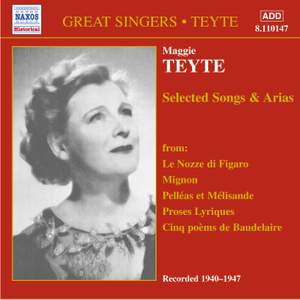
| |  | French Songs and Arias (1940-1947)Selected works by Thomas, Duparc and more
| |
|
| |  | Elly Ameling: The Dutch Nightingale
Bach, J S: | Cantata BWV202 'Weichet Nur, betrübte Schatten' (Wedding Cantata) Cantata BWV209 'Non sa che sia dolore' (Italian Cantata) Cantata BWV80 'Ein feste Burg ist unser Gott': Komm in mein Herzenshaus Cantata BWV147 'Herz und Mund und Tat und Leben': Bereite dir, Jesu, noch itzo die Bahn Cantata BWV149 'Man singet mit Freuden vom Sieg': Gottes Engel weichen nie St John Passion, BWV245: Ich folge dir gleichfalls St John Passion, BWV245: Zerfliesse, mein Herze Christmas Oratorio, BWV248: Nur ein Wink von seinen Händen Cantata BWV93 'Wer nur den lieben Gott läßt walten': Ich will auf den Herren schau'n Cantata BWV177 'Ich ruf zu dir, Herr Jesu Christ': Verleih', dass ich aus Herzens Grund Cantata BWV94 'Was frag ich nach der Welt': Es halt es mit der blinden Welt Cantata BWV202 'Weichet Nur, betrübte Schatten' (Wedding Cantata): Sich üben im Lieben Cantata BWV144 'Nimm, was dein ist, und gehe hin': Genügsamkeit Cantata BWV89 'Was soll ich aus dir machen, Ephraim?': Gerechter Gott, ach, rechnest du? Cantata BWV21 'Ich hatte viel Bekümmernis': Seufzer, tränen, kummer, not Flosst, mein Heiland, flosst dein Namen (from Christmas Oratorio) Cantata BWV187 'Es wartet alles auf dich': Gott versorget alles Leben Cantata BWV199 'Mein Herze schwimmt im Blut': Stumme Seufzer, stille Klagen Cantata BWV98 'Was Gott tut, das ist wohlgetan': Hört, ihr Augen, auf zu weinen Erfullet, ihr himmlischen, gottlichen Flammen (Wie schon leuchtet der Morgenstern BWV1) Cantata BWV75 'Die Elenden sollen essen': Erfüllet, ihr himmloschen göttlichen Flamen Cantata BWV74 'Wer mich liebet, der wird mein Wort halten': Komm, mein Herze steht dir offen Mass in F major, BWV233: Qui tollis peccata mundi | Beethoven: | Wonne der Wehmut, Op. 83 No. 1 Mass in C major, Op. 86: Kyrie | Beginiker: | Ecce nova guadia Nun wiegen wir das Kindlein | Brahms: | Da unten im Tale (No. 6 from Deutsche Volkslieder, WoO 33) Geistliches Wiegenlied, Op. 91 No. 2 | Chausson: | Les Papillons, Op. 2 No. 3 (Gautier) Le Colibri, Op. 2 No. 7 (de Lisle) | Debussy: | Nuit d'étoiles Fleur des blés (André Girod) Dans le jardin Fêtes galantes - Set 1 Proses Lyriques Trois Poèmes de Stéphane Mallarmé Noël des enfants qui n'ont plus de maison | Duparc: | Chanson triste | Fauré: | Le papillon et la fleur, Op. 1 No. 1 Rêve d'amour, Op. 5 No. 2 Dans les ruines d'une abbaye Op. 2 No. 1 Seule! Op. 3 No. 1 L'aurore Puisqu'ici-bas toute âme Op. 10 No. 1 Tarentelle Op. 10 No. 2 Au bord de l'eau, Op. 8 No. 1 (Prudhomme) Automne, Op. 18 No. 3 Le parfum impérissable Op. 76 No. 1 Arpège, Op. 76 No. 2 (Samain) Pleurs d'or Op. 72 Chanson de Melisande Soir Op. 83 No. 2 Chanson Op. 94 Vocalise-étude La chanson d'Ève, Op. 95 Le jardin clos Op. 106 C'est la paix Op. 114 Après un rêve, Op. 7 No. 1 | Grieg: | Ich liebe Dich, Op. 5 No. 3 | Hahn, R: | Si mes vers avaient des ailes | Haydn: | The Mermaid's Song, Hob. XXVIa:25 Ein Magd, ein' Dienerin, Hob. XXVIId:1 | Loewe, C: | Niemand hat's gesehn, Op. 9, H.X/4 | Mahler: | Symphony No. 4 in G major: Wir geniessen den himmlischen Leben | Marchesi: | La Folletta | Mendelssohn: | Auf Flügeln des Gesanges, Op. 34 No. 2 | Mozart: | Ridente la calma, K152 Oiseaux, si tous les ans, K307 Dans un bois solitaire, K308 Die Zufriedenheit, K473 Komm, liebe Zither, K351 Warnung 'Männer suchen stehts zu naschen', K433 Das Veilchen, K476 Sei du mein Trost, K391 Der Zauberer, K472 Das Lied der Trennung, K519 Als Luise die Briefe, K520 Das Traumbild, K.530 Un moto di gioia, K579 Die Verschweigung, K518 Die kleine Spinnerin, K531 Abendempfindung an Laura, K523 Die Alte K517 An Chloë, K524 Sehnsucht nach dem Frühlinge, K596 | Poulenc: | Airs chantés Trois Poèmes de Louise Lalanne Cinq Poèmes de Max Jacob La courte paille Fancy Colloque Trois poèmes de Louise de Vilmorin Ce doux petit visage Fiançailles pour rire | Satie: | La diva de l'empire Je te veux | Scarlatti, A: | Le violette | Schubert: | Auf dem Wasser zu singen, D774 Auf dem See, D543 (Goethe) Erlafsee D586 (Mayrhofer) Die Forelle, D550 Die gefangenen Sänger D712 (Schlegel) Verklarung D59 (Herder, after Pope) Der Jungling und der Tod, D545 (Spaun) Suleika I, D720 Suleika II, D717 Raste Krieger, Krieg ist aus (Ellens Gesang I), D837 Jäger, ruhe von der Jagd (Ellens Gesang II), D838 Ave Maria, D839 Gretchen am Spinnrade, D118 Trost im Liede, D546 (Schober) An die Musik D547 Ganymed, D544 (Goethe) Trost im Liede, D546 (Schober) An die Musik D547 Ganymed, D544 (Goethe) Frühlingsglaube, D686 Liebe schwarmt auf allen Wegen, D239 No. 6 (Goethe) Lachen und Weinen, D777 Ständchen 'Horch! Horch! die Lerch!', D889 Der Hirt auf dem Felsen, D965 (Von Chezy / Muller) Im Frühling, D882 Amalia, D195 (Schiller) Atys D585 Seligkeit D433 (Holty) | Stölzel: | Bist du bei mir | Stravinsky: | Pastorale | trad.: | As I sat on a sunny bank Sweet was the song In Dulci Jubilo Uff'm Berge O suver maecht van Israel Klein, klein Jezuken Canco de nadal Baile de Nadal Baile de Córdoba Baile Andaluz Entre le boeuf et l'ane gris L'appel des bergers Noël pour l'amour de Marie Noël des jouets |
Born Elisabeth Sara Ameling on 8 February 1933 in Rotterdam, the Dutch soprano known as Elly Ameling won first prize at the Vocal Concours in ’s- Hertogenbosch in Holland in 1956, and the Concours International de Musique in Geneva in 1958. She gave her first formal recital in Amsterdam in 1961 and went on to perform for more than thirty years in virtually every major cultural centre in the world as one of the greatest singers of our age, renowned for her warm, unaffected personality, purity of tone and effortless technique. She made her career mainly as a concert and lieder singer, with some appearances in opera (Mozart and Haydn), and became renowned for her recitals of French and German songs and for her superlative interpretative gifts. CD 1 begins with two solo cantatas for soprano by Johann Sebastian Bach – the famous Wedding Cantata (BWV202) and ‘Non sa che sia dolore’ (BWV209) – followed by further arias from Bach cantatas and oratorios. CD 2 presents more music by Bach, with a collection of beautiful soprano arias from cantatas, accompanied by oboe and bass continuo. The oboe soloist is the Dutch virtuoso Han de Vries, who plays three different types of instrument, namely the normal oboe, the ‘oboe da caccia’ and the ‘oboe d’amore’, as specified by the composer, to striking musical effect in the various arias. In CD 3 Ameling shows her skill as an unrivalled interpreter of the music of Schubert with a collection of the composer’s best-known and most popular Lieder including ‘Die Forelle’, ‘Ave Maria’, ‘Gretchen am Spinnrade’ and ‘An die Musik. The piano accompanists are Irwin Gage and Jörg Demus. CD 4 opens with Schubert’s great showpiece for soprano and clarinet: ‘Der Hirt auf dem Felsen’ (‘The Shepherd on the Rock’), in which the clarinet soloist is George Pietersen, plus three other Schubert songs. These are followed by a group of songs by Mozart, including ‘Ridente la calma’, ‘Dans un bois solitaire’ and ‘Un moto di gioia’. The soprano is accompanied by Irwin Gage in the Schubert and Jörg Demus in the Mozart. In CDs 5 and 6, Ameling moves into the field of French song, for which she was trained by the famous French baritone Pierre Bernac. Her repertoire here encompasses many well-known songs by Gabriel Fauré, Claude Debussy and Francis Poulenc. She is accompanied by the distinguished pianist Dalton Baldwin, with whom she frequently performed. In CD 7 we hear a collection of much loved popular songs, typical of the mixed programmes with which the artist always delighted her audiences at recitals. These include Mendelssohn’s ‘Auf Flügeln des Gesanges’ (‘On Wings of Song’) and Grieg’s ‘Ich liebe dich’ (‘I Love You’). The disc closes with a further group of French mélodies by Poulenc. The final CD begins with a collection of Christmas songs from many lands, to which Ms Ameling brings her own special charm. Then comes a typical example of Ameling as a participant in a large-scale liturgical work, in the Kyrie from Beethoven’s Mass in C, where her clearly focussed voice blends perfectly with those of her three fellow soloists. The programme ends with the finale from Mahler’s Fourth Symphony, in which Ameling is heard as the radiant soprano soloist extolling the joys of heaven in a child-like way, with the Pittsburgh Symphony Orchestra conducted by André Previn. | | | In stock - usually despatched within 1 working day. |
|
|
| |
|