All recordingsPrices shown exclude VAT. (UK tax is not payable for deliveries to United States.) See Terms & Conditions for p&p rates. | |  | R. Strauss: Four Last Songs
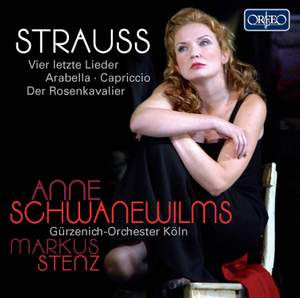
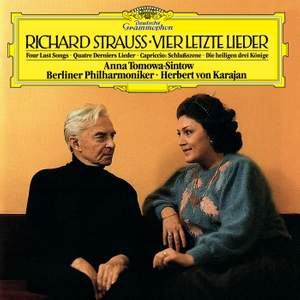
A setting of poems by Hermann Hesse and Joseph von Eichendorff, Richard Strauss’s 'Four Last Songs' afford ultimate proof of Strauss’s unique ability to write soaring melodic lines for the soprano voice. Many outstanding Strauss sopranos have faced up to the challenge and now Anne Schwanewilms joins them, ahead of her Proms performance on 17th July. She is one of the most sought-after Strauss sopranos of our day; a regular visitor to all the world’s leading opera houses and festivals, from Salzburg Festival and the Royal Opera, Covent Garden, to the Bavarian, Dresden and Vienna State Operas. She has also been heard in many of Strauss’ works at the Cologne Opera, most recently at a recital in 2011, when she was joined by the Gürzenich Orchestra under Cologne’s general music director, Markus Stenz, which included excerpts from roles with which she is most closely associated. The valedictory tone of the songs contrasts with that of the final scene from 'Arabella,' in which Schwanewilms strikes just the right balance between the simplicity of the opening and the increasingly jubilant note on which the opera ends. In the final scene from 'Capriccio', this last-named quality is combined with the singer’s ability to achieve the parlando style ideally demanded by Strauss. In the 'Rosenkavalier' trio her emotionally-charged singing captures the Marschallin’s rejection in favour of a younger woman with an immediacy that is altogether overwhelming. “There’s some wonderful singing [in the Capriccio extract]...She’s also excellent as Arabella. At the start of the solo her singing is touching and with a hint of vulnerability to it. Later...she becomes more impassioned, as the music and the sentiments of the text demand...the Gürzenich-Orchester is inspired by Markus Stenz to some gorgeous playing.” MusicWeb International, August 2012 “Schwanewilms is arguably the finest native German interpreter of Strauss’s more lyrical operatic roles, yet despite a soprano of considerable loveliness, she can sound disengaged, particularly from the words. Here, she gives a good account of herself, especially in the closing monologues of Arabella and Countess Madeleine” Sunday Times, 22nd July 2012 “she soars through them all, pearl-like, backed by the succulent purr of Cologne’s Gürzenich Orchestra, conducted by Markus Stenz.” The Times, 20th July 2012 **** | | | In stock - usually despatched within 1 working day. |
|
|
| |  | Christine Schäfer: Arias
The acclaimed soprano Christine Schäfer is making her label debut for Sony Classical with a highly unconventional aria album. The arias she has recorded range in time from Handel to Messiaen, and in style from virtuosic belcanto to the drama of Verdi and the serenity of Richard Strauss. Christine Schäfer’s first-ever recital of operatic arias is a carefully composed musical essay that combines popular and lesser-known works. This highly personal programme is no selection of greatest hits, but a journey of adventure in search of musical beauty. In the manner of a resounding essay Schäfer takes well-known but intentionally diverse pieces from the Baroque period to the present and relates them to each other in unexpected ways. Seductive as they are on their own, in this changed context each seems to have been illuminated anew. The orchestra, the Deutsches Symphonieorchester Berlin under Julien Salemkour is the singer’s artistic counterpart and peer, and can shine in a variety of roles. | | | In stock - usually despatched within 1 working day. |
|
|
| |  |
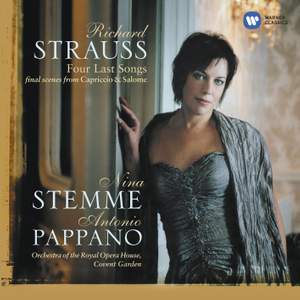
Speaking of Nina’s interpretation of the Four Last Songs, Pappano enthuses: “I trust the warmth of Nina's voice. There are a lot of lighter voices that have recorded the piece but you have to remember that Kirsten Flagstad sang the premiere and it's that kind of ample voice with warmth and body - Nina's voice - that I think is too rarely heard in this repertoire.” “Pappano and his orchestra (what solo playing!), while never hurrying, keep the forward pace of an attentive Lied accompanist - emotional points are made without milking, matching the cool beauty of the soloist's timbre. Stemme has vocal height and weight in equal measure and (again) really uses her text.” Gramophone Magazine, June 2007 “…Antonio Pappano never gets to record more than bleeding chunks of the Strauss operas… Yet nothing illustrates better his genius for going straight to the theatrical heart of the matter than the opening blaze of this Salome finale. It's both beautifully textured and keenly energised, and his sense of the drama seems to have rubbed off on Nina Stemme's Salome, poised between anger and nostalgia, and Gerhard Siegel's anxious Herod.” BBC Music Magazine, May 2007 ***** “To borrow a phrase from Richard Osborne, mighty tents are already pitched on these fields – for the Four Last Songs Schwarzkopf/Szell, Della Casa/Böhm, Norman/Masur; for the Salome finale Krauss/Cebotari, Welitsch/ Reiner and so on. But the conductor who has already got onto record a newly thoughtthrough Bohème, a Tosca that can hold its own with de Sabata's, and a modern Tristan with Domingo need fear no competition. All the hounds of hell are let loose by the ROH's percussion section to launch a wild, but always intricately shaped and detailed, account of young Princess Salome's sickly Liebestod. Being already a searching, grown-up Isolde, Stemme, like her 1950s forerunners, now really manages to be a teenage Isolde too, by turns sweet, spooky and growing up. The discs's running order is cunning and effective, and both conductor and soprano are in command of the switch to Madeleine's musicor- words dilemma. In Capriccio's Moonlight Interlude, as in the Songs, Pappano achieves richness without overweighting; his rubato lingers rather than indulges (like… but let's not compare). Stemme is a more torn and dramatic Countess than, say, Janowitz, Schwarzkopf or Della Casa; this performance harks back to Clemens Krauss and Viorica Ursuleac, emotion shaping the (fine) text, rather than vice-versa. As if to create a valedictory survey of Strauss, the soprano voice and the orchestra, the start of 'Frühling' aptly seconds the Countess's mood. Michael Tanner's note for the new remastering of Flagstad's creator's performance (see above) remarks how tempi in this work have got slower over the past 50 years. Pappano and his orchestra (what solo playing!), while never hurrying, keep the forward pace of an attentive Lied accompanist – emotional points are made without milking, matching the cool beauty of the soloist's timbre. Stemme has vocal height and weight in equal measure and (again) really uses her text. Finally, the record is produced and engineered with sensitivity to the layout of Strauss's instrumental and vocal textures.” Gramophone Classical Music Guide, 2010 | | | In stock - usually despatched within 1 working day. |
|
|
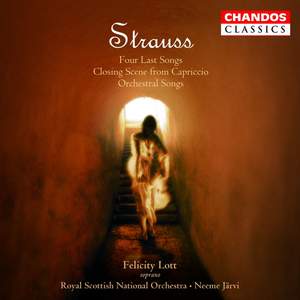
| |  | Strauss R: Four Last Songsand other works
Strauss, R: | Four Last Songs Wiegenlied, Op. 41 No. 1 Ruhe, meine Seele!, Op. 27 No. 1 Freundliche Vision, Op. 48 No. 1 Waldseligkeit, Op. 49 No. 1 Morgen, Op. 27 No. 4 Das Rosenband, Op. 36 No. 1 Zueignung, Op. 10 No. 1 Des Dichters Abendgang, Op. 47 No. 2 Morgen mittag um elf! (from Capriccio) Capriccio: Intermezzo (Moonlight Music) |
'She [Felicity Lott] never loses sight of what the words are about; her vocalism is consistently poised and centered; and its no wonder that the wealth of commitment and knowledge shes brought to Strauss music over the years has made her a prime exponent of this repertoire.'
Fanfare | | | (also available to download from $10.50) | In stock - usually despatched within 1 working day. |
|
|
| |  | Aga Mikolaj sings Strauss & Mozart
Aga Mikolaj (soprano) WDR Rundfunkorchester Köln, Karl Sollak Ana Mikolaj sings a selection of popular works by Richard Strauss and Mozart on this CPO recording. The prize-winning Polish soprano has been a student of Dame Elisabeth Schwarzkopf, who worked closely with her on the preparation and interpretation of certain roles and of certain composers, notably Mozart and Strauss. Mikolaj has performed at Glyndebourne and many of the world’s opera houses and is currently performing in Carmen with Jonas Kaufmann at the Bavarian State Opera. | | | Usually despatched in 2 - 3 working days. |
|
|
| |  | An Evening with Renée FlemingRecorded live at Waldbühne, Berlin, 2010
The Waldbühne in Berlin, one of the most appealing outdoor amphitheatres on the European continent, is the home of the Berliner Philharmoniker’s summer concerts. With over 20,000 attendances, these are some of the most popular classical music concerts in the world. This year the Berliner Philharmoniker play under the baton of Ion Marin, one of the most exciting conductors on today’s musical scene. They welcome "America's Beautiful Voice", Grammy Award winning soprano Renée Fleming, who has a devoted international following wherever she appears. Her career has been built on success across a wide range of musical styles, but she is best-known for her excellence in opera worldwide. The device of the evening was “Night of Love”- the most beautiful Opera Arias in combination with atmospheric instrumental pieces. | | | Usually despatched in 2 - 3 working days. |
|
|
| |  | An Evening with Renée FlemingRecorded live at Waldbühne, Berlin, 2010
The Waldbühne in Berlin, one of the most appealing outdoor amphitheatres on the European continent, is the home of the Berliner Philharmoniker’s summer concerts. With over 20,000 attendances, these are some of the most popular classical music concerts in the world. This year the Berliner Philharmoniker play under the baton of Ion Marin, one of the most exciting conductors on today’s musical scene. They welcome "America's Beautiful Voice", Grammy Award winning soprano Renée Fleming, who has a devoted international following wherever she appears. Her career has been built on success across a wide range of musical styles, but she is best-known for her excellence in opera worldwide. The device of the evening was “Night of Love”- the most beautiful Opera Arias in combination with atmospheric instrumental pieces. Picture format DVD: NTSC 16:9 Sounds formats DVD: PCM Stereo, DD 5.1, DTS 5.1 Region code: 0 Booklet notes: English, German, French Subtitles: English, German, French Running time: 130 mins FSK: 0 | | | Usually despatched in 2 - 3 working days. |
|
|
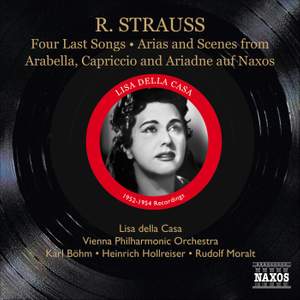
| |  | Strauss - Four Last SongsRecorded at the Musikvereinssaal, Vienna, June, 1953
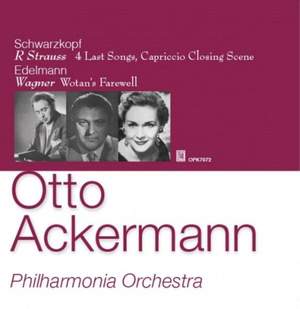
Producer and Audio-Restoration engineer: Mark Obert-Thorn. Acclaimed as one of her generation’s finest interpreters of Richard Strauss (the composer himself identified her as his ideal Arabella), the Swiss soprano Lisa della Casa was blessed with a seemingly effortless, shimmeringly beautiful voice as well as an innate sense of musical style. In the words of the distinguished critic John Steane: ‘Della Casa remains one of the best of all sopranos in Richard Strauss. Her voice has that touch of spring and silver that Strauss loved and wrote for; her tone will float and soar’. These vivid recordings are essential for every collection. | | | (also available to download from $9.00) | Usually despatched in 2 - 3 working days. (Available now to download.) |
|
|
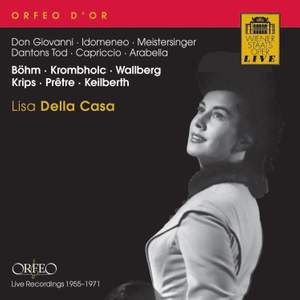
| |  | Lisa della CasaVienna State Opera 1955-1971
Einem: | Das ist eine böse Zeit (from Dantons Tod) | Mozart: | Fuggi, crudele, fuggi! (from Don Giovanni) sung in German Crudele? Ah no, mio bene! ... Non mi dir, bell'idol mio (from Don Giovanni) sung in German Quando avran fine omai ... Padre, germani, addio! (from Idomeneo) Principessa, a' tuoi sguardi...Spiegarti non poss'io (from Idomeneo) | Strauss, R: | Morgen mittag um elf! (from Capriccio) Ich danke, Fraulein (from Arabella) Das war sehr gut, Mandryka (from Arabella) | Wagner: | O Sachs, mein Freund (from Die Meistersinger) Selig, wie die Sonne (from Die Meistersinger von Nürnberg) |
No singer at the Vienna State Opera or elsewhere has been as closely associated with the title role in Strauss's Arabella as Lisa Della Casa, who celebrates her 90th birthday on 2 February 2009, and yet we should be guilty of doing the Swiss soprano a grave disservice by reducing her repertory to this one role alone.This point is well illustrated by an impressive portrait of the singer that is released as part of ORFEO's series 'Wiener Staatsoper live'. Lisa Della Casa took part in the opening performances in the rebuilt house in 1955, a bundle of nervous energy as Donna Anna under Karl Böhm, with Anton Dermota as Don Ottavio.With the silvery gleam of her soprano and her crystalline high notes, she was also a natural choice as Eva in Die Meistersinger, a role she also sang at Bayreuth and the Met. Here she demonstrates that she was capable of raising standards to those worthy of an international festival whenever she appeared with other world-class singers.The same is true of the closing scene from Capriccio under Georges Prêtre and of the scene from Arabella in which her sister, Zdenka, is played by Anneliese Rothenberger in an inspired piece of casting. As Lucile in Gottfried von Einem's Dantons Tod, under Josef Krips in 1967, she proved a worthy successor to Maria Cebotari, who at the start of Della Casa's career had recommended her younger colleague for more challenging roles.Von Einem's opera by no means marked a new direction in the singer's career: far from taking on character roles in the later stages of her career, she was still singing lyric soprano roles until shortly before she retired from the stage. A unique voice, with distinctive simplicity and even phrasing. | | | Usually despatched in 3 - 4 working days. |
|
|
| |  | Seduction - Songs by Richard Strauss
Strauss, R: | Heimliche Aufforderung, Op. 27 No. 3 Allerseelen, Op. 10 No. 8 Ständchen, Op. 17 No. 2 Ruhe, meine Seele!, Op. 27 No. 1 Morgen, Op. 27 No. 4 Zueignung, Op. 10 No. 1 Traum durch die Dämmerung, Op. 29 No. 1 Ich trage meine Minne, Op. 32 No. 1 Liebeshymnus, Op. 32 No. 3 Verfuehrung Op. 33 No. 1 Das Rosenband, Op. 36 No. 1 Befreit, Op. 39 No. 4 Wiegenlied, Op. 41 No. 1 Freundliche Vision, Op. 48 No. 1 Waldseligkeit, Op. 49 No. 1 Die heiligen drei Könige aus Morgenland Op. 56 No. 6 Morgen mittag um elf! (from Capriccio) Capriccio: Intermezzo (Moonlight Music) Waltz Sequence No. 2 (from Der Rosenkavalier, Op. 59) |
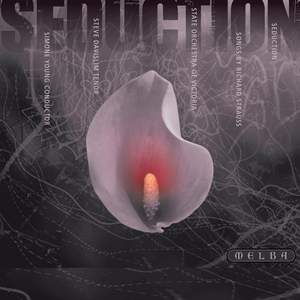
A deluxe edition re-mastered and remixed for SACD surround sound from the original acclaimed recording made in 1999. CD received glowing reviews and is in the Gramophone Best CDs and DVDs Yearbook. Steve Davislim is a highly sought after Australian tenor based in Vienna who has established a stellar international career working with the most prestigious orchestras and conductors in Europe, the USA and Australia. Davislim’s voice is full of colour and warmth and informed in every note by an all too rare combination of intelligence and imagination: “it’s almost enough to make you believe in God” St Petersburg Times. Recording debut of Australian-born Simone Young, recognised as one of the leading conductors of her generation and Music Director of Hamburg State Opera. First of a series of five CDs that Steve Davislim is making with Melba, including Schubert’s song-cycle Winterreise and the world premiere recording of Saint-Saëns’ 1-act opera Hélène. CD notes by distinguished Strauss biographer Michael Kennedy. Digipak with picture disc and 30-page colour booklet with essay and aria translations. “An outstanding recital by an excellent young tenor singing superb Strauss… [Davislim] is worth being spoken of in the same breath as his notable predecessors – Peter Anders and Fritz Wunderlich – praise can hardly be higher than that.” Gramophone
“The years drop off Richard Strauss... in this new disc of his orchestrated songs... [Davislim’s] lithe, rhythmically and verbally alert tenor has the red blood surging from the start...” BBC Music Magazine (on Original CD Release) | | | Usually despatched in 4 - 5 working days. |
|
|
| |
|