All recordingsPrices shown exclude VAT. (UK tax is not payable for deliveries to United States.) See Terms & Conditions for p&p rates. | |  | Chopin - Journal Intime
Chopin: | Mazurka No. 41 in C sharp minor, Op. 63 No. 3 Ballade No. 1 in G minor, Op. 23 Mazurka No. 11 in E minor, Op. 17 No. 2 Mazurka No. 47 in A minor, Op. 68 No. 2 Fantasia in F minor, Op. 49 Nocturne No. 20 in C sharp minor, Op. post. Mazurka No. 6 in A minor, Op. 7 No. 2 Ballade No. 2 in F major, Op. 38 Mazurka No. 13 in A minor, Op. 17 No. 4 Largo, Prelude Op. 28 No. 4 Écossaises (3), Op. 72 No. 3 Contredanse in G flat major, KKAnh.Ia/4 Impromptu No. 4 in C sharp minor, Op. 66 'Fantaisie-Impromptu' Nocturne No. 2 in E flat major, Op. 9 No. 2 |
Already established as one of today’s most individual and thoughtful pianists, Alexandre Tharaud makes his debut on Virgin Classics with this collection of pieces by Chopin, ‘Journal intime’ (Private diary). Each of the chosen pieces – mazurkas, nocturnes, ballades, the famous Fantaisie-impromptu and a number of other, lesser-known works – has a special importance or association for Tharaud, who cites the pianism of Vlado Perlemuter and Sergey Rachmaninov as a particular influence in the music of Chopin. Many of these pieces have been in Tharaud’s repertoire since his student days: “I let time work for me. It is extraordinarily enriching to study a work when you are young and then revisit it in the course of your life. It becomes part of you.” Tharaud, born in Paris in 1968, takes a discerning approach to repertoire, highlighting and often juxtaposing composers such as Bach, Rameau, Couperin, Chabrier, Satie, Ravel, Poulenc and Thierry Pécou (b.1965). His catalogue of recordings for Harmonia Mundi has contributed substantially to his reputation: “Alexandre Tharaud [is] a young aristocrat of the keyboard. Cool, supple and elegant, all his performances are in the best French tradition; a fine union of sense and sensibility ... each phrase bringing a renewed sense of delight … the inwardness and grace one associates with true artists ... All these performances suggest a fastidious musical intelligence with an immaculate technique, the music's character and fragrance made light yet pervasive ... these scrupulously modern and sensitive performances are among the finest available." Gramophone "Alexandre Tharaud plays Chopin with superlative technique. (...) He has recorded a breathtaking disc … This is intelligent playing that matches its clarity with perception and sensitivity, and variety of touch with sonic beauty. Tharaud is unfailingly responsive to melodic nuance and seems to relish every new twist of the texture. But there is also immense power when the dark energy beneath is unleashed. His concept plumbs the depths of Chopin's musical psyche with humility … a brilliant and original performance." BBC Music Magazine “Alexandre Tharaud has dedicated his reading of Chopin’s Préludes to the memory of Vlado Perlemuter, and it is as unhistrionic and clearly articulated as the versions left by the late pianist … Tharaud is immediately persuasive with his uncontrived musicality. The more serene pages unfold gracefully … [but] shadows often assert their menacing presence: the pianist has spoken of the darkness he finds in the cycle, and it makes itself felt, though with no suggestion of artificiality or overstatement.” Diapason " … New discs of Chopin's waltzes are invariably compared to Dinu Lipatti's ethereal 1950 recording, which still inspires cult-like devotion. But even die-hard Lipatti fans will be impressed with the powerfully evocative musicianship of the superb young French pianist Alexandre Tharaud. Languid, wistful and dignified, his spontaneous and imaginative interpretations reinforce the enchanting, otherworldly quality of Chopin's miniatures …” Time Out, New York “His vision [of the Chopin waltzes] is completely personal – sensitive, but unaffected, sovereign in its pianism and always mobile, winged, in search of a multiplicity of voices and views.” ClassicToday “Alexandre Tharaud plays Chopin’s waltzes with the naturalness that comes when one’s wishes have been fulfilled … a wish to play, to speak, to sing, to be carried like a child on the momentum of the waltzes and to take private pleasure in these little things from a time when everything seemed simpler … Chopin’s nostalgia is not just a Romantic cliché … there is a sense that music is taking the place of narrative, the better to tell the story of a lost land … Alexandre Tharaud surpasses every expectation … making this an indispensable disc.” Arte Tharaud takes a quietly unconventional approach to performance and to study. For instance, he gives concerts with the score to hand – he finds this liberating rather than restrictive, since he does not have to worry about possible lapses of memory – and he does not have his own piano, preferring to practise on friends’ instruments. ”It is by digging, by chipping away [at the score] that I find the answers, that I reach the colours I am searching for. Then, when it comes to the concert, the particularities of the instrument become secondary to some degree, since I am so used to engaging in a dialogue with any type of piano.” Tharaud also feels that this approach maintains the freshness of his relationship with the piano: “It is rather like being part of a long-established couple: there comes a time where you need to be able to leave a little space, to manage the desire so that you can appreciate it all the more.” Alexandre Tharaud’s personal text Why this private diary… My life has been mapped out by Chopin; more than any other composer, he has accompanied me at every stage. Some of his works take me back ineluctably to a particular event or meeting, and I wanted to put them all together in a single programme, like an album of personal memories. What was your first encounter with this music? When I was four I was not allowed to touch the family record-player, but I would ask my parents to put on the LPs of Samson François and Tamás Vásáry – so my first Chopin had dash and dazzle. I also took in the coarse, hammered-out Chopin of Mireille, the old lady pianist who played for my mother’s dancing-classes, to which I went every week. I adored Mireille – she introduced me to a fair number of composers – but I really have to say she massacred Chopin, to the extent of adding a beat to his waltzes, making them waltzes in 4/4 time. I was lulled to sleep by the Écossaises and the Op. 9 Nocturne played by her quirky fingers. How did you first come to play Chopin? Right from my first years on the piano, Carmen Taccon-Devenat, a teacher of genius, readily understood that I “needed” Chopin to give me pleasure. Straight away she introduced me to that little gem the Contredanse, which has so seldom been recorded, then to some mazurkas, waltzes and études. Some years later came the Fantaisie-Impromptu, a showy piece but not beyond a child’s hands, which I played all the time, to whoever would listen. She was by my side at each of these discoveries, a twinkle in the corner of her eye, her hand on my arm to stop me from racing away. For her, Chopin had to speak: “Tone above all!” We put words or syllables to each note. I have never forgotten what she taught me. And at the conservatoire? The piano was the secret garden of my adolescence, and it was through Chopin that I gave myself up to it. The second Ballade is indissolubly linked with my entry into the Conservatoire National. On the day of the audition, Carmen Taccon-Devenat and I were in panic, my hands trembling in hers as I waited my turn outside the room. We had spent a month at her house in the country, working intensively to prepare ourselves for this moment. At the Conservatoire the Fantaisie was my party-piece. I dreamt of the first Ballade, and I would have given anything to play it, but it was consistently denied me. The years passed and I ended up being convinced we were not made for one another. I was twenty before I got my hands on it. And then I pounced on it! What about the other pieces in this album? These pieces remind me of certain rather private moments in my life, of people I have loved or friends I have lost. Once, at the funeral of a close friend, I heard a terrific funeral march on the organ; much later, I was amazed to learn that it was from the Largo in C minor, a practically unknown piece, written originally for piano. The Mazurkas, Op.17 No.4, Op.7 No.2 and Op. 63 No.3, and the Nocturne in C sharp minor, Op. posth., take me back to Warsaw, Montreal, Munich and Senigallia… How did the recording go? Cécile Lenoir and I chose a Steinway piano with a clear tone, and a warm, ample recording which gave a sense of the hall, to approximate as closely as possible to a concert ambience. We opted for a generous, natural reverberation. In the course of recording, the personal memories to which each of these pieces is linked came to the forefront, blending together and completely suffusing me. In a way, they became the real performers of this “Private Diary”… “He clearly has qualms about the emotional involvement he brings to Chopin's miniatures, executing an evocative transformation from languid self-absorption to high drama in the 'Ballade no. 1 op. 23', and navigating the turbulent, oceanic depths of the 'Fantaisie op. 49'.” The Independent, 19th February 2010 **** “He plays the music with palpable affection and sensitivity, gilded with a panache and passion in the more tempestuous moments...Tharaud’s feel for tonal colouring and his eloquence of expression are a perfect match for this inspiring, kaleidoscopic music.” The Telegraph, 26th February 2010 ***** “this sequence of carefully chosen pieces makes for a satisfying listen. Tharaud lifts the music across the bar-lines with deft rubato, his sound clear, shining and sensuous; altogether breathtakingly beautiful.” The Observer, 7th March 2010 “memorably refined and stylish performances...Here, as so often with Tharaud, there is an aristocratic balance of sense and sensibility, though his brilliant fury in the Second Ballade's Presto storm is breathtaking” Gramophone Magazine, April 2010 “Tharaud's playing is never less than elegant.” The Independent on Sunday, 7th March 2010 “We can almost take for granted Tharaud's virtuosity, his sensitivity of touch and his satisfying mixture of imagination, intuition and good sense. But he is extraordinary in one very special area: for him quietness speaks more than loudness...there is as much music in the silences as in the notes...It's breathtaking.” BBC Music Magazine, April 2010 ***** BBC Music Magazine
Instrumental Choice - April 2010 |
| | | In stock - usually despatched within 1 working day. |
|
|
| |  | Chopin: Piano Music
Chopin: | Waltz No. 6 in D flat major, Op. 64 No. 1 'Minute Waltz' Écossaises (3), Op. 72 No. 3 Mazurka No. 1 in F sharp minor, Op. 6 No. 1 Mazurka No. 2 in C sharp minor, Op. 6 No. 2 Mazurka No. 3 in E major, Op. 6 No. 3 Mazurka No. 4 in E flat minor, Op. 6 No. 4 Impromptu No. 1 in A flat major, Op. 29 Impromptu No. 2 in F sharp major, Op. 36 Impromptu No. 3 in G flat major, Op. 51 Impromptu No. 4 in C sharp minor, Op. 66 'Fantaisie-Impromptu' Nocturne No. 7 in C sharp minor, Op. 27 No. 1 Nocturne No. 8 in D flat major, Op. 27 No. 2 Mazurkas (4), Op. 17 Fantasia in F minor, Op. 49 |
SOMM has recently embarked on an extensive series of recordings with this pianist and this first release celebrates Chopin’s 200th anniversary. He begins his recital with the famous “Minute Waltz” and also includes Ecossaises Op. 72 and Four Mazurkas Op. 6. “McCawley, an English pianist with a rising profile, offers a self-effacing introduction to Chopin...He is best in the Three Ecossaises Op.72 and the Impromptus Op.29, 36 and 51, where he captures the music’s salon-like elegance without sentimentalising it or showing off.” Financial Times, 7th January 2011 *** “...performances which veer away from the glamour and opulence of the concert hall, almost as if given before a late-night audience of carefully chosen friends. His inwardness and reserve pay rich dividends in the C sharp minor Nocturne's coda...And in the companion Nocturne in D flat, his translucent tone is particularly apt.” Gramophone Magazine, March 2011 “His playing is never projected but conveyed in the tones of a private conversation. Textures are translucent and pliant. Above all, McCawley always mantains focus on the life of the phrase, which lends his playing that natural cantabile one expects from the finest singers...Warmly recommended.” International Record Review, March 2011 “The virtues of Leon McCawley's Chopin playing are impressive, which will come as no surprise to those who know his earlier recordings. These beautifully recorded performances are characterised by a refined musical intelligence, cultivated taste and lack of exaggeration.” BBC Music Magazine, April 2011 *** | | | Usually despatched in 2 - 3 working days. |
|
|
| |  | The Great Pianists Volume 11 - Shura Cherkassy & Leopold GodowskyMasters of the Piano Roll series
Cherkassky: | Prélude Pathétique Shura Cherkassy | Chopin: | Nocturne No. 2 in E flat major, Op. 9 No. 2 Leopold Godowsky Écossaises (3), Op. 72 No. 3 Leopold Godowsky Ballade No. 1 in G minor, Op. 23 Leopold Godowsky | Henselt: | La Gondola, Op. 13 No. 2 Leopold Godowsky Lullaby in G flat major Leopold Godowsky | Liszt: | Concert Paraphrase on Rigoletto, S.434 after Verdi's opera Shura Cherkassy Frühlingsnacht (after Schumann, Op. 39 No. 12), S568 Shura Cherkassy | Moszkowski: | Liebeswalzer, Op. 57 No. 5 Shura Cherkassy Polonaise in D, Op. 17 Leopold Godowsky | Rachmaninov: | Polka de V.R. Shura Cherkassy | Rubinstein: | Serenade Leopold Godowsky | Schumann: | Kinderszenen, Op. 15: Traümerei Leopold Godowsky | Tchaikovsky: | Song without words, Op. 2 No. 2 Shura Cherkassy |
New digital recording | | | Usually despatched in 8 - 10 working days. |
|
|
| |  | Chopin GoldChopin 200th anniversary
Chopin: | Polonaise No. 6 in A flat major, Op. 53 'Héroïque' Maurizio Pollini (piano) Prelude Op. 28 No. 15 in D flat major ‘Raindrop' Martha Argerich (piano) Waltz No. 6 in D flat major, Op. 64 No. 1 'Minute Waltz' Maria João Pires (piano) Waltz No. 7 in C sharp minor, Op. 64 No. 2 Alice Sara Ott (piano) Étude Op. 10 No. 12 in C minor ‘Revolutionary' Vladimir Ashkenazy (piano) Étude Op. 10 No. 3 in E major 'Tristesse' Nelson Freire (piano) Prelude Op. 28 No. 4 in E minor Rafal Blechacz (piano) Prelude Op. 28 No. 7 in A major Rafal Blechacz (piano) Berceuse in D flat major, Op. 57 Hélène Grimaud (piano) Polonaise No. 3 in A major, Op. 40 No. 1 'Military' Emil Gilels (piano) Impromptu No. 4 in C sharp minor, Op. 66 'Fantaisie-Impromptu' Maria João Pires (piano) Nocturne No. 2 in E flat major, Op. 9 No. 2 Daniel Barenboim (piano) Ballade No. 1 in G minor, Op. 23 Maurizio Pollini (piano) Scherzo No. 2 in B flat minor, Op. 31 Arturo Benedetti Michelangeli (piano) Waltz No. 1 in E flat major 'Grande Valse Brillante', Op. 18 Zoltán Kocsis (piano) Étude Op. 25 No. 11 in A minor 'Winter Wind' Sviatoslav Richter (piano) Nocturne No. 8 in D flat major, Op. 27 No. 2 Lang Lang (piano) Étude Op. 10 No. 4 in C sharp minor Nelson Freire (piano) Prelude Op. 28 No. 3 in G major Martha Argerich (piano) Prelude Op. 28 No. 6 in B minor Martha Argerich (piano) Mazurka No. 13 in A minor, Op. 17 No. 4 Vladimir Horowitz (piano) Scherzo No. 3 in C sharp minor, Op. 39 Ivo Pogorelich (piano) Piano Sonata No. 2 in B flat minor, Op. 35 'Marche funèbre': 3rd movement (Funeral March) Hélène Grimaud (piano) Prelude Op. 28 No. 11 in B major Friedrich Gulda (piano) Prelude Op. 28 No. 20 in C minor Friedrich Gulda (piano) Écossaises (3), Op. 72 No. 3 Mikhail Pletnev (piano) Étude Op. 25 No. 9 in G flat major 'Butterfly' Vladimir Ashkenazy (piano) Nocturne No. 10 in A flat major, Op. 32 No. 2 Maria João Pires (piano) Impromptu No. 1 in A flat major, Op. 29 Mikhail Pletnev (piano) Barcarolle in F sharp major, Op. 60 Maurizio Pollini (piano) Mazurka No. 19 in B minor, Op. 30 No. 2 Arturo Benedetti Michelangeli (piano) Ballade No. 3 in A flat major, Op. 47 Vladimir Ashkenazy (piano) |
The essential collection of favourite solo works for Chopin Year 2010! Over 140 minutes of pure listening pleasure 2CDs for the price of 1 Featuring Argerich, Ashkenazy, Barenboim, Blechacz, Freire, Grimaud, Gulda, Horowitz, Lang Lang, Michelangeli, Ott, Pires, Pollini and many more “Chopin was the greatest of us all, for he discovered everything through the piano alone”. So wrote Debussy about the Polish master, the 200th anniversary of whose birth is celebrated in 2010. This collection – featuring the world’s greatest pianists – bears out this remark, ranging from the dreamy to the heroic, from the passionate to the playful, with all Chopin’s favourite titles included. | | | Usually despatched in 2 - 3 working days. |
|
|
| |  | Chopin - The Complete Waltzes
The lilting waltz form we know today is derived from the Drehtanz and the Ländler, two lusty peasant dances from Germany and Austria. By the late 1770s classical composers had begun to write refined versions of the form with the three strong beats to the bar giving way to a strong downbeat and two faint afterbeats. Schubert brought the waltz to its first high point in the early 1800s. Its structure—a chain of uncomplicated melodies over a simple accompaniment—and this new lightness of rhythm led to a dance craze that swept the ballrooms of Europe. The waltz reached Warsaw in the early years of the nineteenth century. As a teenager, Chopin would have known the piano waltzes of Polish composers like Maria Szymanowska, Kurpinski, Dobrzynski and Stefani. As far as the piano was concerned, the most important reference point was Weber’s ground-breaking Invitation to the Dance (1819). Chopin’s earliest waltzes were not written until 1829 (he had already composed some thirteen mazurkas and polonaises), by which time the waltzes of Joseph Lanner and Johann Strauss the Elder were all the rage. A year later, Chopin left Poland and arrived in Vienna, the Waltz City, before making his permanent home in Paris. Paradoxically, almost all of the twenty waltzes he would eventually compose are more Gallic in character than Viennese, far removed from those of Lanner and Strauss. Only eight were published in Chopin’s lifetime. The two Waltzes Op 69, three Waltzes Op 70 and six of the seven early waltzes without opus numbers were all published posthumously. Outstanding among these are the poetic Op 69 No 2 in B minor and Op 70 No 3 in D flat major, inspired by his youthful love for the singer Konstancja Gladkowska and composed, according to Chopin, ‘early this morning’ (3 October 1829). Of all the posthumous waltzes rescued for posterity, we must be most grateful for the dazzling waltz in E minor (1830). As with the Fantaisie-Impromptu Op 66 it is a mystery why Chopin overlooked it; with its bravura introduction and coda and its spirited motifs this waltz has all the hallmarks of a mature work. The first waltz that Chopin authorized to be published, the Grande valse brillante in E flat major Op 18, was written in Vienna in 1830. It differs from most of the others in that it can actually be danced to, reflected by its inclusion in the ballet Les Sylphides (the only others are Op 64 No 2 and Op 70 No 1); the mature waltzes are, generally, more like ‘dance poems’. It also presages the consistently high standard of the seven subsequent waltzes—unlike most contemporary examples, these are no mere pot-boilers churned out to please publishers and amateur pianists alike (though most of Chopin’s are not beyond the reach of good amateurs). In welcoming the three Waltzes Op 34 in 1838 Schumann wrote, ‘[They] will delight above all things, so different are they from the ordinary ones, and of such a kind as only Chopin dare venture on or even invent, while gazing inspired among the dancers … Such a wave of life flows through them that they seem to have been improvised in the ballroom.’ No 1 in A flat major revisits many of the rhythmic and motific ideas of Op 18; No 2 in A minor opens with a haunting, melancholic, cello-like melody and was Chopin’s own favourite; No 3 in F major is memorable for the moto perpetuo passagework and cross-rhythms of its outer sections and the sequence of acciaccaturas in the middle. Wilhelm von Lenz reported that, according to Chopin himself, the Waltz in A flat major Op 42, ‘springing from the eight-bar trill, should evoke a musical clock. In his own performances it embodied his rubato style to the fullest; he would play it as a continued stretto pianissimo with the bass maintaining a steady beat. A garland of flowers winding amidst the dancing couples!’ The final group of three Waltzes Op 64, published in 1847, opens with the waltz in D flat otherwise known as the ‘Minute Waltz’, one of the best-known works in the entire literature of the piano. Its hackneyed status should not detract from the miracle of its economy and invention. (Despite its nickname, it is impossible to play the waltz in a minute, at least not musically.) No 2 of the set in C sharp minor alternates between a lovesick opening theme, a rapid quaver passage with echoes of Op 42 and a tender nocturne-like theme in D flat. These two contrasted miniature masterpieces are followed by a further Waltz in A flat, less well known but with a graceful, insinuating theme of wistful regret. To complete this disc, Garrick Ohlsson plays four short and relatively unimportant dance miniatures, all published posthumously: the Contredanse in G flat major was composed in 1827 but did not appear in print until 1943, while the three Ecossaises Op 72 No 3 (D major, G major, D flat major) date from 1826. The écossaise was originally a Scottish dance in 2/4 time, a form that had earlier attracted Beethoven and Schubert. “He is… captivating in the Waltzes, delivering the bel canto musical line with great tenderness and affection and applying rubato in a spontaneous and entirely unmannered fashion.” BBC Music Magazine, February 2010 ***** | | | Usually despatched in 2 - 3 working days. |
|
|
| |  | Chopin: Walzes, Barcarolle, Berceuse & Ecossaises
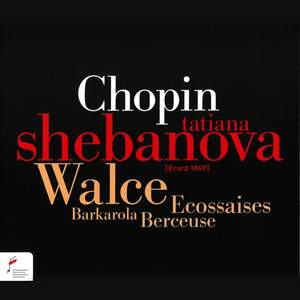
Tatiana Shebanova is one of the most eminent pianists performing today. She is the winner of international competitions in Prague (1969), Geneva (1976) and Brussels (1990), among others. Polish audiences remember her performances during the Tenth International Fryderyk Chopin Piano Competition in Warsaw in 1980, when she received Second Prize and the special prizes for the best performances of a polonaise and a concerto. The disc features new recordings of the Waltzes, Ecossaises, Op. 72, Barcarolle in F sharp major, Op. 60, Berceuse in D flat major, Op. 57. Recordings made on an Erard piano from 1849. Recorded in Witold Lutoslawski Polish Radio Concert Studio, Warsaw, 19-20 May 2007. | | | Usually despatched in 2 - 3 working days. |
|
|
| |  | Chopin - Piano Pieces
This is fascinating programme given by pianist Momo Kodama. Some of the compositions on this
recording are of Chopin’s most popular pieces. Two of them, the Fantaisie Impromptu and 3
Ecossaises were first published and premiered in 1855, six years after the composers death. | | | Usually despatched in 4 - 5 working days. |
|
|
| |  | Chopin ValsesThe Complete Bicentennial Edition of the Works of Chopin
Performed on an authentic Pleyel piano | | | Usually despatched in 4 - 5 working days. |
|
|
| |  | Chopin: Mazurkas, waltzes and other dances
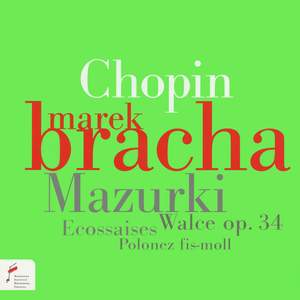
Chopin: | Polonaise No. 1 in C sharp minor, Op. 26 No. 1 Écossaises (3), Op. 72 No. 3 Waltz No. 14 in E minor, Op. post., KKIVa:15, B 56 Tarantella in A flat major, Op. 43 Ländler and Trio in A flat major, Op. posth. Waltz No. 4 in F major 'Grande Valse Brillante', Op. 34 No. 3 Polonaise No. 2 in E flat minor, Op. 26 No. 2 Contredanse in G flat major, KKAnh.Ia/4 Waltz No. 6 in D flat major, Op. 64 No. 1 'Minute Waltz' Waltz No. 7 in C sharp minor, Op. 64 No. 2 Cantabile in B Flat Major (Andantino) Bolero, Op. 19 Waltz No. 3 in A minor 'Grande Valse Brillante', Op. 34 No. 2 Mazurkas (4), Op. 6 |
| |
|
| |  | Stanislav Bunin plays Chopin
Chopin: | Impromptus Nos. 1-4 Waltz No. 17 in E flat major, Op. post., KKIVa:14, B 46 Waltz No. 16 in A flat major, Op. post., KKIVa:13, B 21 Waltz No. 15 in E major, Op. post., KKIVa:12, B 44 Écossaises (3), Op. 72 No. 3 Mazurka No. 19 in B minor, Op. 30 No. 2 Mazurka No. 29 in A flat major, Op. 41 No. 4 Mazurka No. 41 in C sharp minor, Op. 63 No. 3 Mazurka No. 34 in C major, Op. 56 No. 2 Mazurka No. 44 in C major, Op. 67 No. 3 Mazurka No. 45 in A minor, Op. 67 No. 4 Polonaise No. 7 in A flat major, Op. 61 'Polonaise-fantaisie' |
DDD | | | Usually despatched in 8 - 10 working days. |
|
|
| |
|