Prices shown exclude VAT. (UK tax is not payable for deliveries to United States.) See Terms & Conditions for p&p rates. | |  | Chopin Recital
Anne-Marie McDermott (piano) Anne-Marie McDermott's latest recording for Bridge features a broad selection of masterworks by Chopin. She is a consummate artist whose recordings range from Bach and Haydn to Prokofiev and Scriabin. Her recordings of Gershwin and Prokofiev on Bridge have been well received by the press. “Here is a Chopin recital to make you think again...Rarely has Chopin been so decidedly taken out of the salon and made to speak with such a dark, rich and full eloquence...such a dramatic reappraisal lifts Chopin far above more familiar glamorous and facile considerations. The Ballade, in particular, is superb.” Gramophone Magazine, January 2013 “McDermott has a really distinctive artistic voice, and it’s a fascinating one. Her Chopin resembles few others. You almost certainly do not have a reading of the C-sharp minor waltz that sounds like this one. I’d commend this most highly if you need to be stimulated by Chopin that’s quite different from the norm; I’d recommend it least if harshness and steeliness aren’t traits you want to hear in this composer.” MusicWeb International, January 2013 | | | Usually despatched in 2 - 3 working days. |
|
|
| |  | François Dumont: 16th International Chopin Piano Competition
Chopin: | Nocturne No. 13 in C minor, Op. 48 No. 1 Étude Op. 10 No. 10 in A flat major Étude Op. 25 No. 11 in A minor 'Winter Wind' Scherzo No. 3 in C sharp minor, Op. 39 Waltz No. 5 in A flat major, Op. 42 Fantasia in F minor, Op. 49 Mazurkas Op. 50 Nos. 1-3 Barcarolle in F sharp major, Op. 60 Polonaise No. 6 in A flat major, Op. 53 'Héroïque' Polonaise No. 7 in A flat major, Op. 61 'Polonaise-fantaisie' Berceuse in D flat major, Op. 57 Impromptu No. 1 in A flat major, Op. 29 Impromptu No. 3 in G flat major, Op. 51 Piano Sonata No. 3 in B minor, Op. 58 Piano Concerto No. 1 in E minor, Op. 11 Warsaw Philharmonic Orchestra, Antoni Wit |
François Dumont is the winner of the 5th prize at the 16th International Fryderyk Chopin Piano Competition in Warsaw [2010] and the 4th prize at the International Piano Competition in Hamamatsu [2009]. He is a graduate of the Paris Conservatoire. The pianist’s interpretations are classical and romantic yet, in a way typical of the French tradition of Chopin's music performance, he tries to be close to the composer's ideas. This is another portrait of one of the most interesting pianists at the International Fryderyk Chopin Piano Competition. | | | Usually despatched in 2 - 3 working days. |
|
|
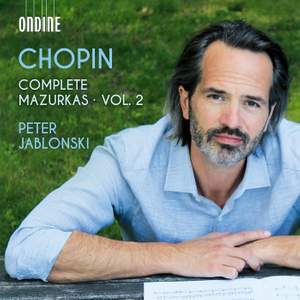
| |  | Chopin - The Complete Mazurkas Volume 2
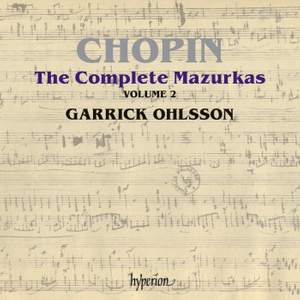
It has been said that the mazurkas are the soul of Chopin, revealing facets of his personality and emotions more directly than any other of his compositions. Of all the forms in which he wrote throughout his career, Chopin turned most frequently to the mazurka, so that the whole collection forms a kind of musical diary, one in which he could confide his most private thoughts, and which, coincidentally, charts his progress as a composer. His modulations, harmonies and use of counterpoint become (generally) more adventurous with each new set. Some later examples verge on the experimental. Chopin preserved the various quintessential elements of this Polish folk dance—the sudden changes of emotion, for instance, or the drone bass of the bagpipes—and, as with the waltz, polonaise and nocturne, elevated an established form into the realm of high art. They are startlingly original—even eccentric sometimes—for the form inspired in him a freedom to explore without inhibition. For all their brevity (few last longer than four minutes) and the variations based on a simple ABA structure (sometimes with a coda), these miniatures have the same narrative cohesion and depth as the more extended Ballades. Volume 2 of the complete mazurkas combines the four late sets of Opp 50, 56, 59 and 63, followed by fifteen individual dances composed between 1826 and 1849. Though Chopin left instructions for them to be destroyed, the two sets published as Opp 67 and 68 were issued after Chopin’s death in 1855 by his friend Julian Fontana with the approval of the composer’s family. The Op 50 set and the three groups that follow share similar structures: an imposing opening dance succeeded by a simpler one and culminating in a contrapuntal finale. On average, they are longer than the earlier mazurkas with more development and use of counterpoint (Op 50 No 3 in C sharp minor and Op 56 No 3 in C minor, for instance, reflect Chopin’s fondness for Bach and the Well-Tempered Clavier). And are they bagpipes we hear in Op 56 No 2? The set was dedicated to his Scottish pupil Catherine Maberly, a friend of his benefactor Jane Stirling. If the three mazurkas of Op 59 (1846) are less ambitious in scope, they seem more spontaneous and at ease, yet with some of Chopin’s most daring modulations (No 1 in A minor) and beautiful melodies (No 2 in A flat major). Also present, and not mentioned hitherto, is another element used frequently throughout the mazurkas—the (sometimes obsessive) use of repeated patterns, as in the well-known final mazurka of the set in F sharp minor. Op 63 was the last set that Chopin published (1847). It is dedicated to the Countess Laura Czosnowska from Warsaw, the flirtatious friend of Chopin’s sister Ludwika. No 1 is certainly vivacious (note a repetitive figure again in the central section). No 3 in C sharp minor is justly celebrated, its poignant melody cleverly worked as a canon in the coda. Of the Opp 67 and 68 mazurkas, the best are Op 67 No 4 in A minor (composed in 1846) and Op 68 No 4 in F minor, to which Fontana affixed the following: ‘Cette Mazurka est la dernière inspiration que Chopin ait jetée sur le papier peu de temps avant sa mort; il était déjà trop malade pour l’essayer au piano.’ (‘This Mazurka is the last inspiration that Chopin committed to paper shortly before his death; he was already too ill to try it out on the piano.’) Wilhelm von Lenz recalled in 1872 the experience of hearing Chopin play his mazurkas: ‘There his playing was truly at home; in them resided Chopin’s originality as a pianist.’ Berlioz agreed. As early as December 1833 (in Le Rénovateur), he was aware of this unique style of playing. ‘Virtually nobody but Chopin himself can play his music and give it this unusual turn’ with ‘a thousand nuances … which are impossible to convey by instructions. There are unbelievable details in his Mazurkas; and he has found how to make them doubly interesting by playing them with the utmost degree of softness, piano in the extreme, the hammers merely brushing the strings, so much so that one is tempted to go close to the instrument and put one’s ear to it as if to a concert of sylphs or elves.’ Chopin played his mazurkas with a rubato so free that some took it to be erratic timing. Meyerbeer called on Chopin one day while he was playing the Mazurka Op 63 No 3, took a seat and commented that Chopin was playing in 2/4. No, Chopin insisted, he was playing in 3/4. No, countered Meyerbeer calmly, beating time, it’s in 2/4. Chopin, who normally never raised his voice, is then reported to have screamed in rage at the suggestion he was playing in anything other than strict time. The two composers held their own and, sadly, parted on bad terms. On another occasion some years later, Karl Halle (better known subsequently as Sir Charles Hallé) made the same observation as Meyerbeer, suggesting that a particular mazurka appeared to be written in 4/4. He obviously caught Chopin in a better mood, for while Chopin initially denied that he was playing in 4/4, in the end had to admit that Halle was right, laughing that it was ‘the national character of the dance which created the oddity’. “Not only does he catch the rhythm, but his feel for nuance and colour misses no element of Chopin’s infinite imagination, and the balance of earthiness and elegance is well-nigh ideal…Ohlsson brings a phenomenal variety of expression and depth of characterisation to these exquisite miniatures - an approach that manages to capture the folk elements of the composer's style to quite hypnotic effect.” BBC Music Magazine, February 2010 ***** | | | Usually despatched in 2 - 3 working days. |
|
|
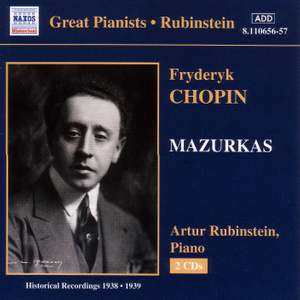
| |  | Chopin: Mazurkas (Vols.1 & 2)
| | | Usually despatched in 4 - 5 working days. |
|
|
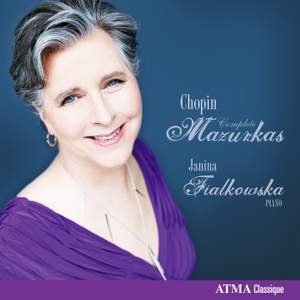
| |  | Chopin: Complete Mazurkas
| | | Usually despatched in 4 - 5 working days. |
|
|
| |  | Chopin: Piano Works
| | | Usually despatched in 4 - 5 working days. |
|
|
| | | |  | Rubinstein plays Chopin
Chopin: | Ballades Nos. 1-4 Recorded in 1959 Scherzi Nos. 1-4 Recorded in 1959 Polonaise No. 1 in C sharp minor, Op. 26 No. 1 Recording first published in 1958 Mazurkas (4), Op. 6 Recording first published 1956 Mazurkas (4), Op. 17 Recording first published 1956 Mazurkas (4), Op. 24 Recording first published 1956 Mazurkas (4), Op. 30 Recording first published 1956 Mazurkas (4), Op. 33 Recording first published 1956 Mazurkas (4) Op. 41 Recording first published 1956 Mazurkas Op. 50 Nos. 1-3 Recording first published 1956 Mazurkas Op. 56 Nos. 1-3 Recording first published 1956 Mazurkas Op. 63 Nos. 1-3 Recording first published 1956 Mazurkas Op. 59 Nos. 1-3 Recording first published 1956 Mazurkas, Op. 68 Recording first published 1956 Mazurka No. 51 in A minor 'Émile Gaillard' Recording first published 1956 Mazurka No. 50 in A minor 'Notre Temps' Recording first published 1956 Polonaise No. 2 in E flat minor, Op. 26 No. 2 Recording first published in 1958 Polonaise No. 3 in A major, Op. 40 No. 1 'Military' Recording first published in 1958 Preludes (24), Op. 28 Recorded in 1946 Nocturnes Nos. 1-19 Recorded 1936-1937 Polonaise No. 4 in C minor, Op. 40, No. 2 Recording first published in 1958 Waltzes Nos. 1-14 Recording first published in 1955 Polonaise No. 5 in F sharp minor, Op. 44 Recording first published in 1958 Polonaise No. 6 in A flat major, Op. 53 'Héroïque' Recording first published in 1958 |
Regis presents a 6 CD box of Chopin’s piano works played by their greatest ever exponent, Artur Rubinstein. The box includes classic recordings of the Ballades, Scherzi, Nocturnes, Mazurkas, Preludes, Waltzes and Polonaises at an incredible price. An indispensible set for lovers of Chopin and piano music in general. ‘One of the greatest pianists of the century ..... a Chopinist ..... without peer.’ New York Times | | | In stock - usually despatched within 1 working day. |
|
|
| |  | Piano Concerto Collection
Beethoven: | Piano Concertos Nos. 1-5 (complete) Piano Concerto in D major, arranged by the composer after the Violin Concerto, Op. 61a | Brahms: | Piano Concerto No. 2 in B flat major, Op. 83 Klavierstücke (4), Op. 119 Piano Concerto No. 1 in D minor, Op. 15 Waltzes (16), Op. 39 | Chopin: | Piano Concerto No. 1 in E minor, Op. 11 Piano Concerto No. 2 in F minor, Op. 21 Variations on Mozart's 'La ci darem la mano' in B flat major, Op. 2 Fantasia in A major on Polish Airs, Op. 13 Krakowiak - Concert Rondo in F, Op. 14 Mazurkas Op. 50 Nos. 1-3 Mazurkas Op. 56 Nos. 1-3 | Gershwin: | Piano Concerto in F major | Grieg: | Piano Concerto in A minor, Op. 16 | Liszt: | Piano Concerto No. 1 in E flat major, S124 Piano Concerto No. 2 in A major, S125 Totentanz, S126 for piano & orchestra Malédiction, S121 Op. 452 | Mendelssohn: | Piano Concerto No. 1 in G minor, Op. 25 Piano Concerto No. 2 in D minor, Op. 40 | Mozart: | Piano Concertos Nos. 1-27 (complete) | Rachmaninov: | Piano Concertos Nos. 1-4 (complete) Rhapsody on a Theme of Paganini, Op. 43 | Ravel: | Piano Concerto in D major (for the left hand) Piano Concerto in G major | Saint-Saëns: | Piano Concertos Nos. 1-5 Africa - Fantasie for piano & orchestra Op. 89 | Schumann: | Piano Concerto in A minor, Op. 54 | Tchaikovsky: | Piano Concerto No. 1 in B flat minor, Op. 23 Piano Concerto No. 2 in G major, Op. 44 |
Derek Han, Shoko Sugitani, Arthur Moreira, Seta Tanyel, Alfred Brendel, Gabriel Tacchino, Karin Lechner, Jorge Federico Osorio, Alexander Cattarino Philharmonia Orchestra, Berliner Symphoniker, Sofia Philharmonic, London Symphony Orchestra, St. Petersburg Philharmonic Orchestra, Vienna Symphony Orchestra, Orchestra of Radio Luxembourg, Royal Philharmonic Orchestra, Slovak Philharmonic Orchestra, Paul Freeman, Gerard Oskamp, Rafael Frühbeck de Burgos, Michael Gielen, Louis de Froment, Eduardo Marturet, Enrique Batiz, Bystrick Rezucha | | | Usually despatched in 4 - 5 working days. |
|
|
| |
|