Liszt: Mephisto Waltz No. 1 (Der Tanz in der Dorfschenke - The Dance in the Village Inn, after lenau)

This page lists all recordings of Mephisto Waltz No. 1 (Der Tanz in der Dorfschenke - The Dance in the Village Inn, after lenau), by Ferencz Liszt (1811-86) on CD, SACD, DVD, Blu-ray & download (MP3 & FLAC). Generally, more recent releases are listed first, but with priority given to those that are in stock.

Recommendations

Instrumental Choice
October 2005
Disc of the Month
May 2009
Disc of the Month
August 2005
Editor's Choice
May 2010
Re-issue of the Month
June 2012
Re-issue of the Month
September 2011
Re-issue of the Month
June 2011
4 star4 starRosette

All recordings

Prices shown exclude VAT. (UK tax is not payable for deliveries to United States.)
See Terms & Conditions for p&p rates.

Kurt Masur conducts Kodály & Liszt

Kurt Masur conducts Kodály & Liszt


Kodály:

Theatre Overture

Háry János Suite

Liszt:

Mazeppa, symphonic poem No. 6, S100

Mephisto Waltz No. 1


Apex - 2564659418

(CD)

$7.50

In stock - usually despatched within 1 working day.

Andrea Kauten plays Liszt

Andrea Kauten plays Liszt


Liszt:

Totentanz, S126 for piano & orchestra

Savaria Symphony Orchestra, Adam Medveczky

Malédiction, S121 Op. 452

Savaria Symphony Orchestra, Adam Medveczky

Les Préludes, symphonic poem No. 3, S97

Savaria Symphony Orchestra, Adam Medveczky

Années de pèlerinage, 2ème année, Italie (7 pieces), S. 161

Hungarian Rhapsody, S244 No. 14 in F minor

Fantasy on Hungarian Folk-tunes, S123

Savaria Symphony Orchestra, Adam Medveczky

Mephisto Waltz No. 1


Andrea Kauten (piano)

“Kauten’s accounts of the pieces making up the Italian-themed second year of Années de Pèlerinage are unusually bold and commanding. The three Petrarch Sonnets show her dreamier, more reflective side and the set ends with an emphatic, enjoyable assault on Liszt’s Hungarian Rhapsody no 14. A comprehensive Liszt greatest hits compilation, beautifully produced and well-annotated.” The Arts Desk, 25th August 2012

Sony - 88697984662

(CD)

$19.00

In stock - usually despatched within 1 working day.

Richter plays Liszt

Richter plays Liszt

From 1958-61 live concerts in Moscow & Budapest


Liszt:

Liebestraum, S541 No. 2 (Nocturne in E flat major)

live, 5 Feb. 1958, Moscow

Liebestraum, S541 No. 3 (Nocturne in A flat major)

live, 5 Feb. 1958, Moscow

Valse oubliée No. 1, S.215/1

live, 5 Feb. 1958, Moscow

Valse oubliée No. 2, S.215/2

live, 5 Feb. 1958, Moscow

Valse oubliée No. 3, S.215/3

live, 5 Feb. 1958, Moscow

Mephisto Waltz No. 1

live, 5 Feb. 1958, Moscow

Fantasy on Hungarian Folk-tunes, S123

live, 27 Sept 1961, Budapest

Hungarian State Orchestra, János Ferencsik

Piano Concerto No. 2 in A major, S125

live, 27 Sept 1961, Budapest

Hungarian State Orchestra, János Ferencsik

Funérailles (Harmonies poétiques et religieuses, S. 173 No. 7)

live, 11 Feb. 1958, Budapest


Sviatoslov Richter (piano)

Although the works of Liszt were not a central part of Richter’s repertoire, he was one of the twentieth century’s important Liszt interpreters and was deeply committed to the works which he did play. In this collection we can hear his delicacy, tenderness and great lyric power in the two Liebesträume and contrasting ferocity in the Mephisto Waltz No.1. These are new digital restorations.

“Richter in his prime and at his best, excelling in music not central to his repertoire. Could even Liszt play better? It seems unlikely. Superb booklet notes.” BBC Music Magazine, September 2012 *****

“The Fantasy is a bravura specimen of Richter’s digital sophistication, a glittering colour-conscious exposé of Liszt’s brilliant vapidity...Bravura, élan, introspection and poetic refinement coalesce in a performance of real power...The whole programme is a feast, in fact, of Richter’s Liszt caught in live performance.” MusicWeb International, January 2013

20% off Music & Arts

West Hill Radio Archive - WHRA6043

(CD)

Normally: $12.75

Special: $10.20

(also available to download from $10.50)

In stock - usually despatched within 1 working day.

Behzod Abduraimov plays Prokofiev, Liszt & Saint-Saëns

Behzod Abduraimov plays Prokofiev, Liszt & Saint-Saëns


Liszt:

Benediction de Dieu dans la solitude (Harmonies poétiques et religieuses, S. 173 No. 3)

Mephisto Waltz No. 1

Prokofiev:

Suggestion diabolique, Op. 4 No. 4

Piano Sonata No. 6 in A major, Op. 82

Saint-Saëns:

Danse macabre, Op. 40


Behzod Abduraimov (piano)

“He doesn’t splash. He doesn’t fake. It’s real” (The Daily Telegraph)

The debut recording from the superb young pianist, who, at the age of just eighteen, won a sensational victory in the 2009 London International Piano Competition, with an electrifying performance of Prokofiev’s Piano Concerto no. 3.

Born in Tashkent, Uzbekistan, Behzod Abduraimov is already a mature concert artist who thrills audiences wherever he appears – including an Asian tour with the Sydney Symphony Orchestra under Vladimir Ashkenazy, where he was dubbed by the press: “The Western Lang Lang”. An extraordinary combination of youthful passion and an astonishing technique gives his performances an irresistible, life-enhancing energy.

His Decca Classics debut album showcases his passionate performance style through the concept of Danses diaboliques, including Horowitz’s incredible version of Saint-Saëns/Liszt Danse macabre – wildly virtuosic pieces, which perfectly capture the white-knuckle ride that is Behzod Abduraimov’s style.

“. . . thought arose: could this fresh-faced child be a new Horowitz?” (The Independent)

“An inventive transcription of Saint-Saens's hackneyed classic allows him to establish immediately his light, transparent touch and immaculately controlled pyrotechnics, while in the middle section he displays a Lisztean grace...La benediction de Dieu is conceived with such refined attention to pace and detail that the poetry is fully released, with the sound possessing a silky sheen.” BBC Music Magazine, August 2012 ***

“Here is a good-themed programme from this 20-year-old Uzbek newcomer of 'demonic dances, God and war, combining technical virtuosity with music fireworks'...The First Mephisto Waltz is fast, accurate and powerful but it won't have you on the edge of your seat...No, but he's a new face on the scene with bags of talent whose future will be well worth watching.” Gramophone Magazine, August 2012

“his debut disc naturally includes plenty that shows off his virtuosity, but music of greater emotional complexity lies at the heart of his programme. Prokofiev’s Sixth Sonata, a complex mix of mood, has kaleidoscopic colour, fierce intensity and, notably in that aching slow-movement waltz, genuine soul.” Sunday Times, 1st July 2012

“His Danse Macabre has a neurotic, sinister air...and he tackles Prokofiev's Piano Sonata No 6 with both youthful eagerness and maturity. That maturity is even more evident in Liszt's reflective Bénédiction de Dieu dans la Solitude, whose subtle shifts of timing and emphasis he negotiates with apparently effortless command.” The Independent, 9th June 2012

“an artist not only of extraordinary technical ability, but also one with a terrific musical personality and sensibility. Those qualities come through clearly on this disc...there is no doubt that Abduraimov has the right intellectual and digital equipment...The two contrasting Liszt pieces at the end...glowing testimony of a talent that is already compelling and certainly one to watch.” The Telegraph, 28th June 2012

“Abduraimov is a young master, that is clear. With luck, time will bring craftier control of musical structures and dynamic shifts...However, he is already well past the point of being brilliant and nothing more. He’s also a player who feels and thinks, and still seems to enjoy performing — a quality not visible in some other young gymnasts of the keys...There’s a big natural talent at work here.” The Times, 8th June 2012 ****

Decca - 4783301

(CD)

$16.75

In stock - usually despatched within 1 working day.

Liszt: Tone Poems & Hungarian Rhapsodies

Liszt: Tone Poems & Hungarian Rhapsodies


Liszt:

Les Préludes, symphonic poem No. 3, S97

London Philharmonic Orchestra, Sir Georg Solti

Prometheus, symphonic poem No. 5, S99

London Philharmonic Orchestra, Sir Georg Solti

Festklänge, symphonic poem No. 7, S101

London Philharmonic Orchestra, Sir Georg Solti

Von der Wiege bis zum Grabe, symphonic poem No. 13, S107

Orchestra de Paris, Sir Georg Solti

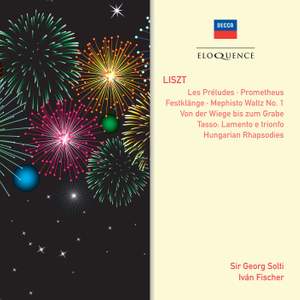
Mephisto Waltz No. 1

Orchestra de Paris, Sir Georg Solti

Tasso, Lamento e trionfo, symphonic poem No. 2, S96

Orchestra de Paris, Sir Georg Solti

Hungarian Rhapsodies, S244 Nos. 1-19: excerpts

Budapest Festival Orchestra, Iván Fischer


Having made revolutionary changes, during the 1830s and 40s, in both piano performance and composition, Liszt was hardly less innovative in his relationship with the orchestra. He is generally credited with having created the genre of the symphonic poem, in which a narrative or extra-musical idea is depicted within a structural framework usually associated with an abstract symphonic movement. In 1974 and 1977 Sir Georg Solti recorded five of the composer’s Tone Poems as well as the Mephisto Waltz No. 1 with the London Philharmonic and the Orchestre de Paris. With fabled ‘Decca Sound’, these recordings have been much sought after by collectors. Recently reissued in the (limited) Liszt Edition, they are now made available generally as a 2CD set.

The coupling is a much-praised version of the Liszt Hungarian Rhapsodies, in orchestrations by both the composer as well as Doppler, by Iván Fischer, considered one of the most important conductors of our time. The interpretations were unforgettably described by Gramophone, on their first appearance, as ‘frisky as foals and as flavoursome as goulash’. Even though he grew up in a family in which German was spoken, and although he left Hungary at a young age, Liszt regarded himself as a Hungarian, and he took considerable pride in that fact. Nevertheless, Liszt and Hungary did not always understand each other. He promoted the idea that Hungary’s true national music was the music of the Gypsies, not realising that many of the melodies played by Gypsy bands were in fact composed (but not written down) by Hungarian landowners whose families did not appreciate Liszt’s misattributions – particularly because the Gypsies were not highly regarded in Hungary. This, however, does nothing to diminish the popularity of the Hungarian Rhapsodies, six of which were orchestrated in conjunction with Franz Doppler, a flute virtuoso and a composer in his own right who met Liszt in 1854 and began orchestrating several of his rhapsodies three years later.

“Solti and Liszt are handsomely matched.” Gramophone Magazine (Solti)

“wildly fiery, pressing things to their utmost limit when the music seems to warrant that, yet not at all without response to the more romantic episodes. [Solti] also has the power to make an orchestra sound like the best in the world and the Orchestre de Paris — this is his first recording with them—play as I have never heard them play before. The Mephisto Waltz No. 1 is given for all it is worth… This is a stunning performance. … this is certainly very exciting record and I commend it without reservation.” Gramophone Magazine (Solti)

“Fischer’s idiomatic foray into this well-worn repertoire is distinguished by tonal lustre and high spirits … Charm is in generous supply everywhere … There is plenty of power, too, with meaty brass and growling crescendos at the start of No. 4, and a riot of colour to close No. 6. Fischer’s Hungarian Rhapsodies are as frisky as foals and as flavoursome as goulash, and are further aided by excellent, full-bodied sound … as dashing and as dancing as anyone might want. Strongly recommended” Gramophone Magazine (Fischer)

GGramophone Magazine

Re-issue of the Month - June 2012

Australian Eloquence - 4804920

(CD - 2 discs)

$14.00

In stock - usually despatched within 1 working day.

Brahms: Piano Concerto No. 1

Brahms: Piano Concerto No. 1


Albéniz:

Triana (from Iberia, book 2)

BBC Maida Vale Studios, London, 29 September 1958

Brahms:

Piano Concerto No. 1 in D minor, Op. 15

BBC Maida Vale Studios, London, 11 October 1967

BBC Symphony Orchestra, Rudolf Kempe

Chopin:

Ballade No. 3 in A flat major, Op. 47

BBC Concert Hall, Broadcasting House, London, 4 October 1965

Liszt:

Mephisto Waltz No. 1

BBC Concert Hall, Broadcasting House, London, 4 October 1965

Schumann:

The Prophet Bird Op. 82 No. 7

BBC Maida Vale Studios, London, 29 September 1958

plus:

Julius Katchen discusses Mozart's Concerto K.466 and Brahms’ Concerto No.1 with John Amis

BBC STUDIOS, LONDON, 15 DECEMBER 1967


The American pianist Julius Katchen (1926–1969) was a child prodigy who at age 11 performed with the Philadelphia Orchestra under Ormandy. In 1946 Katchen toured Europe, settled in Paris in late 1947 and became a frequent performer on the European concert platform.

His technique was ‘gold plated’ and despite his early death at aged 43 from cancer, he had a large discography which still sells today. In December 1968 he famously participated in the two-day spectacular known as the Rolling Stones’ Rock and Roll Circus, playing the first movement of Mozart’s Sonata K545 and Falla’s ‘Ritual Fire Dance’ from El amor brujo.

Katchen made a major study of Brahms during his career and this 1967 live broadcast of Brahms Piano Concerto No.1, with the distinguished German conductor Rudolf Kempe, reflects his deep understanding of this composer.

This recording gives the collector the rare opportunity of hearing Katchen ‘live’ in comparison to his studio account made much earlier in 1959.

The fill-ups consist of familiar Katchen composers, Chopin and Liszt but also two new additions to his discography, Schumann's Prophet Bird Op.82, No.7 and Albéniz’s Triana.

Completing this CD is a rare interview with John Amis where Katchen discusses his early life including his thoughts on Mozart and Brahms interpretation.

These recordings have never been released before and have been remastered using ICA’s Ambient Mastering process which recreates the atmosphere of the concert hall.

“Every bar of Chopin's Third Ballade is illuminated by his stylistic luxuriance and audacity (try the tumultuous rush and glitter in the final bars) and even when almost engulfed by his own virtuosity, his performance of Liszt's First Mephisto Waltz is arguably the most wildly exciting on record....This record is a reminder and a remembrance of a tragic loss but an indelible musical force.” Gramophone Magazine, March 2012

ica classics Legacy - ICAC5048

(CD)

$15.00

(also available to download from $10.50)

In stock - usually despatched within 1 working day.

Liszt: Piano Works

Liszt: Piano Works


Liszt:

Hungarian Rhapsody, S244 No. 8 in F sharp minor

Les jeux d'eaux à la Villa d'Este (Années de pèlerinage III, S. 163 No. 4)

Après une lecture du Dante, fantasia quasi sonata (Années de pèlerinage II, S. 161 No. 7)

Liebesträume, S541 Nos. 1-3

Mephisto Waltz No. 1


Donka Angatscheva (piano)

Gramola - GRAM98924

(CD)

$17.75

(also available to download from $10.50)

In stock - usually despatched within 1 working day.

Liszt: Reve d'Amour

Liszt: Reve d'Amour


Liszt:

Liebestraum, S541 No. 3 (Nocturne in A flat major)

Kun Woo Paik (piano)

Consolation, S. 172 No. 3 in D flat major

François-René Duchâble (piano)

Ballade No. 2 in B minor, S171/R16

François-René Duchâble (piano)

Un Sospiro from 3 Concert Studies, S144 No. 3

François-René Duchâble (piano)

Les jeux d'eaux à la Villa d'Este (Années de pèlerinage III, S. 163 No. 4)

Stephen Hough (piano)

Mephisto Waltz No. 1

Stephen Hough (piano)

Benediction de Dieu dans la solitude (Harmonies poétiques et religieuses, S. 173 No. 3)

Stephen Hough (piano)

Isolde's Liebestod (after Wagner), S447

Mikhail Rudy (piano)


An incomparably gifted pianist, Liszt was a stunning virtuoso, the creator of the solo recital and the father of modern piano technique, as well as being an intensely spiritual artist and a noble composer. “Liszt is not a pianist, he is a poet, whether he plays his own music or that of others,” Théophile Gautier wrote. The influence of the man who Lamartine called “the king of the piano” on the development of piano music was immense, and his piano music amounted to a passionate overture pointing the way to the future of the art.

Liszt considered virtuosity of the kind that makes such a powerful impression in his “Campanella” study (based on one of Paganini’s Caprices for solo violin) or the Mephisto Waltz to be a vital ingredient of the music and not an end in itself. A great admirer of Wagner’s harmonic language, he produced a number of transcriptions of the music of Wagner, which he realised with great brilliance.

Liszt took minor orders in 1863, and several of his works – such as Bénédiction de Dieu dans la solitude, the third piece in the Harmonies poétiques et religieuses (a title borrowed from Lamartine) – can be seen as central to his spiritual quest. He could also be lyrical, as in the celebrated Nocturne, which has become better known under the title Liebestraum, and melancholy or intimate, as in the Consolations, which he dedicated to Victor Hugo. As for the Jeux d’eau a la Villa d’Este (from the Années de pèlerinage), the extraordinary impressionism of this piece look forward to Ravel’s Jeux d’eau.

Virgin Virgo - 0840282

(CD)

$7.25

In stock - usually despatched within 1 working day.

Liszt: Favourite Pieces

Liszt: Favourite Pieces


Liszt:

Grande Étude de Paganini, S. 141 No. 3 'La Campanella'

Romance oubliée, for piano, S. 527

Gnomenreigen, S145 No. 2

Un Sospiro from 3 Concert Studies, S144 No. 3

Rhapsodie espagnole, S254

Liebestraum, S541 No. 3 (Nocturne in A flat major)

Mephisto Waltz No. 1

Consolation, S. 172 No. 3 in D flat major

Rakoczi March, S242a/1 (first version, 1839/40)

Nuages gris, S199

Valse oubliée No. 1, S.215/1

La leggierezza - Étude de concert No. 2, S144

La Lugubre Gondola II, S200 No. 2

Étude d'exécution transcendante d'après Paganini, S. 140 No. 6

Les Préludes, symphonic poem No. 3, S97

Totentanz, S126 for piano & orchestra

Orpheus, symphonic poem No. 4, S98

Mazeppa, symphonic poem No. 6, S100

Piano Concerto No. 1 in E flat major, S124


Sony - 88697897532

(CD - 2 discs)

$16.50

In stock - usually despatched within 1 working day.

Liszt: Piano Works

Liszt: Piano Works


Liszt:

Liebestraum, S541 No. 3 (Nocturne in A flat major)

Piano Sonata in B minor, S178

Mephisto Waltz No. 1

La Lugubre Gondola II, S200 No. 2

Prelude and Fugue in a minor, BWV 543 (J.S. Bach), S. 462/1


Recent Sony Classical signing Khatia Buniatishvili is a phenomenal and acclaimed young artist, and regarded as one of the great pianists of the future. Her debut album for Sony Classical is devoted to Franz Liszt, with a focus on the Faust theme: Liszt’s third Liebestraum is characterised by the line from Goethe’s Faust: ”O stay! Thou art so fair!” and the Mephisto Waltz was inspired by an episode in Nikolaus Lenau’s Faust poem. Moreover Khatia Buniatishvili reads Faust, Marguerite and Mephisto into the themes of the centrepiece of the recording, the Sonata in B Minor – technically one of the most demanding works ever written for piano.

“she certainly shows a startling affinity with [Liszt's] very particular musical world. The B minor Sonata is the centrepiece of Buniatishvili's programme, and she goes at it with real ferocity...Her floating of the melody of the Liebestraum, and her elegant weaving through the mysterious harmonies of La Lugubre Gondola, though, show there is much more to her artistry than just full-frontal musical assaults.” The Guardian, 2nd June 2011 ****

“This debut disc looks like a safe 'Best of Liszt' selection but, thrillingly, is much more than that. Buniatishvili is a young artist with a huge temperament and technique that puts one in mind of the young Martha Argerich.” Classic FM Magazine, August 2011 *****

“as a result of the focused intensity and sumptuous beauty of tone that Buniatishvili brings to the Liebestraum No. 3 we seem to be hearing this hoary old standard afresh. That mesmeric sense of inwardness is here, too, in the transcription of the Bach A minor Prelude and Fugue - which at first feels like a hallucinatory extension of her eloquently desolate account of the near-atonal Lugubre gondola No. 2.” BBC Music Magazine, August 2011 ****

“Buniatishvili is at her best in the Bach A minor BWV543 Prelude and Fugue transcription, where her playing becomes far more poised and controlled, without sacrificing one iota of imagination. The latter selection alone is worth the price of admission.” Gramophone Magazine, September 2011

Sony - 88697766042

(CD)

$17.50

In stock - usually despatched within 1 working day.

Page: 

 1   2   3   4   5   6   7   8   9   10   11   12   13 

 Next >>

Copyright © 2002-13 Presto Classical Limited, all rights reserved.