All recordingsPrices shown exclude VAT. (UK tax is not payable for deliveries to United States.) See Terms & Conditions for p&p rates. | |  | Schumann: Liederkreis
Gerald Finley and Julius Drake return to Schumann, following a magisterially intense Dichterliebe which won them a third Gramophone award. Here they focus on the two contrasting Liederkreis (‘song-circle’) cycles using texts by Heine and Eichendorff. Heine is the poet of Dichterliebe, and Op 24 contains extremes of elation and despair that call all Finley’s considerable dramatic powers into play. Eichendorff’s seductive, crepuscular ‘night-songs’ of Op 39 require the velvety tone for which this singer is equally revered. Separating these two great works are the Sechs Gedichte aus dem Liederbuch eines Malers, Op 36, which find Schumann in more homespun, folksong-influenced vein. “Finley and pianist Julius Drake are well attuned to those pervading atmospheres and psychological shifts; beginning with the veiled tone with which Finley opens Op 39 every song is individually coloured (some of his inflections suggest a close study of Dietrich Fischer-Dieskau's performances), and the text is always clear.” The Guardian, 26th September 2012 **** “With his slow tempos and dark vowels, Finley draws from the Op. 39 Eichendorff Liederkreis a real sense of the fear lurking behind even the ecstasies of love...Drake is perfectly attuned to the palette of shifting colours in Finley's dark baritone - here in top form.” BBC Music Magazine, Christmas 2012 **** “This new recording shows a greater richness in Finley's voice plus an evolving intimacy in his approach to recording Lieder, one that retreats from the word-by-word vocal painting of Dietrich Fischer-Dieskau...Each song's overall conception - of which Julius Drake is a key part - reflects great thought as to its core emotion.” Gramophone Magazine, January 2013 | | | In stock - usually despatched within 1 working day. |
|
|
| |  | Auf Einer Burg
Loewe, C: | Wandrers Nachlied, Op. 9 No. 3b Hinkende Jamben, Op. 62 No. 5 Odins Meeresritt "Meister Oluf, der Schmied auf Helgoland", Op. 118 Süßes Begräbnis, Op. 62 No. 4 Herr Oluf "Herr Oluf reitet spät und weit", Op. 2/2 Der selt'ne Beter op. 141 Tom der Reimer "Der Reimer Thomas lag am Bach", Op. 135a Edward, Op. 1 No. 1 (Herder) Der Pilgrim vor St Just, Op. 99, No. 3 Die Uhr, Op. 123 No. 3 | Schumann: | Liederkreis, Op. 39 |
Henk Neven (baritone) & Hans Eijsackers (piano) Henk Neven studied with Maarten Koningsberger and Margreet Honig at the Conservatory of Amsterdam where he graduated cum laude in 2003. In 2002 he received a diploma cum laude from the New Opera Academy. He followed masterclasses with Graham Johnson, Graham Clark, Rudolf Jansen, Hartmut Höll, Jard van Nes and Robert Holl. He was awarded a Borletti-Buitoni Fellowship in 2009, and is a BBC New Generation Artist 2009-2011. Henk Neven has performed at the BBC Proms and at the Wigmore Hall. He also has a busy career in the opera houses of Europe, including Leporello in Don Giovanni in De Doelen Rotterdam, Patrocle in Iphigénie en Tauride by Gluck at La Monnaie in Brussels, Ottokar in Der Freischütz in Theater an der Wien, Mercutio in Roméo et Juliette at De Nederlandse Opera and Gralritter in Parsifal in Het Concertgebouw Amsterdam. As a recitalist he will appear with Hans Eijsackers in de ‘Vocale Serie’ of Het Concertgebouw, La Monnaie Brussels and de Beurs van Berlage Amsterdam. This is his debut recording, and he has selected Lieder by Carl Loewe to programme with Schumann’s Liederkreis op22, repertoire he loves performing. Neven is a major new vocal talent. “Neven’s highly individual timbre is unlike any other lieder interpreter’s; he sings with astonishing technical finesse, verbal acuity and a youthful sense of wonder in these pieces from Schumann’s annus mirabilis of song, 1840...Eijsackers’s virtuoso piano-playing only enhances this remarkable young singer’s outstanding debut.” Sunday Times, 17th April 2011 **** “His gift of bringing out word-meaning is enhanced by the clearest possible diction and by the beautifully balanced recording. His shading of dynamics and phrasing then crowns each interpretation. It is a consistent joy to hear a Lieder singer whose tone is pure over the widest range without a trace of roughness...It is a long time since I enjoyed a disc of Lieder from a young singer quite as much as this, and I long to hear more from him.” Gramophone Magazine, July 2011 “[Neven] has a beautiful voice, flexible, rounded and warm, and sings, always in the middle of the note, with much intelligence and no affectation...both Neven and his excellent accompanist Hans Eijsackers manage almost to avoid sentimentality” International Record Review, July 2011 “Neven possess a lightly textured, attractive voice, and his diction is focused and expressive” BBC Music Magazine, July 2011 *** | | | In stock - usually despatched within 1 working day. |
|
|
| |  | Schumann Favourite Songs
“full unblemished tone, faultless legato...thoughtful phrasing - many pleasures to offer” Gramophone Magazine “Felicity Lott is a connoisseur's artist, far greater than many more illustrious and publicised rivals...here with great poise and completely unaffected artistry...treasurable” Penguin Guide | | | In stock - usually despatched within 1 working day. |
|
|
| |  | Schumann - Dichterliebe & Liederkreis
“Güra …deserves a place among the elite….it is the only one by a tenor recommendable at present.” Alan Blyth, Gramophone Magazine, January 2003 “[Gura's] partnership with Dutch pianist Jan Schultz is consolidated here with highly intelligent, deeply felt accounts of Schumann's two immortal song cycles....Gura's dashing, dynamic Dichterliebe even
invites comparison with Fritz Wunderlich.” The Observer, 2 February 2003 Classical CD of the Week | | | In stock - usually despatched within 1 working day. |
|
|
| |  | Schumann - Lieder
Vivian Hanner (mezzo soprano) & Frank Peter (piano) | | | In stock - usually despatched within 1 working day. |
|
|
| |  | Schumann - Maria Stuart Lieder
“I would like to sing myself to death like a nightingale”, wrote Schumann in 1840, revealing a sudden passion for the lied, a genre he had hitherto disdained. Written in 1852 in a period of intense nervous suffering, the cycle of Poems of Queen Mary Stuart stands out for its austerity and exceptional concentration of resources; it might be seen as Schumann’s testament. "it's hard to think of a more consistently pleasing example of this voice category recording today" International Record Review, February 2009 “The cycle fits Fink's grave, elegant voice ideally, while pianist Anthony Spiri gently highlights some of the stranger timbres. In the Rückert and Myrthen songs, "Jemand" and "O Sonn', o Meer, o Rose!" have extraordinary shimmer” The Independent on Sunday, 24th January 2010 “Bernarda Fink's light, fresh-voiced mezzo is ideally cast in Schumann's early, ardent Myrthen songs… Here, as throughout the recital, her every phrase is illumined and delicately coloured by the fine-tuned accompanying of Anthony Spiri. …ten of Schumann's settings of Friedrich Rückert, in which Fink captures delightfully the composer's heartfelt love for the inner music of this poetry, in all its fragrant and rapt ardour. This enticing programme ends with a delicately inflected performance of the Op. 39 Liederkreis. Both Fink and Spiri recreate the elusive half-lights and scents of these Eichendorff settings, with every vocal turn and ornament clear and poised, every nuance of rhythm and dynamic seemingly instinctively achieved.” BBC Music Magazine, January 2010 **** “Fink lays bare the pain of both poet and composer, sensitively supported by Anthony Spiri. Rare glimpses of warmth...are beautifully conveyed, even if it's a fleeting comfort...'Mondnacht' is compelling and in 'Zwielicht' she grasps your attention as only the greatest of Lieder singers can do.” Gramophone Magazine, April 2010 | | | In stock - usually despatched within 1 working day. |
|
|
| |  | Schumann - Lieder
Marianne Beata Kielland (mezzo-soprano), Christian Hilz (baritone) & Katia Bouscarrut (piano) Robert Schumann was a romantic par excellence. His life was nomadic, with longed-for fulfilment always elusively out of reach. For Schumann life, love and creative energy rolled themselves together in an unfolding drama, causing together with his long struggle with syphilis – moments of euphoria amidst constant anxiety and self-doubt. His wife and longest love Clara Wieck, though today a ‘moon in eclipse’, was during their lifetimes very much the celebrity of the pair. The three song cycles in this recital reveal Schumann’s deep sensitivity both to poetry heightened as sung melody, and to the piano, supplying its non-verbal accompaniment. It has always been a delicate balance for any composer: maintaining a piano party that is never banal or formulaic, yet not overwhelming. Schumann’s song-writing supports the voice, or more importantly the poetic gesture, with the native virtuosity of Carnaval or the Dävidsbundlertänze, but turned into the most exquisite commentary beneath the vocal line | | | In stock - usually despatched within 1 working day. |
|
|
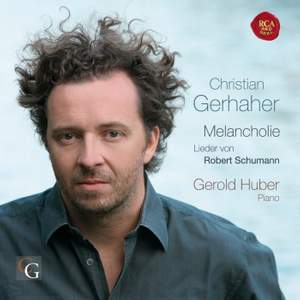
| |  | Melancholie
“The German baritone’s approach to Schumann’s lieder is eminently sensible, sensitive to every word, the curve of each phrase, carefully weighting emotions and colours, strongly supported throughout by Gerold Huber’s poetic piano accompaniments. The Liederkreis cycle is the prime offering, but watch out too for the Hans Christian Andersen settings (Op 40) – in these musicians’ hands, masterpieces of foreboding, death stalking sunshine.” The Times, 25th April 2008 **** “With his bright, burnished high baritone, expressive diction and alert, unexaggerated response to mood and nuance, Gerhaher confirms his credentials as one of the most probing Lieder singers of the younger generation.” Gramophone Magazine, July 2008 “Gerhaher twins the Eichendorff Liederkreis with Schumann's four settings of poems by Hans Christian Andersen - and reveals, in minutely sensitive, sometimes harrowing performances their emotional and musical kinship. And the Op. 39 Liederkreis itself? Well, Gerhaher's fusion of deeply pondered insight and unselfconscious enunciation, together with Gerold Huber's sentient piano allow this exceptional performance to become a benchmark in its own right.” BBC Music Magazine, July 2008 ***** “Though the catch-all title 'Melancholie' is slightly misleading, Christian Gerhaher's enterprisingly planned programme provides a conspectus of Schumann's art as a Lieder composer. With his bright, burnished high baritone, expressive diction and alert, unexaggerated response to mood and nuance, Gerhaher confirms his credentials as one of the most probing Lieder singers of the younger generation. While it is virtually impossible for a single voice to do equal justice to all 12 songs of the Liederkreis, he succeeds better than most. He beautifully suggests the melancholy and mystery of the opening 'In der Fremde', singing with fine legato and a subtly judged use of rubato, and brings an impetuous urgency and a chilling final frisson to the Lorelei scene 'Waldesgespräch'. 'Die Stille', a difficult song for a man to bring off, is delicate and wondering without archness; the bardic 'Auf einer Burg' is hypnotically sustained in a numb, blanched tone, devoid of all nuances, while the final 'Frühlingsnacht', which can easily sound flustered, here has an ecstatic sense of finality. Perhaps Gerhaher and the discerning if sometimes over-discreet Gerold Huber slightly miss the tremulous expectation of 'Intermezzo'; and there have been more magical performances of 'Mondnacht', here taken dangerously slowly. But for imaginative depth in the Liederkreis Gerhaher can certainly stand alongside the best. Gerhaher and Huber choose unusually slow tempi for one or two of the other songs, most questionably in the Andersen song 'Der Spielmann', where the village wedding music should surely suggest more feverish wildness than here. Far more often, though, Gerhaher impresses with his unselfconscious eloquence, whether in the anguished life-weariness of the Harpers' songs, a chillingly timed and coloured 'Der Soldat' or in the potentially mawkish 'Liebesbotschaft', sung with a rapt, echt Schumannesque inwardness. Not for the only time in these Reinick songs, Gerhaher makes you 'upgrade' music that can look distinctly homely, even bland, on the printed page. The baritone provides his own thoughtful note, though frustratingly you'll have to go to his website for English translations of the song texts.” Gramophone Classical Music Guide, 2010 | | | In stock - usually despatched within 1 working day. |
|
|
| |  | The Songs of Robert Schumann - Volume 10
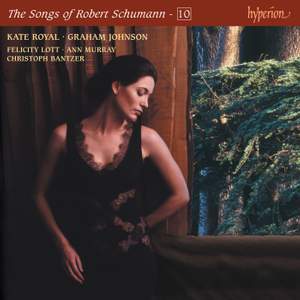
Kate Royal is the soprano of the moment, at the start of her career yet an acknowledged great artist, and her performance here of the Eichendorff Liederkreis Op 39 is one where ‘imagination, intellect and vocal technique are inextricably fused in the single moment of a song’, as The Times wrote of her Wigmore Hall recital in January this year. “In this cycle of dusk and shadows there are two or three songs that always seem to elude a bright, lyric soprano; and for all her beauty of voice and care for phrasing, Royal doesn't quite catch the fear and eeriness of 'Zwielicht' (which here sounds merely melancholy) or the sudden sense of isolation and dread at the end of 'Im Walde'. Other singers, too, have made 'Waldesgespräch' more scary, though Royal does touchingly suggest a human sadness in the spooky woodland drama. But these are minor quibbles. Abetted by Johnson's ever-sentient keyboard-playing, Royal reveals a true understanding of Schumann's Innigkeit, whether in the suppressed passion of the opening 'In der Fremde' (the notorious phrase beginning 'Und über mir rauscht' taken effortlessly in a single breath) and 'Die Stille' (where she avoids the trap of ingénue coyness), the exquisite poise of 'Die Mondnacht' or the tremulous excitement and sense of imminent revelation in 'Schöne Fremde'. In the final 'Frühlingsnacht', often rushed off its feet, she and Johnson catch the elusive mix of secretiveness and ecstasy to perfection. The remainder of the disc is given over to curiosities and rarities. Despite the eloquent declamation of actor Christoph Bantzer, it's hard to work up much enthusiasm for three 'melodramas' which too easily suggest silentmovie music. But there are innocent, Biedermeier delights in assorted duets, sung with bright-eyed eagerness by Felicity Lott and Ann Murray, and in three settings of Emanuel Geibel, beginning with a duet in Schumann's most cosy-comfy vein and ending with a mildly exotic ensemble evoking the gypsy life. Among a clutch of young singers making cameo appearances, the virginal-toned Lydia Teuscher is true and touching in 'Die Nonne' and in the virtually unknown 'Frühlingsgrüsse', whose shy, halting lyricism is so typical of late Schumann. Collectors of this revelatory series will need no reminder that Johnson writes about the music as discerningly and eloquently as he plays.” Gramophone Classical Music Guide, 2010 “The prime attraction for many here… Kate Royal in the popular Eichendorff Liederkreis… Royal's pure, pellucid tone, free-soaring top notes… and refined musicianship give constant pleasure.” Gramophone Magazine, January 2008 | | | In stock - usually despatched within 1 working day. |
|
|
| |  |
| | | (also available to download from $10.50) | In stock - usually despatched within 1 working day. |
|
|
| |
|