Prices shown exclude VAT. (UK tax is not payable for deliveries to United States.) See Terms & Conditions for p&p rates. | |  |
Francesco Cera (organ) Coro della Radiotelevisione Svizzera, Diego Fasolis An original concept: the Orgelbüchlein BWV 599‐644 performed alternating the organ chorale with the same choral sung by a choir. Bach wrote the chorales in the Orgelbüchlein as educational material, to teach how to treat a chorale in polyphonic writing, but as in most of his works, the didactic element is far surpassed by the spiritual content of these miniature masterworks. The alternation of the organ and sung chorale provides a fascinating insight into Bach different treatment of the same melody. New recording with excellent performances by one of Italy’s most famous harpsichordists, Francesco Cera, and the Coro della Radiotelevisione Svizzera conducted by early music specialist Diego Fasolis. For many, Johann Sebastian Bach is ‘the’ composer of the Baroque period, a master of harmony, counterpoint and genre. During his lifetime he was particularly renowned as a virtuoso organist, and his compositions for the instrument have formed the core repertory of any aspiring organist ever since. The content of the Orgelbüchlein – a selection of chorale preludes composed while Bach held the post of Ducal Organist at Weimar – includes several pieces that are considered to be among Sebastian’s finest works. There is evidence that they were written for ‘teaching the various ways of treating a chorale, and the use of the pedal’, but they also have a definite spirituality – the dedication reads: ‘To God Almighty in praise, to everyman for instruction’. The compositions divide into groups intended for use throughout the liturgical year, from Advent to Pentecost. Italian organist and harpsichordist Francesco Cera is a renowned interpreter of 17thcentury keyboard music. He has performed on historical organs throughout Europe, and has recorded four of J.S. Bach’s concertos for harpsichord as well as Domenico Scarlatti’s keyboard sonatas, which he has also performed at the Flanders Festival. He is joined on the recording by the Coro della Radiotelevisione Svizzera, directed by Diego Fasolis. | 
| | | In stock - usually despatched within 1 working day. |
|
|
| |  | Monument: Bach/ Kurtág & Bartók
Bach, J S: | Chorale Prelude BWV633 'Liebster Jesu, wir sind hier' transcriptions for two pianos by G. Kurtág Chorale Prelude BWV611 'Christum wir sollen loben schon' transcriptions for two pianos by G. Kurtág Chorale Prelude BWV619 'Christe, du Lamm Gottes' transcriptions for two pianos by G. Kurtág Chorale Prelude BWV618 'O Lamm Gottes, unschuldig' transcriptions for two pianos by G. Kurtág Chorale Prelude BWV600 'Gott, durch deine Guete' transcriptions for two pianos by G. Kurtág Chorale Prelude BWV599 'Nun komm, der Heiden Heiland' transcriptions for two pianos by G. Kurtág Chorale Prelude BWV601 'Herr Christ, der ein'ge Gottessohn' transcriptions for two pianos by G. Kurtág Chorale Prelude BWV635 'Dies sind die heil'gen zehn Gebot' transcriptions for two pianos by G. Kurtág Chorale Prelude BWV643 'Alle Menschen müssen sterben' transcriptions for two pianos by G. Kurtág Chorale Prelude BWV687 'Aus tiefer Not schrei ich zu dir' transcriptions for two pianos by G. Kurtág Chorale Prelude BWV614 'Das alte Jahr vergangen ist' transcriptions for two pianos by G. Kurtág Chorale Prelude BWV633 'Liebster Jesu, wir sind hier' transcriptions for two pianos by G. Kurtág Chorale Prelude BWV644 'Ach wie nichtig, ach wie flüchtig' transcriptions for two pianos by G. Kurtág Chorale Prelude BWV619 'Christe, du Lamm Gottes' transcriptions for two pianos by G. Kurtág | Bartók: | 7 Pieces from Mikrokosmos for Two Pianos, Four Hands, Sz 108, BB 120 Két Kép (Two Images), Op. 10, BB 59 transcription for two pianos by Zoltán Kocsis, 1978 Suite for Two Pianos, BB 122, Sz. 115a |
After La Valse à mille temps (FUG 577), Jan Michiels and Inge Spinette (the Yin-Yang Duo) return with a new two-piano programme for Fuga Libera. “This recording pays tribute to Bach, Bartók and Kurtág, and also to two legendary piano duos: Dittá and Béla Bartók, and Márta and György Kurtág. We don’t compose music ourselves; that’s why we have composed . . . a programme; with a “monument” by Bartók – one of the greatest pianists of his time – accompanied by Bach chorales in a Kurtágian landscape . . .” (Jan Michiels). A recording that highlights the strength of the union of two minds, which – like Dittá and Béla Bartók, Márta and György Kurtág, and . . . Inge Spinette and Jan Michiels – can phrase music with a rare degree of intensity and acuity. | 
| | | Usually despatched in 4 - 5 working days. |
|
|
| |  |
Bruno Oberhammer (organ) Capella St. Nicolaus, Benjamin Lack This is a collection of 48 choral arrangements which takes us through the ecclesiastical year, although the work was never completed. Bruno Oberhammer plays the Rieger Organ in the Parish Church of St.Johann, Höchst, one of the most prominent neo-baroque churches in the Lake Constance area. | | | Usually despatched in 2 - 3 working days. |
|
|
| |  |
Markku Heikinheimo (Verschueren organ of the Sibelius Academy Organ Hall) | |
|
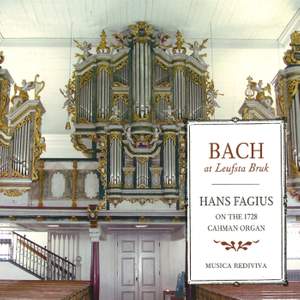
| |  | Hans Fagius on the 1728 Cahman Organ at Leufsta Bruk
Bach, J S: | Fantasia in G major, BWV572 Chorale Prelude BWV645 'Wachet auf, ruft uns die Stimme' Chorale Prelude BWV646 'Woll soll ich fliehen hin' Chorale Prelude BWV647 'Wer nur den lieben Gott laesst walten' Chorale Prelude BWV648 'Meine Seele erhebt den Herren' Chorale Prelude BWV649 'Ach bleib’ bei uns, Herr Jesu Christ' Chorale Prelude BWV650 'Kommst du nun, Jesu, vom Himmel herunter' Prelude & Fugue in C major, BWV545 Trio Sonata No. 4 in E minor, BWV528 Chorale Partita BWV767 'O Gott, du frommer Gott' Chorale Prelude BWV635 'Dies sind die heil'gen zehn Gebot' Fantasia & Fugue in G minor, BWV542 'Great' |
The organ in the church of Leufsta Bruk (north of Uppsala) was built in 1726-28 by Johan Niclas Cahman, Sweden's foremost organ maker at the time. It is without comparison the most outstanding among the maintained baroque organs in Sweden. It has recently undergone a thorough restoration in order to bring it, as far as possible, back to its original state. Therefore, this CD demonstrates the sound and musical possibilities of the organ in all its former glory. Moreover, professor Fagius likes to show how congenially this instrument conveys J.S. Bach's matchless music. In addition to the commentary by professor Fagius, the booklet contains beautiful colour photos of the organ and also of the interior and surroundings of the church. | | | Usually despatched in 4 - 5 working days. |
|
|
| |  |
Pierre Bardon performs on the great organ of St. Maximin, giving us a striking interpretation of Bach's musical "Bible". | | | Usually despatched in 2 - 3 working days. |
|
|
| |  |
Jozef Sluys (Collon Organ in Brussels Cathedral) | |
|
| |  | JS Bach: Orgelbüchlein avec alternance de chorals à 4 voix
Vincent Warnier (organ - Kern organ of l'Eglise Saint-Martin de Masevaux) | | | Usually despatched in 2 - 3 working days. |
|
|
| |  | Bach: Complete Organ Works Volume 5
Helga Schauerte (organ) Immortal Bach Ensemble These chorale settings by Bach are for the various liturgical seasons of the year. Each chorale is set with a vocal text, sung by the Immortal Bach Ensemble, in either a mixed a cappella scoring or by members of the ensemble singing in direct unison with the organ. | | | Usually despatched in 2 - 3 working days. |
|
|
| |  | JS Bach: Organ Works Volume 2
two CDS for the price of one “For Bach's '18' and 'Schublers' Margaret Phillips went to Germany; her new Orgelbüchlein explores the recent Bachian Aubertin organ of Saint-Lous-en-L'Île, Paris - an inspired match for her attentive and unfussy readings.” BBC Music Magazine, November 2007 **** | | | Usually despatched in 4 - 5 working days. |
|
|
| |
|