Prices shown exclude VAT. (UK tax is not payable for deliveries to United States.) See Terms & Conditions for p&p rates. | |  | Handel In The Playhouse
Handel: | Rinaldo: March Some confounded Planet reigning, HWV 28 Smile, smile, my Chloe, smile, HWV 22 The little wanton god, HWV 228/14 Sonata in C major for recorder and continuo, HWV365, Op. 1 No. 7: Allegro In vain, in vain, I rove, HWV 47 How cruel are the Traitors, HWV 228/19 Water Music Suite No. 3 in G major, HWV350: excerpts Was ever a Man possest?, HWV 15 Beauty's but a fading Flower, HWV 228/6 Why you little blind Contriver, HWV 228/22 Rinaldo Overture Away with Suspicion, HWV 542 Brave Boys prepare, HWV 20 Oboe Sonata in f major, HWV 363a: Bourree Hence with tedious dull repining, HWV 228/4 Abroad after Misses, HWV 348 Variation for the Harpsichord to the Gavot in Otho Women in vain Love's powerful Torrent, HWV 14 Do not ask me if I love you, HWV 27 Grant Mars, grant us thy Fires, HWV 28 |
Mary Bevan (soprano) & Greg Tassell (tenor) L'Avventura London, Zak Ozmo (director) London-based early music group L'Avventura announces the launch of their debut CD, a unique collection of previously unrecorded music by Handel. Fighting the deluge of re-recordings and re-issued CDs in this Handel anniversary year, Opella Nova Records is pleased to present a new group with a completely different take on the venerated composer. The playful, eminently-listenable Handel in the Playhouse is the debut album of new early music ensemble L'Avventura London, directed by Zak Ozmo, based on new musicological research. Consisting mainly of previously unheard English playhouse music composed by Handel, the recording is perfectly timed to coincide with the anniversary of the composer's death. An unusually large number of Handel tunes have been discovered in comic 18th-century musical theatre pieces called ballad operas.Working in London in the 1730s, the authors of these theatre works (which included quality playwrights and writers such as novelist Henry Fielding) cleverly stole Handel's music from his fashionable operas and instrumental works, added new English texts and used them in their own music theatre pieces. The ballad operas, which included (among others) the timeless Beggar's Opera, were staged many hundred times more than even the most successful of Handel's Italian operas. They were performed ceaselessly in London and were huge hits in the provinces for over a century. It was these versions of Handel's music, according to scholars, that were the most well known among British middle-class audiences in the first half of the 18th century. It was also this music that made the composer popular as a national composer, as these very English ballad operas were successes years before Handel's oratorios were fashionable. Handel in the Playhouse is full of new discoveries and the instrumentalists' energetic and sensitive playing brings light to the novel and highly entertaining songs. These little musical gems, played and sung as they would have been performed in the fairs and tiny packed theatres outside London, show the lively and colourful tastes of 18th-century middle-class audiences.The disc also includes a fresh take on movements of the Water Music and the overture from Rinaldo. L'Avventura London has a UK tour planned for Winter 2009-2010. Future releases include a recording of unrecorded 18th-century Portuguese modinhas (sentimental love songs) and related instrumental music, a CD of greatest Baroque hits, Italian instrumental works and a recording of 18th-century Scottish folk songs (all previously unrecorded) in collaboration with a modern Scots folk singer. “The performances are fully in keeping with the nature of the genre: hearty singing by Mary Bevan and Greg Tassell; robust instrumental playing by a small band of string and winds. …medley of popular ditties and foot-tapping instrumental numbers - movements from Handel's solo sonatas and arrangements from Rinaldo and the Water Music - carried off with spirit.” BBC Music Magazine, March 2010 **** “Ozmo has researched and worked incredibly hard on this labour of love, and his insightful commentary on the music and performance practice chosen for this programme contains some fascinating facsimiles of historical sources” Gramophone Magazine, April 2010 | | | Usually despatched in 3 - 4 working days. |
|
|
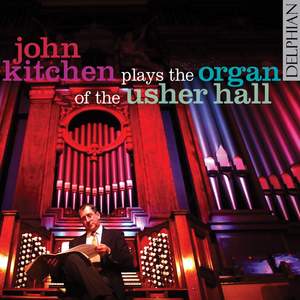
| |  | John Kitchen plays the Organ of the Usher Hall
The first recording of the newly refurbished Norman & Beard concert organ in Edinburgh's Usher Hall, built in 1914. In an eclectic selection of repertoire ranging from transcriptions of popular orchestral works to Liszt's tortuous Weinen, Klagen, internationally acclaimed organist John Kitchen demonstrates the instrument's sonic versatility and brilliance of tone. "Kitchen brings rhythmic swagger and élan…The great Edwardian, Elgar, is represented by the Larghetto from his Serenade for Strings, giving Kitchen the chance to demonstrate the organ's quasi-orchestral strings, before letting rip in the celebrated 'Nimrod' from Enigma Variations." London Evening Standard, May 2004 “Kitchen leaves no stone unturned in his search for colour, and reveals how close this type of instrument is to its cousin, the theatre organ. The Walton Popular Song and Hollins Triumphal March see the organ in its natural habitat and Kitchen's playing is instinctive and full of pizzazz.” BBC Music Magazine, November 2004 **** “Built in 1914, the monumental organ in the Usher Hall, Edinburgh has been restored to its former Edwardian glory. City Organist John Kitchen celebrates the aesthetic of that period. Three Handel marches are delivered in grand style, with irrepressible brio. Kitchen brings rhythmic swagger and élan to Hollins’ Triumphal March (complete with carillon), Walton’s Orb and Sceptre and Bach’s “St Anne” Prelude and Fugue.” Evening Standard “Alfred Hollins’s Triumphal March. Elgar’s Nimrod and marches by Handel are atmospherically rendered, and real expressive depth achieved in Bach’s monumental St Anne Fugue and Liszt’s Weinen, Klagen, Sorgen, Zagen. Arrangements of Walton’s Popular Song (from Façade) and Orb and Sceptre march are delightfully contrasted.” Sunday Times, 19th April 2009 *** | | | Usually despatched in 3 - 4 working days. |
|
|
| |  | 40 Famous Marches
Alford: | Colonel Bogey March | Bach, C P E: | March | Beethoven: | The Ruins of Athens -Turkish March | Berlioz: | La Damnation de Faust, Op. 24: Rákóczi March | Bizet: | Carmen Suite No. 2 - Marche des contrebandiers | Bliss: | Things to Come: March | Chabrier: | Joyeuse marche | Clarke, Jeremiah: | Trumpet Voluntary 'Prince of Denmark's March' | Coates, E: | Dam Busters March | Elgar: | Pomp and Circumstance March No. 1 in D major, Op. 39 No. 1 Pomp and Circumstance March No. 4 in G major, Op. 39 No. 4 | Fucik: | Entry of the Gladiators | Gounod: | Funeral March of a Marionette | Handel: | Rinaldo: March Dead March from Saul The Occasional Oratorio, HWV62: March | Karg-Elert: | Nun danket alle Gott, marche triomphale, Op. 65 No. 59 | Mendelssohn: | Athalie: War March of the Priests A Midsummer Night's Dream: Wedding March | Meyerbeer: | Le prophète: Coronation March | Nielsen: | Aladdin Suite, Op. 34: Oriental Festive March | Prokofiev: | The Love for Three Oranges: March | Purcell: | Music for the Funeral of Queen Mary, 1695: March | Rimsky Korsakov: | The Tale of Tsar Saltan: March Mlada: Procession of the Nobles | Schubert: | Marche Militaire, D733 No. 1 | Sibelius: | Karelia Suite, Op. 11: Alla marcia | Sousa: | Washington Post The Stars and Stripes Forever | Strauss, J, II: | Jubel Marsch Persischer Marsch, Op. 289 Egyptischer Marsch, Op. 335 Napoleon-Marsch Russischer Marsch Spanischer Marsch, Op. 433 | Tchaikovsky: | The Nutcracker: March | Verdi: | Grand March from Aida | Wagner: | Tannhäuser: Grand March | Walton: | Crown Imperial |
| | | Usually despatched in 2 - 3 working days. |
|
|
| |
|