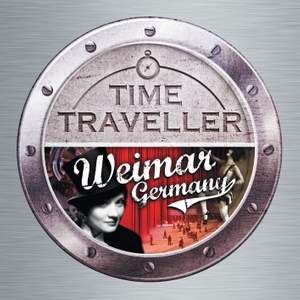
All recordingsPrices shown exclude VAT. (UK tax is not payable for deliveries to United States.) See Terms & Conditions for p&p rates. | |  | Time Traveller: Weimar Germany
and excerpts from Wozzeck, Berliner Requiem, Mahagonny, Happy End, The Threepenny Opera and Remembering Maria
Famed for its divine decadence, explosive politics, rampant inflation and feverish creativity. Germany’s Weimar Republic – born in the wake of World War I – ended in 1933 with Hitler’s seizure of power. Nothing is more evocative of this tumultuous ear than Kurt Weill’s piquant, jazzy score setting the iconoclastic texts of Bertolt Brecht. Putting them graphically in context are works by other musical luminaries of the era: lust Korngold, purposeful Hindemith, sensitive Berg and revolutionary Schoenberg. | | | In stock - usually despatched within 1 working day. |
|
|
| |  | Hindemith: 20th Century Classics Volume 2Kammermusik
Hindemith: | Kammermusik No. 1 Op. 24 No. 1 für 12 Solo-Instrumente Berliner Philharmoniker, Claudio Abbado Kammermusik No. 2 Op. 36 No. 1 Klavierkonzert Lars Vogt (piano) Berliner Philharmoniker, Claudio Abbado Kammermusik No. 3 Op. 36 No. 2 Cellokonzert Georg Faust (cello) Berliner Philharmoniker, Claudio Abbado Kammermusik No. 4 Op. 36 No. 3 Violinkonzert Kolja Blacher (violin) Berliner Philharmoniker, Claudio Abbado Kammermusik No. 5 Op. 36 No. 4 Bratschenkonzert Wolfram Christ (viola) Berliner Philharmoniker, Claudio Abbado Kammermusik No. 6 Op. 46 No. 1 Konzert für Viola d'amore Wolfram Christ (viola d'amore) Berliner Philharmoniker, Claudio Abbado Kammermusik No. 7 Op. 46 No. 2 Konzert für Orgel Wayne Marshall (organ) Berliner Philharmoniker, Claudio Abbado Sonata for Solo Violin, Op. 11 No. 6 Première of the complete version Christian Tetzlaff (violin) Sonata for 10 Instruments (fragment 1917) Kornelia Brandkamp, Diemut Schneider, Ib Hausmann, Jochen Ubbelohde, Dag Jensen, Julia Fischer, Daniel Hope, Tatjana Masurenko, Alban Gerhardt & Rolf Jansen |
Paul Hindemith (1895-1963) is a greatly misunderstood composer. General opinion would have it that his music is rather dry, academic and lacking in humour but this is very far from the truth, as this set of his complete Kammermusik beautifully illustrates. The seven Kammermusik (Chamber Music) were written in the 1920s and are the first works of Hindemith's maturity, at a time when he had already established himself as one of the leading young composers in Germany. Hindemith's music here is very much of its time, being a thumb-to-nose reaction to the romantic excesses that had gone before. Kammermusik No.1, written in 1921, reflects the composers earlier experience as a performer in dance bands and musical comedy orchestras; Nos.2-7 are all concertos, each for a different soloist and instrumentation, that in essence have a more than passing resemblance to the Brandenburg Concertos of Bach. | | | In stock - usually despatched within 1 working day. |
|
|
| |  | Hindemith - Kammermusik Nos. 1-7
“As the Chailly set appears to have limited distribution, do consider the Abbado discs. While lacking a little of the gem-like incisiveness of his compatriot's Concertgebouw version, it is needless to say magnificently played.” Gramophone Classical Music Guide, 2010 | | | In stock - usually despatched within 1 working day. |
|
|
| |  | Paul Hindemith
Lee Luvisi (piano), Raphael Hillyer (viola) Louisville Orchestra, Jorge Mester, Lawrence Leighton Smith | | | In stock - usually despatched within 1 working day. |
|
|
| |  | Hindemith: Kammermusik 1-7
Neo-classicism with a German accent – a recording from the mid 1960s with outstanding soloists more usually associated with Baroque music. | | | Usually despatched in 4 - 5 working days. |
|
|
| |  | Paul Hindemith - Kammermusik
“Hindemith's series of Kammermusik ('Chamber Music') began in 1921 as an iconoclastic response to the hyperintense emotionalism of German Expressionist music over the previous 15 years. It continued until 1927, at which point he began to rationalise the harmonic and expressive foundations of his style. This, then, is neo-classicism with a German accent; as such it was to be a vital force in sweeping away the cobwebs of late romanticism; Walton, Prokofiev, Shostakovich and Britten were among those who, however indirectly, would feel the benefit. The music is also immensely enjoyable in its own right. Hindemith cheekily throws together disparate idioms and sheer force of personality is all that guards against anarchy. All this is done with more than half an eye on the performers' enjoyment of recreation, and the fine array of artists assembled by Chailly savour every detail. Recording quality is exemplary.” Gramophone Classical Music Guide, 2010 | | | Usually despatched in 8 - 10 working days. |
|
|
| |  | Hindemith - Complete Orchestral Works Volume 2
| | | Usually despatched in 2 - 3 working days. |
|
|
| |  | Sviatoslav Richter - Concerto Edition
Bach, J S: | Keyboard Concerto No. 1 in D minor, BWV1052 USSR State Symphony Orchestra, Kurt Sanderling Keyboard Concerto No. 3 in D major, BWV1054 Students’ Orchestra of the Moscow State Conservatory, Yuri Nikolayevsky Keyboard Concerto No. 7 in G minor, BWV1058 Students’ Orchestra of the Moscow State Conservatory, Yuri Nikolayevsky | Bartók: | Piano Concerto No. 2, BB 101, Sz. 95 USSR State Symphony Orchestra, Evgeny Svetlanov | Beethoven: | Piano Concerto No. 3 in C minor, Op. 37 Moscow Youth Symphony Orchestra, Kurt Sanderling Fantasia for Piano, Chorus and Orchestra in C minor, Op. 80 USSR State Radio Symphony Orchestra and Chorus, Kurt Sanderling | Berg: | Chamber Concerto for Piano and Violin with 13 Wind Instruments Oleg Kagan (violin) All-Union Radio and TV Large Symphony Orchestra, Rudolf Barshai | Brahms: | Piano Concerto No. 2 in B flat major, Op. 83 USSR State Symphony Orchestra, George Georgescu | Britten: | Piano Concerto, Op. 13 USSR State Symphony Orchestra, Evgeny Svetlanov | Chopin: | Piano Concerto No. 2 in F minor, Op. 21 USSR State Symphony Orchestra, Evgeny Svetlanov | Dvorak: | Piano Concerto in G minor, Op. 33 Moscow Philharmonic Orchestra, Evgeny Svetlanov | Franck, C: | Les Djinns, Op. 45 Moscow Youth Symphony Orchestra, Kirill Kondrashin | Haydn: | Keyboard Concerto No. 11 in D major, HobXVIII:11 Minsk Chamber Orchestra, Yuri Tsiryuk | Hindemith: | Kammermusik No. 2 Op. 36 No. 1 Klavierkonzert Moscow Conservatory Orchestra, Yuri Nikolayevsky | Mozart: | Piano Concerto No. 20 in D minor, K466 Moscow State Symphony Orchestra, Karl Eliasberg Piano Concerto No. 27 in B flat major, K595 Moscow Philharmonic Orchestra, Kirill Kondrashin Piano Concerto No. 14 in E flat major, K449 Moscow Chamber Orchestra, Rudolf Barshai | Prokofiev: | Piano Concerto No. 1 in D flat major, Op. 10 Moscow Youth Symphony Orchestra, Kirill Kondrashin | Schumann: | Piano Concerto in A minor, Op. 54 USSR State Symphony Orchestra, George Georgescu | Strauss, R: | Burleske for Piano and orchestra in D minor USSR State Symphony Orchestra, Gennady Rozhdestvensky | Tchaikovsky: | Piano Concerto No. 1 in B flat minor, Op. 23 Moscow Philharmonic Orchestra, Kirill Kondrashin |
A generous and adventurous collection of piano concertos played by the Russian Giant of the Keyboard, Sviatoslav Richter. Next to standard concert repertoire some novelties, like the Franck, Britten, Berg and Hindemith works. Famous conductors like Evgeny Svetlanov, Kyril Kondrashin and the recently deceased Rudolf Barshai (his favourite conductor). One of the greatest pianists of the 20th century, Sviatoslav Richter was also one of the most self contained, enigmatic and elusive artists of the time.A fierce self-critic he seldom was happy with the results of his recordings. His criticism often embraced conductors, producers and sound engineers. These recordings capture him a wide range of concertos from Bach to Britten, via his beloved Haydn, Mozart, Beethoven (though he only recorded his concertos 1&3 and the Triple Concerto) and Brahms. Many of the recordings date from prior to the commercial releases. The Dvorak here is from 1966 and conducted by Kondrashin. The famous EMI LP with Kleiber appeared in the 1970s – Richter claimed that neither he nor Kleiber were in the best form. In the case of the Britten concerto with the composer conducting, the recording here is from 3 years earlier than the famous Decca LP. Richter was unhappy with this as Britten was apparently ill and ‘a shadow of himself’. The Brahms 2 and the Schumann are from private tapes owned by conductor George Georgescu who is at the helm in both concertos. A good example of Richter’s self - criticism can be found in his comment on his later RCA Chicago Symphony/Leinsdorf recording ‘one of my worst records…I can’t bear it’. It won a Grammy! This set also includes some of the lesser known works Richter championed - Les Djinns by Franck and the Dvorak Piano Concerto which he played more than 25 times from the 1960s to the 80s. He did more than any pianist to restore this work to the repertoire. | | | In stock - usually despatched within 1 working day. |
|
|
| |
|