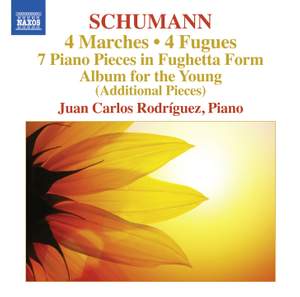
Prices shown exclude VAT. (UK tax is not payable for deliveries to United States.) See Terms & Conditions for p&p rates. | |  | Schumann: Vier Märsche & Vier Fugen
Juan Carlos Rodríguez (piano) Schumann’s Four Fugues, Op. 72 were written during a period of ill-health in 1845 but these masterly pieces reveal nothing of his private turmoil. The Album für die Jugend followed in 1848. In this recording we hear the alternative version of Wilder Reiter (The Wild Rider), with its slightly more ambitious ending, as well as those pieces Schumann excised from the first edition. The Revolutionary year of 1849 brought resurgence in his creativity in the form of the Four Marches, Op. 76 which are imbued with a martial spirit. The Albumblatt: Ahnung (Album Leaf: Foreboding) was only rediscovered in 2007. | 
| | | (also available to download from $6.00) | Usually despatched in 2 - 3 working days. (Available now to download.) |
|
|
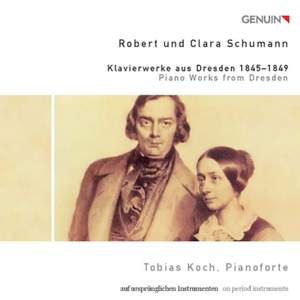
| |  | Robert & Clara Schumann: Piano Works from Dresden 1845 - 1849
This CD includes Robert Schumann’s 4 Marches Op. 76 and 4 Fugues Op. 72, as well as Clara Schumann’s 3 Preludes and Fugues Op. 16. Tobias Koch is considered one of the most versatile and distinguished keyboard artists of his generation and specializes in period performance. Here he performs on an 1852 Erard Concert Grand. | |
|
| |  | Schumann - Piano Works & Chamber Music V
Eric Lesage continues his flamboyant exploration of Robert Schumann's solo piano repertoire, recorded in the outstanding acoustic of La Chaux-de-Fonds.This series will be completed in 2010, the anniversary of Schumann's birth. | | | (also available to download from $21.00) | Usually despatched in 4 - 5 working days. (Available now to download.) |
|
|
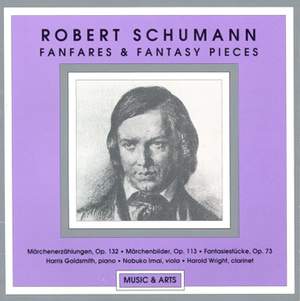
| |  | Robert Schumann: Fanfares & Fantasy Pieces
Harris Goldsmith (piano), Harold Wright (clarinet), Nobuko Imai (viola) | |
|
| |  | Schumann Project: Eric Le SageComplete Piano Solo Music
Schumann: | Davidsbündlertänze, Op. 6 Intermezzi (6), Op. 4 Piano Sonata No. 3 in F minor, Op. 14 'Concerto Without Orchestra' Variations (Impromptus) on a Theme by Clara Wieck, Op. 5 Fantasie in C major, Op. 17 Humoreske, Op. 20 Piano Sonata No. 1 in F sharp minor, Op. 11 Bunte Blätter, Op. 99 Études symphoniques, Op. 13 Études symphoniques (5), WoO 6 Novelletten (8), Op. 21 Marches (4), Op. 76 Piano Sonata No. 2 in G minor, Op. 22 Nachtstücke, Op. 23 Fantasiestücke, Op. 111 Gesänge der Frühe (5), Op. 133 Kreisleriana, Op. 16 Fugues (4), Op. 72 Fantasiestücke, Op. 12 Album for the Young, Op. 68 Allegro in B minor, Op. 8 Faschingsschwank aus Wien, Op. 26 Klavierstücke (4), Op. 32 Three Sonatas for the Young, Op. 118 Papillons, Op. 2 Variations (Impromptus) on a Theme by Clara Wieck, Op. 5 Paganini Studien (6), Op. 3 Paganini Studien (6), Op. 10 Abegg Variations, Op. 1 Toccata in C major, Op. 7 Kinderszenen, Op. 15 Variations on a theme by Beethoven Carnaval, Op. 9 Etüden (4) aus dem ersten Autograph Etüden (4) aus dem zweiten Autograph Romances (3), Op. 28 Albumblatter, Op. 124 Blumenstück, Op. 19 Seven Clavierstücke in Fughettenform, Op.126 Theme with Variations for Pianoforte Waldszenen, Op. 82 |
A great Romantic journey! Winner of Prix de l'Académie Charles Cros, this set brings together Robert Schumann's complete works for solo piano. This great cycle benefited from having been recorded in the unique acoustics of La Chaux-de-Fonds, Switzerland, by the same recording engineer, Jean-Marc Laisné. Sales of the 13 CDs comprising this set have exceeded 20,000 copies round the world. This complete recording is now acknowledged as a reference and, at the same time, an important step in the artistic life of pianist Eric le Sage. | 
| | | In stock - usually despatched within 1 working day. |
|
|
| |  | Schumann: Complete Solo Piano Works
Schumann: | Kreisleriana, Op. 16 Piano Sonata No. 1 in F sharp minor, Op. 11 Piano Sonata No. 2 in G minor, Op. 22 Piano Concerto in A minor, Op. 54 Faschingsschwank aus Wien, Op. 26 Fantasiestücke, Op. 12 Waldszenen, Op. 82 Arabeske in C major, Op. 18 Kinderszenen, Op. 15 Allegro in B minor, Op. 8 Novelletten (8), Op. 21 Fantasiestücke, Op. 111 Gesänge der Frühe (5), Op. 133 Album for the Young, Op. 68 Carnaval, Op. 9 Nachtstücke, Op. 23 Toccata in C major, Op. 7 Klavierstücke (4), Op. 32 Presto passionato in G minor op.22 Abegg Variations, Op. 1 Intermezzi (6), Op. 4 Études symphoniques, Op. 13 Davidsbündlertänze, Op. 6 Papillons, Op. 2 Piano Sonata No. 3 in F minor, Op. 14 'Concerto Without Orchestra' Variations (Impromptus) on a Theme by Clara Wieck, Op. 5 Humoreske, Op. 20 Liederalbum für die Jugend, Op. 79 Paganini Studien (6), Op. 3 Three Sonatas for the Young, Op. 118 Bunte Blätter, Op. 99 Albumblatter, Op. 124 Blumenstück, Op. 19 Paganini Studien (6), Op. 10 Marches (4), Op. 76 Seven Clavierstücke in Fughettenform, Op.126 Scherzo in F minor, Op. posth. Variations on a theme by Beethoven Fugues (4), Op. 72 Romances (3), Op. 28 Theme with Variations in E flat major WoO 24 ('Geistervariationen') Studies (6) in Canonic Form, Op. 56 |
Schumann’s piano output contains only 2 sonatas (3 if the Op.14 concerto without orchestra is included), the reason for this is that he was not at all comfortable working within the classical structures, preferring freer structures. The masterpieces – the Fantasy Op.17, the Humoreske Op.20, Carnaval, Pappilons, Kreisleriana and the Symphonic Etudes rank among the greatest works in the piano repertoire. The torrent of imagination and emotion Schumann poured into these works is extraordinary by any standards. These 13 CDs contain his entire output for solo piano, plus his only completed piano concerto (again his problem with classical forms lead him to abandon 2 other piano concertos), which has become one of the best loved piano concertos in the repertoire. “What I enjoyed most is Brautigam's vitality— vitality of imagination no less than of fingers. You are immediately gripped by his plunge into the Op.8 Allegro, with its arresting octave 'motto'. His mercurial fancy
and ear for hidden melodic strands in the ensuing stream certainly makes nonsense of hasty dismissal of this work as mere old-style virtuoso note-spinning. Moreover, such is his unflagging impulse in the eight
Novelletten that never for a moment are you tempted to accuse Schumann of overrepetitively patterned figuration.” Gramophone Magazine, June 1994 | | | Usually despatched in 4 - 5 working days. |
|
|
| |
|