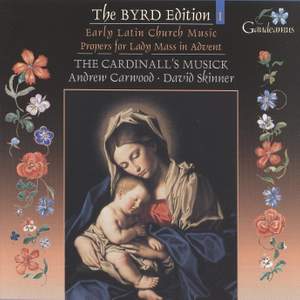
All recordingsPrices shown exclude VAT. (UK tax is not payable for deliveries to United States.) See Terms & Conditions for p&p rates. | |  | Byrd Edition Volume 1Early Latin Church Music - Propers for Lady Mass in Advent
“This is a great start to The Cardinall's Musick's project to record Byrd's complete output. On the disc, some of the shorter motets are entrusted to The Cardinall's' habitual instrumental accomplices, the Frideswide Consort. A full list of sources is given for each piece, along with appropriate editorial commentary. Since Byrd set certain texts a number of times, such precision seems only sensible. Much of this music is new to the CD catalogue, and even in this selection of largely unpublished motets, there are impressive finds (the nine-voice Dominequis habitabit, for instance). This repertory is the mother's-milk of English choristers, and of the younger generation of English vocal ensembles The Cardinall's Musick remains perhaps the closest to that tradition outside of actual choral establishments. So they respond to Byrd with a suavity and confidence born of longstanding acquaintance. The expansive penitential pieces, such as the early Lamentations, are far removed from the small-scale forms of the Gradualia. The Cardinall's Musick respond effectively to these different functions and moods, and the recording complements them admirably.” Gramophone Classical Music Guide, 2010 | | | In stock - usually despatched within 1 working day. |
|
|
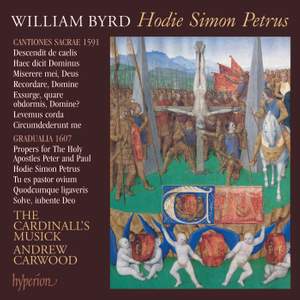
| |  | Byrd Edition Volume 11 - Hodie Simon Petrus
This latest release in The Cardinall’s Musick complete Byrd Edition is surely one of the most eagerly-awaited events in the early music calendar. Previous discs in this award-winning survey of the greatest composer of the age have commanded the highest possible critical acclaim. Performances of filigree clarity, yet great passion and sincerity, allow the composer’s particular genius to shine forth in an unhindered blaze of glory. The works in this eleventh volume present Byrd the recusant: covering the last year of his fashionable career in London and moving to a quieter life in the Essex countryside. The music is from two sources: the magnificent Cantiones Sacrae of 1591 and the Gradualia from 1607. The seven motets from 1591 show Byrd to be pre-occupied with thoughts of desolation, loss, deprivation and separation—familiar ideas for the recusant Catholic community. A feeling of angst in the music is leavened by a sense of salvation and a glimmer of hope which is the composer’s constant refrain. The Gradualia are some of the most imaginative, modern-sounding and energetic music that the composer ever wrote. The Cardinall’s inspirational director Andrew Carwood sets the scene with fascinating booklet notes that illustrate the complex political and religious circumstances in which this great music was engendered. “All save one of these works come from two collections published by William Byrd, Cantiones Sacrae, of 1591, and the 1607 Gradualia, the former among his most deeply touching pieces. Descendit de caelis, a setting of a respond for Christmas Day, tells of anguish rather than joy, betraying the heavy oppression that recusant Catholics, of whom Byrd was one, suffered in Elizabethan England. The pieces from Gradualia are all six-voice motets for the feast of Saints Peter and Paul, in which we hear Byrd at his most modern, with lively rhythms and dense, closely imitative counterpoints. Carwood and his 10 singers relish the music’s expressivity and sophistication to the full.” Sunday Times, 15th February 2009 **** “The performances are admirably directed, responsive to words, clear in their exposition of counterpoint, carefully blended in the homophonic passages. The Cardinall's Musick is an expert body of singers who know exactly what they are doing.” Gramophone Magazine, April 2009 “…this performance is unparalleled in its depth of expression and intelligence. The Cardinall's Musick unerringly leads the listener to musical events that unlock Byrd's conception. These may be either one word invested with meaning ('miseracordium' in the celebrated 'Miserere mei, Deus'), a climax throughout a movement (in 'Circumdederunt me'), or a gesture that accrues meaning (the descending triad in 'Hodie Simon Petrus'). Crystalline sound reproduction ensures that every detail is captured.” BBC Music Magazine, April 2009 ***** “The works for St Peter and St Paul … positively shimmer with exuberance … the beauties of these performances are revealed: litheness, energy and intelligence” International Record Review “The completion of this series will be a landmark, but don’t wait to hear this beautiful disc” Fanfare “Andrew Carwood's programme-note begins with a comment on the motet Haec dicit Dominus with which the programme ends. The lament of Rachel weeping for her children is thematic, if indeed we are to see these Cantiones sacrae of 1591 as a cry on behalf of the old, true believers besieged in a Protestant stronghold. As Rachel wept then, so (it is suggested) does the Church now. And yet there is hope ('et est spes') and this is the message reiterated throughout these heartfelt works of a master craftsman. This is the 11th volume in The Cardinall's Musick's edition of Byrd's Latin settings. Apart from the Cantiones, the other major source is the Gradualia of 1607, probably written for the Catholics of Ingatestone Hall in Essex. The Litany from Book 2 (1605) is the principal variant in the mode of composition, which is dense in imitative polyphony, usually in six parts, concentrated in the intensity of their utterance. Particularly fine examples are the Miserere mei,Deus and the vigorous Exsurge, quare obdormis,Domine? with its strong, well defined climax. The performances are admirably directed, responsive to words, clear in their exposition of counterpoint, carefully blended in the homophonic passages. The Cardinall's Musick is an expert body of singers who know exactly what they are doing. Even so, balance and tone are not everywhere ideal: the bass-line, for instance, though utterly reliable, has been so stripped of natural vibrancy that the tone is dulled. A small point, no doubt, in relation to the riches their work is opening up.” Gramophone Classical Music Guide, 2010 | | | In stock - usually despatched within 1 working day. |
|
|
| |  | Byrd and his ContemporariesMotets in Paired Settings
| | | In stock - usually despatched within 1 working day. |
|
|
| |  | Byrd: Mass for Five Voices and English Motets
The Vienna Vocal Consort is one of the most renowned vocal groups for Early Music in Austria. | 
| | | Usually despatched in 2 - 3 working days. |
|
|
| |  | Awake my soul
Jonathan Hope & Peter Wright (organ) The Girl Choristers and Lay-Clerks of Southwark Cathedral Choir, Stephen Disley The first recording featuring the Southwark Cathedral Girl choristers, with the Lay-clerks. A wide-ranging survey of English choral music from the 16th to 21st centuries. Includes first recordings of works by Judith Bingham, Martin Bussey, David Terry, and Huw Morgan. Begins and ends with two major choral works by Parry – I was glad and Blest pair of Sirens - both works featured in the 2011 Royal wedding of Prince William and Katherine Middleton. | 
| | | Usually despatched in 4 - 5 working days. |
|
|
| |  | Exultate Deo
Andrew Arthur (organ) The Choir of the Chapels Royal, HM Tower of London, Colm Carey (director) The Psalms of David – sometimes referred to as the hymn-book of the bible – have inspired composers writing for the church through the ages. The vivid, poetical nature of the texts, arousing the full gamut of human emotions, has stimulated the composition of many great sacred works in Western music. The Choir of the Chapels Royal, HM Tower of London, directed by Colm Carey, was established in 1966 to lead and enrich both worship and liturgy in the two historic chapels within HM Tower of London. This new CD, Exultate Deo, creates a kaleidoscopic snapshot of music inspired by the Psalms, and is a captivating insight into the wealth and variety of repertoire sung on a weekly basis by the choir. | | | Usually despatched in 2 - 3 working days. |
|
|
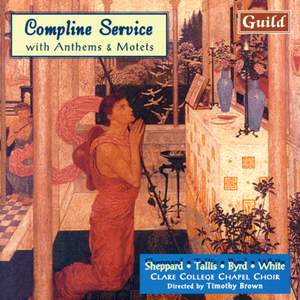
| |  | Tudor Anthems & Motets
Byrd: | Haec dies Ave verum Corpus O Lux beata Trinitas Miserere mei O God give ear and do apply Sing joyfully | Dering: | Factum est silentium | Farrant, R: | Call to remembrance, O Lord Lord, for thy tender mercy's sake | Gibbons, O: | Hosanna to the son of David O Lord, in thy wrath rebuke me not | Mudd: | Let thy merciful ears, O Lord | Parsons, R: | Ave Maria | Philips, P: | Ascendit Deus | Sheppard, J: | Libera Nos | Tallis: | Salvator mundi If ye love me | Tomkins: | When David Heard | Weelkes: | O Lord Arise Hosanna to the Son of David | White, Robert: | The Lord Bless Us |
The Choir of Clare College, Cambridge, directed by Timothy Brown perform Tudor Anthems and Motets by an array of sixteenth century composers including the ever popular Byrd and Tallis and the less familiar figures of Dering, Philips, Mudd and Farrant. Clare College Choir is one of the UK’s finest mixed choirs. “Clear trebles in Tallis's Salvator, alive rhythms in Philips's Ascendit” BBC Music Magazine, September 2011 *** | | | Usually despatched in 8 - 10 working days. |
|
|
| |  | Consorts & Consort SongsMusic by William Byrd & His Contemporaries
Jill Feldman (soprano) Concerto delle Viole | | | Usually despatched in 2 - 3 working days. |
|
|
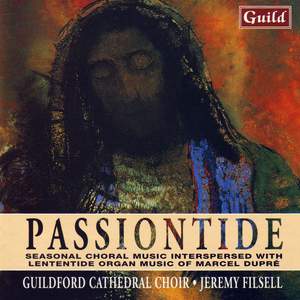
| |  | Music for PassiontideSeasonal Choral Music interspersed with Lententide Organ music of Marcel Dupré
| | | Usually despatched in 8 - 10 working days. |
|
|
| |  | The Artistry of Hans Fagius
Bach, W F: | Fugue in G minor Jesu, meine Freude (Organ Chorale) | Boëly: | Andante con moto in G minor Fantasia and Fugue in B flat major, Op. 18 | Böhm, G: | Partita 'Ach wie nichtig, ach wie flüchtig' Capriccio in G minor | Buxtehude: | Fantasia on 'Wie schön leuchtet der Morgenstern', BuxWV223 Canzona in G major, BuxWV170 Prelude and Fugue in G minor, BuxWV163 | Byrd: | Praeludium Miserere mei Fantasia | Geist, C: | Alleneste Gudh i Himmelrijk O Jesu Christ som mandom tog Lofwad ware tu Jesu Christ | Gibbons, O: | A Voluntary Ground | Keeble: | Double Fugue in C major | Kellner, J C: | Prelude in C major Jesus meine Zuversicht (Organ Chorale) | Kolb, C: | Prelude and Four Versets from Certamen Aonium | Krebs, J L: | Trio in E flat major | Mozart: | Fantasia in F minor for a mechanical organ, K608 | Purcell: | Voluntary on the 100th Psalm, Z721 | Reincken: | Fugue in G minor | Scheidemann: | Praeambulum in D minor | Tallis: | Hymn (ex more docti mistico) Fantasia Hymn (iam lucis orto sidere) | Walond: | Voluntary in G major, Op 1 No. 5 | Weckmann: | Canzon in C major Toccata in E minor | Wesley, S: | Five Pieces from Twelve Short Pieces for Organ | Wesley, S S: | Choral Song & Fugue (from Three Pieces for a Chamber Organ) |
| | | (also available to download from $21.00) | Usually despatched in 2 - 3 working days. (Available now to download.) |
|
|
| |
|