Prices shown exclude VAT. (UK tax is not payable for deliveries to United States.) See Terms & Conditions for p&p rates. | |  | Quatuor Thymos play Schubert & Berg
'Thymos': a word that was used by the ancient Greek philosophers to refer to feeling and emotion… And it was the spirit of thymos that brought together the musicians of the eponymous quartet, first-prize winners from the Paris and Lyon Conservatoires and members of the Orchestre de Paris. The Thymos Quartet, like Calliope, is keenly interested in music of the Viennese school.This recording presents two masterpieces, representing two different periods in the rich history of Viennese music: Franz Schubert's String Quartet No. 13 'Rosamunde', completed in March 1824, and Alban Berg's Lyric Suite, a “suite for string quartet” (Berg's own words), written between September 1925 and October 1926.The latter is Berg's first extended 12-note composition, using the technique that Schoenberg had developed in 1923. In January 1977 the American musicologist George Perle discovered a copy of the score of the Lyric Suite annotated by Berg, in which the composer revealed its secret programme: without that key to the code, the complexities of this work would be indecipherable.The Lyric Suite is the story of a passion, recounting the episodes in the personal drama of an impossible love: that between Berg and Hanna Fuchs-Robettin. The musicians of the Thymos Quartet feel in tune with the aesthetic of this work, which calls for a very subtle balance between individual performance and harmony between all the players. It is a very difficult work to perform and one that is deeply moving for the performers. Schubert's String Quartet No. 13, also a moving work, refers to the inevitability of death; we discover in this composition an almost symphonic expression of violence, and it is also a tragic yet intimate confession. In this quartet Schubert quotes his lieder Gretchen am Spinnrade D118 (text by Goethe) and Schöne Welt, wo bist du? D677 (text by Schiller); Berg's Schliesse mir die Augen beide, to a poem by Theodor Storm, is connected with his Lyric Suite.These songs are therefore presented on this recording in order to give a fuller picture. These songs, as well as the sixth movement of the Lyric Suite, are performed the young soprano Salomé Haller, who was as enchanted by this programme as the musicians of the Thymos Quartet are. The musicians of the Thymos Quartet have played this programme many times.They came to the notice of the conductor Christoph Eschenbach when they presented it at the Théâtre Mogador in Paris, as a result of which he subsequently invited them to the Ravinia Festival (Chicago, USA) where, in August 2005, they performed Alban Berg's Lyric Suite with the Debussy String Quartet and (with Eschenbach at the piano) Dvorak's Piano Quintet (to be recorded on the Calliope label in November 2010). In 2006 Christoph Eschenbach invited the Thymos Quartet to take part in the Orchestre de Paris's Boulez cycle at the Salle Pleyel in Paris, where they performed Webern's Five Movements, Opus 5, and Berg's Lyric Suite. From that time dates their desire to take their work one step further by recording the latter. | | | In stock - usually despatched within 1 working day. |
|
|
| |  | Berg & Hartmann: Lieder
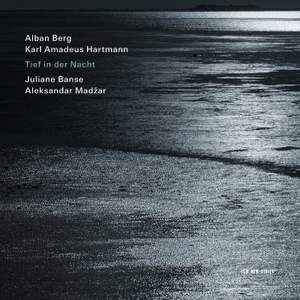
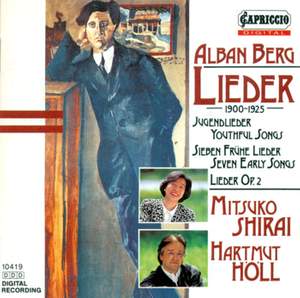
Eagerly-awaited new album by uniquely gifted soprano Juliane Banse, whose previous ECM recordings have been showered with awards and positive reviews. Accompanied by the insightful Serbian pianist Aleksandar Madžar, the German singer performs a wonderful programme of music by Alban Berg and Karl Amadeus Hartmann, powerful and poetic songs spanning a turbulent era. Alban Berg’s early songs, written while he was still under Schoenberg’s tutelage, chart the young composer’s metamorphosis from writer of late romantic love songs to master of the modern idiom. The Berg selections here comprise 18 songs – the Sieben frühe Lieder, the Jugendlieder and two fascinatingly-contrasting versions of Schließe mir die Augen beide from 1900 and 1925. Hartmann’s cantata Lamento for soprano & piano was made in 1955 out of solo passages from a choral work of 1936/7 dedicated to Berg. A demanding work, it has rarely been recorded. In his note Paul Griffiths writes, “Lamento is a big piece, one that thoroughly engages the two formidable musicians who present it. Banse is the kind of singer Hartmann must have imagined, one who can maintain ease, power and warmth under difficult circumstances, whose singing conveys at once authority and vulnerability and whose musical experience runs from Bach to the present day. Aleksandar Madžar similarly brings out the depth of history and the immediacy of feeling written into this work.” “Embedded in their different worlds, each [Berg song] is a jewel-like miniature, in which Juliane Banse invests exquisite expressiveness...Banse is simply in a class of her own with music like this [the Hartmann], fiercely declamatory when required, but tenderly and touchingly entreating, too.” The Guardian, 28th October 2010 ***** “Lamento (1955) sets three works by the 17th-century German poet Andreas Gryphius. Hartmann plainly highlights the equivalence of the Thirty Years War and the Nazi terrors. Banse and Madzar are equally telling. This powerful music is prefaced by 18 compact, intimate songs by Berg.” Sunday Times, 21st November 2010 **** “Alban Berg’s Seven Early Songs have a fascinating sense of an overripe romantic world on the edge of dissolution, shot through with glimpses of a modernism just around the corner. It’s a spirit these two performers catch to absolute perfection. What makes this CD so welcome is that it includes nine other early songs, similarly intense, but hardly known.” The Telegraph, 26th November 2010 ***** “Juliane Banse brings to all of them her intense voice, focused and lovely...and makes them as memorable as anyone I've ever heard...whatever the merits of this neglected music turn out in the long run to be, they will certainly not be a given a more riveting and committed interpretation than they are by these two artists.” BBC Music Magazine, January 2011 ***** “her restrained vibrato and extraordinary sense of line make her ideal in this repertoire. There's a truly marvellous fluidity about her singing...It helps, of course, that Banse has such a singularly sensitive collaborator...Anyone interested in the origins of mature Berg will be fascinated and enlightened by this recording” International Record Review, January 2011 “[Hartmann] makes something strongly shaped and distinctively characterised...and strength of character also distinguishes this performance by Juliane Banse and Aleksandar Madžar. [They] also find a powerfully dramatic rhetoric in the fervent, sometimes rather congested textures of Berg's early songs.” Gramophone Magazine, March 2011 | | | Usually despatched in 4 - 5 working days. |
|
|
| |  | Songs after poems of Theodor Storm
Ulf Bästlein (baritone), Charles Spencer (piano) | | | Usually despatched in 2 - 3 working days. |
|
|
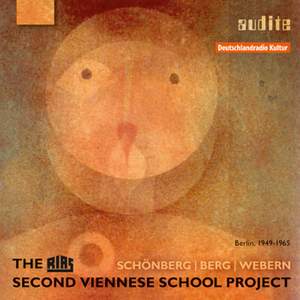
| |  | The RIAS Second Viennese School ProjectBerlin 1949-1965
Berg: | Lyric Suite - for string quartet (1926) Four Pieces for Clarinet and Piano, Op. 5 Sieben frühe Lieder Schliesse mir die Augen beide (1907 version) Schliesse mir die Augen beide (1925 version) | Schoenberg: | Pierrot lunaire, Op. 21 Chamber Symphony No. 1 in E major, Op. 9 Piano Concerto, Op. 42 Phantasy for Violin with Piano Accompaniment, Op. 47 Das Buch der Hängenden Gärten, Op. 15 De Profundis (Psalm 130), Op. 50b for mixed choir a cappella Klavierstücke (3), Op. 11 Kleine Klavierstücke (6), Op. 19 Klavierstücke (5), Op. 23 Klavierstück, Op. 33a Klavierstück, Op. 33b String Trio, Op. 45 Suite in G for String Orchestra Phantasy for Violin with Piano Accompaniment, Op. 47 | Strauss, J, II: | Rosen aus dem Süden, Op. 388 arr. Schoenberg Schatz-Walzer, Op. 418 arr. Webern | Webern: | Passacaglia for Orchestra, Op. 1 Five Pieces for Orchestra Op. 10 Four pieces for violin & piano, Op. 7 (1910) |
This 4-CD boxed set presents historic recordings of works by Arnold Schoenberg, the founding father of 20th-century modern music, and his most prominent pupils, Alban Berg and Anton Webern. These recordings, made between 1949 and 1965, comprise works which were written between 1906 and 1950, thus portraying practically the entire era of the Viennese School. Not only do they trace the multi-layered compositional developments of the Viennese School, but they are also significant musical and historic documents of multi-faceted interpretational approaches towards this music. The Viennese School was formed before the First World War as a movement in music attempting to unite radical expressive techniques and traditional form concepts, demanding specially trained interpreters for this undertaking. In these RIAS recordings, first-rate artists from the circle of the three Viennese composers can be heard: Rudolf Kolisch, Eduard Steuermann, Winfried Zillig and Else C. Kraus were immediately shaped by their teacher, Schoenberg, whereas others, such as Peter Stadlen and Tibor Varga were in contact with the composer, or with Webern or Berg. Ferenc Fricsay or Suzanne Danco, on the other hand, did not belong to the circle of the Viennese School and its performance teachings. Their interpretations are of particular interest as they brought these works to life, unprejudiced by performance traditions of this music which, at that time, was hardly performed. The comparison of the two recordings of Schoenberg’s 'Fantasy for Violin and Piano', Op. 47, with Kolisch and Varga respectively, and the sensational interpretation of Schoenberg’s 'Pierrot Lunaire' by the Munich singer Irmen Burmester alongside an outstanding instrumental ensemble under the direction of Josef Rufer (1949) are particular highlights of this anthology. These radio recordings were made possible thanks to the indefatigable initiative of the music writer Hans Heinz Stuckenschmidt in his role as Editor of New Music at the RIAS. He and his colleague Josef Rufer, who can be heard as conductor, ensured that those musicians who had returned from exile would be engaged to contribute to these radio documents. By doing so, Stuckenschmidt and Rufer intended, on the one hand, to continue the tradition of Schoenberg’s stay in Berlin from 1925 until 1933, and, on the other hand, to provide the music of the Viennese School with greater resonance within public awareness. This edition is complemented by the publication of a text by Prof Dr Rudolf Stephan, the doyen of research into the Viennese School in Germany after the Second World War and editor of the complete works of Arnold Schoenberg and Alban Berg. He reflects on his comprehensive experiences with the music of the Viennese School, stretching back to the years immediately following the end of the war. “Hard to exaggerate the richness of these four CDs...Irmen Burmester insightfully takes the Sprechstimme in a vivid Pierrot lunaire...[Stadlen] is a commanding soloist in Schoenberg’s Piano Concerto” Sunday Times | | | (also available to download from $35.25) | In stock - usually despatched within 1 working day. |
|
|
| |  | The Alban Berg Collection
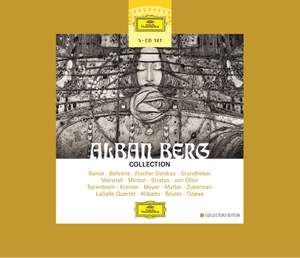
Berg: | Drei Orchesterstücke, Op. 6 Lyric Suite - three movements for string orchestra (1928) Violin Concerto 'To the Memory of an Angel' (1935) Anne-Sophie Mutter (violin) Chamber Concerto for Piano and Violin with 13 Wind Instruments Daniel Barenboim (piano), Pinchas Zukerman (violin) Piano Sonata, Op. 1 Daniel Barenboim (piano) Four Pieces for Clarinet and Piano, Op. 5 Sabine Meyer (clarinet), Oleg Maisenberg (piano) Lyric Suite - for string quartet (1926) String Quartet, Op. 3 Sieben frühe Lieder Anne Sofie von Otter (mezzo-soprano), Bengt Forsberg (piano) Schliesse mir die Augen beide (1907 version) An Leukon Schliesse mir die Augen beide (1925 version) Margaret Marshall (soprano), Geoffrey Parsons (piano) Vier Lieder, Op. 2 Dietrich Fischer-Dieskau (baritone), Aribert Reimann (piano) Sieben frühe Lieder 5 Orchesterlieder nach Ansichtskartentexten von Peter Altenberg, Op. 4 Der Wein Lulu-Suite (Five Symphonic Pieces) for soprano and orchestra Lulu Wozzeck | Strauss, J, II: | Wein, Weib und Gesang, Op. 333 (trans. Alban Berg) |
| | | In stock - usually despatched within 1 working day. |
|
|
| |
|