Prices shown exclude VAT. (UK tax is not payable for deliveries to United States.) See Terms & Conditions for p&p rates. | |  | The Barbirolli English Music Album
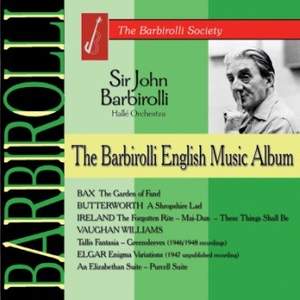
anon.: | The Irish Ho Hoane arr: John Barbirolli | Barbirolli: | An Elizabethan Suite | Bax: | The Garden of Fand recorded 21 June 1956, Free Trade Hall, Manchester | Bull, J: | The King's Hunt arr: John Barbirolli | Butterworth, G: | A Shropshire Lad - Rhapsody recorded 20 June 1956, Free Trade Hall, Manchester | Byrd: | Pavana "The Earle of Salisbury" arr: John Barbirolli | Elgar: | Enigma Variations, Op. 36 Recorded 12 May 1947 Houldsworth Hall, Manchester HMV previously unpublished Bavarian Dance No. 2 Recorded 30 May 1947 Kingsway Hall, London HMV unpublished take | Farnaby, G: | A Toye arr: John Barbirolli Giles Farnaby’s Dreame arr: John Barbirolli | Ireland: | The Forgotten Rite - Prelude recorded 31 May 1949, No.1 Studio, Abbey Road, London Mai-Dun recorded 31 May 1949, No.1 Studio, Abbey Road, London These Things Shall be recorded 1 May 1948, Houldsworth Hall, Manchester with Parry Jones (tenor) Hallé Choir | Purcell: | Suite for strings, woodwind and horns arr: John Barbirolli | Vaughan Williams: | Fantasia on Greensleeves recorded 26 February 1948 Houldsworth Hall, Manchester Fantasia on a Theme by Thomas Tallis recorded 6 June 1946 Houldsworth Hall, Manchester |
This BARBIROLLI ENGLISH MUSIC ALBUM contains something of a scoop in that the recording of Elgar’s Enigma Variations was made on 12 May 1947, the first time Barbirolli recorded the work. For some undiscoverable reason, the discs were never issued and the work was re-recorded on 23 October of the same year (also issued on CD by the Barbirolli Society on SJB1017). His affection for this inexhaustible masterpiece shone through every performance of it he gave as he gloried in the piquancy of the illustration of Elgar’s “friends pictured within” — and he liked to remind Michael Kennedy that the Variations and JB were born in the same year, 1899. Elgar’s genius was to weld his series of vignettes into a large-scale composite portrait — of himself. This gift for writing a miniature which was a microcosm of a big work is illustrated also in the second (the exquisite Lullaby) of the Three Bavarian Dances, a previously unpublished take, recorded on 30 May 1947. | | | In stock - usually despatched within 1 working day. |
|
|
| |  | Sir John Barbirolli: Boston Concerts, 1959
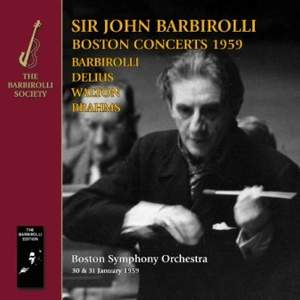
Barbirolli: | An Elizabethan Suite Symphony Hall, Boston, 30 January, 1959 [Stereo] An Elizabethan Suite Symphony Hall, Boston, 31 January, 1959 [Stereo] | Brahms: | Symphony No. 2 in D major, Op. 73 Symphony Hall, Boston, 30 January, 1959 [Stereo] | Delius: | The Walk to the Paradise Garden Symphony Hall, Boston, 30 January, 1959 [Stereo] The Walk to the Paradise Garden Symphony Hall, Boston, 31 January, 1959 [Stereo] | Walton: | Partita for Orchestra Symphony Hall, Boston, 30 January, 1959 [Stereo] Partita for Orchestra Symphony Hall, Boston, 31 January, 1959 [Stereo] |
Although Barbirolli’s achievement in rebuilding the war-ravaged Hallé Orchestra during the darkest days of the Second World War may remain the greatest fulfilment of his life, his renown as a conductor within the United States was not confined to his New York era. From 1961-67 Barbirolli was music director of the Houston Symphony Orchestra in Texas, holding the post concurrently with that in Manchester, and in 1967, marking the 125 anniversary of the New York Philharmonic, he was invited back to conduct the orchestra at Lincoln Center. But even before then, Barbirolli’s appearances in north America would seem to demand a special study by themselves, for early in 1959 he gave several concerts with the Boston Symphony Orchestra as part of a quite extended tour involving a number of the greatest American and Canadian orchestras, including those in Winnipeg and Vancouver alongside those in Detroit, Washington, Philadelphia, Boston, Cincinnati, Los Angeles, San Francisco and New York (where in the last city he conducted no fewer than sixteen concerts). The issue under discussion commemorates a typical Barbirolli programme, given in Boston on consecutive days in January 1959, notable for half of it being given over to British music, in essence from the sixteenth-century to the twentieth. Barbirolli never ‘drove’ the Symphony No.2 by Brahms, which approach can be profoundly detrimental to its inner qualities – for this conductor, the nature of the music was essentially Brahms at his most lyrically expressive, and there can be no doubt that for the Boston players, Barbirolli’s view of the work came as something of a revelation: they had performed it under Monteux and Koussevitsky – string players both, like Barbirolli – but the Englishman brought something of a southern European nature to the music, allowing it to unfold at its own pace, yet at all times never allowing a trace of somnolence to enter his interpretation. Barbirolli treads a fine line, but it is remarkably successful and interpretatively impressive, as the Boston players surely felt so themselves, for in a letter home to his mother, written in Boston on February 1, he said ‘…this Boston orchestra is perhaps the greatest of the lot…The other day after I had rehearsed the 2nd Brahms symphony the whole orchestra stood and cheered me for quite some time, and they have done the same at both concerts…It was lovely, too, to have both the present conductor, [Charles] Münch, and one of the past conductors, Pierre Monteux, both there.’ After that first concert, we learn that all three conductors had a ‘memorable dinner’ together afterwards – the conversation at which would surely have also been worth recording! | | | Usually despatched in 4 - 5 working days. |
|
|
| |  | Beethoven - Symphony No. 3
anon.: | The Irish Ho Hoane No.1 Studio, Abbey Road, London 19 May 1967 | Barbirolli: | An Elizabethan Suite No.1 Studio, Abbey Road, London 19 May 1967 | Beethoven: | Symphony No. 3 in E flat major, Op. 55 'Eroica' No.1 Studio, Abbey Road, London 18 – 19 May 1967 | Bull, J: | The King's Hunt No.1 Studio, Abbey Road, London 19 May 1967 | Byrd: | Pavana "The Earle of Salisbury" No.1 Studio, Abbey Road, London 19 May 1967 | Farnaby, G: | Giles Farnaby’s Dreame No.1 Studio, Abbey Road, London 19 May 1967 A Toye No.1 Studio, Abbey Road, London 19 May 1967 |
No conductor can aspire to greatness unless the works of Beethoven are firmly in his repertory. Sir John Barbirolli may be best known as an interpreter of Elgar, Sibelius, Mahler, Brahms, Vaughan Williams and others, but the symphonies and concertos of Beethoven were never absent from his Hallé programmes and he brought a keen temperamental interpretative skill to their performance. Although he declared that if he could choose the last music he was destined to conduct it would be Elgar’s Second Symphony, fate decreed that the last symphony he conducted in public, at King’s Lynn in July 1970, was Beethoven’s Seventh. No elegiac coda, then, but a joyous, frenetic outburst of rhythmical fervour. Strangely, it was also the last work conducted by the man who gave J.B. his first professional job in an orchestra, Sir Henry Wood. Although Sir John rejected the 1948 offer of the conductorship of the BBC Symphony Orchestra, he remained one of its guest conductors whenever engagements allowed. He took it to Eastern Europe and Russia in 1967. Two years earlier he had conducted it in a performance of the Eroica Symphony which excited the players enormously and led to a recording in May 1967. If this lacks the extra frisson of the ‘live’ performance, it is still a remarkable performance. Barbirolli’s An Elizabethan Suite was the result of the time he spent, happily, in Vancouver in 1942. His friend, the composer Arthur Benjamin, drew his attention to certain examples from the Fitzwilliam Virginal Book, a remarkable collection of 297 early 17th century English keyboard compositions preserved in the Fitzwilliam Library of Cambridge University. Some would say that today’s passion for ‘authenticity’ and period instruments renders arrangements such as these redundant. But the tasteful scoring and musical sensitivity, comparable with Sir Hamilton Harty’s and Elgar’s Handel transcriptions, surely guarantees them a sympathetic hearing from all but the bigoted purists. Sir John recorded the suite with the BBC Symphony Orchestra also in May 1967. | | | Usually despatched in 4 - 5 working days. |
|
|
| |  | Columbia Masters Volume 4All recordings made in the Liederkranz Hall, New York City
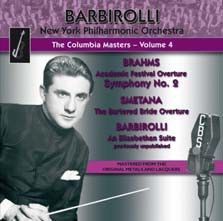
These American Columbia recordings have been mastered from the original metals and lacquers and offer some amazing sound quality for recordings from 1940-1942. The contrast between Toscanini and Barbirolli was symbolic of the contrast between two generations of conductors and the altering role of conductors. Toscanini was the supreme autocrat of the old school, ruling by terror, insult, tantrums and his own daemonic drive. Barbirolli, over thirty years younger, was the benevolent autocrat, more democratic, ruling through comradeship with his players, inviting them and the audience to share his own delight in music. The contrast in their philosophy was reflected in their interpretations: Toscanini inspired awe for the music he conducted; Barbirolli inspired love and affection. Their different approaches are crystallized in their respective recordings of Verdi’s Otello and Requiem: the older man relentless, electric, dramatic in the extreme, incomparably exciting; the younger broader, with more humanity, many felicitous touches of detail, and caressing the phrases like a lover. Both are valid interpretations, both are true to the spirit of the music, both reveal different aspects of Verdi’s and of their own genius. It is overlooked that Barbirolli not only succeeded Toscanini in New York: that would have soon been accomplished, a nineday wonder. For seven years he conducted almost alongside him, the one in Carnegie hall, the other in the NBC studio. Of course, Barbirolli was not then the great conductor he was to become, for most conductors improve with age, but recordings (commercial and off-air) show that he was very good and that the orchestra had a rich and sensitive sound. (He himself confessed in his last years that he ‘sometimes smiled’ at the recollection of his younger interpretations; he constantly re-studied even the most familiar symphonies.) John Barbirolli | | | Usually despatched in 4 - 5 working days. |
|
|
| |  | Sir John Barbirolli
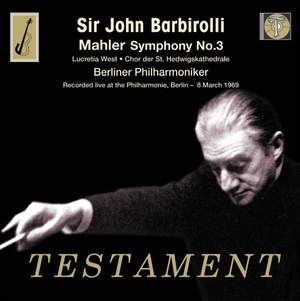
Recorded 1969 & 1964 | | | Usually despatched in 4 - 5 working days. |
|
|
| |  | BSO Historic Telecasts: Barbirolli
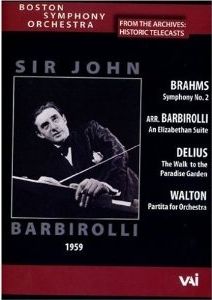
The only extant video of Sir John’s work with the BSO, this 1959 telecast finds the conductor in exemplary form 1959 telecast | | | Usually despatched in 4 - 5 working days. |
|
|
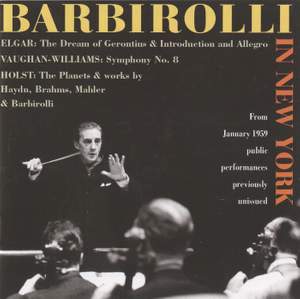
| |  | Barbirolli in New York: The 1959 Concerts
Barbirolli: | An Elizabethan Suite Recorded 10th January, 1959 | Brahms: | Violin Concerto in D major, Op. 77 Recorded 18th January, 1959 Berl Senofsky (violin) | Elgar: | The Dream of Gerontius, Op. 38 Recorded 25th January, 1959 Richard Lewis (tenor), Maureen Forrester (contralto), Morley Meredith (baritone) Westminster Choir Introduction & Allegro for strings, Op. 47 Recorded 3rd January, 1959 William Lincer (viola), John Corigliano & Leopold Rybb (violin) & Laszlo Varga (cello) | Haydn: | Symphony No. 88 in G major Recorded 10th January, 1959 | Holst: | The Planets: Mars The Planets: Mercury The Planets: Uranus The Planets: Jupiter Recorded 18th January, 1959 | Mahler: | Symphony No. 1 in D major 'Titan' Recorded 10th January, 1959 | Vaughan Williams: | Symphony No. 8 in D minor Recorded 3rd January, 1959 |
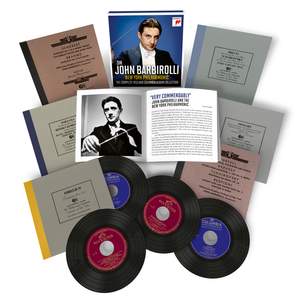
Barbirolli conducted the New York Philharmonic from 1936 to 1943 and returned to New York in 1959 to conduct the orchestra in a series of concerts featuring English repertoire rarely heard by Americans. Here are the best performances of Sir John’s visit, previously unissued, in state-of-the-art digital restorations. Includes “Dream of Gerontius” with Richard Lewis, a very fine Gerontius. “[Gerontius] anticipates the superlative studio recording Barbirolli and Lewis made together with Janet Baker five years later, though Maureen Forrester is a more than capable Angel here and the baritone, Morley Meredith, is arguably superior to his later equivalent...The mono sound is patchy but just about serviceable, but Barbirolli fans won't worry about that.” The Guardian, 23rd September 2010 *** | | | (also available to download from $28.00) | Usually despatched in 2 - 3 working days. (Available now to download.) |
|
|
| |
|