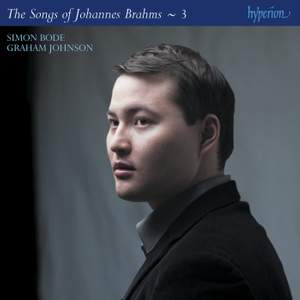
Prices shown exclude VAT. (UK tax is not payable for deliveries to United States.) See Terms & Conditions for p&p rates. | |  | Brahms: The Complete Songs Volume 3 (Simon Bode)
Brahms: | Wach auf, mein Herzensschöne, WoO33 No. 16 Erlaube mir, fein's Mädchen (No. 2 from Deutsche Volkslieder WoO 33) Mein Mädel hat einen Rosenmund (No. 25 from Deutsche Volkslieder, WoO 33) Ein Sonett, Op. 14 No. 4 (Herder) Ständchen, Op. 14 No. 7 Der Kuss, Op. 19, No. 1 An eine Äolsharfe, Op. 19 No. 5 Magyarisch, Op. 46, No. 2 Die Schale der Vergessenheit, Op. 46, No. 3 Lieder (5), Op. 49 Mein wundes Herz verlangt, Op, 59, No. 7 Im Garten, Op. 70 No. 1 Lerchengesang Op. 70 No. 2 Serenade, Op. 70 No. 3 An den Mond, Op. 71 No. 2 (Text: K. Simrock) In Waldeseinsamkeit, Op. 85 No. 6 Auf dem Schiffe, Op. 97, No. 2 Es hing der Reif, Op. 106 No. 3 Ein Wanderer, Op. 106 No. 5 Die Sonne scheint nicht mehr (No. 5 from Deutsche Volkslieder, WoO 33) Wo gehst du hin, du Stolze? WoO33, No. 22 Es steht ein Lind (No. 41 from Deutsche Volkslieder, WoO 33) |
Following the iconic series of the complete songs of Schubert and Schumann, Graham Johnson further demonstrates the phenomenal depth of his knowledge in the expert programming of this recital. Each disc in the series represents a different journey through the repertoire, and thus through Brahms’s life. This new volume is sensitively balanced, the opening and closing folksong transcriptions possessing beguiling charm and the five songs of Op 49 being performed in their entirety. Hyperion is thrilled to welcome the young German tenor Simon Bode to the label. At home in the opera house and the recital hall, Bode possesses a controlled voice of great beauty, and gives performances of immediacy and conviction. Johnson, as accompanist, is immaculate and his usual scholarly notes are of course included. “Bode sings [Sehnsucht and the Wiegenlied] with a fine sense of artistry and wonderment. Johnson takes care over his placing of Brahms's many folksong settings within this series, inserting a few at a time. Here, they frame the recital, with Bode's instinctive musicality making an irresistably friendly greeting of 'Wach auf, mein Herzensschone.'” BBC Music Magazine, January 2012 **** “His tone is sweet and gently rounded, his diction crystal-clear, his phrasing always thoughtful. Spinning a rapt, sustained lined, he movingly catches the Brahmsian twilit melancholy of 'Abenddammerung'...'Wiegenlied', too, is as dulcet as you could wish, with singer and pianist vindicating a provocatively slumbrous [sic] tempo.” Gramophone Magazine, February 2012 “Bode has an unquestionably beautiful voice, his line is exquisitely controlled and his care over words and meaning were already evident in the folksong settings...There are marvellous things, such as a wondrously sustained “Es hing der Reif”. Indeed, according to their own lights, all the performances are marvellous...Every Brahmsian quality you could want is here except fullness of heart” MusicWeb International, March 2012 | | | In stock - usually despatched within 1 working day. |
|
|
| |  | Lieder im Volkston
Bartók: | 8 Hungarian Folksongs, BB 47, Sz. 64 | Brahms: | Es steht ein Lind (No. 41 from Deutsche Volkslieder, WoO 33) Die Sonne scheint nicht mehr (No. 5 from Deutsche Volkslieder, WoO 33) Da unten im Tale (No. 6 from Deutsche Volkslieder, WoO 33) Schwesterlein, WoO posth. 37 No. 1 Sehnsucht 'Mein Schatz ist nicht da', Op. 14 No. 8 Volkslied 'Die Schwälbe ziehet fort', Op. 7 No. 4 Die Trauernde, Op. 7 No. 5 In stiller Nacht, WoO 34 No. 8 | Dvorak: | In Folk Tone - four songs, Op. 73 | Kodály: | Hungarian Folk Music: selection |
Esther Kretzinger (soprano) & Andrej Hovrin (piano) | | | (also available to download from $10.50) | Usually despatched in 2 - 3 working days. (Available now to download.) |
|
|
| |  | Lieder von Liebe und TodSongs of Love & Death
Brahms: | Erlaube mir, fein's Mädchen (No. 2 from Deutsche Volkslieder WoO 33) Da unten im Tale (No. 6 from Deutsche Volkslieder, WoO 33) Schwesterlein, WoO posth. 37 No. 1 All mein Gedanken, die ich hab (No. 30 from Deutsche Volkslieder, WoO 33) Wie komm ich denn zur Tur herein (No. 34 from Deutsche Volkslieder, WoO 33) Es steht ein Lind (No. 41 from Deutsche Volkslieder, WoO 33) Soll sich der Mond nicht heller scheinen (No. 35 from Deutsche Volkslieder, WoO 33) | Schubert: | Das Wandern (No. 1 from Die schöne Müllerin, D795) Nachtstück, D672 (Mayrhofer) Der Tod und das Mädchen, D531 Am feierabend (No. 5 from Die schöne Müllerin, D795) Sei mir gegrüsst! D741 (Rückert) Der König in Thule, D367 Nacht und Träume, D827 Der Leiermann (No. 24 from Winterreise, D911) Meeres Stille, D216, Op. 3 No. 2 (Goethe) Der Unglückliche, D713 | Spohr: | Lied beim Rundetanz Op. 37:6 Schlaflied Lied aus 'Aslauga's Ritter' Getrennte Liebe Op. 37:5 Beruhigung Die Stimme der Nacht Schifferlied der Wasserfee |
'By replacing the piano with the guitar, Christoph Prégardien and Tilman Hoppstock have changed the mood of the songs. The tension between voice and instrument changes, forms a different colour-mixture. (Peter Härtling) 'Never has the guitar sounded so absolutely right for these songs.' (Classical Guitar) “...it's a revelation. The tension between voice and accompanist is...never less than creative. That's largely thanks to Prégardien 's matchless enunciation, always subtly nuanced inflection, and [Hoppstock's] ability to sustain a legato line through his nicely variegated and perfectly balanced plucking.” BBC Music Magazine, June 2010 **** | | | (also available to download from $10.50) | Usually despatched in 3 - 4 working days. (Available now to download.) |
|
|
| |  | Lucia Popp
Brahms: | Es steht ein Lind (No. 41 from Deutsche Volkslieder, WoO 33) Sehnsucht 'Hinter jenen dichten Wäldern', Op. 49 No. 3 Wie komm ich denn zur Tur herein (No. 34 from Deutsche Volkslieder, WoO 33) Die Trauernde, Op. 7 No. 5 In stiller Nacht (No. 42 from Deutsche Volkslieder, WoO 33) | Dvorak: | In Folk Tone - four songs, Op. 73 | Mahler: | Starke Einbildungskraft (Lieder und Gesänge aus der Jugendzeit) Ich ging mit Lust (Lieder und Gesänge aus der Jugendzeit) Ablösung im Sommer (Lieder und Gesänge aus der Jugendzeit) Um schlimme Kinder artig zu machen (Lieder und Gesänge aus der Jugendzeit) | Schoenberg: | Erwartung, Op. 17 Schenk mir deinen goldenen Kamm Op. 2 No. 2 Erhebung Op. 2 No. 3 Waldsonne Op. 2 No. 4 | Schubert: | An Mein Herz D860 Der Jüngling an der Quelle, D300 (Salis-Seewis) Jägers Abendlied, Second Setting, D368 Der Einsame, D800 | Strauss, R: | Drei Lieder der Ophelia Op. 67 Mein Auge Op. 37 No. 4 Meinem Kinde, Op. 37 No. 3 Die Zeitlose, Op. 10 No. 7 Hat gesagt - bleibt's nicht dabei, Op. 36 No. 3 Allerseelen, Op. 10 No. 8 |
“…in Dvořák's anniversary year, the unmistakable and irresistible character of Popp's voice, by turns radiant and rueful, buoyant and melancholy, wonderfully recreates something at the very heart of the composer's settings of three Slovak folk poems which she included in her 1980 Edinburgh Festival programme with Geoffrey Parsons.” BBC Music Magazine, September 2004 **** | | | (also available to download from $10.50) | Usually despatched in 2 - 3 working days. (Available now to download.) |
|
|
| |  | Bejun
| | | (also available to download from $10.50) | Usually despatched in 2 - 3 working days. (Available now to download.) |
|
|
| |  | Lucia Popp - Lieder
| | | Usually despatched in 3 - 4 working days. |
|
|
| |  | Lucia Popp: The Unforgotten
Bach, J S: | Cantata BWV51 'Jauchzet Gott in allen Landen' | Brahms: | Mädchenfluch (No. 9 from Neun Gesänge, Op. 69) Vorschneller Schwur (No. 5 from Sieben Lieder, Op. 95) Mädchenlied, Op. 107 No. 5 Mädchenlied (No. 6 from Sieben Lieder, Op. 95) Mädchenlied, Op. 85 No. 3 Das Mädchen spricht, Op. 107 No. 3 Die Trauernde, Op. 7 No. 5 Sehnsucht 'Mein Schatz ist nicht da', Op. 14 No. 8 Wie komm ich denn zur Tur herein (No. 34 from Deutsche Volkslieder, WoO 33) In stiller Nacht (No. 42 from Deutsche Volkslieder, WoO 33) Es steht ein Lind (No. 41 from Deutsche Volkslieder, WoO 33) Regenlied, WoO23 | Charpentier, G: | Depuis le jour (from Louise) sung in German | Dvorak: | Mesícku na nebi hlubokém 'Song to the Moon' (from Rusalka) sung in German In Folk Tone - four songs, Op. 73 | Goetz: | Die Kraft versagt | Handel: | Samson: Let the bright seraphim | Janacek: | Moravian Folk Songs (15), JW VIII/23: excerpts | Kodály: | Hungarian Folk Songs | Lortzing: | Die Eifersucht ist eine Plage (from Zar und Zimmermann) | Mahler: | Frühlingsmorgen (Lieder und Gesänge aus der Jugendzeit) Ich ging mit Lust (Lieder und Gesänge aus der Jugendzeit) Nicht wiedersehen (Lieder und Gesänge aus der Jugendzeit) Scheiden und Meiden (Lieder und Gesänge aus der Jugendzeit) Um schlimme Kinder artig zu machen (Lieder und Gesänge aus der Jugendzeit) Hans und Grete (Lieder und Gesänge aus der Jugendzeit) Starke Einbildungskraft (Lieder und Gesänge aus der Jugendzeit) Ablösung im Sommer (Lieder und Gesänge aus der Jugendzeit) Erinnerung (Lieder und Gesänge aus der Jugendzeit) | Massenet: | Allons! Il le faut pour lui-même!... Adieu, notre petite table (from Manon) | Monteverdi: | L'Orfeo: excerpts | Mozart: | E Susanna non vien! … Dove sono i bei momenti (from Le nozze di Figaro) Ach, ich fühl's (from Die Zauberflöte, K620) | Prokofiev: | Russian Folksongs, Op. 104 | Puccini: | O mio babbino caro (from Gianni Schicchi) sung in German | Smetana: | Endlich allein (from Die verkaufte Braut) | Telemann: | Arias from Psalm 111 "Ich danke dem Herrn von ganzem Herzen" | Verdi: | Caro nome (from Rigoletto) sung in German | Weber: | Wie nahte mir der Schlummer … Leise, leise, fromme Weise (from Der Freischütz) |
Soprano Lucia Popp (1939-1993) was one of the most acclaimed singers of her generation. In this four-CD set she is heard in arias from operas by Weber, Mozart, Lortzing, Puccini, Verdi, Massenet and Monteverdi, songs by Brahms, Mahler, Prokofiev, Dvorak, Kodaly, Janacek, and sacred music by Telemann and Bach. After making her debut at the Vienna State Opera in the modest role of Barbarina in The Marriage of Figaro, Lucia Popp worked with all the great conductors of her day including Leonard Bernstein, Sir George Solti, Rafael Kubelik, Lorin Maazel, Sir Neville Marriner, Bernard Haitink and Carlos Kleiber. The State Operas of Vienna and Munich honoured Lucia Popp with the title of Kammersängerin and the Vienna Philharmonic Orchestra awarded her the “Silver Rose”. In 2007 she was placed 7th on BBC Music Magazine's list ‘20 All-time Best Sopranos’ based on a poll of 21 British critics and BBC presenters. | | | (also available to download from $16.00) | Usually despatched in 4 - 5 working days. (Available now to download.) |
|
|
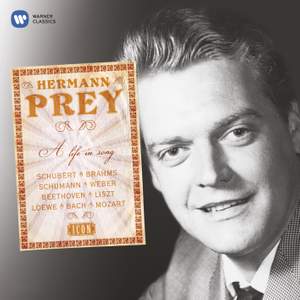
| |  | Hermann Prey: A Life in Song
Bach, J S: | Cantata BWV82 'Ich habe genug' Siegfried Arnold (cello), Heinz Morawietz (double bass), Willy Gerlach (oboe), Hannes Kästner (organ) Gewandhaus-Orchester Leipzig, Kurt Thomas | Beethoven: | Adelaide, Op. 46 Marmotte, Op. 52 No. 7 Der Kuss, Op. 128 An die Hoffnung, Op. 94 Neue Liebe, Neues Leben, Op. 75, 2 Mephistos Flohlied, Op. 75, 3 Gerald Moore (piano) | Berlin, I: | They say it's wonderful Symphonie-Orchester Graunke, Carl Michalski | Bizet: | Votre toast je peux vous le rendre 'Toreador Song' (from Carmen) Sung in German as 'Euren Toast!...Auf inden Kampf' Ursula Schirrmacher (Frasquita), Ursula Gust (Mercedes), Christa Ludwig (Carmen) Berliner Symphoniker, Chor der Deutschen Oper Berlin, Horst Stein | Brahms: | Wach auf meins Herzens Schone, WoO posth. 35 No. 2 Erlaube mir, fein's Mädchen (No. 2 from Deutsche Volkslieder WoO 33) Feinsliebchen, du sollst mir nicht barfuß gehen (No. 12 from Deutsche Volkslieder, WoO 33) All mein Gedanken, die ich hab (No. 30 from Deutsche Volkslieder, WoO 33) Es steht ein Lind (No. 41 from Deutsche Volkslieder, WoO 33) Mein Mädel hat einen Rosenmund (No. 25 from Deutsche Volkslieder, WoO 33) Die Sonne scheint nicht mehr (No. 5 from Deutsche Volkslieder, WoO 33) Der bucklichte Fiedler (No. 1 from Sechs Lieder und Romanzen, Op. 93a) Da unten im Tale (No. 6 from Deutsche Volkslieder, WoO 33) Schöner Augen, schöne Strahlen (No. 39 from Deutsche Volkslieder) Ach, englische Schäferin (No. 8 from Deutsche Volkslieder, WoO 33) In stiller Nacht (No. 42 from Deutsche Volkslieder, WoO 33) Martin Mälzer (piano) | Flotow: | Martha: Lasst mich euch fragen (Porterlied) Bayerisches Staatsorchester, Chor der Bayerischen Staatsoper, Robert Heger | Gluck: | Che faro' senza Euridice? (from Orfeo ed Euridice) Sung in German as 'Ach, ich habe sie verloren' Berliner Symphoniker, Horst Stein | Gounod: | Avant de quitter ces lieux (from Faust) Sung in German as 'Da ich nun verlassen soll' Berliner Symphoniker, Wilhelm Schüchter | Humperdinck: | Verdorben! Gestorben! (from Königskinder) Berliner Symphoniker, Berliner Mozartchor, Horst Stein | Keiser: | Prangt die allerschönste Blume (from Der hochmüthige, gestürzte und wieder erhabene Croesus) Götter, übt Barmherzigkeit (from Der hochmüthige, gestürzte und wieder erhabene Croesus) Berliner Philharmoniker, Wilhelm Brückner-Rüggerberg | Korngold: | Mein Sehnen (from Die tote Stadt) Berliner Symphoniker, Horst Stein | Kreutzer, K: | Ein Schütz' bin ich (from Das Nachtlager von Granada) Die Nacht ist schön...Fürwahr es ist ein Abenteuer (from Das Nachtlager von Granada) Berliner Symphoniker, Chor der Deutschen Oper Berlin, Wilhelm Schüchter | Leoncavallo: | Nedda! Silvio! A quest'ora che imprudenza (from I Pagliacci) Anneliese Rothenberger (Nedda) Berliner Symphoniker, Wilhelm Schüchter | Liszt: | Es muss ein Wunderbares sein, S. 314 Ein Fichtenbaum steht einsam, S309 Ihr Auge (Rellstab) Die Vätergruft, S.281 Anfangs wollt ich fast verzagen, S311 Lasst mich ruhen Morgens steh ich auf und frage, S290 Über allen Gipfeln ist Ruh (Wandrers Nachtlied II), S.306 Der du von dem Himmel bist (Goethe), S279 Die drei Zigeuner, S.320 Blume und Duft Wer nie sein Brot mit Tränen ass, S.297 Die Fischerstochter Sonetti di Petrarca (3) for voice & piano, S270 Alexis Weissenberg (piano) | Loewe, C: | Der Schatzgräber, Op. 59 No. 30 Karl Engel (piano) Herr Oluf "Herr Oluf reitet spät und weit", Op. 2/2 Der Erlkönig, Op. 1 No. 3 (Goethe) Die wandelnde Glocke, Op. 20 No..3 Hochzeitlied, Op. 20 No. 1 Der getreue Eckart, Op. 44 No. 2 Archibald Douglas, Op. 128 Tom der Reimer "Der Reimer Thomas lag am Bach", Op. 135a Heinrich der Vogler, Op. 56 No. 1 Graf Eberstein Prinz Eugen, der edle Ritter, Op. 92 Gunther Weissenborn (piano) | Loewe, F: | My Fair Lady: On the street where you live Symphonie-Orchester Graunke, Carl Michalski | Lortzing: | Verraten! Von euch verraten!...Die Macht des Zepters (from Zar und Zimmermann) Wie freundlich strahlt...Heiterkeit und Fröhlichkeit (from Der Wildschütz) Berliner Symphoniker, Horst Stein Nun ist's vollbracht!...Schwanensang, Schwanenklang (from Undine) Radio-Sinfonie-Orchester Berlin, RIAS-Kammerchor, Robert Heger | Marschner, H A: | An jenem Tag (from Hans Heilig) Berliner Symphoniker, Wilhelm Schüchter | Millöcker: | Gasparone (highlights) Anneliese Rothenberger (Carlotta) Symphonie-Orchester Graunke, Chor des Theaters am Gärtnerplatz, München, Carl Michalski Und da soll man noch galant sein (from Der Bettelstudent) Mit Geld und guten Worten (from Der Bettelstudent) Symphonie-Orchester Graunke, Franz Allers | Mozart: | La ci darem la mano (from Don Giovanni) Sung in German as 'Reich mir die Hand, mein Leben' Erika Köth (Zerlina) Fin ch'han dal vino (from Don Giovanni) Sung in German as 'Auf denn zum Feste' Deh! vieni alla finestra (from Don Giovanni) Sung in German as 'Feinsliebchen, komm ans Fenster' Berliner Symphoniker, Hans Zanotelli Der Vogelfänger bin ich, ja (from Die Zauberflöte) Ein Mädchen oder Weibchen (from Die Zauberflöte) Berliner Symphoniker, Horst Stein Hai gia vinta la causa! (from Le nozze di Figaro) Sung in German as 'Der Prozeß schon gewonnen...Ich soll ein Glück entbehren' Berliner Symphoniker, Berislav Klobucar Donne mie la fate a tanti (from Così fan tutte) Sung in German as 'Mädchen, so treibt ihr's mit allen' Nordwestdeutsche Philharmonie, Wilhelm Schüchter | Nessler: | Möchte in die Ferne Schweifen (from Der Trompeter von Säkkingen) Trompeter von Säkkingen: Behüt dich Gott Berliner Symphoniker, Chor der Deutschen Oper Berlin, Wilhelm Schüchter | Porter, C: | So in Love Symphonie-Orchester Graunke, Carl Michalski | Reichardt, J F: | Heideröslein Karl Engel (piano) Blumengruß Karl Engel (piano) | Rodgers, R: | If I Loved You (from Carousel) Symphonie-Orchester Graunke, Carl Michalski | Rossini: | Largo al factotum (from Il barbiere di Siviglia) Sung in German as 'Ich bin das Faktotum' All'idea di quel metallo (from Il barbiere di Siviglia) Sung in German as 'Strahlt auf mich der Blitz des Goldes' Richard Holm (Almaviva) Dunque io son? (from Il Barbiere di Siviglia) Sung in German as 'Also ich, meinst du es wirklich?' Erika Köth (Rosina) Berliner Symphoniker, Wilhelm Schüchter | Schubert: | Hoffnung, D637 An den Fruhling, D283 (Schiller) Der Alpenjäger, D588 (Schiller) Sehnsucht, D52 Gruppe aus dem Tartarus, second version, D583 (Schiller) Der Pilgrim, D794 (Schiller) Der Musensohn, D764 (Goethe) Der Rattenfänger, D255 Geheimes, D719 (Goethe) Harfenspieler I D325 (Goethe) Ganymed, D544 (Goethe) Wandrers Nachtlied I 'Der du von dem Himmel bist', D224 Gerald Moore (piano) Winterreise D911 Karl Engel (piano) Tischlied, D234 Karl Engel (piano) Prometheus, D674 (Goethe) Karl Engel (piano) Der Goldschmiedsgesell, D560 Karl Engel (piano) | Schumann: | Dichterliebe, Op. 48 Karl Engel (piano) Gedichte (12) von Justinus Kerner Op. 35 Karl Engel (piano) Liederkreis, Op. 39 Karl Engel (piano) Sonntags am Rhein, op. 36 No. 1 Karl Engel (piano) | Spohr: | Ah Mignon!, Op. 41 No. 3 Karl Engel (piano) | Strauss, J, II: | Her die Hand, es mußja sein (from Der Zigeunerbaron) Als flotter Geist (from Der Zigeunerbaron) Einst träumte mir (from Fürstin Ninetta) Stadt der Liebe, Stadt der Freuden (from Casanova) In Hispaniens heißem Sonnenland (from Casanova) Symphonie-Orchester Graunke, Franz Allers | Strauss, R: | Sie woll'n mich heiraten, sagt mein Vater (from Arabella) Anneliese Rothenberger (Arabella) Symphonie-Orchester Graunk, Kurt Graunke Ach, so versuchet doch ein kleines Lied (from Ariadne auf Naxos) Sylvia Geszty (Zerbinetta) Staatskapelle Dresden, Rudolf Kempe | Suppe: | Boccaccio: excerpts Anneliese Rothenberger (Fiametta), Heinz Hoppe (Pietro), Hans Günther Grimm (Lambertuccio) ymphonie-Orchester Graunke, Carl Michalski | Tchaikovsky: | Uzhel ta samaya Tatyana (from Eugene Onegin) Sung in German as 'Ist dies denn wirklich die Tatjana?' Ya vas lyublyu 'Yeletsky’s aria' (from Pique Dame) Sung in German as 'Als deine Liebe du mir schenktest' Bayerisches Staatsorchester, Meinhard von Zallinger | Wagner: | Wie Todesahnung...O du, mein holder Abendstern (from Tannhäuser) O du, mein holder Abendstern (from Tannhäuser) Berliner Symphoniker, Horst Stein | Weber: | Die Zeit Op. 13:5 Meine Lieder, meine Sänge, J. 73 (Op. 15 No. 3) Klage ('Ein steter Kampf'), J. 63 (Op. 15 No. 2) Was zieht zu deinem Zauberkreise, J. 68 (Op. 15. No. 4) Das Röschen ('Ich sah ein Röschen am Wege steh’n'), J. 67 (Op. 15 No. 5) Er an Sie, J. 57 (Op. 15 No. 6) Meine Farben, J. 62 (Op. 23 No. 1) Liebe-Glühen, J. 140 (Op. 25 No. 1) Es stürmt auf der Flur, J. 161 (Op. 30 No. 2) Die Temperamente bei dem Verluste der Geliebten Leonard Hokanson (piano) | Zeller: | Gleich und gleich Karl Engel (piano) |
and a selection of German Folk and Wayfarer Songs
The German baritone Hermann Prey was born in Berlin in 1929. In a career that spanned some 48 years, he became one of the most popular singers of his time and formed a great bond with his audiences through his unaffected and natural style of singing and his personal charm and acting ability. His repertoire was extremely wide and encompassed all the classic German Lieder, as well as a whole range of operatic roles from the lively Figaro of both Mozart and Rossini to more serious baritone parts in Verdi and Wagner, although it is in the lighter roles that he is most affectionately remembered. He enjoyed great success in the world’s major opera houses including Vienna, Bayreuth, Salzburg, Munich, Milan and New York, and also appeared frequently on German TV and in opera films. He died in 1998. CD 1 begins with two groups of Lieder by Schubert to words by Schiller and Goethe, followed by a selection of 12 Deutsche Volkslieder by Brahms, while CD 2 contains a complete performance of Schubert’s great song cycle Winterreise. CD 3 is devoted to Schumann, including Dichterliebe and songs with words by Kerner, and CD 4 opens with Schumann’s Liederkreis before going on to a collection of songs by Weber. CD 5 presents six songs by Beethoven, starting with the popular ‘Adelaide’, and these are followed by a group of songs by Liszt, concluding with his setting of Three Sonnets by Petrarch. CD 6 begins with a group of songs by various composers all to words by Goethe that were recorded in 1974 but issued for the first time in 1998 as a tribute to Prey at the time of his death. These are followed by a very attractive selection of German Folk and Wayfarer songs that show Prey in lighter mood. In CD7 we have a group of ten descriptive ballads by Loewe including his setting of Goethe’s ‘Erlkönig’ and the traditional Scottish poem ‘Tom der Reimer’ (Tom the Rhymer). This CD ends with a magnificent performance of Bach’s Cantata Ich habe genug with the Orchestra of the Leipzig Gewandhaus conducted by Kurt Thomas that illustrates Prey ‘s talent for German liturgical music and oratorio. With CD 8 we move to opera in a wide range of repertoire from Baroque and Classical works by Keiser, Gluck and Mozart to the Romantic music of Wagner and Humperdinck. All the arias from French and Italian operas are sung in German, as was the practice in German opera houses at the time these recordings were made. CD 9 brings us to some more modern operatic items by Leoncavallo Richard Strauss and Korngold and then two powerful arias by Tchaikovsky, after which the mood lifts with extracts from the operettas Gasparone by Millöcker and Boccaccio by Suppé. Finally we have four romantic songs from American musicals that Prey sings in fine idiomatic style. On this CD we also hear Prey’s frequent partner in both opera and operetta, the much loved soprano Anneliese Rothenberger, in several duets. The final CD begins with arias from a number of German so-called ‘Spielopern’ by Kreutzer, Nessler and Lortzing before concluding in high spirits with items from operettas by those two masters of the genre, Johann Strauss II and Carl Millöcker. | | | In stock - usually despatched within 1 working day. |
|
|
| |
|