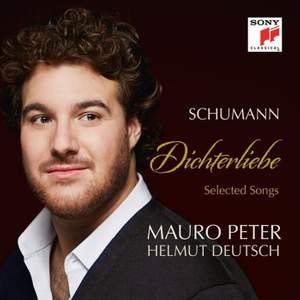
All recordingsPrices shown exclude VAT. (UK tax is not payable for deliveries to United States.) See Terms & Conditions for p&p rates. | |  | Schumann: Dichterliebe & Ausgewählte Lieder
| | | In stock - usually despatched within 1 working day. |
|
|
| |  | Schumann/Heine Lieder
Schumann: | Liederkreis, Op. 24 Der arme Peter, Op. 53 No. 3 Die beiden Grenadiere, Op. 49 No. 1 Abends am Strand, Op. 45 No. 3 Die feindlichen Brüder, Op. 49 No. 2 Belsazar, Op. 57 Du bist wie eine Blume, Op. 25 No. 24 Was will die einsame Träne, Op. 25 No. 21 Die Lotosblume, Op. 25 No. 7 Tragödie Op. 64 No. 3 Es leuchtet meine Liebe, Op. 127 No. 3 Lehn deine Wang' Op. 142 No. 2 Dein Angesicht, Op. 127 No. 2 Mein Wagen rollet langsam, Op. 142 No. 4 |
ONYX is proud to present an exceptional Schumann recital by the outstanding Austrian baritone Florian Boesch. The recital consists of the greatest Heine settings, the op24 Liederkreis, plus many of the great Romances and Ballads including Belshazzar (Belsatzar). Boesch is rapidly becoming known as one of the most truthfully dramatic lieder interpreters of our day, and made a sensational debut at the Edinburgh Festival in 2005 with Martineau. Florian Boesch studied in Vienna with Robert Holl. In 2003 he made his operatic debut with Opernhaus Zürich as Papageno, and is now working with many of the world’s greatest conductors including Gergiev, Bychkov, Harnoncourt, Herreweghe, Viotti and Adam Fischer. Despite his opera work he is perhaps unusual in devoting much of his time to lieder with performances at London’s Wigmore Hall, Concertgebouw Amsterdam, Edinburgh Festival, Mozarteum Salzburg, Wiener Konzerthaus, Palais des Beaux-Arts Brussels, the Schubertiade Festival Schwarzenberg. “The Austrian baritone opens with an exquisitely gauged Liederkreis, Op 24, full of subtle emotional twists and turns. The rest is a carefully varied selection of settings of words by Heine.” Sunday Times, 3rd May 2009 **** “Having an accompanist as perceptive and exquisitely musical as Malcolm Martineau is a big asset, these are lieder performances of very high quality indeed.” The Guardian, 1st May 2009 **** “There is much to enjoy in Boesch's dramatic, intensely "lived" performances, and in the imaginative playing of Malcolm Martineau (ultra-sensitive in Schumann's secretive piano postludes).” Gramophone Magazine, Awards Issue 2009 | | | In stock - usually despatched within 1 working day. |
|
|
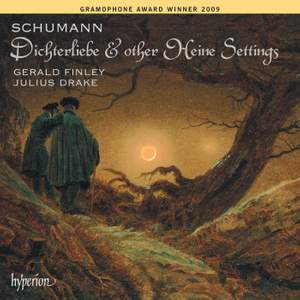
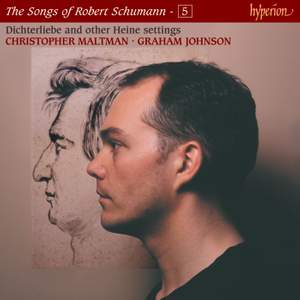
| |  | Schumann - Dichterliebe & other Heine settings
Schumann: | Tragödie Op. 64 No. 3 Die beiden Grenadiere, Op. 49 No. 1 Abends am Strand, Op. 45 No. 3 Die feindlichen Brüder, Op. 49 No. 2 Der arme Peter, Op. 53 No. 3 Belsazar, Op. 57 Die Lotosblume, Op. 25 No. 7 Was will die einsame Träne, Op. 25 No. 21 Du bist wie eine Blume, Op. 25 No. 24 Lehn deine Wang' Op. 142 No. 2 song originally conceived for Dichterliebe Es leuchtet meine Liebe, Op. 127 No. 3 song originally conceived for Dichterliebe Dein Angesicht, Op. 127 No. 2 song originally conceived for Dichterliebe Mein Wagen rollet langsam, Op. 142 No. 4 song originally conceived for Dichterliebe Dichterliebe, Op. 48 |
Why another Dichterliebe recording? Because Gerald Finley has simply one of the greatest voices of his generation, and is an artist at the peak of his powers. He brings to this noble song cycle the supreme technical ability and penetrating musical understanding that characterize all his performances, whether on the concert platform, in the recording studio or on the great opera stages of the world. This is his fourth disc with collaborator Julius Drake, and the partnership has proved to be a uniquely rewarding one. This fine recital also includes many of Schumann’s other Heine settings. The extremes of elation and despair in Heine’s poetry stimulated Schumann to write some of his most poignant and unforgettable songs. This is truly a disc to treasure. “[Finley] brings eloquence to the text and maturity to his interpretations, but with a still youthful-sounding voice. Darker and more “bassy” of tone than Dieskau, he is especially impressive in the sardonic and bitter songs...Finley is a gripping narrator, too, in the tale of Belshazzar’s feast, and can refine his voice to the most arresting of internalised confidences in the love songs to Clara Wieck.” Sunday Times, 14th September 2008 **** “Finley is a much less knowing, more direct performer than Fischer-Dieskau, concentrating less on precise verbal nuance (though his German diction is wonderfully clear) than on more generalised expressive contours, but the effect is still overwhelmingly powerful.” Andrew Clements, The Guardian, 5th September 2008 ***** “Doubts as to whether the world needs yet another Dichterliebe are allayed by a performance that probes the extremes of Schumann's evocation of remembered, blighted love. Gerald Finley's burnished baritone is one of the most beautiful voices to have recorded the cycle.” The Telegraph, 6th September 2008 “Finley's performance gives huge pleasure and insight…” BBC Music Magazine, September 2008 **** “In close collusion with the ever-sentient Julius Drake, Gerald Finley gives one of the most beautifully sung an intensely experience performances on dic of Schumann's cycle of rapture, disillusion and tender regret. This is a Dichterliebe firmly in the past tense, the poet-lover achingly resigned from the outset. Singer and pianist are just as compelling in the other Heine settings here.” Gramophone Magazine, November 2008 “Isserlis's mobile, feeling but never gushing legato lines… Hough's winged, crystalline partnership.” BBC Music Magazine, December 2005 “[Finley] sings Schumann's great song-cycle with much tonal beauty and feeling, above all capturing the deep disillusion of Schumann's inspiration” Penguin Guide, 2010 edition **** “In close collusion with the ever-sentient Julius Drake, Gerald Finley gives one of the most beautifully sung and intensely experienced performances on disc of Schumann's cycle of rapture, disillusion and tender regret. This is a Dichterliebe firmly in the past tense, the poetlover achingly resigned from the outset. Finley sings the second song, 'Aus meinen Tränen', as if in a trance, and lingers luxuriantly, even masochistically, over the remembered 'Ich liebe dich' in 'Wenn ich' in deine Augen seh''. Yet here and elsewhere some dangerously slow tempi are vindicated by the acuity of his verbal and musical responses. Where most singers end 'Im Rhein' in wistful tenderness, Finley infuses his final words with a wry bitterness. The disenchantment of 'Ich grolle nicht' is already glimpsed. In the cycle's latter stages Finley veers between numb reverie and acerbic self-dramatisation. The birds' assuaging response in 'Am leuchtenden Sommermorgen' is magical, barely breathed, the mounting trauma of the funereal dream-song 'Ich hab' im Traum geweinet' chillingly conveyed, the dissolving vision of the penultimate 'Aus alten Märchen' relived with ineffable sadness. Adding a cutting edge to his warm, mahogany baritone, Finley imbues the final song with savage irony, before the rueful, healing close. Throughout, Drake's playing is a model of clarity and acutely observed detail (he is more attentive than most to bass-lines), epitomised in his fluid, exquisitely voiced epilogue. Singer and pianist are just as compelling in the other Heine settings here. The church acoustic is more resonant than is ideal for Lieder, though that hardly detracts from a glorious Schumann recital.” Gramophone Classical Music Guide, 2010 “Grotesquerie, beauty, irony, sentimentality and overwhelming passion mingle to breathtaking effect...His in-the-moment honesty is matched note-for-note by pianist Julius Drake, who partners him with a superb sense of drama and detail. It's a recital which can stand comparison with the greatest Schumann recordings.” METRO | | | In stock - usually despatched within 1 working day. |
|
|
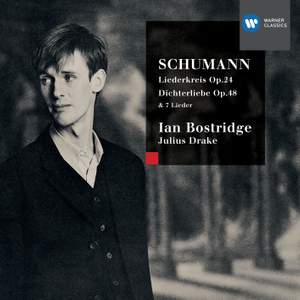
| |  | Schumann: Dichterliebe
“Bostridge makes you think anew about the music in hand, interpreting all these songs as much through the mind of the poet as that of the composer, and, being youthful himself, getting inside the head of the vulnerable poet in his many moods. Quite apart from his obvious gifts as a singer and musician, that's what raises Bostridge above most of his contemporaries, who so often fail to live the words they're singing. Every one of the magnificent Op-24 songs has some moment of illumination, whether it's the terror conveyed so immediately in 'Schöne Wiege', the breathtaking beauty and sorrow of 'Anfang wollt ich' or the breadth and intensity of 'Mit Myrten und Rosen'. In between the two cycles comes a group of the 1840 Leipzig settings that adumbrates every aspect of Bostridge's attributes, as well as those of his equally perceptive partner. The vivid word-painting in Belsatzar brings the Old Testament scene arrestingly before us. Perhaps best of all is the unjustly neglected Es leuchtetmeine Liebe, a melodrama here perfectly enacted by both performers. Mein Wagen rollet langsam forms a perfect introduction, in its lyrical freedom, to Dichterliebe, an interpretation to rank with the best available in terms of the sheer beauty of the singing and acute response to its sustained inspiration. Listen to the wonder brought to the discovery of the flowers and angels in 'Im Rhein', the contained anger of 'Ich grolle nicht', the sense of bereavement in 'Hör ist das Liedchen' and you'll judge this is an interpretation of profundity and emotional identification, the whole cycle crowned by the sensitivity of Drake's playing of the summarising postlude. To complete one's pleasure EMI has provided an exemplary and forward recording balance.” Gramophone Classical Music Guide, 2010 “It would be difficult to overpraise this issue given its manifold revelations concerning the setting of Heine's poetry by Schumann” Gramophone Magazine, April 1998 | | | In stock - usually despatched within 1 working day. |
|
|
| |  | Schumann: | Dichterliebe, Op. 48 Liederkreis, Op. 24 Liederkreis, Op. 39 Liederreihe Op. 35 Der Himmel hat eine Träne geweint, Op. 37 No. 1 Ich hab' in mich gesogen, Op. 37 No. 5 Rose, Meer und Sonne , Op. 37 No. 9 Mein Wagen rollet langsam, Op. 142 No. 4 Der arme Peter, Op. 53 No. 3 Tragödie Op. 64 No. 3 Lehn deine Wang' Op. 142 No. 2 Du bist wie eine Blume, Op. 25 No. 24 Was will die einsame Träne, Op. 25 No. 21 Die Lotosblume, Op. 25 No. 7 Widmung, Op. 25 No. 1 Freisinn, Op. 25 No. 2 Zwei Venetianische Lieder, Op. 25 Nos. 17 & 18 Der Nussbaum, Op. 25 No. 3 Aus dem Schenkenbuch im Divan I, Op. 25 No. 5 Aus dem Schenkenbuch im Divan II, Op. 25 No. 6 Aus den östlichen Rosen, Op. 25 No. 25 Zum Schluß, Op. 25 No. 26 |
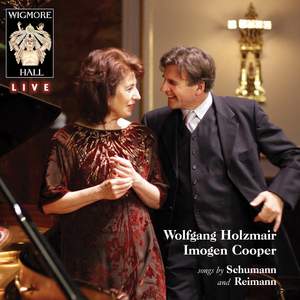
Wolfgang Holzmair and Imogen Cooper's lieder partnership is the stuff of dreams and their traversal of the Schumann repertoire has won them international plaudits both, for performance as well as the sound engineering on these Philips recordings. Here, brought together for the first time as a collection, is their complete traversal of a vast selection of Robert Schumann's lieder, including all the cycles - the two sets of Liederkreis, the 'Kerner Lieder' and Dichterliebe. Included too are individual songs to poems by Heine and Ruckert, as well as a selection of Myrthen. Two songs Rose, Meer und Sonne, Op. 37 No. 9 and Aus den ostlichen Rosen, Op. 25 No. 25, only appeared previously as part of an Imogen Cooper anthology and are here included to well and truly complete the duo's Schumann survey. “Singer and pianist work together almost by instinct in thinking themselves into the very heart of these songs... Holzmair's plangent, very Viennese voice bespeaks the vulnerability that lies at the soul of Robert's Eusebius side, heard to mesmeric effect in the great, slower songs of Op 35, but he is just as capable of tramping the ways with Schumann when he is in his Florestan mood.... [Imogen Cooper's] playing throughout the programme is at once supportive of her partner and individual in itself. The recording is faultless” Gramophone Magazine “Holzmair with his light, tenorish baritone proves a perfect poet in Dichterliebe and Imogen Cooper is an inspired accompanist....[In Liederkreis], too, Holzmair proves a masterly interpreter alert and intense but finely controlled....The sound throughout is impressive,” Penguin Guide, 2010 edition *** “I was transfixed by the sheer artistry... Rarely have I heard so sensitive, intelligent and gloriously musical a partnership... no one could have asked for more attentive, detailed expressions nor more complete harmony of feeling between singer and pianist” The Independent | | | In stock - usually despatched within 1 working day. |
|
|
| |  | Dietrich Fischer-Dieskau: Schubert & Schumann RecitalsTwo Films by Bruno Monsaingeon
Schubert: | An Schwager Kronos, D369 Hoffnung, D637 Auf der Donau, D553 (Mayrhofer) Der Strom, D565 (poet unknown) Der Wanderer, D489 Die Gotter Griechenlands D677 (Schiller) Freiwilliges Versinken D700 (Mayrhofer) Der Zwerg, D771 (Collin) Wehmut, D825 Totengräbers Heimwehe D842 (Craigher) Auf der Bruck, D853 Des Sängers Habe D832 (Schiechta) Am Fenster, D878 Fischerweise, D881 (Schlechta) Das Zugenglocklein D871 (Seidl) Der Kreuzzug D932 (Leitner) Des Fischers Liebesgluck, D933 (Leitner) Die Sterne, D939 (Leitner) Der Einsame, D800 Aus 'Heliopolis' - II D754 (Mayrhofer) Geheimes, D719 (Goethe) Im Abendrot, D799 Abschied D475 (Mayrhofer) | Schumann: | Mein Wagen rollet langsam, Op. 142 No. 4 Es leuchtet meine Liebe, Op. 127 No. 3 Abends am Strand, Op. 45 No. 3 Liederkreis, Op. 24 Dichterliebe, Op. 48 Du bist wie eine Blume, Op. 25 No. 24 Der Kontrabandiste, Op. 74 No. 10 Erstes Grün, Op. 35 No. 4 Schöne Fremde (No. 6 from Liederkreis, Op. 39) Sitz'ich allein, Op. 25, No. 1 |
SCHUBERT RECITAL (1992) SCHUMANN RECITAL (1991)
This DVD release celebrates the life of Dietrich Fischer-Dieskau, German lyric baritone and one of the most acclaimed Lieder performers of the late 20th century. Elisabeth Schwarzkopf called him ‘a born god who has it all’. He performed and recorded a great many operatic roles and dominated both the opera and concert platform for over thirty years, being regarded as one of the finest lyrical vocalists of his generation. In these two concerts from the Opera Theatre of Nuremberg, recorded in 1991 and 1992, Fischer-Dieskau performs beautiful and dramatic Lieder by Franz Schubert and Robert Schumann. 157 MINS • ALL REGIONS • NTSC 4:3 • COLOUR • L-PCM STEREO | 
| | | Usually despatched in 4 - 5 working days. |
|
|
| |  | The Art of Bryn Terfel
Berlioz: | Une puce gentille 'Flea Song' (from La damnation de Faust) Voici des roses (Air de Méphistophélès) | Gurney: | Sleep | Gwynn Williams: | My Little Welsh Home | Handel: | Si, tra i ceppi (from Berenice) Te Deum in D major 'Dettingen', HWV283: Vouchsafe, O Lord | Hughes, J: | Guide me, O thou great Redeemer (Cwm Rhondda) | Loewe, F: | Paint Your Wagon: They Call the Wind Maria | Mahler: | In diesem Wetter, in diesem Braus (Kindertotenlieder) | Mendelssohn: | Lord God of Abraham (Elijah) | Mozart: | Non piu andrai, farfallone amoroso (from Le Nozze di Figaro) Il core vi dono (from Così fan tutte) Ein Mädchen oder Weibchen (from Die Zauberflöte) Io ti lascio, oh cara, addio, KAnh. 245 | Puccini: | Tre sbirri...Una carozza...Presto 'Te Deum' (from Tosca) | Quilter: | Go, lovely Rose, Op. 24 No. 3 (Edmund Wailer) | Rutter: | The Lord bless you and keep you | Schubert: | Erlkönig, D328 Du bist die Ruh D776 (Rückert) Der Musensohn, D764 (Goethe) | Schumann: | Du bist wie eine Blume, Op. 25 No. 24 Die beiden Grenadiere, Op. 49 No. 1 Mein Wagen rollet langsam, Op. 142 No. 4 | Sullivan, A: | Hereupon we’re both agreed (The Yeomen of the Guard) | trad.: | Amazing Grace Shenandoah Ar hyd y Nos (All through the night) Suo gan Deep River | Vaughan Williams: | The Vagabond (from Songs of Travel) Silent Noon | Verdi: | Ehi! Paggio! ... L'onore! Ladri! (from Falstaff) | Wagner: | Die Frist ist um (from Der fliegende Holländer) O du, mein holder Abendstern (from Tannhäuser) |
Bryn Terfel is one of Britain’s best-loved singers, as comfortable in popular musical repertoire as he is in the great roles of opera. Ahead of his curated BrynFest appearances at London’s Southbank Centre, and his career-defining role as Wotan in Wagner’s Ring Cycle at the Royal Opera House this autumn, Deutsche Grammophon is proud to release this 2CD career retrospective. | | | (Sorry, download not available in your country) | Usually despatched in 2 - 3 working days. |
|
|
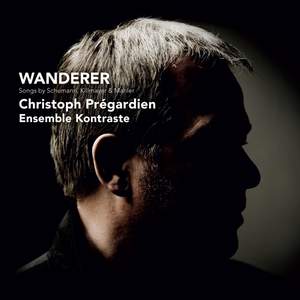
| |  | Wanderer: Songs by Schumann, Killmayer & Mahler
Killmayer: | Four songs from 'Hölderlin-Lieder II' arranged for small ensemble | Mahler: | Lieder eines fahrenden Gesellen (4 songs, complete) arranged for small ensemble by Arnold Schönberg | Schumann: | Frühlingsfahrt, Op. 45 No. 2 arranged for small ensemble by Reißenberger Eintritt, Op. 82 No. 1 (from Waldszenen) instrumental: arranged for small ensemble by Reißenberger In der Fremde (No. 1 from Liederkreis, Op. 39) arranged for small ensemble by Reißenberger Waldesgesprach (No. 3 from Liederkreis, Op. 39) arranged for small ensemble by Reißenberger Mondnacht (No. 5 from Liederkreis, Op. 39) arranged for small ensemble by Reißenberger Einsame Blumen, Op. 82 No. 3 (from Waldszenen) arranged for small ensemble by Reißenberger Trost im Gesang, Op. 142 No. 1 arranged for small ensemble by Reißenberger Sehnsucht nach der Waldgegend, Op. 35 No. 5 'Wär' ich nie aus euch gegangen' arranged for small ensemble by Reißenberger Wanderung, Op. 35 No. 7 'Wohlauf und frisch gewandert ins unbekannte Land!' arranged for small ensemble by Reißenberger Herberge, Op. 82 No. 1 (from Waldszenen) instrumental: arranged for small ensemble by Reißenberger Es leuchtet meine Liebe, Op. 127 No. 3 arranged for small ensemble by Reißenberger Dein Angesicht, Op. 127 No. 2 arranged for small ensemble by Reißenberger Lehn deine Wang' Op. 142 No. 2 arranged for small ensemble by Reißenberger Mein Wagen rollet langsam, Op. 142 No. 4 arranged for small ensemble by Reißenberger Der Abschied, Op. 82, No. 9 insturmental: arranged for small ensemble by Reißenberger Kinderszenen, Op. 15: Der Dichter spricht arranged for small ensemble by Reißenberger |
Ensemble Kontraste has taken Schoenberg’s arrangement of Mahler’s Lieder eines fahrenden Gesellen as the starting point for a musical collaboration with the tenor Christoph Prégardien called ‘Wanderer’. The disc also includes 16 lieder by Robert Schumann, arranged for this project by Marcus Reißenberger, and four lieder by contemporary composer Wilhelm Killmayer, written by the composer with instrumentation to fit in with that used in the Mahler and Schumann pieces. Christoph Prégardien started a new long-term collaboration with Challenge Classics in 2008 with the release of Schubert’s Die schöne Müllerin (CC72292). The pianist on this disc is Michael Gees. It was soon followed by Schwanengesang (CC72302) with Andreas Staier as accompanist. Die schöne Müllerin was awarded the Midem ‘Record of the Year’ 2009 at Cannes, and the duo Christoph Prégardien and Michael Gees also received the MIDEM ‘Vocal Recitals’ Award 2009. Throughout 2008 the recording received critical acclaim from many national and international magazines (Gramophone Editor’s Choice & ‘Best of 2008’ accolades among others). Since then he has recorded Between Life and Death, a collection of songs and arias with Michael Gees, and the Italienische Liederbuch of Wolf with Julia Kleiter and Hilko Dumo which has been shortlisted for a 2011 Gramophone award. “Prégardien never allows the novelty of a new incarnation to distract him: his singing here is full of imaginative insights...the tenor's courage and imagination triumph.” BBC Music Magazine, January 2012 ***** “it would be hard to find more committed advocates [for the Mahler arrangement] than Christoph Prégardien and the expert players of Ensemble Kontraste. As ever, Prégardien sings with an unaffected directness that by no means precludes subtlety. He finds an incisive blade in his lyrical, slightly baritonal tenor for the anguished third song” Gramophone Magazine, February 2012 BBC Music Magazine
Choral & Song Choice - January 2012 |
| | | Usually despatched in 4 - 5 working days. |
|
|
| |  | Bryn Terfel - A Song in my Heart
| | The Vagabond Whither Must I Wander Sea Fever Little Prince (The Little Prince) They Call the Wind Maria (Paint Your Wagon) English Northern Philharmonia, Paul Daniel Come Home (Allegro) English Northern Philharmonia, Paul Daniel Suo-Gan (Lullaby) Sì, tra i ceppi e le ritorte (Berenice) Vouchsafe, O Lord (Dettingen Te Deum) Scottish Chamber Orchestra, Mackerras | Berlioz: | Une puce gentille 'Flea Song' (from La damnation de Faust) Voici des roses (Air de Méphistophélès) Philharmonia Orchestra and Chorus, Myung-Whun Chung | Gurney: | Sleep | Hughes, J: | Guide me, O thou great Redeemer (Cwm Rhondda) The Black Mountain Chorus, Risca Male Choir & The Orchestra of Welsh National Opera, Gareth Jones | Mahler: | In diesem Wetter, in diesem Braus (Kindertotenlieder) Philharmonia Orchestra, Giuseppe Sinopoli | Mendelssohn: | Lord God of Abraham (Elijah) Orchestra of the Age of Enlightenment, Paul Daniel | Mozart: | Non piu andrai, farfallone amoroso (from Le Nozze di Figaro) Il core vi dono (from Così fan tutte) Cecilia Bartoli (Dorabella) & Bryn Terfel (Guglielmo) Orchestra dell’Accademia die Santa Cecilia, Myung-Chun Chung Ein Mädchen oder Weibchen (from Die Zauberflöte) Io ti lascio, oh cara, addio, KAnh. 245 Scottish Chamber Orchestra, Sir Charles Mackerras | Quilter: | Go, lovely Rose, Op. 24 No. 3 (Edmund Wailer) Malcolm Martineau (piano) | Rutter: | The Lord bless you and keep you London Symphony Orchestra, Barry Wordsworth | Schubert: | Erlkönig, D328 Du bist die Ruh D776 (Rückert) Der Musensohn, D764 (Goethe) | Schumann: | Du bist wie eine Blume, Op. 25 No. 24 Die beiden Grenadiere, Op. 49 No. 1 Mein Wagen rollet langsam, Op. 142 No. 4 | Sullivan, A: | Hereupon we’re both agreed (The Yeomen of the Guard) Academy of St Martin in the Fields, Sir Neville Marriner | trad.: | Amazing Grace London Symphony Orchestra, Barry Wordsworth Shenandoah London Symphony Orchestra, Barry Wordsworth Ar hyd y Nos (All through the night) Deep River arr. Chris Hazell | Vaughan Williams: | Silent Noon | Verdi: | Ehi! Paggio! ... L'onore! Ladri! (from Falstaff) MET Orchestra, James Levine | Wagner: | Die Frist ist um (from Der fliegende Holländer) Berliner Philharmoniker, Claudio Abbado O du, mein holder Abendstern (from Tannhäuser) The Metropolitan Opera Orchestra, James Levine |
| | | Usually despatched in 2 - 3 working days. |
|
|
| |  | Schumann - Lieder
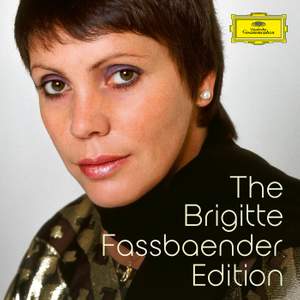
Schumann: | Aufträge, Op. 77 No. 5 Der Nussbaum, Op. 25 No. 3 Das verlassene Mägdlein, Op. 64 No. 2 Er ist's! Op. 79 No. 23 (Eduard Mörike) Frauenliebe und -leben, Op. 42 Die Sennin, Op. 90 No. 4 Kommen und Scheiden, Op. 90 No. 3 Der schwere Abend, Op. 90 No. 6 Gedichte der Königin Maria Stuart, Op. 135 Mit Myrten und Rosen (No. 9 from Liederkreis, Op. 24) Mein Wagen rollet langsam, Op. 142 No. 4 Es fiel ein Reif in der Fruhlingsnacht Op. 64/2 Ein Jungling liebt ein Mädchen (No. 11 from Dichterliebe, Op. 48) Aus alten Marchen (No. 15 from Dichterliebe, Op. 48) Zigeunerliedchen I & II Fruhlingsnacht |
Live recording, 1977 “As a Lieder singer, Brigitte Fassbaender was a law unto herself. …her Frauenliebe und-leben from the 1977 Salzburg Festival has a no-holds-barred intensity. No other singer suggests such pain within the cycle's dominant moods of dreamy rapture and happy enthusiasm, as if its ending were implicit at the outset.” BBC Music Magazine, May 2005 **** | | | Usually despatched in 3 - 4 working days. |
|
|
| |
|