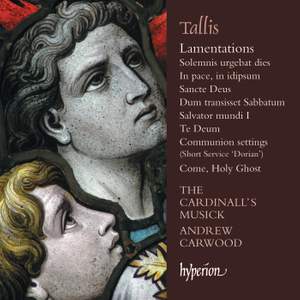
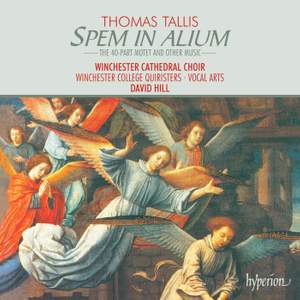
All recordingsPrices shown exclude VAT. (UK tax is not payable for deliveries to United States.) See Terms & Conditions for p&p rates. | |  | Tallis: Spem in Alium
La Chappelle du Roi give highly praised and beautifully sung performances of Tallis’ most famous works including Spem in Alium and the Lamentations of Jeremiah I&II. Super budget price. | 
| | | In stock - usually despatched within 1 working day. |
|
|
| |  | Tallis: Spem in Alium
| | | In stock - usually despatched within 1 working day. |
|
|
| |  | Tallis: Spem in aliumand other choral works
“Never before has Spem in alium, Tallis's great 40-part motet, so closely resembled The Last Judgement as it does in this vast and awesome performance” Gramophone Magazine “A thrilling large scale performance” CD Review | | | In stock - usually despatched within 1 working day. |
|
|
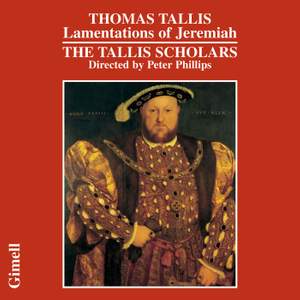
| |  | Tallis: Lamentations of Jeremiah
| | | In stock - usually despatched within 1 working day. |
|
|
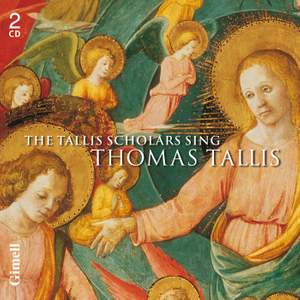
| |  | The Tallis Scholars sing Thomas Tallis
“The Tallis Scholars produce a distilled, transparent sound and the spiritual tone of their performance is one of serene contemplation through which the Requiem's ecstatic 'external light' shines.” BBC Music Magazine, September 2005 ***** | | | In stock - usually despatched within 1 working day. |
|
|
| |  | Tallis - Spem in alium
This is quite the best performance of Tallis's 40-part Spem in Alium that I have heard." Gramophone “This is quite simply the best performance of Tallis's 40-part Spem in alium to date. Sung by a constellation of singers, many of them familiar names from other wellestablished choral groups, it's a gripping realisation. The effect of the slowly moving harmonies is enhanced by a well-conceived and very positive use of dynamics. Precise entries, gently undulating rhythms that are wonderfully supple, and then those firm antiphonal phrases – one group of choirs answered by another at 'Creator coeli et terra' – raise the tension, until we twice almost miss a heart-beat at the well-placed rest before 'Respice …'. That great motet, so central to the whole programme, is well supported by the four-part Mass and the delightful group of other pieces for various combinations of voices. The hymn Te lucis with its alternating chant strophes sounding so very English (almost too perfect for what was, after all, just run-of-the-mill everyday chant!) has the tempo relationship of the chant to the polyphony just right, which is a tremendous plus, rarely achieved.” Gramophone Classical Music Guide, 2010 | | | (also available to download from $10.50) | In stock - usually despatched within 1 working day. |
|
|
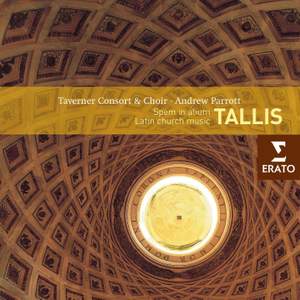
| |  | Tallis: Latin Church Music
“[In Spem in alium] Parrott's sure touch tells in the form: the first entry is clear and confident...the first Mexican wave spreads inexorably, the arrival on the second tutti rings out like a clarion-call, the antiphonal section doesn't flag, the initial 'Respice' is solemn and arresting, and the final tutti gloriously full-bodied.” Gramophone Magazine, February 2010 | | | In stock - usually despatched within 1 working day. |
|
|
| |  | Tallis - Lamentations of Jeremiah
“This, the third volume of the survey by The Tallis Scholars of the music of the Tudor composer, Thomas Tallis, contains the well-known Lamentations, eight motets, and the extended motet Salve intemerata virgo. The Lamentations and motets are typical of the style of late Renaissance English composers. The overall mood is one of considerable austerity and their simplicity is indicative of the probability of their having been written for the private use of loyal Catholics rather than for formal ritual. Salve intemeratavirgo, on the other hand, looks back to the glories of the late 15th century. In particular, Tallis's use of the phrygian mode gives the work as a whole a strong sense of the medieval. Despite this disparity of styles the Tallis Scholars acquit themselves, as always, with great distinction. In the Lamentations and motets they achieve an appropriate sense of intimacy, while in Salve intermerata virgo they rise fully to the challenges of one of the more extended and demanding examples of Tudor choral composition. In addition the formidable challenges which this latter work sets for the conductor, such as the sense of pace, variation of dynamics, and overall architecture of the work, are all extremely well handled by Peter Phillips. The recording is very fine.” Gramophone Classical Music Guide, 2010 | | | In stock - usually despatched within 1 working day. |
|
|
| |  | Renaissance Choral Masterpieces
Allegri: | Miserere mei, Deus The Sixteen, Harry Christophers | Byrd: | Ave verum Corpus The Sixteen, Harry Christophers | Despres: | Ave Maria (4vv) The Sixteen, Harry Christophers | Lasso: | Timor et Tremor The Sixteen, Harry Christophers | Lotti: | Crucifixus in 8 parts The Sixteen, Harry Christophers | Obrecht: | Salve Regina The Sixteen, Harry Christophers | Palestrina: | Stabat mater transcribed & edited by Jon Dixon Gabrieli Consort, Paul McCreesh | Tallis: | Lamentations of Jeremiah I & II Ed. Philip Brett The Choir of King's College, Cambridge, Stephen Cleobury | Victoria: | Salve Regina a 8 Gabrieli Players & Gabrieli Consort, Paul McCreesh |
| | | (Sorry, download not available in your country) | Usually despatched in 2 - 3 working days. |
|
|
| |  | Tallis - Spem in alium
Booklet essay, sung texts & translations Recording made in 1989 Thomas Tallis (c1505-85) lived through one of the most turbulent and dangerous periods in English history. Entering in to the service of Waltham Abbey in 1538 his employment looked secure, writing masses and music for the many religious festivals and services. Henry VIII’s simmering row with Rome over his divorce from Queen Katherine so he could marry Anne Boleyn finally boiled over, and in 1540 Waltham Abbey was ‘taken down’. The break with Rome, the dissolution of the monasteries meant that Tallis was out of work. He received severance pay, and with these funds purchased a quantity of musical manuscripts and a technical manual on polyphonic music. Armed with the knowledge from these materials, he obtained his next job as a member of Henry VIII’s Chapel Royal. Here Tallis weaved a dangerous path over the shifting sands of political intrigue and religious persecutions to serve not only Henry, but Edward VI, Mary I and Elizabeth I. It is for the Anglican Church under Elizabeth that he made his greatest contribution to English music. If the Queen knew of his Catholic leanings, she was untroubled – in fact she was by all accounts far more tolerant of such things than either her Protestant brother Edward VI or her rabidly anti-Protestant Catholic sister ‘Bloody’ Mary. Tallis’s masterpiece, the 40 part motet Spem in alium was commissioned by Thomas Howard, Duke of Norfolk. It was intended to surpass a work for 40 voices by Alessando Striggio, which is does with ease. By way of a footnote, Howard was executed in 1572 for his involvement in a catholic plot to assassinate Elizabeth. ‘This is King’s College Choir at its most typical: assured, technically precise, with a marvellously professional attention to detail, but quite unfussed; a precision which simply lets the music speak for itself, in the characteristic acoustic of the great perpendicular chapel. In the two Lamentations settings one has the rare chance of hearing the men alone – a fine rich sound. Their calm restraint is admirable, the balance of the voices impeccable and there is some remarkable phrasing’ Gramophone, December 1990 “This recording showcases an excellent vintage of this celebrated choir in fine performances of some Tallis's finest works.” BBC Music Magazine, November 2010 **** | | | Usually despatched in 2 - 3 working days. |
|
|
| |
|