All recordingsPrices shown exclude VAT. (UK tax is not payable for deliveries to United States.) See Terms & Conditions for p&p rates. | |  |
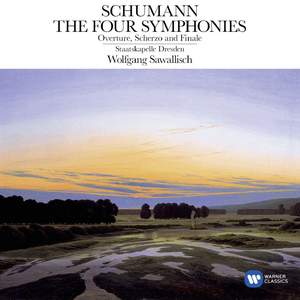
“Schumann's symphonies come in for criticism because of his supposed cloudy textures and unsubtle scoring, but in the hands of a conductor who's both skilful and sympathetic they're most engaging works. Sawallisch's recordings, brightly transferred, are a much admired set. His style, fresh and unforced, isn't as high powered as some other conductors but it's sensible, alert and very pleasing. He achieves great lightness in the First and Fourth Symphonies – there's always a sense of classical poise and control but never at the expense of the overall architecture of the pieces. The Second and Third Symphonies, larger and more far-reaching in their scope, again benefit from Sawallisch's approach. The playing of the Staatskapelle Dresden is superlative in every department, with a lovely veiled string sound and a real sense of ensemble. With the Overture,Scherzo and Finale thrown in for good measure, this isn't to be missed.” Gramophone Classical Music Guide, 2010 | | | In stock - usually despatched within 1 working day. |
|
|
| |  | Schumann: Manfred Overture, Piano Concerto and Overture, Scherzo & Finale
| |
|
| |  | Schumann: Symphony No. 1 in B flat major, Op. 38 'Spring'
This CD includes two of Schumann’s greatest orchestral compositions together with the lesser known “Nachtlied”. The SWR Vokalensemble bring their skills to Schumann’s moody choral work. This renowned choir has won many recording prizes. | | | (also available to download from $10.50) | Usually despatched in 2 - 3 working days. (Available now to download.) |
|
|
| |  | Schumann - Das Paradies und die Peri
In celebration of the Schumann-year 2010. Robert Schumann wrote his oratorio Das Paradies und die Peri on Persian fairy tales, a rather unusual subject in a period when oratorios were mainly based on biblical history. As always in Schumann’s case his way of treating the form is highly original and imaginative. Rather than keeping in the tradition of separate sections of recitative, aria and choruses, he blended the form in a continuous stream of action, in which motives related to persons or situations were the main dramatic features. In this he paved the way for Richard Wagner’s musical dramas. Wonderful soloists: Julia Faulkner, Florence Quivar and others, and the oldest (and some say best…) orchestra of Germany, Staatskapelle Dresden, conducted by the late Giuseppe Sinopoli. Complete text of the oratorio included in the booklet. “the singers are the glory of this recording of Schumann's innovative work” BBC Music Magazine, March 2011 *** | | | Usually despatched in 4 - 5 working days. |
|
|
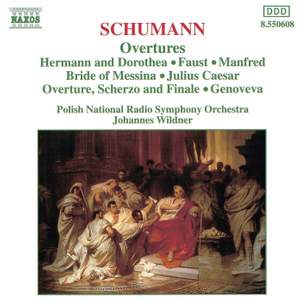
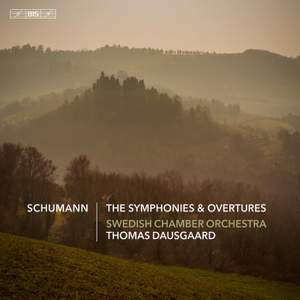
| |  | Schumann - Symphony No. 1 & Overtures
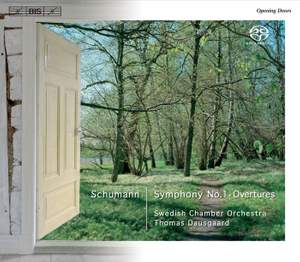
“Clarity is a given with this particular band (their coupling of Symphonies Nos2 and 4 has already proved that) and here the same impressions of transparency, watertight ensemble, dovetailed phrasing and buoyant rhythms pertain.” Gramophone Magazine, May 2008 “To call a performance 'well made' might seem like a half-hearted compliment but in the case of Thomas Dausgaard's account of the Spring Symphony it's only part of the story, albeit a very important part. Clarity is a given with this particular band and here the same impressions of transparency, watertight ensemble, dovetailed phrasing and buoyant rhythms pertain. The first movement is kept on its toes and 'in tempo', and likewise the Scherzo where the Trios are skilfully integrated into the rest of the movement, the first of them opening, unusually, to a gently brushed legato. The Larghetto is streamlined without sounding cold, the important horn and pizzicato string parts always crystal-clear, whereas the finale's prime virtue is its judicious pacing, especially the idyllic horn passage just after the halfway point, and the symphony's closing pages, which are thrillingly played. Dausgaard's understanding of tempo relations is even better demonstrated in the Zwickau movement of an early G minor symphony. There are reminders of early Schubert and Bruckner in that rays of light are crossed with moments of darkness, for example the unresolved bassoon motif that closes the exposition, very imaginative (and unsettling), and so is the return of the stern introduction towards the end of the movement. The Mendelssohnian Overture, Scherzo andFinale is again beautifully shaped, the introduction unusually pensive, the ensuing Allegro full of life, the Scherzo crisp but unhurried. The two relatively late overtures again benefit from smaller-than-usual orchestral forces and perceptive direction, Dausgaard generating bags of energy while allowing textures to breathe. So all we need now is an equally compelling Rhenish Symphony to round off the cycle. The recorded sound is superb.” Gramophone Classical Music Guide, 2010 “Right from the opening fanfares, there's a sense of joy and exhilaration, and the openness of the orchestral textures brings freshness and clarity. The ensemble’s lithe flexibility is used to the full by Dausgaard, whose instincts on tempo are persuasive, and the dramatic tension underpinning the work isn't allowed to evaporate.” Andrew McGregor, bbc.co.uk, 7th March 2008 | | | (also available to download from $10.50) | Usually despatched in 2 - 3 working days. (Available now to download.) |
|
|
| |  |
| | | (also available to download from $10.50) | Usually despatched in 2 - 3 working days. (Available now to download.) |
|
|
| |  | Robert Schumann - The Symphonies
| | | (Sorry, download not available in your country) | Usually despatched in 2 - 3 working days. |
|
|
| | | |  |
“For Schumann's admirers the bargain disc is a must.” Nottingham Evening Post | | | (also available to download from $6.00) | Usually despatched in 2 - 3 working days. (Available now to download.) |
|
|
| |  | Schumann: | Piano Concerto in A minor, Op. 54 Ingrid Haebler (piano) Royal Concertgebouw Orchestra, Eliahu Inbal Cello Concerto in A minor, Op. 129 Lynn Harrell (cello) Cleveland Orchestra, Neville Marriner Konzertstück for four horns, Op. 86 Dale Clevenger, Richard Oldberg, Thomas Howell, Norman Schweikert (horns) Chicago Symphony Orchestra, Daniel Barenboim Introduction & Allegro appassionato in G major, Op. 92 Vladimir Ashkenazy (piano & conductor) London Symphony Orchestra Introduction and Allegro Op. 134 Vladimir Ashkenazy (piano) London Symphony Orchestra, Uri Segal Violin Concerto in D minor, WoO 23 Joshua Bell (violin) Cleveland Orchestra, Christoph von Dohnanyi Overture, Scherzo, and Finale, Op. 52 Wiener Philharmoniker, Sir Georg Solti |
A unique collection, bringing together Schumann's Concertos and concertante works, including the first international release of Ingrid Haebler's recording of the Piano Concerto and Barenboim's of the Konzertstuck for Four Horns. The unjustly neglected Concert Pieces, Opp. 92 and 134 are given glorious readings by Ashkenazy, and both the Cello and Violin Concertos receive admirable performances from Lynn Harrell and Joshua Bell, respectively. “Every orchestral thread gleams ...the cellist's most confidential whisper (and there are many) is never lost. (Cello Concerto)” Gramophone Magazine “unlikely to be surpassed for a long time. (Violin Concerto)” Gramophone Magazine | | | Usually despatched in 2 - 3 working days. |
|
|
| |
|