Prices shown exclude VAT. (UK tax is not payable for deliveries to United States.) See Terms & Conditions for p&p rates. | |  | Suppé: Overtures & Marches
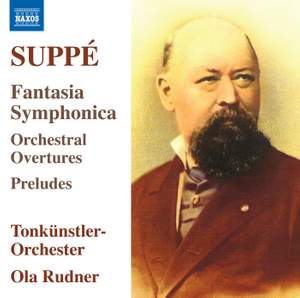
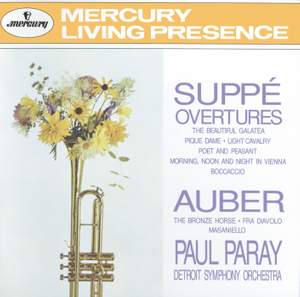
Francesco Ezechiele Ermenegildo, Cavaliere Suppé-Demelli, or as he is more commonly known today, Franz von Suppé, was born in Spalato (Split), then part of the Austrian Empire, to parents of Italian / Belgian and Austrian descent. Although discouraged from a musical career from an early age, Suppé received encouragement from a distant yet illustrious relative, the great Italian opera composer Donizetti. By the 1840s Suppé had carved for himself a successful niche as a composer for the stage, and over the four decades that followed there was rarely a year without a new stage work from him. Although the bulk of his operas and operettas have sunk into relative obscurity, his bright and colourful overtures have survived. Suppé was often referred to as ‘the Viennese Offenbach’, and in fact he was responsible for introducing many of Offenbach’s operettas to the Austrian capital. The Beautiful Galatea was among his first efforts in the style of Offenbach, Suppé here taking on the French composer’s La Belle Hélène. Also on this disc are the overtures to Poet and Peasant, perhaps Suppé’s most familiar, and Boccaccio which is widely regarded as Suppé’s finest work for the stage, based very loosely on the life of Giovanni Boccaccio (1313 – 1375), the Florentine author of the Decameron. It would seem that wars and musical comedy often go hand in hand, perhaps partly for the purpose of deflating military pomposity. Several of Suppé’s operettas are in this vein, including Light Cavalry, The Jolly Robbers, Isabella, and, a major success, Fatinitza, all of which feature military plots in some form. Last, but not least, this disc features Suppé’s overtures to A Morning, Noon, and Night in Vienna, The Queen of Spades, Donna Juanita, and The Model, several operatic marches, the concert march Up Hill and Down Dale, and the Humorous Variations on the beloved Student Song ‘Who comes from afar?’. The works are performed by the Royal Scottish National Orchestra under Neeme Järvi, who in 2012 celebrated his thirty-year recording career with Chandos Records. “What other composer created such a body of rousing, exhilarating and immensely tuneful pieces?...Järvi and his Scottish players provide more than just a touch of extra precision and zip. Järvi indeed seems born to direct this music” Gramophone Magazine, May 2013 “The performances are always alert, sharply focused and carefully balanced, with tempi well chosen. I do however sense a lack of the kind of commitment and sharpness of characterisation that is found in the best of earlier discs of this material...I would not wish to exaggerate my concerns. It is certainly a well chosen, well recorded and well annotated collection, played with enviable precision” MusicWeb International, February 2013 “These stylish, extrovert, often deeply touching set pieces — overtures, marches, a potpourri and a set of variations — come off predictably brilliantly in Jarvi’s spirited hands.” Sunday Times, 13th January 2013 | 
| | | (also available to download from $10.75) | In stock - usually despatched within 1 working day. |
|
|
| |  | Zubin Mehta - New Year's Concert 1990
Strauss, J, I: | Indianer-Galopp (Indian Galop), Op. 111 Radetsky March, Op. 228 | Strauss, J, II: | Der Zigeunerbaron: Einzugsmarsch Donauweibchen Waltz, Op. 427 Wiener Blut Waltz, Op. 354 Im Sturmschritt! (At the Double!), Op. 348 Demolirer-Polka, Op. 269 Geschichten aus dem Wienerwald, Op. 325 Tritsch-Tratsch Polka, Op. 214 Explosions Polka, Op. 43 An der schönen, blauen Donau, Op. 314 | Strauss, Josef: | Die Emanzipierte Sport-Polka, Op. 170 Sympathie, Op. 73 Eingesendet, Op. 240 | Suppe: | Ein Morgen, ein Mittag, ein Abend in Wien Overture |
Directed by Brian Large After three decades of collaboration with the Vienna Philharmonic, Zubin Mehta made his New Year’s Concert debut, which instantly achieved legendary status. "It’s easy to hear why they keep inviting him – Mehta brings a knowing discretion of touch, freeing the amazing Vienna Philharmonic to weave its customary magic” (BBC Music Magazine) First release in 5.1 DTS Surround Sound | | | In stock - usually despatched within 1 working day. |
|
|
| |  | The Barbirolli Viennese Album
Lehár: | Gold und Silber Walzer, Op. 79 Recorded 30-31 December 1966, Kingsway Hall, London STEREO | Schubert: | Symphony No. 9 in C major, D944 'The Great' Recorded 2-3 June 1964, Kingsway Hall, London STEREO | Strauss, J, I: | Radetsky March, Op. 228 orch: Jacob. Recorded 30-31 December 1966, Kingsway Hall, London STEREO | Strauss, J, II: | An der schönen, blauen Donau, Op. 314 Recorded 30-31 December 1966, Kingsway Hall, London STEREO Unter Donner und Blitz, Op. 324 Recorded 30-31 December 1966, Kingsway Hall, London STEREO Der Zigeunerbaron Overture Recorded 30-31 December 1966, Kingsway Hall, London STEREO Perpetuum Mobile, Op. 257 Recorded 30-31 December 1966, Kingsway Hall, London STEREO Champagner-Polka, Op. 211 Recorded 30-31 December 1966, Kingsway Hall, London STEREO | Strauss, R: | Der Rosenkavalier: Waltzes Recorded 30-31 December 1966, Kingsway Hall, London STEREO | Suppe: | Ein Morgen, ein Mittag, ein Abend in Wien Overture Recorded 28-29 June 1957, Free Trade Hall, Manchester STEREO Pique Dame Overture Recorded 28-29 June 1957, Free Trade Hall, Manchester STEREO Die Banditenstreiche Overture Recorded 28-29 June 1957, Free Trade Hall, Manchester STEREO Dichter und Bauer Overture Recorded 28-29 June 1957, Free Trade Hall, Manchester STEREO Leichte Kavallerie Overture Recorded 28-29 June 1957, Free Trade Hall, Manchester STEREO Die schöne Galathée Overture Recorded 28-29 June 1957, Free Trade Hall, Manchester STEREO |
In the Free Trade Hall, at Belle Vue and in the Royal Albert Hall the Viennese Nights were occasions which gave intense musical pleasure and also had a remarkable atmosphere of bonhomie. Sir John could relax, but he never relaxed his artistic standards and he treated the waltzes and polkas as masterpieces of their kind which demanded and deserved top rank treatment. His recording sessions on 30 and 31 December 1966 included Johann Strauss II’s Blue Danube waltz, Perpetuum mobile and Gypsy Baron overture and Johann Strauss I’s Radetzky March in Gordon Jacob’s orchestration. To these are added Strauss II’s cork-popping Champagne Polka and the Thunder and Lightning Polka. No Barbirolli Viennese evening would be complete, of course, without Lehár’s Gold and Silver waltz (1902), performed with especial sumptuousness. From the 1957 Pye sessions come six items by Franz von Suppé, the Austrian composer and conductor of Belgian descent who sealed in Vienna in 1835 where five years later he became third conductor at the Theater in der Josefstadt. In 10 years there, he wrote over twenty scores, including Morning, Noon and Night in Vienna, in which he proved himself in the line of Johann Strauss I. He moved to the Theater an der Wien in 1845 as one of its chief conductors for the next 17 years, after which he went to Kaitheater in 1862 and the Carltheater in 1865 where he remained until his retirement in 1882. His Queen of Spades overture was for a one-act comic operetta, first staged in Berlin, and The Jolly Robbers (Banditenstreiche) for yet another in 1867. Perhaps his best-known and most popular pieces are the Light Cavalry overture and the Poet and Peasant overture. Of all his stage works, only Boccaccio is seen with any regularity today, although he was regarded in his lifetime as Vienna’s answer to Offenbach. But the overtures survive and are ideal Barbirolli Viennese material. The other Strauss in this album is the German, Richard. He is represented by Barbirolli’s suite of waltzes from his most popular opera Der Rosenkavalier which Barbirolli often conducted with the Covent Garden touring company in the 1930s. Sir John never conducted this particular compilation in the concert-hall although he often conducted a suite, probably arranged by Artur Rodzinski, which includes the Presentation of the Rose and the trio in orchestral disguise and can be heard on ‘Barbirolli at the Opera’ (SJB1004). It is interesting to note that Strauss himself made only arrangements of the waltzes for concert performance. Barbirolli recorded this rarity of his own in the December 1966 sessions for Columbia Studio 2. Sir John made two recordings of Schubert’s Great C major Symphony, the first in December 1953 (Barbirolli Society SJB1020) and the second (issued here) in June 1964, also for HMV. | | | Usually despatched in 4 - 5 working days. |
|
|
| |  | Famous Operetta Overtures
| | | (also available to download from $6.00) | Usually despatched in 2 - 3 working days. (Available now to download.) |
|
|
| |  | Franz von Suppé: Overtures, Vol. 4
| |
|
| |  | Suppe: Overtures
Hungarian State Opera Orchestra, Janos Sandor | |
|
| |  | Famous Operetta Overtures
| |
|
| |  | Rossini & Suppe - Overtures
| | | Usually despatched in 8 - 10 working days. |
|
|
| |  | Constant Lambert - The Last Recordings
A charming and delightful disc. Edward Greenfield, Gramophone. | | | Usually despatched in 2 - 3 working days. |
|
|
| |  | Suppe: Famous Overtures
| | | (also available to download from $6.00) | Usually despatched in 2 - 3 working days. (Available now to download.) |
|
|
| |
|