Machaut: Messe de Nostre Dame

This page lists all recordings of Messe de Nostre Dame, by Guillaume de Machaut (c.1300-77) on CD, SACD & download (MP3 & FLAC). Generally, more recent releases are listed first, but with priority given to those that are in stock.

The Messe de Nostre Dame is the earliest known complete mass setting that can be attributed to a single composer.

Recommendations

Choral & Song Choice
June 2008
4 star

All recordings

Prices shown exclude VAT. (UK tax is not payable for deliveries to United States.)
See Terms & Conditions for p&p rates.

Machaut: Messe de Nostre Dame

Machaut: Messe de Nostre Dame


Harmonia Mundi - HMGold - HMG501590

(CD)

$11.75

In stock - usually despatched within 1 working day.

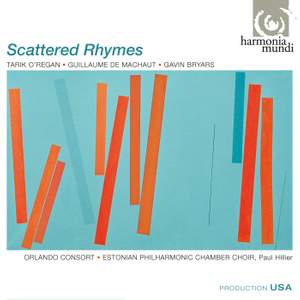
Scattered Rhymes

Scattered Rhymes


Bryars:

Super Flumina

Dufay:

Ave regina celorum

Machaut:

Messe de Nostre Dame

Douce dame jolie, V4

O'Regan:

Scattered Rhymes

Orlando Consort

Douce dame jolie


Machaut's extraordinary Messe de Nostre Dame was not only the first complete mass setting in history, but also the first whose composer can be identified, making it emblematic of the Ars Nova style of the 14th century. In this recording, the Orlando Consort performs the mass in parallel with a work by Tarik O'Regan (born in 1978) which was inspired by it. Scattered Rhymes links two texts from the same period as Machaut's mass, one by Petrarch, the other an anonymous English poem. Both of them subtly combine earthly and divine love, while the music blends polyphonic tradition and contemporary inspiration.

Scattered Rhymes was commissioned by the Spitalfields Festival and first performed with The Joyful Company of Singers. O'Regan's Douce dame jolie was commissioned by the Orlando Consort. Super flumina by Gavin Bryars was commissioned by the National Centre for Early Music,York. Ave Regina celorum by Guillaume Dufay is sung from an edition by Gareth Curtis.

Two-time British Composer Award winner Tarik O'Regan was educated at Oxford University and completed his postgraduate studies at Cambridge. He now divides his time between Trinity College, Cambridge, where he is Fellow Commoner in Creative Arts, and New York City, where he has held the Fulbright Chester Schirmer Fellowship at Columbia University and a Radcliffe Institute Fellowship at Harvard.

Gavin Bryars, born in Yorkshire, was first of all a jazz bassist and pioneer of free improvisation with Derek Bailey and Tony Oxley. His early iconic works The Sinking of the Titanic (1969) and Jesus' Blood Never Failed Me Yet (1971), both enjoyed major recording success. He has written extensively for early music performers such as the Hilliard Ensemble, Red Byrd and Trio Medieval, and for the Estonian National Male Choir and the Latvian Radio Choir.

The Estonian Philharmonic Chamber Choir's repertoire ranges from Gregorian chant to 20th-century music, with special emphasis on Estonian composers like Arvo Pärt and Veljo Tormis. Many of the Choir's recordings have received the highest critical acclaim, including 5 Grammy nominations and a Grammy Award (Arvo Pärt, Da Pacem).Their conductor, Paul Hillier enjoys close creative relationships with a number of contemporary composers, most notably Steve Reich and Arvo Pärt. In 2007, he prepared Stockhausen's Stimmung with Theatre of Voices for a UK tour and subsequent recording.

Since its formation in 1988, the award-winning Orlando Consort has been hailed as the most imaginative champion of vocal music of the Middle Ages and the Renaissance; it now records exclusively for harmonia mundi USA.

“The four male voices of the Orlando Consort bring vigour and tonal variety to Machaut's Messe de Notre Dame, and its tenor Mark Dobell gives a lilting account of the composer's song Douce dame jolie. Tarik O'Regan's Virelai on the same tune then makes playful, contrapuntal use of its melodies. His Scattered Rhymes, inspired by the Mass, pairs the Consort in medieval English poetry with Paul Hillier's choir in texts by Petrarch: a vivid meditation on earthly and divine love. The Consort's perceptive accounts of Du Fay's Ave Regina celorum and Gavin Bryars's Super flumina complete the picture.” The Telegraph, 10th May 2008

“This collection has been programmed with considerable care. Machaut's glorious Messe de Nostre Dame forms its centre, both in terms of its musical substance and its famously provocative rhythmic and harmonic structure.” BBC Music Magazine, June 2008 *****

“Vocal treats in a meeting of old-fashioned sense and modern sensuality” Gramophone Magazine, October 2008

BBC Music Magazine

Choral & Song Choice - June 2008

BBC Music Magazine Awards 2009

Choral Finalist

Super Audio CD

Format:

Hybrid Multi-channel

Harmonia Mundi - HMU807469

(SACD)

$17.50

In stock - usually despatched within 1 working day.

Machaut: Mass

Machaut: Mass


Machaut:

Messe de Nostre Dame

Le lay de la fonteinne 'Je ne cesse de prier', L11

Ma fin est mon commencement, R14


“Machaut's Messe de Nostre Dame is the earliest known setting of the Ordinary Mass by a single composer. Paul Hillier avoids a full reconstruction on this release: his deference to 'authenticity' restricts itself to the usage of 14th century French pronunciation of the Latin. His ensemble sings two to a part, with prominent countertenors.
It's arguable whether the musicians sing the chant at too fast a tempo but they're smooth and flexible, and the performance as a whole is both fluid and light in texture. Also included on this release are two French compositions. The wonderful Lai 'de la fonteinne' is admirably sung by three tenors and is pure delight – providing food for the heart as well as for the intellect. The rather more familiar Ma fin est mon commencement, with its retrograde canon, completes this admirable disc.”
Gramophone Classical Music Guide, 2010

40% off selected Hyperion

Hyperion - CDA66358

(CD)

Normally: $16.75

Special: $10.05

In stock - usually despatched within 1 working day.

Machaut: Messe de Nostre Dame & Songs from Le Voir Dit

Machaut: Messe de Nostre Dame & Songs from Le Voir Dit


Machaut:

Messe de Nostre Dame

Ploures, dames, B32

Nes qu'on porroit, B33

Sans cuer, dolens, R4

Le lay de bonne esperance 'Longuement me sui', L13

Puis qu'en oubli, R18

Dix et sept, cinc, trese, R17


“This is the closest anyone has yet come to recording Machaut's setting as he himself might have heard it; the coupling is a sampling of songs from Le Voir Dit, another intriguingly autobiographical offering.” Early Music America, Winter 2001/Spring 2002

20% off Naxos

Naxos Early Music Collection - 8553833

(CD)

Normally: $8.25

Special: $6.60

(also available to download from $6.00)

In stock - usually despatched within 1 working day.

In Memoriam

In Memoriam


Machaut:

Messe de Nostre Dame


Musica Nova, Lucien Kandel

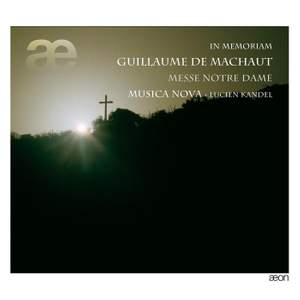
Musica Nova, with its rich experience performing the ballades and motets of Guillaume de Machaut, set out to rewrite the book on his most famous and emblematic work: the so-called Messe de Nostre Dame. The very elaborate construction of the mass and its strange and subtle harmonies win the admiration of all. But do we really know what its true sound was?

Aeon have delved into the 14th-century theory of musica ficta, led by specialist Gérard Geay. In order to perform this music the singers worked from various 14th-century manuscript sources using reading techniques of that era in an attempt to stay as close as possible to the phrasing and vocal movement that Machaut might have had in mind. Reading from the manuscript places the singer in a world of long note values with ternary divisions (modus perfectus), which automatically suggests longer breaths and a more spacious performance. Machaut’s mass alternates between two styles of composition: the conductus, in which all voices follow the same rhythm, and the isorhythmic motet, specific to the Ars Nova.

Aeon - AECD1093

(CD)

$17.00

(also available to download from $10.50)

Usually despatched in 4 - 5 working days. (Available now to download.)

Machaut: Messe de Nostre Dame

Machaut: Messe de Nostre Dame


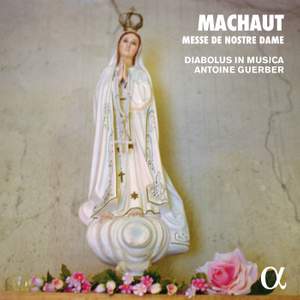
The emblematic work of the gothic period, Guillaume de Machaut's Messe de Notre Dame is where music blossomed into polyphony, just as architecture gained height thanks to the use of the ribbed vault and flying-buttress. A quest for light, as in the cathedral in Reims, where Machaut was canon.

“A splendid Messe de Nostre Dame from an enterprising French ensemble. Diabolus in Musica… like Parrott… intersperse plainchant between the Mass movements, but they also add a few tenor motets… by less well known or anonymous masters. This yields a more satisfying balance between plainsong and polyphony, and it's quite likely that such shorter pieces would have been performed in services at the time. As to the Mass itself, the singing is again superb. Guerber takes a more relaxed view of the general pacing and argument, and to the local shaping of phrases, that Parrott's more driven approach.” Gramophone Magazine, April 2009

Alpha - ALPHA132

(CD)

$17.00

(also available to download from $10.50)

Usually despatched in 4 - 5 working days. (Available now to download.)

Messe de Nostre Dame

Messe de Nostre Dame

High Mass in Reims Cathedral


Machaut:

Messe de Nostre Dame

Inviolata genitrix/Felix virgo/Ad te suspiramus gementes et flentes, M23


Schola Gregoriana of Cambridge, Mary Berry

“…an impressive performance, with the occasional hint of an Eastern Orthodox tinge, especially in the opening melisma of the Introit, but it does not detract from the overall balance and integrity of the presentation of the Mass. The blend of solemnity with pleasure in the celestial potential of the voices evokes the experience of a late-14th-century service as convincingly as you could reasonably expect.” BBC Music Magazine, December 2005 ****

“This is neither the first recording of Machaut's most famous work to have been made in Rheims Cathedral, where the composer worked, nor the first to present the Mass as part of a 'liturgical reconstruction'. (The first distinction belongs to the Oxford Camerata's recording for Naxos, the second to the Taverner Consort's for EMI.) As a liturgical reconstruction, this is more nearly complete than the Taverner's, to the extent of including the celebrant's sotto voce recitation during the Secret.
The plainchant is especially well managed: the beginnings of the longer chant items are sung by a soloist in a rapt, florid style described fairly precisely by contemporary theorists. And as ever in this type of programme, it is most instructive to experience sacred polyphony unfolding in its natural environment (that is, as a literal outgrowth of chant), rather than as the 'bleeding chunks' in which we so often consume it. The Schola Gregoriana recording is currently alone in offering this opportunity.
That said, the polyphony itself doesn't quite have the polish of other recordings. This is felt particularly in the Gloria and Credo, whose fastmoving 'close harmony' demands a degree of unanimity (both rhythmic and intonational) that these singers do not quite achieve (it's high tenors – as on the Tavener recording – not countertenors who best impart the slightly astringent 'bite' that brings Machaut's dissonances most vividly to life). Whether or not you agree, this stimulating recording is unlikely to be the first choice for the polyphony itself.”
Gramophone Classical Music Guide, 2010

Herald - HAVP312

(CD)

$16.75

Usually despatched in 2 - 3 working days.

Copyright © 2002-13 Presto Classical Limited, all rights reserved.