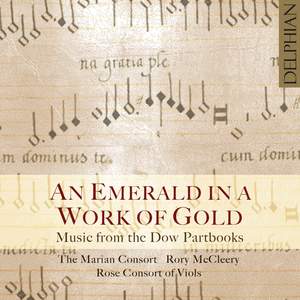
All recordingsPrices shown exclude VAT. (UK tax is not payable for deliveries to United States.) See Terms & Conditions for p&p rates. | |  | An Emerald in a Work of GoldMusic from the Dow Partbooks
The Marian Consort & Rose Consort of Viols, Rory McCleery For its second Delphian recording, The Marian Consort have leafed through the beautifully calligraphed pages of the partbooks compiled in Oxford between 1581 and 1588 by the Elizabethan scholar Robert Dow, to present a deeply satisfying sequence of some of their brightest jewels. Sumptuous motets, melancholy consort songs and intricate, harmonically daring viol fantasies are seamlessly interwoven, all brought to life by seven voices and the robust plangency of the Rose Consort of Viols in the chapel of All Souls College, Oxford – where Dow himself was once a Fellow. The Marian Consort is a young, dynamic early music vocal ensemble founded in Oxford in 2007. Combining academic insight with high levels of performance practice, the ensemble predominantly explores the repertoire of Renaissance and early Baroque music with its director Rory McCleery. They are joined by the Rose Consort of Viols, which takes its name from the celebrated family of viol makers, whose work spanned the development of the English consort repertoire. “It's a well-designed programme in which the two groups alternate, only partly combining when the viols accompany a vocal soloist....The Marian Consort's contributions are cleanly and calmly delivered, though offering less scope for variety than the instrumental numbers.” Gramophone Magazine, February 2013 “Performances are uniformly excellent, the Marian Consort’s rich, sweet timbre, immaculate tuning and clear diction … complemented by the Rose Consort’s own gloriously rich yet transparent sound … Mention too should be made of the sympathetic, detailed and quite intimate recording itself, made in the chapel of All Saint’s College, Oxford – sympathetic, detailed and intimate” International Record Review, March 2013 “Forty years after the creation of the Tallis Scholars, bright young things from Oxford still form small-scale vocal groups devoted to Renaissance polyphony. The Marian Consort is one of the finest...the ensemble sings with eloquence and expressive finesse.” Sunday Times, 2nd December 2012 “This disc restores the music to the chapel of All Souls, Oxford, where he worked, a sonorous but clear acoustic that warms the viol pieces and allows the voices of the Marian Consort to bloom. The two sopranos are very different, one with ample vibrato, one very straight, but each is suited to [the repertoire]...A beautiful picture of one man's enthusiasms.” The Observer, 23rd December 2012 | 
| | | In stock - usually despatched within 1 working day. |
|
|
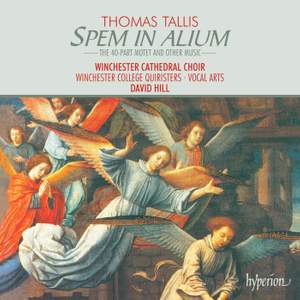
| |  | Tallis: Spem in aliumand other choral works
“A thrilling large scale performance” CD Review “Never before has Spem in alium, Tallis's great 40-part motet, so closely resembled The Last Judgement as it does in this vast and awesome performance” Gramophone Magazine | | | In stock - usually despatched within 1 working day. |
|
|
| |  | Tallis - Spem in alium
This is quite the best performance of Tallis's 40-part Spem in Alium that I have heard." Gramophone “This is quite simply the best performance of Tallis's 40-part Spem in alium to date. Sung by a constellation of singers, many of them familiar names from other wellestablished choral groups, it's a gripping realisation. The effect of the slowly moving harmonies is enhanced by a well-conceived and very positive use of dynamics. Precise entries, gently undulating rhythms that are wonderfully supple, and then those firm antiphonal phrases – one group of choirs answered by another at 'Creator coeli et terra' – raise the tension, until we twice almost miss a heart-beat at the well-placed rest before 'Respice …'. That great motet, so central to the whole programme, is well supported by the four-part Mass and the delightful group of other pieces for various combinations of voices. The hymn Te lucis with its alternating chant strophes sounding so very English (almost too perfect for what was, after all, just run-of-the-mill everyday chant!) has the tempo relationship of the chant to the polyphony just right, which is a tremendous plus, rarely achieved.” Gramophone Classical Music Guide, 2010 | | | (also available to download from $10.50) | In stock - usually despatched within 1 working day. |
|
|
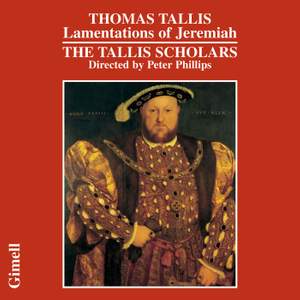
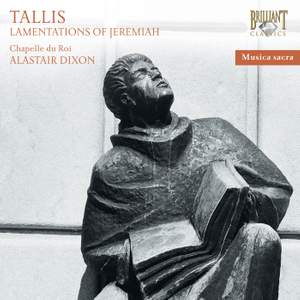
| |  | Tallis - Lamentations of Jeremiah
“This, the third volume of the survey by The Tallis Scholars of the music of the Tudor composer, Thomas Tallis, contains the well-known Lamentations, eight motets, and the extended motet Salve intemerata virgo. The Lamentations and motets are typical of the style of late Renaissance English composers. The overall mood is one of considerable austerity and their simplicity is indicative of the probability of their having been written for the private use of loyal Catholics rather than for formal ritual. Salve intemeratavirgo, on the other hand, looks back to the glories of the late 15th century. In particular, Tallis's use of the phrygian mode gives the work as a whole a strong sense of the medieval. Despite this disparity of styles the Tallis Scholars acquit themselves, as always, with great distinction. In the Lamentations and motets they achieve an appropriate sense of intimacy, while in Salve intermerata virgo they rise fully to the challenges of one of the more extended and demanding examples of Tudor choral composition. In addition the formidable challenges which this latter work sets for the conductor, such as the sense of pace, variation of dynamics, and overall architecture of the work, are all extremely well handled by Peter Phillips. The recording is very fine.” Gramophone Classical Music Guide, 2010 | | | In stock - usually despatched within 1 working day. |
|
|
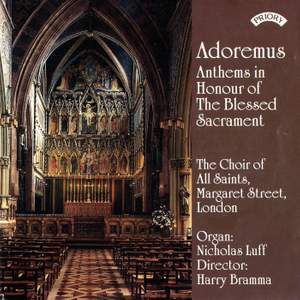
| |  | Adoremus: Anthems in Honour of the Blessed Sacrament
Nicholas Luff (organ) The Choir of All Saints, Margaret Street, London, Harry Bramma Recorded in All Saint's Margaret Street, London on 17/18th December 1993 | | | Usually despatched in 8 - 10 working days. |
|
|
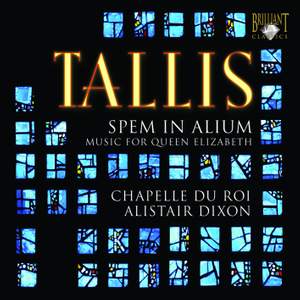
| |  | Music for Queen Elizabeth
Thomas Tallis served four English monarchs during his long life. A Catholic, he survived the tumultuous religious and political upheavals and persecutions of Edward VI and Mary I. He adapted to the demands of the new reformed church, the Church of England under Henry VIII, self appointed ‘Defender of the Faith’. Under Elizabeth I a more tolerant approach to religion emerged – even the ever-present threat of invasion by Catholic Spain did not deter the Queen from allowing her subjects freedom of worship and expression. Elizabeth’s tolerance may have been dueto the fact that she herself was raised as a Catholic, and it is possible that she missed the pomp and ceremony of the Mass compared to the plain and simple Protestant services of her father’s new Church. Tallis had seen most of the old choirs of the monasteries disbanded, and the music destroyed in the dissolution. He had learned his trade in this world, and to younger colleagues such as William Byrd he must have appeared as if from a bygone age. However, the great survivor was also very open to new compositional techniques from the continent. He adapted many of his Latin settings for the new Church – this practice called ‘contrafactum’ saw many older works given new life. This extended to his masterwork, the huge 40-part motet Spem in alium (which opens this CD) from 1573. Possibly written to celebrate Elizabeth’s 40th anniversary on the throne, it reappeared as Sing and glorify heaven’s high majesty, in which form it was used in 1616 at the investiture of the future Charles I as Prince of Wales. | | | Usually despatched in 4 - 5 working days. |
|
|
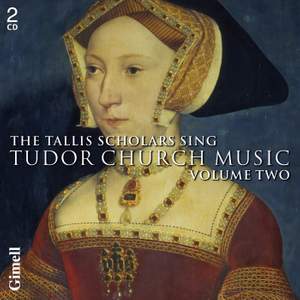
| |  | The Tallis Scholars Sing Tudor Church Music - Volume 2Marking the 500th Anniversary of the Coronation of King Henry VIII on June 24th, 1509
“Of all the polyphony we have recorded, this early English style with its dazzling high treble parts and luminous sonorities is, for me, as good as it gets. Henry VIII would have known this sound from childhood and may well have included some of the music recorded here at his Coronation.” Peter Phillips | | | Usually despatched in 2 - 3 working days. |
|
|
| |  | Thomas Tallis - Latin & English Motets & Anthems
“The variety of Tallis's music is amply demonstrated in this issue… This breadth of range allows the choir to show off a correspondingly wide range of expressive and interpretative skills.” Gramophone Magazine, March 2006 | | | Usually despatched in 2 - 3 working days. |
|
|
| |  | Meditation
Meditation celebrates the completion of David Hill's first year at St John's, and is a highly personal choice of music for Advent, Lent and Passiontide. It is an extraordinarily diverse sequence of pieces, which show the emotional and musical range of the Choir. Allegri's Miserere and Lotti's Crucifixus are deeply loved masterpieces and there are works by composers ranging from Arvo Part to Thomas Tallis as well as Jonathan Harvey's fine new work, which was commissioned for the Choir in 2004. | | | Usually despatched in 8 - 10 working days. |
|
|
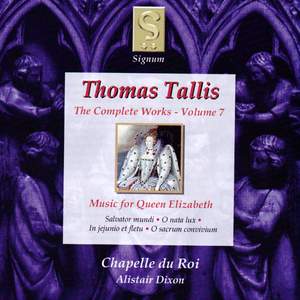
| |  | Thomas Tallis - Complete Works Volume 7Music for Queen Elizabeth
“Volume 7 of Chapelle du Roi's complete series of Tallis recordings, is a further witness to the composer's consummate command of his art, in whatever religious or political situation he found himself at each changing period of his life. It might seem puzzling that Elizabeth, in 1575, should sanction the publication of Tallis's and Byrd's Cantiones sacrae, but she apparently enjoyed hearing Latin-texted music in her private chapel, and many of the prayers would have been familiar from her childhood. Dixon makes a number of interesting points. He demonstrates Tallis's use of older material: for example, the Latin Absterge Domine, side by side with its later English contrafactum Discomfortthem, O Lord. He shows how five-voice scoring might be used for an all-male ensemble, or privately in, say, a recusant family situation, with ladies on the top line (In ieiunio et fletu). Tallis's craftsmanship is further revealed in his two through-composed psalms, Domine, quis habitabit and Laudate Dominum, which, while adhering to 16th-century principles of syllabic word-setting, are varied enough to relieve the inevitable tedium. We hear finally, Dixon's masterly interpretation of Spem in alium 'in the round' – or 'in horseshoe formation' – possibly the Chapelle's highest achievement to date.” Gramophone Classical Music Guide, 2010 | | | Usually despatched in 3 - 4 working days. |
|
|
| |
|