Prices shown exclude VAT. (UK tax is not payable for deliveries to United States.) See Terms & Conditions for p&p rates. | |  | Parry - Choral Masterpieces
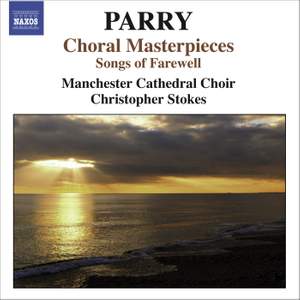
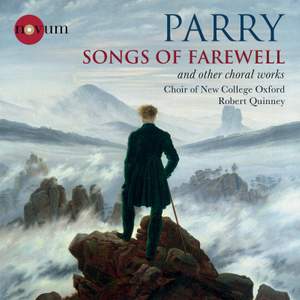
Jeffrey Makinson (organ) Manchester Cathedral Choir, Christopher Stokes Sir Hubert Parry composed some of the most masterful and moving choral music of the Victorian and Edwardian eras. His magnificent coronation anthem for Edward VII, I was glad, and his setting of Blake’s mystical poem Jerusalem rightly remain famous, while his Magnificat and Nunc dimittis display his debt to Anglican musical traditions. The Songs of Farewell draw psalms and English poetry together into a charming garland, and ‘Long since in Egypt’s plenteous land’ from his oratorio Judith sets the composer’s own prayerful text. “Choir, director and organist have clearly enjoyed themselves… a very high standard throughout. The Manchester Cathedral organ comes over well throughout. Highly recommended.” The Organ on a previous release “The choir sings with an unusually expressive tonal vocabulary as well as with dynamic variation which makes it distinctive from other choirs… The whole thing is very refreshing.” Cathedral Music on a previous release “The performances of the "Great" Service and the two grand pièces d'occasion, I was glad and Hear my words, are sung with conviction, rhythmical vitality and control, and sensitively accompanied by Jeffrey Makinson…” Gramophone Magazine, December 2009 “The opening 'My soul, there is a country' immediately draws the listener in by its self-communing quality, and conductor Christopher Stokes intelligently punctuates Parry's response to Henry Vaughan's poetic adumbration of the afterlife.” BBC Music Magazine, November 2009 **** | | | (also available to download from $6.00) | In stock - usually despatched within 1 working day. |
|
|
| |  | A Festival of Psalms
Sally Pryce (harp), Robert Millett (percussion) & Greg Morris & Ian Le Grice (organ) The Choir of the Temple Church, James Vivian (director) The Psalms of David are arguably the portion of the Old Testament that has been enfolded most completely within the Christian tradition and its liturgies. Their messages of strife and joy, prayer and praise, resonate strong and loud alongside the teachings of Jesus and find special expression in musical settings. This disc is an exploration of all these themes, as interpreted by composers over the course of four and a half centuries. The Temple Church is one of the most historic and beautiful churches in London. Situated between Fleet Street and the Thames Embankment, its recorded musical history extends back to its restoration in 1841, although a church has stood on the site for over 800 years. This is Signum’s second disc with the choir, following 2010’s release of ‘The Majesty of Thy Glory’. “this anthology links the liturgies of Jewish and Christian traditions...
The organ can sometimes hang too heavily over the pieces by Wesley and Parry. But the highlight is the beautiful version of Allegri's "Miserere mei, Deus", with its solo treble soaring high and weightless like the vaulting of a cathedral.” The Independent, 10th February 2012 *** | | | Usually despatched in 3 - 4 working days. |
|
|
| |  | Rise HeartRomantic English Choral Works by Elgar, Parry, Stanford and Vaughan Williams
Worcester Cathedral Chamber Choir, Stephen Shellard The second release on Regent from Worcester Cathedral Chamber Choir. Released to celebrate the centenary of the first performance of Five Mystical Songs in the 1911 Three Choirs Festival at Worcester. This disc frames that well-loved masterpiece by Vaughan Williams with works by Elgar, Parry, and Stanford, with some rarities including Elgar’s Memorial Ode for Queen Alexandra, and three settings of O salutaris hostia. “Elgar's Memorial Ode for Queen Alexandra of 1932, practically unknown until its recent revival, emerges under Shellard's direction as much more than an exercise in nostalgia. Choir, conductor and organist also tease out turbulent emotions from below the elegiac surface of the same composer's The Spirit of the Lord is upon me.” Classic FM Magazine, November 2011 *** | | | Usually despatched in 4 - 5 working days. |
|
|
| |  | Hear My Words: Choral Classics from St John’s
As exclusive Chandos artists, the Choir of St John’s College, Cambridge here presents its second release. The first CD, of choral music by Howells (CHAN10587), was released to rave reviews in March this year. Choir and Organ wrote: ‘There is musicianship here of a rare and moving kind.’ This new release of popular choral classics should meet with a similar reception while at the same time appealing to a wider audience. Established in the 1670s, the Choir of St John’s has a distinguished tradition of performing religious music. Its main duty is singing the daily services in the College Chapel during the University Term. During the University vacation the Choir carries out engagements in the UK and overseas, as well as undertaking a busy recording schedule. This particular release was recorded in the College Chapel in full surround-sound. The disc not only sounds spectacular, but recreates to an uncanny degree the experience of listening to the Choir perform in the chapel. The music itself represents a time span of nearly 500 years of choral music. The earliest piece dates from the first half of the sixteenth century, and the newest was composed as recently as 2007. The styles and genres are varied, but there are clear links between the works throughout. For example, several are based on texts from the psalms, and the works by Pärt, Parsons, and Rachmaninoff offer three radically different interpretations of the Ave Maria. Some of the works also add a solo instrument to the familiar mix of voices and organ. But perhaps most importantly, all the pieces recorded here sit comfortably under the heading of ‘Popular Choral Classics’. Allegri’s Miserere is counted among the great classics of church music. Part of its mystique stems from its origins; for many years the work was performed only in the Sistine Chapel, and as with other works tied to a single place it became an object for pilgrimage. In this case the pilgrims included Mendelssohn, as well as Mozart who famously noted down the work from memory after leaving the Vatican, thereby risking excommunication by the Catholic Church. This new release also features Stanford’s Jubilate, which was written for Trinity College, Cambridge. Intended as part of the service of Morning Prayer, it has long been one of the most popular canticles in the Anglican repertoire. In keeping with the text, Psalm 100, the tone is festive throughout. “The boy treble voices bring lustre and freshness to the sonority, and the singing throughout is stirring and polished.” The Telegraph, 29th October 2010 **** “the poised, sentient performance of Allegri's famous Miserere opening the disc bespeaks dedicated preparation, both technical and spiritual. I like the spatial variegations drawn by [Andrew Nethsinga]...and the unobtrusively pregnant phrasing of the tenor plainsong interjections...John's are a choir in fulsome health” BBC Music Magazine, Christmas 2010 **** “eclectic repertoire expertly sung” The Observer, 5th December 2010 “A word of reassurance to those who fear that this may be a "lovely" programme of hallowed pot-boilers...If these are indeed, as the title proclaims, "choral classics", that term must have been stretched to include all that is old and good...There are also pieces of modernity...The famous choir appear to thrive under Andrew Nethsinga's management.” Gramophone Magazine, January 2011 “It is with Allegri's impressive Miserere that the disc begins. One must congratulate those boys who rise well above their fellows...an admirable choir and a nicely varied programme.” International Record Review, December 2010 “St John's has a wonderful acoustic, neither too spacious nor too intimate, and in Andrew Nethsinga it has a director who knows how to fill every corner with grace and clarity...the choir sings suavely and radiantly without resorting to cathedral prissiness; the recorded sound is superb. A joy all round.” Classic FM Magazine, February 2011 **** | | | (also available to download from $10.50) | Usually despatched in 2 - 3 working days. (Available now to download.) |
|
|
| |  | Great Cathedral Anthems Vol. 9
| | | Usually despatched in 8 - 10 working days. |
|
|
| |  | Hear My Words
Berkeley, L: | The Lord is my Shepherd, Op. 91 No. 1 | Boyle, M C: | Thou, O God, art praised | Byrd: | Teach me, O Lord | Franck, C: | Panis Angelicus | Greene, M: | Lord, Let Me Know Mine End | Haydn: | Benedictus from Mass No. 7 in B flat major, Hob.XXII:7 "Little Organ Mass" | Ley: | A Prayer of King Henry VI | Mendelssohn: | Hear My Prayer | Mozart: | Vesperae Solennes de Confessore, K339: Laudate Dominum | Parry: | Hear my words, ye people I was glad | Stanford: | Evening Service in G, Op. 81: Magnificat A Song of Wisdom Op. 113 | Tomkins: | Out of the deep |
This disc features some of the best-loved anthems in the church repertoire, and notably that with an Etonian connection.Thus it begins and ends with the music of Parry, Eton's favourite musical son, whose success with Blest Pair of Sirens in 1887, saw him regarded as the leading choral composer in England. In 1441, Henry VI founded Eton College and its sister college, King's College in Cambridge, giving each a chapel in magnificent Perpendicular style.The foundation of Eton College provided ten men and sixteen boys to sing the services and with very few breaks, the choir has been singing in the chapel from then until the present day. “None of these young voices is anything less than impressive, and several are quite distinguished” Gramophone Magazine “the chief impression one is left with after hearing this disc is the excellence and polish of the choir ... this is a fine and very enjoyable disc. The performance standard is uniformly very high” MusicWeb International | | | Usually despatched in 3 - 4 working days. |
|
|
| |  |
'A fine recital' (Gramophone) “The more of Parry's music one comes to know, the more apparent it becomes that the received opinion of him is askew. Take the 1882 settings of the Magnificat and Nunc dimittis, for instance. These, amazingly, were not published until 1982. This recording – another example of Hyperion's courageous policy – shows how un- Victorian in the accepted sense they're. In other words, they're bold, unconventional and unsanctimonious – like quite a lot of Victorian church music, one may add. Perhaps the big anthem, Hear my words (1894) shows more signs of conventionality, but it has an attractive part for solo soprano (treble here) and ends with the hymn 'O praise ye the Lord'. The St George's Chapel Choir, conducted by Christopher Robinson, sings these works with more ease than it can muster for the famous and magnificent Coronation anthem I was glad, ceremonial music that not even Elgar surpassed. A sense of strain among the trebles is always evident. Although a wholly adult choir in the Songs of Farewell might be preferable, these are assured and often beautiful performances – excellent diction – of these extraordinarily affecting motets. English music doesn't possess much that's more perfect in the matching of words and music than the settings of 'There is an old belief' and 'Lord, let me know mine end', invidious as it is to select only two for mention. A stirring Jerusalem completes this enterprising recording, which brings the sound of a great building into our homes with absolute fidelity.” Gramophone Classical Music Guide, 2010 | | | Usually despatched in 2 - 3 working days. |
|
|
| |
|