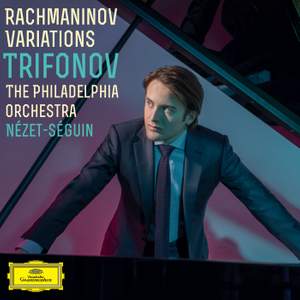
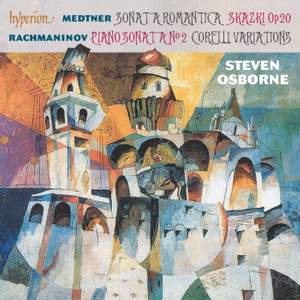
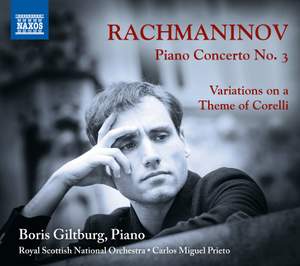
All recordingsPrices shown exclude VAT. (UK tax is not payable for deliveries to United States.) See Terms & Conditions for p&p rates. | |  | Rachmaninov: Variations on a Theme of Corelli, Vocalise & 13 Preludes
| 
| | | In stock - usually despatched within 1 working day. |
|
|
| |  | Rachmaninoff: Moments musicaux
With her winning combination of consummate technical brilliance, fine musicianship, and personal verve, the pianist Xiayin Wang captures the hearts of audiences wherever she appears. She is achiving high levels of recognision for her commanding performances as a recitalist, chamber musician, and orchestral soloist in such venues as New York’s Carnegie Hall and Lincoln Center. This is Wang’s second disc for Chandos Records. Her previous disc, of piano works by Earl Wild, was an ‘International Piano Choice’ in International Piano. The six Moments musicaux constitute a set of solo piano pieces, each representing a different but complementary musical form, such as the nocturne, song without words, barcarolle, virtuoso étude, or variations. Although intended from the beginning as part of a set, each piece holds its own well, with individual themes and moods, ranging from the sombre funeral march of No. 3 to the majestic canon of No. 6. Revolutionary and grand in style, the Moments musicaux still retain the charm of Rachmaninoff’s early works: dense, rich in counterpoint, highly chromatic, poignantly nationalistic, deeply felt, and, of course, exceptionally challenging to the pianist. The Études-tableaux were composed as ‘picture pieces’. Rachmaninoff never did disclose what inspired each piece, but stated: ‘I don’t believe in the artist that discloses too much of his images. Let [the public] paint for themselves what [the music] most suggests.’ The Variations on a Theme of Corelli was the last original solo piano work that Rachmaninoff wrote, and the only one he composed outside Russia. The theme of this cycle is actually not by Arcangelo Corelli (1653 – 1713), but an old Spanish-French folk dance. The Variations were written in 1931, the same year that the composer boldly denounced the Soviet Union, referring to its leaders as ‘Communist grave-diggers’. Stalin consequently banned Rachmaninoff’s music, but, recognising its more appealing and generally less radical nature, rehabilitated it three years later. The work is among several pieces that were later well received in Moscow. “she fares extremely well in major solo works by Rachmaninov...Every one of the numbers in the Op. 33 Etudes-tableaux is vividly and incisively characterised, and she conjures a wonderful depth of feeling and range of keyboard colouring...The Corelli Variations here possess a poise, dignity and underlying melancholy that not every interpreter finds in this fascinating late work.” BBC Music Magazine, August 2012 ***** “Here, even in Rachmaninov's most savage and turbulent pages, is playing of an awesome clarity and poise. Xiayin Wang makes her chosen composer sound greater and more indelibly Russian than ever...you will surely be lost in wonder at Wang's pianistic but above all musical glory. Such playing underlines the pity one feels for those poor puritan souls still unable to appreciate such beauty.” Gramophone Magazine, September 2012 | | | (also available to download from $10.50) | In stock - usually despatched within 1 working day. |
|
|
| |  | Rachmaninov: Piano Music
Critically acclaimed performances, given by one of the UK’s most highly regarded pianists. ‘Lill at his finest’ Classical CD of Piano Sonata No. 2 “a hotline to Rachmaninov's dark poetry. The Variations and Moments Musicaux are vividly characterised, the Sonata majestic.” BBC Music Magazine, February 2012 **** | | | In stock - usually despatched within 1 working day. |
|
|
| |  | Freddy Kempf plays Rachmaninov, Bach/Busoni, Ravel & Stravinsky
Freddy Kempf has previously recorded ten highly acclaimed solo discs for BIS, of which the latest (BISSACD1820) was described by Gramophone as “a formidable programme formidably played… This is “live” virtuosity with a vengeance, with absolutely no hint of a safety net”. Rachmaninov’s Corelli Variations is inspired by the theme used by Corelli in his violin sonata La Follia which undergoes a radical pianistic treatment taking it through all the sonic and atmospheric possibilities offered by the instrument. With his celebrated transcription of Bach’s Chaconne, Ferruccio Busoni had a very different aim, wanting to shed new light on the work without actually changing it. Ravel’s collection of waltzes was composed as a nod to Schubert and in it Ravel shows the range of his musical palette. Stravinsky’s Three movements from Petrushka is the composer’s arrangement of music from his own ballet, commissioned by Arthur Rubinstein. “Kempf follows [Bach's] text faithfully, allowing each variation to shape the movement without sounding forced...[He] shows an impressive range of organ-like colour along with a pointillism that suits quick passages well...The scene of 'Shrove-Tide Fair' is a roller-coaster ride under Kempff's fingers, driven by a motoric energy that many pianists would find difficult to sustain over eight-and-a-half minutes.” International Record Review, April 2011 “this is a colourful and enjoyable account [of Petrushka], well-characterised and full of dynamic contrast...fans of Kempf need have no qualms about acquiring this release.” BBC Music Magazine, June 2011 **** “In Rachmaninov's Corelli Variations, Kempf distinguishes himself for assiduous, well-integrated tempo relationships between movements, and the easy command and intelligent, symphonically orientated delineation with which he shapes the composer's thick textures...Kempf's glittering technique, supple touch and extroverted demeanour in Stravinsky's Three Movements from Petrushka bring out the music's balletic roots” Gramophone Magazine, July 2011 “Kempf opens with a beautifully-voiced and judiciously-paced view of Rachmaninov's Variations...he finds a meltingly silvery touch for the Ravel Valses (exquisite) before a return to the Russian repertoire that he plays so well, leaving us, thrillingly, in no doubt that the piano is a percussive instrument.” Classic FM Magazine, July 2011 **** “Kempf’s command of the immense pianistic range to be found in Rachmaninov’s keyboard music clearly has few equals, and this set delivers at a stroke several jaw-dropping performances” london24.com, 17th June 2011 | | | (also available to download from $10.50) | In stock - usually despatched within 1 working day. |
|
|
| |  | Richard Farrell - The Complete Recordings, Volume 2
Brahms: | Variations and Fugue on a Theme by Handel, Op. 24 Klavierstücke (4), Op. 119 Rhapsody in G minor, Op. 79 No. 2 | Chopin: | Scherzo No. 1 in B minor, Op. 20 Mazurka No. 10 in B flat major, Op. 17 No. 1 Mazurka No. 41 in C sharp minor, Op. 63 No. 3 Étude Op. 10 No. 3 in E major 'Tristesse' Previously unreleased Étude Op. 10 No. 4 in C sharp minor Previously unreleased Étude Op. 10 No. 5 in G flat major 'Black Key' Étude Op. 10 No. 10 in A flat major Previously unreleased Étude Op. 25 No. 11 in A minor 'Winter Wind' Previously unreleased Nocturne No. 4 in F major, Op. 15 No. 1 Waltz No. 14 in E minor, Op. post., KKIVa:15, B 56 Polonaise No. 6 in A flat major, Op. 53 'Héroïque' Previously unreleased | Debussy: | Clair de Lune (from Suite Bergamasque) | Granados: | Goyescas: Quejas ó La Maja y el Ruiseñor | Liszt: | Concert Paraphrase on Rigoletto, S.434 after Verdi's opera Widmung S566 after Schumann (Liebeslied) Hulanka (Drinking Song, after Chopin) | Mendelssohn: | Song without Words, Op. 38 No. 6 in A flat major 'Duetto' | Rachmaninov: | Variations on a theme of Corelli, Op. 42 First ever stereo release Prelude Op. 3 No. 2 in C sharp minor First ever stereo release Prelude Op. 23 No. 4 in D major First ever stereo release Prelude Op. 23 No. 5 in G minor First ever stereo release Prelude Op. 23 No. 6 in E flat major First ever stereo release Prelude Op. 32 No. 5 in G major First ever stereo release Prelude Op. 32 No. 12 in G sharp minor First ever stereo release | Schumann: | Arabeske in C major, Op. 18 |
| | | In stock - usually despatched within 1 working day. |
|
|
| |  | Rachmaninov - Piano Music
For modern audiences the name of Sergei Rachmaninov, who was born in 1873, conjures up great memorable tunes primarily from his second piano concerto (used in the film Brief Encounter) and second symphony; he was indeed the last flowering of Russian late Romanticism. For his contemporaries, however, he was one of the greatest pianists and who was an expert in expressing moods in the briefest time scale – he was a brilliant miniaturist. He wrote 17 Etudes-Tableaux and 26 Préludes, this collection provides all of the former and 5 of the latter including the one (in C# minor), written when was only 19, which became so popular that it haunted him as he was known to the general public by that piece alone. The Second Sonata is in one movement but three distinct sections, with the slower central movement providing some respite from the turbulence of the outer movements. The Variations on a theme of Corelli was Rachmaninov’s last work for solo piano and is based on the traditional tune La follia which Corelli used in his twelfth violin sonata. The Variations are skilfully wrought as they are in the Rhapsody on a theme of Paganini, the work that immediately followed it; the tune on which the Variations are made is the 24th Caprice for solo violin by the brilliant violinist-composer Paganini. | | | In stock - usually despatched within 1 working day. |
|
|
| |  |
Alternating the roles of soloist and accompanist,Alexander Melnikov has brought together here two works emblematic of Rachmaninov at his creative peak, before it was brutally interrupted by the sound and the fury of 1917: the famous Études-tableaux Op.39 and Six Poems Op.38 were followed by a very long silence. In 1931, it was a broken man who produced the Variations on a Theme by Corelli, a bitter work that yearns for a past long gone. The coloratura soprano Elena Brilova studied with Nina Dorliac at the Moscow Conservatory. In 1985 she won first prize at the international singing competition in Holland and has since sung at the Bolshoi, the Vienna State Opera, La Scala, Düsseldorf from 1998 to 2005 and in Japan, China,Taiwan and Israel. She has worked with Alexander Melnikov for many years, exploring the Russian song repertoire from Glinka to Shostakovich. Alexander Melnikov’s CDs for harmonia mundi include a Scriabin recital and acclaimed collaborations with Isabelle Faust and Jean-Guihen Queyras. Since 2002 he has taught at the RNCM. “Melnikov shows unerring judgement in programming and execution. Melnikov's partnership with soprano Elena Brilova in the near-contemporary songs written for the dazzling Nina Koshetz… surely touch new heights in the art of the recital duo. …this opulently recorded Rachmaninov disc is essential.” BBC Music Magazine, August 2008 ***** “This stunning disc is finely recorded and makes you look forward to a further balance of songs and piano music from both these remarkable artists.” Gramophone Magazine, April 2008 | | | In stock - usually despatched within 1 working day. |
|
|
| |  |
“Rachmaninov is the composer Lugansky seems born to play.” (The Observer) | | | In stock - usually despatched within 1 working day. |
|
|
| |  | Rachmaninov - Music for Two Pianos
| | | In stock - usually despatched within 1 working day. |
|
|
| |  | Romantic PianoAntonio Pompa-Baldi Live in Cleveland
Antonio Pompa-Baldi (piano) | 
| |
|
| |
|