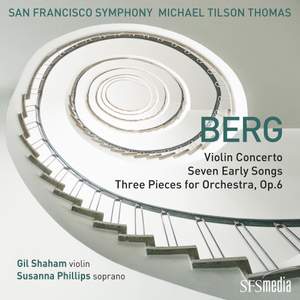
Prices shown exclude VAT. (UK tax is not payable for deliveries to United States.) See Terms & Conditions for p&p rates. | |  | Berg: Three Orchestral Pieces
| 
| | | (Sorry, download not available in your country) | In stock - usually despatched within 1 working day. |
|
|
| |  | Open Your Eyes: Lieder for the Turn of a Century
Soprano Katherine Broderick makes her debut recording on Champs Hill Records with a recital disc of Strauss, Berg and Schoenberg, accompanied by Malcolm Martineau. Katherine Broderick was the winner of the 2007 Kathleen Ferrier Award. Following studies at the National Opera Studio in London, Guildhall School of Music and Drama, Royal Northern College of Music and the Mendelssohn Hochschule in Leipzig, she is now a member of the ENO Young Singers Programme. In demand at opera houses in the UK and Europe, her stage repertoire encompasses Wagner, Verdi, Mozart and Britten. The repertoire on 'Open Your Eyes' was all composed between 1885 and 1908 and opens with Eight poems by Herman Gilm from his Letze Blätter which Richard Strauss set in 1885 while still in his very early twenties. The set includes three of his best‐loved songs (also recorded by Felicity Lott on CHRCD037), including Die Nacht, where he shows his flair for nocturnal tone painting and Allerseelen or 'All Souls Day' where the most lyrical of vocal lines is set against the background of flower‐decked graves. Alban Berg composed his 'Seven Early Songs' starting in 1905, while a student of Schoenberg, with the songs influenced by Strauss, Mahler, Wolf and Debussy and having a distinct sense of a romantic musical world expanded beyond its limits, on the brink of dissolving into modernism. Arnold Schoenberg's Brettl Lieder or Cabaret Songs of 1901 are tonal works, intended to use a more popular song idiom to convey more 'serious' ideas, and setting eight poems taken from a collection published as simply 'German Songs' in 1900 by Otto Julius Bierbaum. The most unusual of the set is Hugo Salus' Der Genügsamerliebhaber or 'Easily satisfied lover': a man tells us that his lady‐friend has a black cat with a soft, velvety coat. The woman spends all her time caressing her cat's fur while it sits on her lap, and it shivers when he strokes it. Later, he puts the kitty on his bald head and she plays with it and laughs. Throughout the songs, Schoenberg responds to the texts with simplicity and humour, and no little suggestiveness in this instance. “Here's an irresistable recital of questing, late-Romantic songs...Katherine Broderick has just the voice and temperament to express these subtle and exciting shifts between innocence and experience, tonality atonality. A sense of tenderness and vulnerability tempers the high brilliance of her soprano...For Schoenberg's calculatedly popular Brettl-Lieder, Broderick becomes entertainer supreme, with knowing, vividly characterised and confiding performances” BBC Music Magazine, March 2013 ***** “[Broderick's] varied experience pays dividends in this recital...Given the scope of her Strauss, it is no surprise to find that Broderick is equally engaging in the contrasting demands of Berg's Seven Early Songs and Schoenberg's cabaret-based Brettl-Lieder...a judicious mix of not-too-brash bravado and playful sensuality makes this perofrmance just the ticket.” Gramophone Magazine, March 2013 | | | In stock - usually despatched within 1 working day. |
|
|
| |  | Berg: Violin Concerto & Lulu Suite
Alban Berg (1885-1935) is, arguably, the most approachable of the three great serialist composers who were working in Vienna at the turn of the century – Schoenberg and Webern being the other two. Of the three, it was Berg whose technique was less stringently atonal: his music has a romantic lyricism that is largely absent from the later music of his two friends. This is no better illustrated than in his last work, the gorgeously wistful Violin Concerto of 1935, a work that is dedicated 'To the Memory of an Angel' – the angel being the recently deceased 18-year-old, Manon Gropius, daughter of the Bauhaus architect Walter Gropius and Mahler's surviving widow Alma. The other works in this set help to make it the perfect introduction to Berg's music, from the Suite from his notorious opera Lulu to the beautiful Lyric Suite and the early lyricism of the Seven Early Songs. | | | In stock - usually despatched within 1 working day. |
|
|
| |  |
| | | In stock - usually despatched within 1 working day. |
|
|
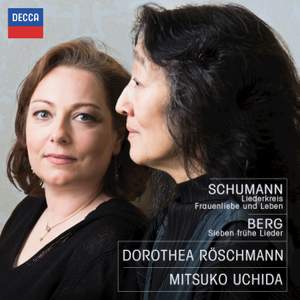
| |  | Berg: | Sieben frühe Lieder | Korngold: | Op.9, No. 4 Liebesbriefchen 3 Lieder Op. 18 5 Lieder Op. 38 Abschiedslieder (Songs of Farewell), Op. 14 Sonett für Wien, Op. 41 | Strauss, R: | Das Rosenband, Op. 36 No. 1 Ich trage meine Minne, Op. 32 No. 1 Hat gesagt - bleibt's nicht dabei, Op. 36 No. 3 Meinem Kinde, Op. 37 No. 3 Die Sieben Siegel Op. 46/3 Befreit, Op. 39 No. 4 Wie sollten wir geheim sie halten, Op. 19 No. 4 |
| | | In stock - usually despatched within 1 working day. |
|
|
| |  | Schöne Welt, wo bist Du?
Julia Kleiter (soprano) & Michael Gees (piano) Alban Berg’s Seven Early Songs form the backbone of this hybrid SACD that features the soprano Julia Kleiter accompanied by pianist Michael Gees. They are threaded throughout the disc in between songs by Gustav Mahler, Richard Strauss, Franz Schubert, Yrjö Kilpinen, Hugo Wolf and Arnold Schoenberg. The recording also includes an improvisation by Julia Kleiter and Michael Gees based on Hermann Hesse’s ‘Sternklare Nacht’. The highly-regarded German soprano Julia Kleiter made her operatic debut in 2004 as Pamina at Opéra-Bastille in Paris under Jiri Kout. Since then she has sung this role in several productions in Madrid, Zürich, at the Edinburgh Festival, in New York, Munich and at Salzburg Festival with conductors such as Nikolaus Harnoncourt, Marc Minkowski, and Claudio Abbado. In 2007 she appeared as Sophie in Der Rosenkavalier and Zdenka in Arabella under Franz Welser-Möst. Other highlights of her operatic career have been performing Papagena under Claudio Abbado, and Amor in Orfeo ed Euridice under Ricardo Muti in Florence. In 2012 she was critically acclaimed for her debut performance as Almirena in Händel's Rinaldo at the Lyric Opera in Chicago. This is Kleiter’s first recording as a solo recitalist, but she has already appeared on Challenge Classics alongside Christoph Prégardien - and Michael Gees - on an acclaimed disc of Hugo Wolf’s Italienisches Liederbuch (CC72378). Michael Gees has also made solo improvised recordings of Satie (CC72512) and Schumann (CC72597) for Challenge. | 
| | | Scheduled for release on 15 July 2013. Order it now and we will deliver it as soon as it is available. |
|
|
| |  | Arnold Bezuyen sings Schumann & Berg
Arnold Bezuyen (tenor) & Jura Margulis (piano) The Dutch tenor Arnold Bezuyen has appeared internationally on the stages of the Teatro alla Scala, Bayreuth Festival, Covent Garden and the Vienna State Opera. He made his debut at the MET last season. “Bezuyen is an experienced Wagner tenor...To begin with, his voice strikes the listener as somewhat heavy and monochrome for Schumann, but after the quiet, grief-surprised last line of the fourth [Dichterliebe] song...it is clear that response to the equivocal poise of the songs will be appropriately complex...It is Margulis's wonderful musicality and intelligence that makes this an exceptional recording” International Record Review, June 2013 | 
| | | (also available to download from $10.75) | Usually despatched in 2 - 3 working days. (Available now to download.) |
|
|
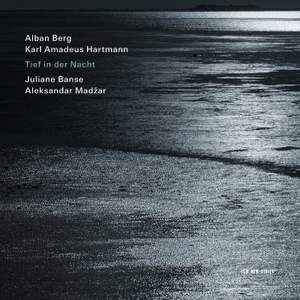
| |  | Berg & Hartmann: Lieder
Eagerly-awaited new album by uniquely gifted soprano Juliane Banse, whose previous ECM recordings have been showered with awards and positive reviews. Accompanied by the insightful Serbian pianist Aleksandar Madžar, the German singer performs a wonderful programme of music by Alban Berg and Karl Amadeus Hartmann, powerful and poetic songs spanning a turbulent era. Alban Berg’s early songs, written while he was still under Schoenberg’s tutelage, chart the young composer’s metamorphosis from writer of late romantic love songs to master of the modern idiom. The Berg selections here comprise 18 songs – the Sieben frühe Lieder, the Jugendlieder and two fascinatingly-contrasting versions of Schließe mir die Augen beide from 1900 and 1925. Hartmann’s cantata Lamento for soprano & piano was made in 1955 out of solo passages from a choral work of 1936/7 dedicated to Berg. A demanding work, it has rarely been recorded. In his note Paul Griffiths writes, “Lamento is a big piece, one that thoroughly engages the two formidable musicians who present it. Banse is the kind of singer Hartmann must have imagined, one who can maintain ease, power and warmth under difficult circumstances, whose singing conveys at once authority and vulnerability and whose musical experience runs from Bach to the present day. Aleksandar Madžar similarly brings out the depth of history and the immediacy of feeling written into this work.” “Embedded in their different worlds, each [Berg song] is a jewel-like miniature, in which Juliane Banse invests exquisite expressiveness...Banse is simply in a class of her own with music like this [the Hartmann], fiercely declamatory when required, but tenderly and touchingly entreating, too.” The Guardian, 28th October 2010 ***** “Lamento (1955) sets three works by the 17th-century German poet Andreas Gryphius. Hartmann plainly highlights the equivalence of the Thirty Years War and the Nazi terrors. Banse and Madzar are equally telling. This powerful music is prefaced by 18 compact, intimate songs by Berg.” Sunday Times, 21st November 2010 **** “Alban Berg’s Seven Early Songs have a fascinating sense of an overripe romantic world on the edge of dissolution, shot through with glimpses of a modernism just around the corner. It’s a spirit these two performers catch to absolute perfection. What makes this CD so welcome is that it includes nine other early songs, similarly intense, but hardly known.” The Telegraph, 26th November 2010 ***** “Juliane Banse brings to all of them her intense voice, focused and lovely...and makes them as memorable as anyone I've ever heard...whatever the merits of this neglected music turn out in the long run to be, they will certainly not be a given a more riveting and committed interpretation than they are by these two artists.” BBC Music Magazine, January 2011 ***** “her restrained vibrato and extraordinary sense of line make her ideal in this repertoire. There's a truly marvellous fluidity about her singing...It helps, of course, that Banse has such a singularly sensitive collaborator...Anyone interested in the origins of mature Berg will be fascinated and enlightened by this recording” International Record Review, January 2011 “[Hartmann] makes something strongly shaped and distinctively characterised...and strength of character also distinguishes this performance by Juliane Banse and Aleksandar Madžar. [They] also find a powerfully dramatic rhetoric in the fervent, sometimes rather congested textures of Berg's early songs.” Gramophone Magazine, March 2011 | | | Usually despatched in 4 - 5 working days. |
|
|
| |  | Astrid Kessler: Songs
Astrid Kessler (soprano) & Natalia Ehwald (piano) | | | (also available to download from $10.75) | Usually despatched in 2 - 3 working days. (Available now to download.) |
|
|
| |  | Britten: War Requiem & Les Illuminations
| | | Usually despatched in 4 - 5 working days. |
|
|
| |
|