All recordingsPrices shown exclude VAT. (UK tax is not payable for deliveries to United States.) See Terms & Conditions for p&p rates. | |  | Mendelssohn: Early Songs
Mendelssohn: | Sicheln schallen (Hölty) unpublished Ich denke dein, wenn durch den Hain Weinend seh' ich in die Nacht Lieben und Schweigen Rausche leise, grünes Dach Erwartung Gruss 'O könnt' ich zu dir fliegen' Volkslied, Op. 63 No. 5 Und über dich wohl streut der Wind Abschied 'Es wehn die Wolken über Meer' Leb wohl, mein Lieb, und weine nicht Weiter rastlos atemlos vorüber Suleika (Goethe/von Willemer) Op. 34 No. 4 Ave Maria, Op. 23 No. 2 Raste, Krieger! Krieg ist aus Glosse 'Mitleidsworte, Trostesgründe' Der Verlassene ('Nacht ist um mich her') Der Bettler Tanzt dem schönen Mai entgegen Durch Fichten am Hügel Sanft weh’n im Hauch der Abendluft Die Freundin (von Willemer) unpublished Auf dem Wasser Erinnerung 'Was will die einsame Träne?' Am Seegestad', in lauen Vollmondsnächten Schlummre sanft und milde Der Tag Faunenklage 'Er ist zerbrochen, der schönste Krug' Der Wasserfall 'Rieselt hernieder, schäumende Fluten!' Vier trübe Monden sind entflohn Die Nachtigall 'Da ging ich hin und dachte nicht an Liebe' Hüt du dich 'Ich weiß mir ein Mädchen hübsch und fein' Es rauscht der Wald Immer fort von Ort zu Ort So schlaf in Ruh! |
Until Mendelssohn’s 200th birthday in 2009, over a third of his songs were hardly known at all. When Breitkopf & Härtel published the last volume of the Mendelssohn Complete Edition, the public gained access to songs not even published during Mendelssohn’s lifetime. When you hear these treasures, you’ll be amazed that it took so long for these works to be unearthed. | | | In stock - usually despatched within 1 working day. |
|
|
| |  | Mendelssohn - Songs & Duets Volume 5
Mendelssohn: | Lied zum Geburtstage meines guten Vaters Katherine Broderick (soprano) Pauvre Jeanette Hannah Morrison (soprano) Erster Verlust, Op. 99 No. 1 Anna Grevelius (mezzo-soprano) Das Schifflein (Uhland) Op. 99 No. 4 Katherine Broderick (soprano) Wenn sich zwei Herzen scheiden, Op. 99 No. 5 Finnur Bjarnason (tenor) Wanderlied 'Laue Luft kommt blau geflossen', Op. 57 No. 6 Finnur Bjarnason (tenor) Das Waldschloss Anna Grevelius (mezzo-soprano) Es weiß und rät es doch keiner, Op. 99 No. 6 Hannah Morrison (soprano) Charlotte to Werther Katherine Broderick (soprano) Sechs schottische National-Lieder Hannah Morrison (soprano), James Rutherford (baritone), Ave Maria, Op. 23 No. 2 Anna Grevelius (mezzo-soprano) Raste, Krieger! Krieg ist aus Anna Grevelius (mezzo-soprano) Volkslied Stephan Loges (baritone) Minnelied 'Wie der Quell so lieblich', Op. 47 No. 1 Stephan Loges (baritone) Morgengruss (Heine) Op. 47 No. 2 Finnur Bjarnason (tenor) Frage Op. 9/1 Finnur Bjarnason (tenor) Geständnis Op. 9/2 Finnur Bjarnason (tenor) Weiter rastlos atemlos vorüber Stephan Loges (baritone) Weihnachtslied Anna Grevelius (mezzo-soprano) Von allen deinen zarten Gaben Finnur Bjarnason (tenor) Song without Words, Op. 67 No. 6 in E major 'Lullaby' Katherine Broderick (soprano) Vier trübe Monden sind entflohn Katherine Broderick (soprano) Lieben und Schweigen Anna Grevelius (mezzo-soprano) Suleika (Goethe/von Willemer) Op. 34 No. 4 Katherine Broderick (soprano) So schlaf in Ruh! Anna Grevelius (mezzo-soprano) Todeslied der Bojaren Stephan Loges (baritone) Erwartung Katherine Broderick (soprano) Und über dich wohl streut der Wind Stephan Loges (baritone) Weinend seh' ich in die Nacht Katherine Broderick (soprano) Ch'io t'abbandono in periglio sì grande James Rutherford (baritone) Volkslied, Op. 47 No. 4 Anna Grevelius (mezzo-soprano) |
Eugene Asti’s pioneering Mendelsson Songs and Duets series, containing a large amount of first recordings and rarities, concludes with this fifth volume, a generous two CDs for the price of one. The contents range from Mendelssohn’s first extant composition of any kind – a birthday song presented to his father by the precocious ten-year-old composer – to settings of the German romantic poets Schiller, Goethe and Eichendorff,which place Mendelssohn firmly in the canon of the great Lieder composers. These works are performed by a talented group of young singers who will be familiar from other discs in the series, including the winner of the 2008 Kathleen Ferrier prize, Katherine Broderick. “It is perhaps invidious to single out any one or two [singers], but Grevelius and Bjarnason are magnificent, and Rutherford and Loges are not far behind. Of course, the real hero is at the piano: Asti, at the end now of a remarkable musical journey. This is indeed a labour of love, and one that we can all applaud - and share.” International Record Review, July/August 2010 “...the best of the young singers here is the mezzo Anna Grevelius...As in previous volumes, Eugene Asti plays with a refreshingly light touch and a lively sense of rhythm.” Gramophone Magazine, September 2010 | | | In stock - usually despatched within 1 working day. |
|
|
| |  | Ohne Worte
Mendelssohn: | Song without Words, Op. 38 No. 6 in A flat major 'Duetto' Im Grünen (wds. Voss) Suleika (Goethe/von Willemer) Op. 34 No. 4 Schilflied, Op. 71 No. 4 Andres Maienlied (‘Hexenlied') Op. 8/8 | Schubert: | Sonata in A minor 'Arpeggione', D821 Herbst, D945 Der Jüngling an der Quelle, D300 (Salis-Seewis) Ständchen 'Leise flehen meine Lieder', D957 No. 4 Auf dem Wasser zu singen, D774 Du bist die Ruh D776 (Rückert) | Schumann: | Du bist wie eine Blume, Op. 25 No. 24 Ich will meine Seele tauchen (No. 5 from Dichterliebe, Op. 48) Widmung, Op. 25 No. 1 Mein Schöner Stern! Op. 101 No. 4 Venetianische Lied, Op. 25 No. 18 Mondnacht (No. 5 from Liederkreis, Op. 39) |
Nils Mönkemeyer (viola), Nicholas Rimmer (piano) | | | In stock - usually despatched within 1 working day. |
|
|
| |  | Mendelssohn - Songs & Duets Volume 2
Sophie Daneman (soprano), Stephen Loges (baritone), Engene Asti (piano) | | | In stock - usually despatched within 1 working day. |
|
|
| |  | Ohne Worte (Without Words)
Mendelssohn: | Song without Words, Op. 38 No. 6 in A flat major 'Duetto' Minnelied im Mai 'Holder klingt der Vogelsang', Op. 8 No. 1 Suleika (Goethe/von Willemer) Op. 34 No. 4 Schilflied, Op. 71 No. 4 Andres Maienlied (‘Hexenlied') Op. 8/8 Venetianisches Gondellied No. 2, Op. 25, No. 18 Mondnacht, Op. 39, No. 5 | Schubert: | Sonata in A minor 'Arpeggione', D821 Ständchen 'Leise flehen meine Lieder', D957 No. 4 Herbst, D945 Der Jüngling an der Quelle, D300 (Salis-Seewis) Auf dem Wasser zu singen, D774 Du bist die Ruh D776 (Rückert) | Schumann: | Du bist wie eine Blume, Op. 25 No. 24 Verratene Liebe, Op. 40, No. 5 Widmung, Op. 25 No. 1 Mein Schöner Stern! Op. 101 No. 4 |
Nils Mönkemeyer & Nicholas Rimmer Mentors like Gerhard Schulz (Alban Berg Quartet) and Yuri Bashmet have already predicted that a great career lies ahead of the 30-year-old violist Nils Mönkemeyer. He is already one of his generation's leading viola players, with many competition wins to his name, including the UK’s Parkhouse Award in 2009, and the International Yuri Bashmet Competition in 2006. For his Sony Classical début Ohne Worte (Without Words), the young musician from Bremen and his English piano partner Nicholas Rimmer have put together a recital programme that highlights the viola's 'voice-like' qualities. To this end, lieder by Schubert, Mendelssohn and Schumann have been arranged as songs without words for the viola. The recital is completed by Schubert's Arpeggione sonata in the version for viola and piano. In selecting the songs to arrange, Mönkemeyer chose songs such as Schubert’s Ständchen, where the emphasis is first and foremost on the vocal line rather than the lyrics. The same applies to the songs by Schumann, which include lieder from well-known song cycles Liederkreis and Dichterliebe. By way of contrast, the remaining works heard here by Mendelssohn and Schubert are arrangements of original instrumental pieces. Mendelssohn composed his Songs Without Words for the piano, while Franz Schubert originally wrote his Arpeggione sonata of 1823 for the six-stringed instrument of the same name. "There are fewer acrobatics involved on the viola", says Mönkemeyer; "the melodies flow more naturally and major leaps are avoided. That makes it all the more clear that the underlying idea that inspired this sonata is that of a song." | | | Usually despatched in 3 - 4 working days. |
|
|
| |  | Mendelssohn: Auf Flügeln des GesangesLieder
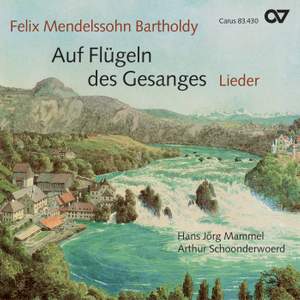
Mendelssohn: | Auf Flügeln des Gesanges, Op. 34 No. 2 Neue Liebe, Op. 19a No. 4 Gruß, Op. 19a No. 5 Morgengruss (Heine) Op. 47 No. 2 Reiselied 'Der Herbstwind', Op. 34 No. 6 Allnächtlich im Traume (Heine) Op. 86 No. 4 Das Waldschloss Der wandernde Musikant (No. 6 from Lieder für gemischten Chor, Op. 88) Es weiß und rät es doch keiner, Op. 99 No. 6 Wanderlied 'Laue Luft kommt blau geflossen', Op. 57 No. 6 Der Mond, Op. 86 No. 5 Die Sterne schau'n in stiller Nacht (Schlippenbach), Op. 99 No. 2 Altdeutsches Frühlingslied 'Der trübe Winter ist vorbei', Op. 86 No. 6 Jagdlied 'Mit Lust tät ich ausreiten', Op. 84 No. 3 Da lieg' ich unter den Bäumen, Op. 84 No. 1 Hexenlied, Op. 8 No. 8 Das Schifflein (Uhland) Op. 99 No. 4 An die Entfernte (Lenau) Op. 71 No. 3 Schilflied, Op. 71 No. 4 Auf der Wanderschaft Op. 71 No. 5 Des Mädchens Klage Venetianisches Gondellied, Op. 57 No. 5 'Wenn durch die Piazetta' Suleika (Goethe/von Willemer) Op. 34 No. 4 Suleika (Was bedeutet die Bewegung?) Op. 57/3 Erster Verlust, Op. 99 No. 1 Bei der Wiege, Op. 47 No. 6 Nachtlied, Op. 71 No. 6 |
Auf Flügeln des Gesangs (On Wings of Song) is far and away the most popular of Mendelssohn's songs. Heard on this CD with selection of his earlier lieder this is another fine release from Carus. The tenor Hans Jörg Mammel, who enjoys an international reputation for his Lieder singing, offers with this selection, impressive insights into Mendelssohn’s Lieder. He is accompanied by Arthur Schoonderwoerd on a historic pianoforte. | | | Usually despatched in 2 - 3 working days. |
|
|
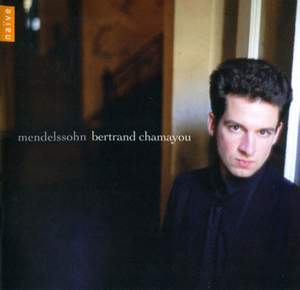
| |  | Mendelssohn - Piano Music
Mendelssohn: | Prélude in B Minor, Op. 104a, No. 2 Rondo capriccioso in E major, Op. 14 3 Etudes, Op. 104b Auf Flügeln des Gesanges, Op. 34 No. 2 transc. Liszt Song without Words, Op. 38 No. 2 in C minor Scherzo in E minor, Op. 16 No. 2 Das erste Veilchen, Op. 19a No. 2 Variations sérieuses in D minor Op. 54 Song without Words, Op. 102 No. 5 in A major 'Childrens Piece' Caprice in E Major, Op. 33, No. 2 Caprice in B Flat Minor Op. 33, No. 3 Suleika (Goethe/von Willemer) Op. 34 No. 4 transc. Liszt Song without Words, Op. 67 No. 2 in F sharp minor Song without Words, Op. 67 No. 5 in B minor A Midsummer Night's Dream: Scherzo transc. Rachmaninov |
During his tragically short life, Felix Mendelssohn produced an extensive output of music covering every genre. Although he claimed that he took little pleasure in writing for the piano and felt that it was not an area of composition that he was particularly good at, the music itself has always retained a place in the affection of performers. After the sonatas of his early youth, he concentrated mostly on producing short pieces which could more readily be put together during the limited gaps in his busy professional life. The anthology selected for this recording by Bertrand Chamayou interweaves many of these shorter works with more substantial pieces, and includes some rarely performed music alongside established masterpieces like the “Songs without words “The Songs Without Words are among the least difficult of the pieces here technically, but the other pieces are much more demanding… It says much for Chamayou's virtuosity and artistry that he makes the results so magnetic.” Gramophone Magazine, October 2008 “There was a time in the 19th century when Mendelssohn's Songs Without Words were regularly regarded as the third great collection of piano music after Beethoven's 32 sonatas and Bach's 48 Preludes and Fugues. While Chopin's piano music is still dominant, Mendelssohn's star as a pianist-composer has faded. It is a splendid idea of the young Toulouse-born French pianist Bertrand Chamayou to choose five of the most striking Songs Without Words and make them a centrepiece for what he describes as a 'Liederabend without words'. The Songs Without Words are among the least difficult of the pieces here technically, but the other pieces are much more demanding, not just the two bigger pieces, the Variations sérieuses and the Rondo capriccioso, but such pieces as the ThreeStudies. It says much for Chamayou's virtuosity and artistry that he makes the results so magnetic. He opens with a brief and powerful Prelude in B minor, leading to a sparkling account of the Rondo capriccioso bringing out echoes of the Scherzo from A Midsummer Night's Dream, which right at the end of the recital comes as a tailpiece in Rachmaninov's arrangement. The articulation in the Three Studies is phenomenally clear and light, as it is too in Chamayou's dazzling account of the Caprices. There are similar qualities in the longest and most ambitious of the pieces, the Variations sérieuses. Along with the Songs Without Words it is good too to have Liszt's surprisingly unshowy arrangements of Mendelssohn's most famous Lied, 'On Wings of Song'. Clean, clear sound to match the playing.” Gramophone Classical Music Guide, 2010 | | | (also available to download from $10.50) | Usually despatched in 3 - 4 working days. (Available now to download.) |
|
|
| |  | Mendelssohn - Violin Concerto
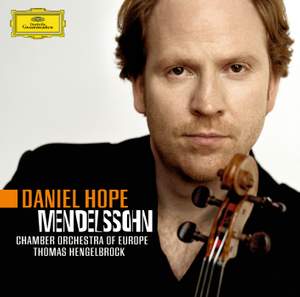
Mendelssohn: | Violin Concerto in E minor, Op. 64 Original 1844 version Octet in E flat major, Op. 20 Critically revised edition 1832 Daniel Hope (violin 1), Lucy Gould (violin 2), Sophie Besançon (violin 3), Christian Eisenberger (violin 4), Pascal Siffert (viola 1), Stewart Eaton (viola 2), William Conway (cello 1) & Kate Gould (cello 2) Hexenlied, Op. 8 No. 8 Sebastian Knauer (piano) Suleika (Goethe/von Willemer) Op. 34 No. 4 Sebastian Knauer (piano) Auf Flügeln des Gesanges, Op. 34 No. 2 (arr. for violin and piano) Sebastian Knauer (piano) |
“The performance has plenty of passion and sensitivity, the slow introduction to the Finale sounding particularly magical.” BBC Music Magazine, October 2007 **** “Hope is minutely responsive to every phrase of this music, making you wonder anew at its brilliance of invention. The outer movements dance, and his Andante has all the depth and subtlety of a great operatic aria, with remarkable richness in the alto register... The Octet is on a similarly elevated level, with Hope clearly the guiding light among his COE colleagues, but never becoming overbearing.” Gramophone Magazine, November 2007 | | | Usually despatched in 8 - 10 working days. |
|
|
| |  | Schubert, Mendelssohn & Strauss - Lieder
Recorded 1980 | | | Usually despatched in 3 - 4 working days. |
|
|
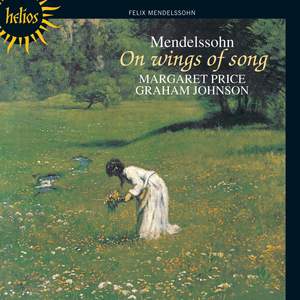
| |  | On wings of song
Mendelssohn: | Frühlingsglaube Op. 9/8 Frage Op. 9/1 Geständnis Op. 9/2 Maienlied Op. 8/7 Andres Maienlied (‘Hexenlied') Op. 8/8 Gruß, Op. 19a No. 5 Neue Liebe, Op. 19a No. 4 Auf Flügeln des Gesanges, Op. 34 No. 2 Frühlingslied 'Es brechen im schallenden Reigen' (Klingemann), Op. 34 No. 3 Suleika (Goethe/von Willemer) Op. 34 No. 4 Suleika (Was bedeutet die Bewegung?) Op. 57/3 Die Liebende schreibt (Goethe) Op. 86 No. 3 Erster Verlust, Op. 99 No. 1 Volkslied, Op. 47 No. 4 Minnelied 'Wie der Quell so lieblich', Op. 47 No. 1 Schilflied, Op. 71 No. 4 There be none of Beauty's daughters Sun of the sleepless! Des Mädchens Klage Der Mond, Op. 86 No. 5 Das Waldschloss Es weiß und rät es doch keiner, Op. 99 No. 6 Nachtlied, Op. 71 No. 6 Wanderlied 'Laue Luft kommt blau geflossen', Op. 57 No. 6 |
| | | Usually despatched in 2 - 3 working days. |
|
|
| |
|