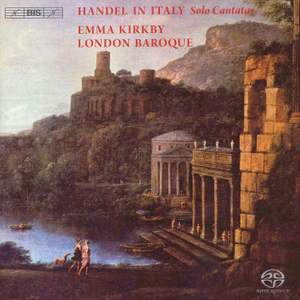
Prices shown exclude VAT. (UK tax is not payable for deliveries to United States.) See Terms & Conditions for p&p rates. | |  | Handel in Italy - Solo Cantatas
During his years in Italy (1706-1710), it is believed that Handel may have written as many as 150 cantatas including a number of so-called cantate con stromenti for one or more solo voices plus additional instruments. The four cantatas on this disc feature the standard combination for such works: soprano, two violins and basso continuo. Thematically, they can be grouped in pairs: Notte placida e cheta (Calm and Placid Night) and Un’ alma innamorata (A Soul in Love) tell of unhappy love and contain elements from Classical mythology against a pastoral backdrop. By contrast, Figlio d’alte speranze (Son of High Hopes) and Agrippina condotta a morire (Agrippina Led to Her Death) tell tales of the use and abuse of power. “Emma Kirkby, a seasoned Handelian, brings her considerable artistry to bear on some of [Handel's] most bold, moving and exciting music. Occasionally, particularly in the tragic 'Agrippina condotta a morire', one yearns for slightly darker shades than her naturally sunny voice can provide. Even so, here and in 'Notte placida e cheta', 'Un’ alma innamorata' and 'Figlio d’alte speranze', she and the [musicians] of London Baroque relish to the full the dramatic genius destined shortly to take London by storm.” Sunday Times, 24th August 2008 *** “Emma Kirkby… sings four solo cantatas… These showpieces make immense technical demands… But splendid though such displays are, it is her sense of characterisation which sets her apart. She can 'rejoice, laugh and hope' with palpable rapture (Un' alma innamorata, HWV173), change mood like quicksilver in the great Scena of Agrippina (HWV110) where the queen, condemned to death by her own son, swings schizophrenically from inconsolable despair to furious anger. Outstanding.” BBC Music Magazine, September 2008 ***** “Emma Kirkby… is on superb form. Her interpretative intelligence and attention to words are a given but she can also catch a subtle mood, as in "Quel povero core" from Un' alman innamorata, whose sense of resigned torment is enhanced by a sensitive contribution from the solo violin.” Gramophone Magazine, October 2008 “The largest single legacy of Handel's years in Italy (in his early twenties) were around 100 chamber cantatas, from which Emma Kirkby and London Baroque have picked out four excellent examples from the 30 or so featuring one or two violins alongside the solo voice and continuo. In this they face strong competition from La Risonanza's series with Italian singers on Glossa, but the clash does no damage to either group as both have distinct virtues. For some, of course, the presence of Emma Kirkby will be enough to seal the deal, and indeed she is on superb form. Early on there are a few signs of a lack of her usual instrumental precision; but by the time she is showing off her artless virtuosity in the final aria of Figlio d'alte speranze and striding easily through 'Orrida, oscura', the first aria of the compellingly dramatic Agrippina condottaa morire, all worries have long been banished. Her interpretative intelligence and attention to words are a given but she can also catch a subtle mood, as in 'Quel povero core' from Un' almainnamorata, whose sense of resigned torment is enhanced by a sensitive contribution from the solo violin. Emanuela Galli captures this kind of intimate emotion even more affectingly in La Risonanza's performances, mind, but with a touch less vocal security. The recorded sound, as often in London Baroque's recordings for BIS, is strangely resonant and steely. The 'Concerto a quattro' included here is claimed as a Handel work in its German 18th-century source but sounds like nothing of the kind.” Gramophone Classical Music Guide, 2010 | | | (also available to download from $10.75) | In stock - usually despatched within 1 working day. |
|
|
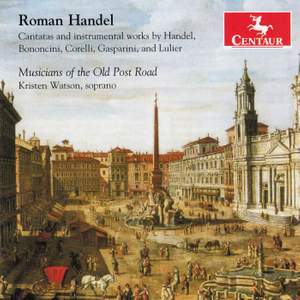
| |  | Roman Handel
Jesse Irons (violin), Daniel Ryan (cello), Michael Bahmann (harpsichord), Sarah Darling (violin), Suzanne Stumpf (baroque flute) Musicians of the Old Post Road | |
|
| |  | Handel - Arias
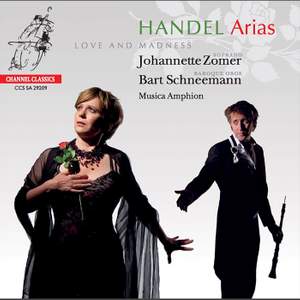
Handel, a child of his time, was fascinated by the poignant human dramas and emotions exemplified by Greek and Roman classical myths, dramas, and poetry. A theatre composer to his very bones, he devoted himself to the portrayal of human psychology. He had a special interest in those moments when the human psyche is at its most vulnerable: moments of indecision, struggle, despair, fury, abandonment, betrayal, unhappy love, conflict with friends, enemies, and fate, or longing for the oblivion of death. The oboe was an instrument especially beloved by Händel. It is the unifying element in the anthology of arias and cantatas recorded here. Bart Schneemann: Handel, that master creator of goosebumps, can juggle emotions with the greatest of ease; he can make you happy, melancholy, resigned, exuberant. A composer who can make two completely different beings, an oboe and a soprano, fall in love, is one of the great ones. Johannette Zomer: After my first collaboration with Bart (Blake Songs by Vaughan Williams, ccs 18598 ), what struck me was the way our two instruments, oboe and voice, completely fused together. Bart’s way of making music is so pure, so honest, that making music with him in these dialogue-arias raises my singing to a whole new level. “It is refreshing to hear Zomer's less 'operatic' voice, with plenty of early music expertise, tackling arias with emotional affinity and stylish eloquence. Schneemann's oboe-playing is an ideally lyrical partner in Berenice's showpiece...Zomer's recital offers plenty to enjoy.” Gramophone Magazine, April 2010 | | | Usually despatched in 4 - 5 working days. |
|
|
| |  | Handel - Cantatas & Sonatas
| | | Usually despatched in 3 - 4 working days. |
|
|
| |
|