All recordingsPrices shown exclude VAT. (UK tax is not payable for deliveries to United States.) See Terms & Conditions for p&p rates. | |  | Régine Crespin in Recital
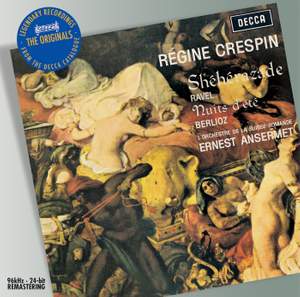
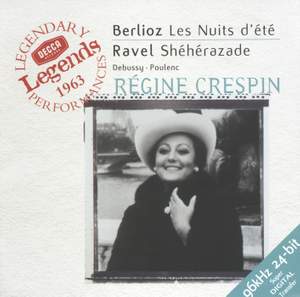
The larger-than-life Régine Crespin, made only one song recital record for Decca, of music by Schumann, Wolf, Debussy and Poulenc. This is the first time the entire recital has been made available on CD. As her career progressed, Crespin became associated with certain roles – Kundry, Sieglinde, Brünnhilde, Tosca, the Marschallin – but she was prodigiously versatile, thanks to her years in the French provinces. An intelligent singer who understood how to make the texts count, Crespin also had tremendous success in non-operatic repertory. Her 1963 Decca recording, with conductor Ernest Ansermet, of Berlioz’s Les Nuits d'été and Ravel’s Shéhérazade, is regarded as among the best available. In its original French, her candid and entertaining autobiography is called La vie et l'amour d'une femme, which is also the French translation of Schumann's song cycle Frauenliebe und -leben. Indeed, Lieder by Schumann and Wolf were important parts of her recital repertory, and she brought the same depth of meaning to their German texts as she did to her Wagnerian roles. Of course French, being her native language, evoked a most immediate and intimate response from this singer. This release marks the launch of an Eloquence series of notable recitals of songs and opera arias by some of the great voices of Decca and Deutsche Grammophon. “Seven songs by Poulenc, in pungent and marvellously characterised performances, form the highlight of this 1967 recital of Crespin in her prime. Her Wolf and Schumann are also irresistable.” BBC Music Magazine, June 2012 **** “It is difficult, indeed I find it impossible, to think of any soprano capable of singing Brünnhilde, as Régine Crespin has done, who is also capable of making a success of such a varied programme as this recital offers, but this she most certainly has achieved from start to finish. […] She has in John Wustman a pianist truly worthy of her, sensitive to every mood and nuance. […] I can give no higher praise to Crespin's singing of Debussy's Chansons de Bililis than to say it does not suffer from comparison with Maggie Teyte's. […]The balance between voice and piano is very good, and so here is everything for our delight. This is, indeed, one of the finest song recitals of recent times and I most warmly and enthusiastically recommend it” Gramophone Magazine | | | In stock - usually despatched within 1 working day. |
|
|
| |  | Simon Keenlyside & Malcolm Martineau
Fauré: | Aubade, Op. 6 No. 1 En sourdine, Op. 58 No. 2 (Verlaine) Green, Op. 58 No. 3 (Verlaine) Notre amour Op. 23 No. 2 Fleur jetée, Op. 39 No. 2 Spleen, Op. 51 No. 3 (Verlaine) Madrigal Op. 35 Le papillon et la fleur, Op. 1 No. 1 | Poulenc: | Hotel Encore | Ravel: | Histoires naturelles (5) | Schubert: | An Sylvia, D891 Die Einsiedlei D393 (Salis-Seewis) Verklarung D59 (Herder, after Pope) Die Sterne, D939 (Leitner) Himmelsfunken, D651 Ständchen 'Leise flehen meine Lieder', D957 No. 4 | Wolf, H: | Der Knabe und das Immlein (No. 2 from Mörike-Lieder) Gesang Weylas (No. 46 from Mörike-Lieder) An die Geliebte (No. 32 from Mörike-Lieder) Auf eine Christblume II (No. 21 from Mörike-Lieder) Lied eines Verliebten (No. 43 from Mörike-Lieder) Lied vom Winde |
He was already noted as a recitalist, and “a talent to cherish” as far back as 1989. Since appearing in La Scala in 1998 he has performed recitals all over the world, his repertoire including: Schubert, Schumann, Strauss, Brahms, Fauré, Wolf and Mahler. He has also recorded many English songs. Gramophone describe him as the finest baritone singer of Lieder this country has ever produced. In Simon's own words “I've probably got around 15 years, and think I can see the end of the tunnel. I've done most of the roles that suit me and some, like Papageno, I'll never want to drop…” “In Wagner I shan't go beyond Wolfram in Tannhauser. I know there's Beckmesser, but I'm afraid it's not a role that excites or fascinates me. I'll never get tired of the stand-and-sing roles like Germont in Traviata and Posa in Don Carlos - parts where you really have to act with your voice and pin the audience to their seats with inflexion, nuance and colour. I probably shan't sing Billy Budd again… and am moving down from Pelleas to Golaud. The two new roles I'm most excited about are Wozzeck and Rigoletto, which are both great theatre and call on a huge palette of colours. Wozzeck in particular, is a mountain any baritone wants to climb…” “The opening Schubert group demonstrates the baritone's natural and unaffected delivery - an ability to hold words and notes together in one single gesture - and his finely tuned vocalism, founded on a lightly rounded but always expressive tone. He sounds equally at ease in the French half of the programme. ...'En sourdine' flows beautifully...and the light humour of 'Le Papillon et la Fleur', Fauré's Op. 1 No. 1, is flawlessly conveyed in Martineau's enchantingly lithe pianism.” BBC Music Magazine, December 2009 “Hugo Wolf is at his most welcoming in "Der Knabe und das Immelein" and Keenlyside is at his most responsive in "An die Geliebte". Keenlyside is at his best in "Notre amour" - and very French. In… Malcolm Martineau: he has a collaborator in whom the life of texts as well as the music is experienced and communicated unfailingly.” Gramophone Magazine, November 2009 “you’re being invited to step into a more gently nuanced and delicately observed world, where the expressive weight of each phrase is being judged to perfection, with not a gram of emotional excess...this is such a successful document of the occasion that you might honestly end up feeling that you were [there]… and can be again, and again.” Andrew McGregor, bbc.co.uk, 22nd December 2009 | | | In stock - usually despatched within 1 working day. |
|
|
| |  | Régine Crespin
Recorded: Geneva, September 1963; Kingsway Hall, May 1967 “Sumptuous of tone, supremely sensitive, Crespin was born to illuminate the art of French song. Whether floating the seductive allure of Ravel or revelling in the wit of Poulenc these recordings were and remain classics.” BBC Music Magazine, November 2006 ***** “Ravel's magically sensuous writing finds the ideal interpreter in Regine Crespin...The sheer richness of tone of the singer's tone does not prevent her from bringing out the delicate languor required by an exquisite song like The enchanted flute...This is ravishing...This CD is one of the great glories of recorded music.” Penguin Guide, 2011 edition | | | In stock - usually despatched within 1 working day. |
|
|
| |  | Poulenc: Voyage à Paris
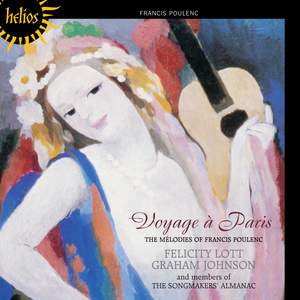
“Interpretation of Poulenc's songs never stands still. But this recording reminds us of the impetus these artists gave to this repertoire, both in sound and imagination.” BBC Music Magazine, November 2011 ***** “This record will enchant you. Best of the Month” Hi-Fi News | | | Usually despatched in 2 - 3 working days. |
|
|
| |  | Picasso I La MusicaVoice and Piano for Picasso
Elena Gragera (mezzo-soprano) & Anton Cardó (piano) This imaginative programme features pieces by composers who were contemporaries of Picasso and includes works by Poulenc, Albéniz, Granados, Stravinsky and Debussy. The first piece is a setting of an Éluard poem called Pablo Picasso by Poulenc. | | | Usually despatched in 2 - 3 working days. |
|
|
| |  | Voyage à ParisChansons Françaises
| | | Usually despatched in 4 - 5 working days. |
|
|
| |  | Régine Crespin - French Songs
Ravishing singing and sultry colours make this coupling irresistable: you may favour Janet Baker's very different approach but I've adored this recording for 30 years - James Jolly, Gramophone 1000th issue “With recent recordings by Bernarda Fink, Susan Graham, Felicity Lott, there has been no shortage of Shéhérazades for our 21st century. But back in 1963 Régine Crespine recorded a performance that recreated Ravel's score in unsurpassed truthfulness of letter and spirit.” BBC Music Magazine, November 2007 “Scandalously available only as a download in many countries, Crespin's Nuits dété has always been the interpretation by which others have been assessed and, listening to it again, there's no reason to challenge the verdict. Sultry, langourous yet sung with a richness of tone, this is a classic version this ravishing work. Ansermet accompanies exquisitely.” Gramophone Classical Music Guide, 2010 | | (Sorry, download not available in your country) | |
|
|
| |
|