Gluck: Orphée et Eurydice (French version of Orfeo ed Euridice)

This page lists all recordings of Orphée et Eurydice (French version of Orfeo ed Euridice), by Christoph Willibald Gluck (1714-87) on CD, DVD, Blu-ray & download (MP3 & FLAC). Generally, more recent releases are listed first, but with priority given to those that are in stock.

Prices shown exclude VAT. (UK tax is not payable for deliveries to United States.)
See Terms & Conditions for p&p rates.

Gluck: Orphée et Eurydice

Gluck: Orphée et Eurydice


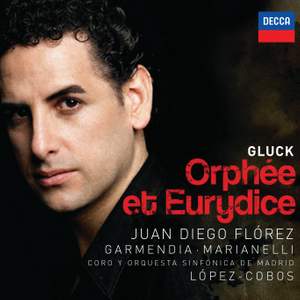
Juan Diego Flórez (Orphée), Ainhoa Garmendia (Eurydice), Alessandra Marianelli (Amour)

Coro y Orquesta del Teatro Real, Madrid, Jesús López-Cobos

Juan Diego Flórez stars as the musician and poet Orpheus in Gluck's mythical opera of love and loss.

Following acclaimed performances at the Teatro Real in Madrid, Juan Diego Flórez records his first major opera role outside the bel canto repertoire, as he stars as Orphée in Gluck's most enduringly popular opera, sung in the original French of his 1774 Paris version.

Includes the much-loved aria 'J'ai perdu mon Eurydice' ('Che faro senza Euridice') sung by Juan Diego Flórez, and the popular 'Dance Of The Blessed Spirits'.

Eurydice is sung by rising Spanish soprano Ainhoa Garmendia, with soprano Alessandra Marianelli as L'Amour.

The opera tells of the poet and musician Orphée who travels to the underworld in search of his wife Eurydice, on the understanding that he doesn't look at her until they are back on earth. When she misinterprets his distance, he is compelled to turn and face her, only to see her die a second time. Moved by the intensity of Orphee's devotion, L'Amour returns Eurydice to life once more as all ends happily.

Twelve years after the Vienna premiere of his original Italian version, Gluck adapted his opera for Parisian audiences. Apart from the change of language, the most significant difference is that the central role, sung in the Italian version by a castrato, was rewritten for the particular kind of high tenor voice that French audiences adored.

“Jesús López-Cobos conducts with great spirit, and the Teatro Real orchestra, woodwinds especially, feast on Gluck’s graceful ballet music, an enlarged feature of this Paris version. When he turns down the dazzle, Flórez himself in selected phrases becomes a tender pleasure.” The Times, 9th April 2010 ***

“Needless to say, the quality of Florez's singing never falters for a second...From the opening scene he sings the most aristocratic of legato lines, which are a constant source of pleasure...The rest of the cast do not let him down. Ainhoa Garmendia makes a warmly sympathetic Eurydice, Alessandra Marianelli is a gleaming L'Amour.” Gramophone Magazine, June 2010

“Flórez's rapid vibrato and sweetness give the impression of gliding brightly above the music. His is an elegant, aloof Orpheus...Alessandra Marianelli's Amour is sparkling” BBC Music Magazine, June 2010 ***

“It's one of [Flórez's] finest performances, sung with noble beauty...Dramatically, it takes him into new territory, revealing a genuinely tragic sensibility on the part of an artist we associate primarily with virtuosity and charm.” The Guardian, 13th May 2010 ****

“Florez demonstrates that the music sounds thrillingly effective in this stirring upward transposition. He sings with power, lyrical elan and a wide range of dynamic...Lopez-Cobos conducts throughout with sensitivity and spirit” Penguin Guide, 2011 edition

Decca - 4782197

(CD - 2 discs)

$26.00

In stock - usually despatched within 1 working day.

Gluck: Orphée et Eurydice

Gluck: Orphée et Eurydice


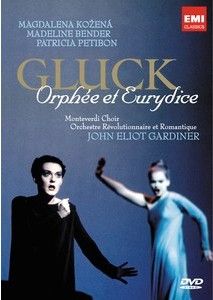
Stage production by Robert Wilson

Duration: 104'

filmed in 16:9 widescreen

Sung in French with English and German subtitles

When the historic Theatre du Chatelet in Paris re-opened after a period of extensive refurbishment, the first two productions mounted in the theatre were Gluck’s Alceste and Orphée et Eurydice.

Both operas were sung in their French versions and were mounted and designed by Robert Wilson and conducted by John Eliot Gardiner. This was the first time Wilson and Gardiner had collaborated and their individual credentials combined to produce an exceptional result.

American polymath Wilson was responsible for some of the most ambitious avant-garde performance projects of the 1970s and 80s.Since the mid-1980s he has increasingly brought his prodigious creativity to works fiom the standard dramatic and operatic repertoire, transforming them into his own unmistakably minimalist yet grandiose visions. His styled, classical interpretations of Alceste and Orphée bear his trademarks of an uncluttered stage and the arresting use of colour and light. They are not so much timeless as, in Robert Wilson’s words, “full of time”. With their minutely rehearsed gestures, at once formal and poetic, the singers have the grace and elegance of Balanchine or Martha Graham dancers.

A key figure in the revival of Early Music, John Eliot Gardiner has long been a champion of Gluck’s French operas and is a great Gluck conductor. He received enormous critical acclaim for his musical direction of both Orphée and Alceste at the Chatelet, as did his orchestras and chorus. He sought to rid the operas of any vestiges of remoteness or venerable respectability and to release the huge emotional charge that lies behind the beauty of Gluck’s classical sobriety. The stories are, after all, he says, not only poignant and deeply moving, they have an immediate and contemporary relevance: they portray two married couples striving to protect their union and their love, plumbing the very depths of their emotional strength and summoning the courage to make huge personal sacrifices. “If presented in a way that’s immediate and with tremendous intensity and truth of expression then all the dross and superficiality of the stage action falls away and you’re left with what’s actually a very visceral connection between two living people.”

Television’s top opera director, Brian Large, worked closely with Robert Wilson and John Eliot Gardiner to ensure that the translation of live performance to the small screen is of the highest artistic and techcal standard.

John Eliot Gardiner chose to use Berlioz’s 1859 revision of Orphee, which adapted the tenor role of Gluck’s 1774 score for the contralto voice of Pauline Viardot, adjusting the register for a mezzo-soprano. Underlining his preference for this version, he performed the opera with the nineteenth-century period instruments of his Orchestre Revolutionnaire et Romantique. His regular chorus, the Monteverdi Choir, excelled vocally and dramatically in its elegant contribution to the drama.

The Greek legend of Orpheus has captured the imaginations of many creative artists over the centuries. In this recording Magdalena Kozena brings to the role expressiveness, exceptional virtuosity and a rare emotion. Madeline Bender as Eurydice is possessed of a touching grace and beauty while Patricia Petibon is deliciously mischievous as Amour. All three of these young singers are among the cream of a new generation of operatic talent.

“In Robert Wilson's production neo-Expressionist gesture outlaws simple human emotions. But Gardiner and his orchestra are in fine fettle and Kožená an affecting Orphée despite the Frankenstein make-up.” BBC Music Magazine, August 2009 ***

“Orphée et Eurydice is performed in the arrangement that Berlioz made in 1859 for the French mezzo-soprano Pauline Viardot. He based it on the later, Paris, version of the opera, but restored the part of Orpheus to the alto tessitura of the original. His influence can also be detected in this recording of Alceste, an opera which likewise exists in two versions: incensed at the way the brass interjections in 'Ombre, larve' were obscured by the extra notes required for 'Divinités du Styx', Berlioz proposed a simple change to 'Ombres, larves'; and his suggestion is adopted here by John Eliot Gardiner. You won't find it in the documentation accompanying the DVDs, because there isn't any. No synopsis, no background articles, no timings; not even a list of 'chapters', except on-screen. And some detailed help is necessary, because the purchaser, in the case of Orphée et Eurydice, is getting neither pure Gluck nor pure Gluck/Berlioz.
Robert Wilson's production of Orphée etEurydice is spare, bordering on minimalist. A blue background; cypresses in Act 1; a rock in the bleak Elysian Fields. There are some striking stage pictures, such as Orpheus silhouetted during the Dance of the Furies (another Gardiner restoration, not in fact danced), and the couple positioned on different levels in Act 3.
The acting is more movement and gesture than facial expression: effective as far as it goes, but the Blessed Spirits look pretty miserable. One miscalculation is the failure to show Orpheus disobeying the gods' commands by turning to look at Eurydice, thereby bringing about her second death. Magdalena KoOená, then virtually unknown, sings Orpheus superbly, including the bravura air in Act 1 (orchestrated, incidentally, by Saint-Saëns). The latter is remarkable for the cadenza, a joint effort by Berlioz, Saint- Saëns and Viardot herself. Madeline Bender and Patricia Petibon have much less to do; they do it well, but Petibon is not helped by the variable sound quality.
The two operas are connected by a suspended cube which, seen at the end of Orphée etEurydice, reappears in the overture to Alceste and many times thereafter. The chorus is heard but not seen: a cop-out, surely, but the dancers replacing the singers on stage provide an unforgettable image when they appear, arms upraised, between the columns of the temple.
Silhouette again, and gesture, too. Anne Sofie von Otter, severe, hair scraped back, is the picture of regal dignity at her first appearance.
Later, unable to look at the husband for whom she is sacrificing her life, her pain is palpable; at the end, after Apollo has descended with the reprieve, the camera focuses on the gentle smile that she permits herself.
The sharp-eyed will have noticed that two orchestras are employed: same players, different pitch. Even at the lower pitch, some of Alceste's music is transposed down. If von Otter is almost unbearably moving in the duets with Admetus, perhaps her finest moment is her scene, alone and terrified, at the entrance to Hades. Paul Groves as Admetus is almost as eloquent, and Dietrich Henschel, swinging an imaginary club, makes a hearty, no-nonsense Hercules. Both discs are well worth investigating.”
Gramophone Classical Music Guide, 2010

“Robert Wilson's production of Orphée et Eurydice is spare, bordering on minimalist. A blue background; cypresses in Act 1; a rock in the bleak Elysian Fields. Magdalena Kožená, then virtually unknown sings Orpheus superbly, including the bravura air in Act 1... Madeline Bender and Patricia Petibon have much less to do; they do it well...” Gramophone Magazine, June 2009

DVD Video

Region: 0

Format: NTSC

EMI - 2165779

(DVD Video)

$15.75

In stock - usually despatched within 1 working day.

Gluck: Orphée et Eurydice

Gluck: Orphée et Eurydice


David Hobson, Amanda Thane & Miriam Gormley

The Australian Opera Chorus, Australian Opera and Ballet Orchestra, Marco Guidarini

PICTURE FORMAT: 4:3
LENGTH: 108 Mins
SOUND: STEREO
SUBTITLES: EN

‘This is a production of exceptional power and range.’ The Financial Review

DVD Video

Region: 0

Format: PAL

Opus Arte Faveo - OAF4005D

(DVD Video)

$19.75

In stock - usually despatched within 1 working day.

Gluck: Orphée et Eurydice

Gluck: Orphée et Eurydice

Berlioz revision, 1859


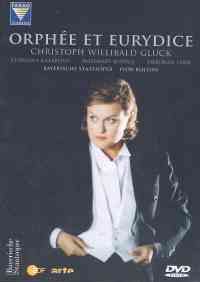
Ewa Podles (Orphée), Raphaëlle Farman (Eurydice), Marie-Noëlle de Callataÿ (L'Amour)

Collegium Instrumentale Brugense, Capella Brugensis, Patrick Peire

Studio recording, 1993

Disque Dom - FOR216720

(CD - 2 discs)

$18.50

Usually despatched in 4 - 5 working days.

Gluck: Orphée et Eurydice

Gluck: Orphée et Eurydice

Recorded in 1961


Léopold Simoneau (Orphée), Pierrette Alarie (Eurydice) & Claire Gagnier (Amour)

Chorus and Orchestre de Radio-Canada, Otto-Werner Meuller

A spectacular television production of the 1774 French version of the opera, with a tenor Orpheus. As produced by the Montreal studios of the Canadian Broadcasting Corporation, the cast stars Léopold Simoneau (Orphée), Pierrette Alarie (Eurydice), and Claire Gagnier (Amour). Designed, staged, and choreographed by Ludmilla Chiriaeff in the style of the French 18th century, and featuring dancers of the Les Grands Ballets Canadiens. The Chorus and Orchestre de Radio-Canada is under the direction of Otto-Werner Mueller. 88 minutes, Black & White, optional subtitles in English, French, German, Italian, and Spanish. All Regions.

DVD Video

Region: 0

Format: NTSC

VAI - DVDVAI4394

(DVD Video)

$29.00

Usually despatched in 4 - 5 working days.

Gluck: Orphée et Eurydice

Gluck: Orphée et Eurydice

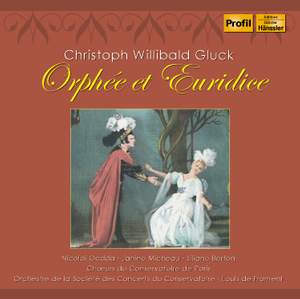
Paris Version 1774


Nicolai Gedda (Orphée), Janine Micheau (Eurydice), Liliane Berton (L'Amour)

Chœurs du Conservatoire de Paris & Orchestre de la Société des Concerts du Conservatoire, Louis de Froment

“Louis de Froment's dignified 1957 recording of the 1774 version of Orphée et Eurydice has aged gracefully. Nicolai Gedda's ringing Orphée and Janine Micheau's Eurydice are supported by an incisive orchestral performance.” BBC Music Magazine, February 2010 *****

Profil Medien - PH09021

(CD - 2 discs)

$23.00

(also available to download from $21.00)

Usually despatched in 2 - 3 working days. (Available now to download.)

Gluck: Orphée et Eurydice

Gluck: Orphée et Eurydice

Sung in German


Orpheus - Yann Bridard (ballet), Maria Riccarda Wesseling (opera), Eurydice - Marie-Agnès Gillot (ballet), Julia Kleiter (opera), Amor - Miteki Kudo (ballet ) & Sunhae Im (opera)

Ballet de l'Opéra national de Paris & Balthasar-Neumann Chor & Ensemble, Thomas Hengelbrock

Choreography and Stage Direction: Pina Bausch

Set, costume and lighting designs: Rolf Borzik

Filmed in HD at the Palais Garnier February 2008 Orpheus and Eurydice is Pina Bausch's masterpiece and the ultimate symbol of the genius of this German choreographer, who died last June, five days after being diagnosed with cancer. Bausch was the artistic director of the Tanztheater Wuppertal, which she founded in 1973. She had a formidable international reputation as one of modern dance's greatest innovators. Her dance-theatre works include the melancholic Café Müller (1978), in which dancers stumble around the stage crashing into tables and chairs, and a thrilling Rite of Spring (1975), which required the stage to be completely covered with soil. Excerpts from Bausch's Café Müller and another of her works, Masurca Fogo, reached a wider audience when they were featured in Pedro Almodóvar's film Talk to Her (2002). Bausch also appeared in Federico Fellini's 1983 film And the Ship Sails On. In recent months, she had been preparing a 3-D cinema project with Wim Wenders; shooting was slated to commence in September. Bausch continued to perform as a dancer throughout her 60s. Her company last visited the UK in 2008 for a sold-out series of performances, drawing long queues for returns at Sadler's Wells in London.

Guardian critic Judith Mackrell gave the show a five-star review, praising Bausch's ability to "combine movement of shocking visceral intensity with stage visions of often hallucinogenic strangeness".

"She was an artist of the kind that the world is only blessed with from time to time. Her repertoire of works has inspired generations of audiences and artists with an impact that is hard to overestimate." Alistair Spalding, artistic director, Sadler's Wells

Color, 16/9, NTSC - PCM STEREO, DOLBY

DIGITAL 5.1, DTS 5.1

“Even though I’m a bit allergic to Bausch’s brand of Teutonic gloom, I can’t deny that this has a rare emotional intensity which grows out of the music.” The Telegraph, 2nd December 2011

DVD Video

Region: 0

Format: NTSC

Bel Air Classiques - BAC044

(DVD Video)

$33.50

Usually despatched in 3 - 4 working days.

Gluck: Orphée et Eurydice

Gluck: Orphée et Eurydice

Sung in German


Orpheus - Yann Bridard (ballet), Maria Riccarda Wesseling (opera), Eurydice - Marie-Agnès Gillot (ballet), Julia Kleiter (opera), Amor - Miteki Kudo (ballet ) & Sunhae Im (opera)

Ballet de l'Opéra national de Paris & Balthasar-Neumann Chor & Ensemble, Thomas Hengelbrock

Choreography and Stage Direction: Pina Bausch

Set, costume and lighting designs: Rolf Borzik

Filmed in HD at the Palais Garnier February 2008 Orpheus and Eurydice is Pina Bausch's masterpiece and the ultimate symbol of the genius of this German choreographer, who died last June, five days after being diagnosed with cancer. Bausch was the artistic director of the Tanztheater Wuppertal, which she founded in 1973. She had a formidable international reputation as one of modern dance's greatest innovators. Her dance-theatre works include the melancholic Café Müller (1978), in which dancers stumble around the stage crashing into tables and chairs, and a thrilling Rite of Spring (1975), which required the stage to be completely covered with soil. Excerpts from Bausch's Café Müller and another of her works, Masurca Fogo, reached a wider audience when they were featured in Pedro Almodóvar's film Talk to Her (2002). Bausch also appeared in Federico Fellini's 1983 film And the Ship Sails On. In recent months, she had been preparing a 3-D cinema project with Wim Wenders; shooting was slated to commence in September. Bausch continued to perform as a dancer throughout her 60s. Her company last visited the UK in 2008 for a sold-out series of performances, drawing long queues for returns at Sadler's Wells in London.

Guardian critic Judith Mackrell gave the show a five-star review, praising Bausch's ability to "combine movement of shocking visceral intensity with stage visions of often hallucinogenic strangeness".

"She was an artist of the kind that the world is only blessed with from time to time. Her repertoire of works has inspired generations of audiences and artists with an impact that is hard to overestimate." Alistair Spalding, artistic director, Sadler's Wells

Color, 16/9 - PCM STEREO, DTS HD

MASTER AUDIO 5.1

Le ballet : 104 minutes

Subtitles : FR, ENG, DE, SP, IT

“Even though I’m a bit allergic to Bausch’s brand of Teutonic gloom, I can’t deny that this has a rare emotional intensity which grows out of the music.” The Telegraph, 2nd December 2011

Blu-ray Disc

Region: all

Blu-rays - up to 40% off

Bel Air Classiques - BAC444

(Blu-ray)

Normally: $41.50

Special: $24.90

Usually despatched in 3 - 4 working days.

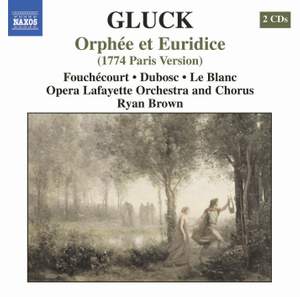
Gluck: Orphée et Eurydice

Gluck: Orphée et Eurydice

(1774 Paris version)


Jean-Paul Fouchécourt, Catherine Dubosc & Suzie LeBlanc

Opera Lafayette Orchestra & Chorus, Ryan Brown

“Here, then, is a fairly rare opportunity to here the Paris version unadulterated, played by an expert band of period instruments whose open sonorities at the beginning of the overture are a joy to hear.” Music Web

20% off Naxos

Naxos Opera Classics - 8660185-86

(CD - 2 discs)

Normally: $15.00

Special: $12.00

(also available to download from $10.75)

Usually despatched in 2 - 3 working days. (Available now to download.)

Gluck: Orphée et Eurydice

Gluck: Orphée et Eurydice


Subtitles: German, English, French, Japanese

DVD Video

Region: 0

Format: NTSC

Farao - DVDD108045

(DVD Video)

$29.00

This item is currently out of stock at the UK distributor. You may order it now but please be aware that it may be six weeks or more before it can be despatched.

Page: 

 1   2 

 Next >>

Copyright © 2002-13 Presto Classical Limited, all rights reserved.