All recordingsPrices shown exclude VAT. (UK tax is not payable for deliveries to United States.) See Terms & Conditions for p&p rates. | |  | Grieg: Piano Concerto & Lyric Pieces
| 
| | | In stock - usually despatched within 1 working day. |
|
|
| |  | Dances & Dreams: Gala from Berlin 2011Recorded live at the Berlin Philharmonic, 31 December 2011
In 2011 the Berliner Philharmoniker and their musical director Sir Simon Rattle welcomed in the New Year with a gala concert programmed with ‘Dances & Dreams’. Spinetingling and inspiring performances of music by Dvořák, Ravel, Richard Strauss, Stravinsky and Brahms are complemented by the extraordinary talent of the multi-awarded Russian pianist Evgeny Kissin. Kissin’s musicality, the depth and poetic quality of his interpretations, and his extraordinary virtuosity have placed him at the forefront of today’s pianists, and his passionate performance of the renowned Piano Concerto in A minor by Edvard Grieg is mesmerizing. Kissin's musicality, the depth and poetic quality of his interpretations, and his extraordinary virtuosity have placed him at the forefront of today's pianists. Picture format: 1080i Full HD 16:9 Sound formats: PCM 2.0, DTS-HD Master Audio Surround Region code: All (worldwide) Booklet notes: English, German, French Running time: 89 mins German FSK: 0 “Where Rattle and company radiate love, Kissin gives us duty. Still, nothing else casts a chill. Hearing the orchestra's splendours, observing the smiles and eye contact, you'd never believe the past stories of turbulence between musicians and conductor...The Blu-ray edition, as always, is markedly crisper” BBC Music Magazine, January 2013 **** | | | In stock - usually despatched within 1 working day. |
|
|
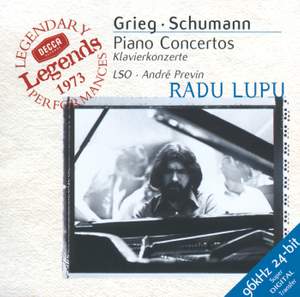
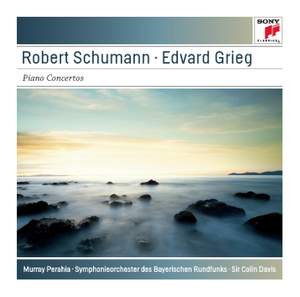
| |  | Grieg & Schumann: Piano Concertos
| | | In stock - usually despatched within 1 working day. |
|
|
| |  | Georges Cziffra play Grieg & Liszt
Grieg: | Piano Concerto in A minor, Op. 16 Paris, 17 April 1959 Orchestre National de l’ORTF, Georges Tzipine | Liszt: | Piano Concerto No. 1 in E flat major, S124 Paris, 12 March 1959 Orchestre National de l’ORTF, André Cluytens Fantasy on Hungarian Folk-tunes, S123 Paris, 12 March 1959 Orchestre National de l’ORTF, André Cluytens | Lully: | Gavotte en rondeau Luxembourg, 20 January 1959 | Scarlatti, D: | Keyboard Sonata K96 in D major Luxembourg, 20 January 1959 |
Hungarian born György Cziffra (1921–1994) was one of the most celebrated and individual piano virtuosos of the post-war decades in Europe, especially noted for his powers of improvisation and as a Liszt pianist. In 1950 Cziffra was arrested after he attempted to escape from Hungary’s Soviet-sponsored regime and was severely tortured. When he was released in 1953, Cziffra started to record for the Qualiton and Supraphon labels (ICAC5008) which began to circulate in Western Europe, propelling him to legendary status. When Russia invaded Hungary, Cziffra fled to Vienna making his debut there in November 1956, with outstanding success. Debuts elsewhere in Europe followed. Cziffra gained international stardom not without critical disfavour, adhering to a nineteenth-century approach to music that allowed for taking ‘liberties’ with the texts. Cziffra settled in France. He retired from recording in 1986 and left the concert platform in 1988. In the same year, France named him a cultural ambassador to a newly liberalised Hungary. He set up the Fondation Cziffra with his wife who runs it today. These live recordings have never been issued commercially before. The Grieg Concerto is typical of Cziffra’s ‘startling and mercurial quality’ while the Liszt Concerto and Fantasy on Hungarian Folk Themes are very much in the style with which Liszt ‘loved to tease and astonish his adoring audiences’. (Bryce Morrison) ‘Cziffra always held miniatures in special affection’ – the Lully Gavotte and Scarlatti Sonata K.96 are ‘infused with all of his unique tangy brilliance and bravura’. (Bryce Morrison) After one recital in London, The Daily Telegraph said the audience ‘witnessed feats of piano playing probably never to be equalled, certainly never surpassed, in their lifetime’, and Cziffra ‘combined the precision of a metronome with the electrical discharge of a thunderstorm’. For the Paris press, ‘he was greater than Horowitz’ and for Marcel Dupré, the great French organist, he was quite simply ‘the reincarnation of Liszt’. As Bryce Morrison states, ‘Either way, (Cziffra) hardly invites a middle course or compromise. Above all, you could never ignore this artist who occupies a unique place in the pianistic Parthenon.’ | | | (also available to download from $9.00) | In stock - usually despatched within 1 working day. |
|
|
| |  | Grieg & Dvorak: Piano Concertos
Sviatoslav Richter (1915-97) left behind the extraordinary legacy of a highly sensitive, angst-ridden yet ultimately serene musician, a true monstre sacré, a perfectionist in search of the absolute. This duo of 'nationalist' concertos by Grieg and Dvorák featured only briefly in his repertoire. The uncharacteristic liberty of his playing and the sense of exultation is astounding, illuminating these romantic compositions based on national folklore. They form a unique, totally unprecedented combination. | | | In stock - usually despatched within 1 working day. |
|
|
| |  | The Very Best of Sviatoslav Richter
and movements from concertos by Brahms, Mozart and Prokofiev; Schubert's Trout Quintet, Beethoven's Tempest Sonata and Schumann's Faschingschwank aus Wien
Sviatoslav Richter is universally acknowledged to be one of the greatest pianists of the 20th century, renowned for his virtuoso technique and the depth of his interpretations. He was born in Zhitomir, Russia, in 1915 but grew up in Odessa. Unusually, he was largely self-taught, although his organist father provided him with a basic education in music. He started to work at the Odessa Conservatory where he accompanied the opera rehearsals. He gave his first recital in 1934 at the engineer club of Odessa but did not formally study piano until three years later, when he enrolled in the Moscow Conservatory. He studied with Heinrich Neuhaus who also taught Emil Gilels, and who claimed Richter to be ‘the genius pupil, for whom he had been waiting all his life’. In 1945 he won the USSR Music Competition and the Stalin Prize in 1949, which led to extensive concert tours in Russia, Eastern Europe and China, but he did not appear in the West until he performed in Finland in May 1960. Appearances in Chicago and New York followed later that year and he then gave concerts in Italy, Germany, France and Britain, confirming his reputation for having a mystic communication with the music he played, and a technique that seemed almost super-human. Richter disliked recording in the studio and some of his finest recordings originate from live performances at concerts. The first CD begins with a live recording from the 1979 Tours Festival of Handel’s Keyboard Suite No.5 in E, whose finale is known as ‘The Harmonious Blacksmith. After this comes another live recording, this time it is a delightful short piece by Mozart – Andante and Allegretto in C for violin and piano, believed to be intended as movements of an unfinished sonata – in which Richter is joined by the Russian violinist Oleg Kagan, whose career was tragically cut short by cancer. Staying with Mozart, Richter next performs the opening movement of the Piano Concerto No.22 in E flat K482, followed by the third movement of Beethoven’s Piano Sonata No.17 in D minor known as ‘The Tempest’. This was the first recording that the Soviet authorities allowed Richter to make in the West. Next we hear two works by Schumann: the finale from Faschingsschwank aus Wien (‘Carnival Joke from Vienna’) and the whole of his Piano Concerto in A minor, which has been described as ‘one of the most brilliant jewels in the diadem of Romantic piano literature.’ CD 2 begins with another great masterwork for piano from the Romantic period: Schubert’s Wanderer Fantasy, which is followed by the delightful Theme and Variations from Schubert’s ‘Trout’ Quintet, in which Richter is joined by the double bass player Georg Hörtnagel and members of the Borodin Quartet. Next we hear the romantic third movement of Brahms’s Second Piano Concerto followed in complete contrast by the first movement of Prokofiev’s Piano Concerto No.5. In 1940, while still a student, Richter had given the world premiere of the Sonata No. 6 by Sergei Prokofiev, a composer with whose works Richter was ever after associated. The programme ends with a complete performance of one of the most popular concertos in the entire piano repertoire: Grieg’s Piano Concerto in A minor. | | | In stock - usually despatched within 1 working day. |
|
|
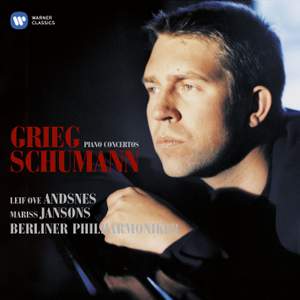
| |  | Grieg & Schumann: Piano Concertos
| | | In stock - usually despatched within 1 working day. |
|
|
| |  | Dvorak, Grieg & Schumann: Piano Concertos
“Richter’s Schumann seems to me unequalled by any other pianist; the slow movement of the Concerto is really exquisite. In the Grieg also, there is some splendid playing and the Adagio is most beautifully done.” Gramophone Magazine | | | In stock - usually despatched within 1 working day. |
|
|
| |  | Schumann & Grieg: Piano Concertos
| | | In stock - usually despatched within 1 working day. |
|
|
| |  | Grieg & Liszt - Piano Concertos
| | | In stock - usually despatched within 1 working day. |
|
|
| |
|