All recordingsPrices shown exclude VAT. (UK tax is not payable for deliveries to United States.) See Terms & Conditions for p&p rates. | |  | Saint-Saëns & Tchaikovsky: Works for Cello & Orchestra
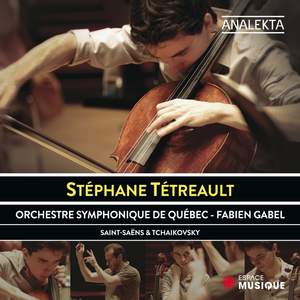
Stéphane Tétreault (cello) Orchestre Symphonique de Quebec, Fabiel Gabel Stéphane Tétreault, 19 years old, was the First Prize winner in the Montreal Symphony Orchestra Standard Life-OSM 2007 Competition as well as various others. Accompanied by the Orchestre Symphonique de Quebec, he performs Saint-Saens’ Concerto No. 1, Tchaikovsky’s Roccoco Variations coupled with Saint-Saens’ Allegro Passionato and The Swan (from Carnival of the Animals) plus Tchaikovsky’s Pezzo Capriccioso op. 62. “From the very first bars of Saint-Saens's First Cello Concerto you sense that this disc is going to be exhilarating and rewarding. The performers launch the concerto with terrific passion and positive intent, and thereafter call into play a discriminating, captivating spectrum of interpretative sensibility. The solo playing is astonishingly mature...it comes as a shock to realise that Stéphane Tétreault is 19 years old. His is a name to watch.” Gramophone Magazine, March 2013 | | | In stock - usually despatched within 1 working day. |
|
|
| |  | The Very Best of Paul Tortelier
Bach, J S: | Cello Suite No. 1 in G major, BWV1007 | Haydn: | Cello Concerto No. 2 in D major, Hob. VIIb:2 (Op. 101): Rondo | Karjinsky: | Esquisse | Nin: | Granadina (from Cantos populares españoles) | Paganini: | Introduction & Variations on 'Dal tuo stellato soglio' from Rossini's 'Mosé in Egitto', MS23 (Op. 24) | Rachmaninov: | Vocalise, Op. 34 No. 14 | Ravel: | Vocalise-étude en forme de habanera | Rimsky Korsakov: | Flight of the Bumble Bee | Saint-Saëns: | Allegro Appassionato in B minor Op. 43 Mon cœur s'ouvre à ta voix (from Samson et Dalila) Le carnaval des animaux: Le Cygne | Sarasate: | Danza Española No. 6: Zapateado, Op. 23, No. 2 | Strauss, R: | Don Quixote, Op. 35 | Tchaikovsky: | Variations on a Rococo Theme, Op. 33 | Tortelier: | Miniatures (3) |
and movements from cello sonatas by Beethoven and Brahms and the Walton and Elgar Concertos
Paul Tortelier had the lean, ascetic look of an El Greco saint, yet possessed the turbulent idealism of Don Quixote, whom he portrayed so memorably in Richard Strauss’s tone poem. Tortelier was born in Paris in 1914, months before the outbreak of the Great War. Though the family knew poverty, it was his mother’s dream that her son should be a cellist. He started to learn the instrument at the age of six and at 12 he entered the Paris Conservatoire where he won several prizes before leaving at 16 to play freelance in cafés and cinemas in the days of silent films. A year later he made his professional debut playing Lalo’s Concerto at the Concerts Lamoureux. In 1935 he went to the Monte-Carlo Orchestra as principal cellist and two years later played Don Quixote under Strauss’s own direction. He began his solo career in 1938 in Boston, but this was interrupted by the war, during which he remained in Paris. In 1947 he played Don Quixote in Beecham’s Richard Strauss festival in London to great acclaim. This effectively relaunched his international career and he went on to become one of the world’s most distinguished cellists. He died suddenly in 1990 at the age of 76. Bach’s solo Cello Suites were always an integral part of Tortelier’s repertoire and CD 1 opens with the first three movements of Suite No.1 in G. Following this is another Baroque work, the Cello Concerto in D by Vivaldi, in which Tortelier also directs the English Chamber Orchestra. Next comes the finale from Haydn’s Cello Concerto No.2 in D recorded with Jörg Faerber conducting the Wurtemburg Chamber Orchestra in Heilbronn. We then hear movements from Beethoven’s Cello Sonata No.4 in C with the French pianist Eric Heidsieck, and Brahms’s Cello Sonata No.2 in F in which the pianist is Tortelier’s daughter, Maria de la Pau. The CD ends with Tortelier’s third EMI recording of his signature work, Don Quixote by Richard Strauss with the Staatskapelle Dresden under Rudolf Kempe. CD 2 begins with the first two movements of another of the works central to Tortelier’s repertoire, Elgar’s Cello Concerto, a performance of which won him a prize while he was studying at the Paris Conservatoire. This is followed by an extract from the Walton Cello Concerto conducted by Paavo Berglund and then Paganini’s variations on an operatic aria by Rossini to show off Tortelier’s technical skill as a virtuoso of his instrument, this recording conducted by Tortelier’s cellist wife, Maud Tortelier. Next comes a group of encore pieces, including the inevitable ‘Flight of the Bumblebee’ and ‘Le Cygne’, culminating in Three Miniatures for two cellos composed by Tortelier himself and played here with his wife Maud as the second cellist. The programme finishes with a spirited performance of Tchaikovsky’s ‘Rococo’ Variations with the Northern Sinfonia of England conducted by Tortelier’s son Jan Pascal Tortelier. | | | In stock - usually despatched within 1 working day. |
|
|
| |  | My Tunes Vol. 2
Jan Vogler (cello) Dresdner Kapellsolisten, Helmut Branny | | | In stock - usually despatched within 1 working day. |
|
|
| |  |
| | | In stock - usually despatched within 1 working day. |
|
|
| |  | Liebesfreud & LiebesleidEncores for the cello
Bach, J S: | Orchestral Suite No. 3 in D major, BWV1068: Air ('Air on a G String') (arr. J. Starker for cello & piano) Arioso (Largo) from Keyboard Concerto in F minor, BWV1056 (arr. J. Starker for cello & piano) | Brahms: | Liebestreu, Op. 3 No. 1 (arr. N. Salter and D. Geringas for cello & piano) Wie Melodien zieht es mir, Op. 105 No. 1 (arr. N. Salter and D. Geringas for cello & piano) Feldeinsamkeit, Op. 86 No. 2 (arr. N. Salter and D. Geringas for cello & piano) Wiegenlied, Op. 49 No. 4 (Lullaby) (arr. N. Salter and D. Geringas for cello & piano) | Dvorak: | Rondo in G minor for cello & piano, Op. 94, B. 171 | Elgar: | Nimrod (from Enigma Variations) Salut d'amour, Op. 12 | Fauré: | Après un rêve, Op. 7 No. 1 (arr. R. Howat for cello & piano) Romance in A major for cello & piano, Op. 69 Romance sans paroles, Op. 17 No. 3 (arr. R. Howat for cello & piano) Berceuse, Op. 16 (arr. R. Howat for cello & piano) | Kreisler: | Liebesfreud (arr. W. Drahts for cello & piano) Liebesleid (arr. W. Drahts for cello & piano) | Massenet: | Meditation (from Thaïs) (arr. J. Delsart for cello and piano) | Rachmaninov: | Vocalise, Op. 34 No. 14 (arr. L. Rose) | Saint-Saëns: | Allegro Appassionato in B minor Op. 43 (arr. S. Isserlis and S.T. Ratner for cello & piano) Le carnaval des animaux: Le Cygne (arr. S. Isserlis and S.T. Ratner for cello & piano) | Sarasate: | Zigeunerweisen, Op. 20 (arr. W. Thomas-Mifune for cello & piano) | Shostakovich: | Jazz Suite No. 2 - Waltz No. 2 (arr. E. Kaufmann for cello & piano) |
Michael Hell (cello) & Micaela Gelius (piano) | | | Usually despatched in 2 - 3 working days. |
|
|
| |  | Saint-Saëns: Cello Concertos Nos. 1 & 2 & Suite for Cello and Orchestra
Christine Walevska (cello) Orchestre National de l’Opéra de Monte Carlo, Eliahu Inbal Many composers, including Shostakovich and Rachmaninov, considered Saint-Saëns’ Cello Concerto No.1 to be the greatest of all cello concertos. The second one is not as popular, but as the composer admitted, is very difficult to play. The Suite and the Allegro Passionata were originally composed for Cello and Piano but were later orchestrated by Saint Saëns. “Driven performances of the Concertos; greater affection in the slighter works” BBC Music Magazine, December 2011 ** | | | Usually despatched in 2 - 3 working days. |
|
|
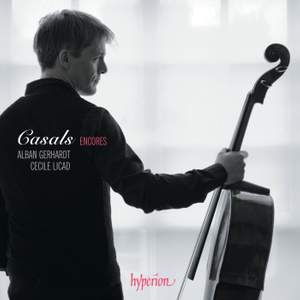
| |  | Casals Encores
Boccherini: | Cello Sonata in A major, G4a: Allegro Moderato | Chopin: | Nocturne No. 2 in E flat major, Op. 9 No. 2 arr. David Popper Prelude Op. 28 No. 15 in D flat major ‘Raindrop' arr. Pablo Casals | Debussy: | Petite Suite: Menuet arr. Gaston Choisnel | Elgar: | Salut d'amour, Op. 12 | Falla: | Nana (No. 5 from Siete canciones populares españolas) arr. Maurice Maréchal | Fauré: | Après un rêve, Op. 7 No. 1 arr. Pablo Casals | Godard, B: | Berceuse from Jocelyn | Granados: | Danza española, Op. 37 No. 5 'Andaluza' arr. Pablo Casals | Kreisler: | Chanson Louis XIII and Pavane (In the style of Couperin) | Lassen: | Thine Eyes So Blue arr. Pablo Casals | MacDowell: | Romance for Cello and Orchestra, Op. 35 | Popper: | La Chanson villageoise, Op. 62 No. 2 Mazurka in G minor, Op. 11 No. 3 Vito, Spanish Dance Op. 54/5 | Saint-Saëns: | Le carnaval des animaux: Le Cygne Allegro Appassionato in B minor Op. 43 | Sgambati: | Serenata napoletana, Op. 24 No. 2 | trad.: | The Song of the Birds traditional, arr. Pablo Casals | Wagner: | O du, mein holder Abendstern (from Tannhäuser) arr. Leo Schulz |
This sensational new release from German cellist Alban Gerhardt recaptures the novelty of the much-loved encores performed by Pablo Casals. Spanish-born Casals was universally recognized as one of the world’s greatest cellists and had a vast repertoire of intimate encores which were adored by his audiences. The disc features transcriptions of works by many notable composers including Fauré, Chopin, Saint-Saëns, Boccherini and Wagner. Also featured are frequently performed musical gems by David Popper: Vito, Chanson villageoise and his Mazurka in G minor, pieces which have gained a special place in the cello literature. Gerhardt performs these miniature masterworks with extraordinary finesse and verve. His very personal interpretations never lapse into self-indulgence and he projects a distinctive luminescence of tone with infallible intonation. Gerhardt is intelligently partnered and perfectly matched by pianist Cecile Licad on her Hyperion debut. This unique disc demonstrates sublime musicianship, with both performers revelling in a wide expressive scope from the vivacious to the lyrical. “There is much more to an encore, as Alban Gerhardt will tell you, than casually capping a recital with an audience-pleaser...Listen to Gerhardt in Benjamin Godard’s Berceuse de Jocelyn and there is a paradigm of the exceptional eloquence and discernment that distinguishes the entire disc.” The Telegraph, 2nd June 2011 ***** “his playing [is] less heart-on-sleeve than Casals's own, but wonderfully eloquent and noble: he can be extraordinarily moving in such once-familiar standards as the Berceuse from Godard's Jocelyn, or in Casals's arrangement of Chopin's Raindrop Prelude...Some of this music makes considerable demands on the pianist, and Cecile Licad rises to its challenges with considerable elegance.” The Guardian, 9th June 2011 **** “Gerhardt has a honeyed, liquid tone all his own. He has created a well-contrasted programme that clearly took a long time to research and hone...This is cello playing of exquisite sophistication and bold imagination. Casals, I feel sure, would have approved.” BBC Music Magazine, August 2011 ***** “An unexpected disc from a cellist one usually thinks of as a heavyweight...he brings to them absolutely the same seriousness of approach and sensitivity that he does to everything. And it works for an album that feels worthwhile as well as easily digestible.” Gramophone Magazine, September 2011 BBC Music Magazine
Chamber Choice - August 2011 |
| | | Usually despatched in 2 - 3 working days. |
|
|
| |  | Saint-Saëns: Music for Piano and Cello and Piano
“Croshaw is a first-rate artist, as her musical characterisation fully demonstrates, and is perfectly balanced in the First Cello Sonata with her partner Christina Shillito, who favours a comparatively restrained lyricism...Excellent recording throughout ensures that altogether this is a morerewarding duet-recital.” Gramophone Magazine, January 2012 “she is clearly a most gifted pianist and a fine interpreter of this composer's music; she is a splendid partner for the gifted Christina Shillito in the two works for cello and piano by Saint-Saens, and all in all, this is a most invigorating issue, very well recorded, which I commend highly.” Musical Opinion, May/June 2011 “Her nuanced, revelatory pianism seems almost outside of time in its understated eloquence, and in a way the chosen repertoire is perfectly suited. Her artless poetry at the keyboard is evident in Saint-Saëns' retro, and magical, Piano Suite...Her athletic legerdemain...seems undiminished...[in] the Allegro Appassionato op.70” MusicWeb International, November 2011 | | | Usually despatched in 8 - 10 working days. |
|
|
| |  | Saint-Saens & Haydn: Cello Concertos
| |
|
| |  | Saint-Saens - Complete Works for Cello & Orchestra
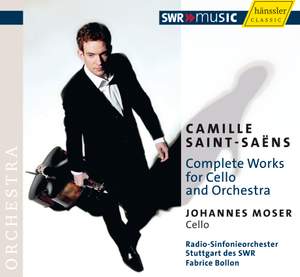
These works are both sweepingly romantic and an acid test for any player’s technical finesse. Apart from the popular First Concerto and the ubiquitous “Swan”, Saint-Saëns composed a Second Cello Concerto in addition to several other shorter works for Cello and orchestra, most of which are seldom heard in performance. Stunning performances from the young start cellist, Johannes Moser. “Hearing the two concertos in succession brings it home how much more inspired the First is, with its thrillingly dramatic opening. Moser plays it with overwhelming passion, while firmly controlling tempo and intonation.” Gramophone Magazine, January 2009 “…Moser gives a strong, impassioned account of the Second Concerto… It's in this work that Moser distances himself most noticeably from Maria Kliegel… overall, Moser is more imaginative and alive to the music's dramatic possibilities. And why isn’t the wonderful Suite Op. 16 heard more often?” BBC Music Magazine, April 2009 ***** | | | (also available to download from $10.75) | Usually despatched in 2 - 3 working days. (Available now to download.) |
|
|
| |
|