All recordingsPrices shown exclude VAT. (UK tax is not payable for deliveries to United States.) See Terms & Conditions for p&p rates. | |  |
Australian Brandenburg Orchestra, Paul Dyer The Australian Brandenburg Orchestra is Australia’s finest period-instrument ensemble. Under their inspiring musical director Paul Dyer, their vibrant concerts and recordings combine historical integrity with electrifying virtuosity and a passion for beauty. Petroc Trelawney has already featured this on BBC Radio 3’s In Tune. “…these are performances of style and understanding into which Paul Dyer and his fine period orchestra have plunged with freshness, buoyancy and joyful enthusiasm. …immensely enjoyable and inspiriting performances.” Gramophone Magazine, March 2010 | | | In stock - usually despatched within 1 working day. |
|
|
| |  |
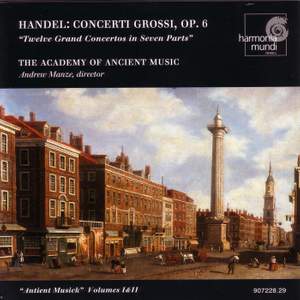
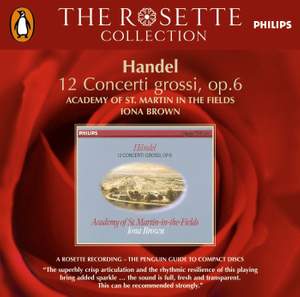
Considered among the finest examples of Baroque orchestral music, Handel’s Concerti Grossi, Op.6, completed in 1739 over a mere four weeks, surpass the work of other outstanding composers of the form, such as Vivaldi, Scarlatti, and Corelli. Conceived as a grand cycle rather than as individual compositions, these 12 pieces demonstrate Handel’s facility blending a variety of styles and devices with seemingly endless melodic beauty. Andrew Manze leads The Academy of Ancient Music in a vivid and vibrant performance. “Richard Egarr's charisma is infectious and the recorded sound sensational.” BBC Music Magazine “With one stride, Harmonia Mundi has stolen a march on Chandos Chaconne's rival set of Handel's Op 6 with Simon Standage's Collegium Musicum 90; by juggling with the order, the 12 concertos have been accommodated on only two CDs. The AAM is on sparkling form, clearly enjoying itself under Andrew Manze's leadership. Performances are invigoratingly alert, splendidly neat (all those semiquaver figurations absolutely precise) and strongly rhythmical but not inflexible, with much dynamic gradation which ensures that phrases are always tonally alive and sound completely natural (even if more subtly nuanced than Handel's players ever dreamt of). Manze's basically light-footed approach is particularly appealing, and he sees to it that inner-part imitations are given their due weight. Speeds are nearly all fast, occasionally questionably so (though exhilarating), as in the first Allegro of No 1, the big Allegro of No 6 and the Allegro in No 9. But Manze successfully brings out the character of all the movements, and the listener can't fail to love the vigorous kick of his No 7 hornpipe. He's mostly sparing in embellishing solo lines except in Nos-6 and 11. Altogether this is an issue of joyous vitality.” Gramophone Classical Music Guide, 2010 | | | In stock - usually despatched within 1 working day. |
|
|
| |  | Handel’s MemoriesA Selection from Grand Concertos Op. 6
Handel: | Concerto grosso, Op. 6 No. 1 in G major, HWV319 Concerto grosso, Op. 6 No. 8 in C minor, HWV326 Concerto grosso, Op. 6 No. 6 in G minor, HWV324 Concerto grosso, Op. 6 No. 10 in D minor, HWV328 Concerto grosso, Op. 6 No. 5 in D major, HWV323 Concerto grosso, Op. 6 No. 11 in A major, HWV329 |
This double hybrid SACD set is the second recording by Al Ayre Español and its conductor Eduardo López Banzo for Challenge Classics, and features a selection of six of Handel’s Twelve Grand Concertos, opus 6, otherwise known as Concerti grossi. Last year their debut release for the label was a highly-regarded disc of sacred cantatas by José de Nebra. The musical director Eduardo López Banzo was born in Zaragoza in 1961. In the operatic field he is considered to be one of the most important specialists as regards Handel’s music for theatre. Eduardo López Banzo founded Al Ayre Español in 1988, and was awarded the Spanish National Music Prize in 2004, thanks to more than twenty years of musicological rigueur and performance excellence. Handel’s Concerti grossi, Op.6 or Twelve Grand Concertos, HWV 319-330 were first published in London by John Walsh in 1739. Taking the older concerto da chiesa and concerto da camera of Arcangelo Corelli as models, rather than the later three-movement Venetian concerto of Antonio Vivaldi favoured by Johann Sebastian Bach, they were written to be played during performances of Handel's oratorios and odes. Despite the conventional model, Handel incorporated in the movements the full range of his compositional styles, including trio sonatas, operatic arias, French overtures, Italian sinfonias, airs, fugues, themes and variations and a variety of dances. The concertos were largely composed of new material, and are amongst the finest examples of the baroque concerto grosso. “The opening [Concerto Grosso] No 1 in G major establishes the character of these interpretations by Eduardo López Banzo's ensemble Al Ayre Español: the perfectly poised gait of the opening movement, with bounteous viols offering a richly textured timbre” The Independent, 14th July 2012 *** | | | Usually despatched in 4 - 5 working days. |
|
|
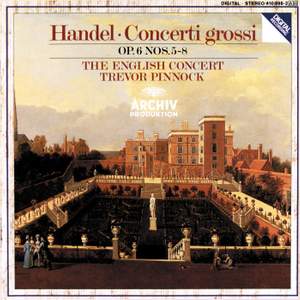
| |  | Handel: Concerti Grossi, Op. 6, Nos. 5-8
New Bach Collegium Musicum Leipzig, Camerata Romana, Max Pommer, Eugen Duvier | |
|
| |  | Handel - Concerti grossi Op. 6 Nos. 7-12 (CD)
Handel: | Concerto grosso, Op. 6 No. 7 in B flat major, HWV325 Concerto grosso, Op. 6 No. 8 in C minor, HWV326 Concerto grosso, Op. 6 No. 9 in F major, HWV327 Concerto grosso, Op. 6 No. 10 in D minor, HWV328 Concerto grosso, Op. 6 No. 11 in A major, HWV329 Concerto grosso, Op. 6 No. 12 in B minor, HWV330 |
“Martin Pearlman… supervises assured performances that do his Bostonian orchestra credit.” Gramophone Magazine, May 2008 | | | Usually despatched in 4 - 5 working days. |
|
|
| |  |
| | | Usually despatched in 2 - 3 working days. |
|
|
| |  | Handel - Concerti grossi Op. 6 Volume 2
“The first disc of the ever-fresh Op 6 Concertigrossi includes the oboe parts that Handel later added to Nos 1, 2, 5 and 6. The performances are brimful of vitality, and the clean articulation and light, predominantly detached style give the music buoyancy and help to bring out Handel's often mischievous twinkle in the eye. Speeds are generally brisk, with boldly vigorous playing, but Standage's team can also spin a tranquil broad line. Dynamics throughout are subtly graded, and except in one final cadence ornamentation is confined to small cadential trills. On the second disc, except, in the sombre colours in the splendid G minor Concerto (No 6) – here with oboe and the agreeable addition of a theorbo to the continuo – there's a general air of cheerfulness that's most engaging. The fugue in No 7 is wittily buoyant, the Allegro in No 9, borrowed from the Cuckoo and the nightingale Organ Concerto, could scarcely be more high-spirited, the final Passepied of No 6 and the Hornpipe of No 7 are spring-toed; and Standage's feeling for convincing tempos is nowhere better shown than in the long Musette of No 6, which in other hands can drag. Phrasing everywhere is shapely, and the surprise chords that interrupt the flow of No 8's Allemande are admirably 'placed'. On the final disc the playing is always on its toes – positively twinkling in dance movements such as the concluding fugal gigue of No 12. The last two concertos, No 11 in particular, give Simon Standage an opportunity to shine as a soloist; his ad lib sections are tastefully done, without excesses; his semiquavers in the variants of the A major Andante are feather-light. All dynamics are well contrasted in a natural way, and the tempos nicely judged; a slightly faster repeat of the first half of No 10's fifth movement suggests the splicing of a different take. As a fillup, we're presented with the Alexander's Feast concerto grosso, for which the string group is joined by oboes and bassoon. The excellent concertino of two violins and cello is thrown into high relief and the Allegro movements are performed with a delightful spring.” Gramophone Classical Music Guide, 2010 | | | (also available to download from $10.50) | Usually despatched in 2 - 3 working days. (Available now to download.) |
|
|
| |  |
Maria Vermes (violin), Gerhard Bosse (violin), Friedemann Erben (cello), Werner Buschnakowski (harpsichord)
Handel Festival Chamber Orchestra, Horst-Tanu Margraf | |
|
| |  | Handel: Concerti Grossi, Op. 6 Nos. 5-8
| | | (also available to download from $10.50) | Usually despatched in 2 - 3 working days. (Available now to download.) |
|
|
| |  |
Handel’s Concerti Grossi contain some of the finest orchestral music of the eighteenth century. The Op. 6 collection brims with a wealth of variety, colour, and dance rhythms – Polish and Pastoral dances, courtly and fast ones – and Handel’s customary self-borrowings and indeed borrowings from other composers. The combination of full orchestra with a concertino solo group of two violins and cello allows both breadth and intimacy, producing concertos in the fullest sense. On this recording Kevin Mallon incorporates the later oboe parts for Concertos Nos. 1, 2, 5 and 6, using them as a model for most of the other concertos. When the oboes are silent, flutes or recorders are added, in line with eighteenth-century practice. “Mallon's new recordings with his Canadian period instrument ensemble offers honest, unfussy readings...while the Aradia Ensemble rarely wants for urbanity, warmth and clarity, a certain under-characterisation can merge one concerto into another.” BBC Music Magazine, April 2013 *** | 
| | | (also available to download from $12.50) | In stock - usually despatched within 1 working day. |
|
|
| |
|