Schubert: Die Taubenpost, D965A (D957 No. 14)

This page lists all recordings of Die Taubenpost, D965A (D957 No. 14), by Franz Peter Schubert (1797-1828) on CD, SACD & download (MP3 & FLAC). Generally, more recent releases are listed first, but with priority given to those that are in stock.

Recommendations

Editor's Choice
April 2009

All recordings

Prices shown exclude VAT. (UK tax is not payable for deliveries to United States.)
See Terms & Conditions for p&p rates.

The Voice of Peter Pears

The Voice of Peter Pears


Berkeley, L:

How Love Came In

Benjamin Britten (piano)

Bridge:

Love went a-riding

Benjamin Britten (piano)

Britten:

The Holy Sonnets of John Donne, Op. 35

Benjamin Britten (piano)

The Plough Boy

Benjamin Britten (piano)

Campion:

Shall I come, sweet love, to thee?

Julian Bream (guitar)

Copland:

Long Time Ago

Benjamin Britten (piano)

Simple Gifts (from Old American Songs, Set I)

Benjamin Britten (piano)

I Bought me a Cat

Benjamin Britten (piano)

Dowland:

I saw my Lady weepe

Julian Bream (guitar)

What if I never speed?

Julian Bream (guitar)

Ford, T:

Faire, sweet, cruell

Julian Bream (guitar)

Grainger:

Six Dukes Went a-Fishin'

Benjamin Britten (piano)

Ireland:

I Have Twelve Oxen

Benjamin Britten (piano)

Moeran:

In youth is pleasure

Benjamin Britten (piano)

Morley:

It was a lover and his lass

Julian Bream (guitar)

Rosseter:

What then is love but mourning?

Julian Bream (guitar)

Schubert:

Im Frühling, D882

Benjamin Britten (piano)

Auf der Bruck, D853

Benjamin Britten (piano)

An die Laute D905

Benjamin Britten (piano)

Die Taubenpost, D965A (D957 No. 14)

Benjamin Britten (piano)

Warlock:

Yarmouth Fair

Benjamin Britten (piano)


Peter Pears (tenor)

Regis - RRC1393

(CD)

$7.50

In stock - usually despatched within 1 working day.

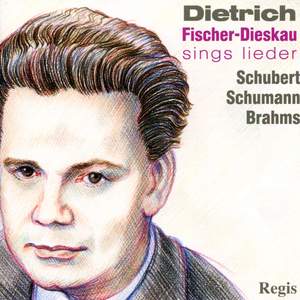
Dietrich Fischer-Dieskau sings Lieder

Dietrich Fischer-Dieskau sings Lieder


Brahms:

Feldeinsamkeit, Op. 86 No. 2

Auf dem See (No. 2 from Acht Lieder und Gesänge, Op. 59)

Abenddämmerung, Op. 49 No. 5

Alte Liebe, Op. 72 No. 1

Verzagen, Op. 72 No. 4

Regenlied (No. 3 from Acht Lieder und Gesänge, Op. 59)

Schubert:

Liebesbotschaft, D957 No.1

Der Atlas, D957 No. 8

Ihr Bild, D957 No. 9

Das Fischermädchen D957 No. 10

Die Stadt, D957 No. 11

Am Meer, D 957 No. 12

Die Taubenpost, D965A (D957 No. 14)

Am feierabend (No. 5 from Die schöne Müllerin, D795)

Trockne Blumen (No. 18 from Die schöne Müllerin, D795)

Nacht und Träume, D827

Schumann:

In der Fremde (No. 1 from Liederkreis, Op. 39)

Waldesgesprach (No. 3 from Liederkreis, Op. 39)

Mondnacht (No. 5 from Liederkreis, Op. 39)

Schöne Fremde (No. 6 from Liederkreis, Op. 39)

Auf einer Burg (No. 7 from Liederkreis, Op. 39)

Wehmut (No. 9 from Liederkreis, Op. 39)

Im Walde (No. 11 from Liederkreis, Op. 39)

Frühlingsnacht (No. 12 from Liederkreis, Op. 39)


Dietrich Fischer-Dieskau (bass-baritone) & Günther Weissenborn, Gerald Moore & Jörg Demu (piano)

“The main purpose of this frustratingly fragmentary and unevenly mastered compilation of Lieder treasure seems to be to give a sampler tasting of the young Fischer-Dieskau in the 1950s, with a varied palette of accompanists.” BBC Music Magazine, February 2010 ****

“The voice is again in finest condition, the art wonderfully flexible in its transitions from light-heartedness to the intensity of despair. The Liederkreis songs include a magical "Mondnacht" and a vividly "faced" "Im Walde". The Brahms group opens with Feldeinsamkeit, masterly in control, technical and expressive. The remastered sound is very immediate, sometimes almost uncomfortably so, but the impression is strong, probably ineffaceable.” Gramophone Magazine, December 2009

Regis - RRC1313

(CD)

$7.50

In stock - usually despatched within 1 working day.

Schubert - Schwanengesang

Schubert - Schwanengesang


Schubert:

Geheimnis, D491 (Mayrhofer)

An Schwager Kronos, D369

Widerschein, D949

Schwanengesang, D957

Die Taubenpost, D965A (D957 No. 14)

Abschied D475 (Mayrhofer)


Ian Bostridge (tenor) & Antonio Pappano (piano)

Following their highly acclaimed Hugo Wolf lieder album, Ian Bostridge and Antonio Pappano have renewed their musical partnership with a recording of Franz Schubert’s Schwanengesang, the third and last of the composer’s song cycles, and literally his swan song, as he succumbed to illness shortly after its completion in 1828.

In addition to Schwanengesang, the CD also includes Schubert songs Abschied (D475); Geheimnis (D250); An Schwager Kronos (D369) and Widerschein (D639).

Bostridge and Pappano performed Schwanengesang in recital at the Schwarzenberg (Austria) Schubertiade, at the Edinburgh and Aldeburgh festivals and in Glasgow before committing it to disc: “[a recital] characterised by unaffected intimacy and reverence to the music … The two gave a performance as intense and intriguing as it was timeless.” (The Scotsman); “Each song is a mini-drama … [Bostridge] is a performer of extremes who, at the moment of delivery, convinces you that this is how it must be.” (Evening Standard)

Schwanengesang ("Swan Song”) was published posthumously. This title is attributed to Schubert’s publisher, Haslinger, who, in his attempt to maximize profits after the composer’s death, presented the work as the composer’s final musical testament. In contrast with Schubert’s previous song cycles, Die schöne Müllerin and Winterreise, each composed to verses by a single poet, Schwanengesang draws on the work of two poets, Ludwig Rellstab (1799-1860) and Heinrich Heine (1797-1856). In the original manuscript, all 13 songs (seven by Rellstab, six by Heine) were copied in Schubert's handwriting on consecutive manuscript pages and appear in the standard performance order. There are thematic connections between the Rellstab and Heine verses in terms of subject matter and musical motifs.

Taubenpost, to a text by Johann Gabriel Seidl (1804-1875), is often performed as a finale to Schwanengesang. However, research indicates that, rather than being intended as such by Schubert, this tradition was initiated by the publisher, who appended the song to the first edition. While the song is not technically part of Schwanengesang, it is considered to be Schubert's last lied.

Ian Bostridge is firmly established in the opera house, concert hall and recital room, and much sought after internationally as one of the finest of his generation of tenors. He is one of today’s leading interpreters of Schubert lieder, repertoire that he names as his first love. Bostridge’s Schubert cycles and song explorations on EMI Classics began in 1998 with the release of a lieder disc with Julius Drake. Subsequent Schubert lieder albums, most recently The Wanderer, a collection of Schubert lieder and fragments released in summer 2008, and cycles of Der Winterreise and Die schöne Müllerin have seen Bostridge in partnership with Leif Ove Andsnes and Mitsuko Uchida.

“Ian Bostridge continues to be the most striking Schubert tenor of the day. When he is joined by Antonio Pappano as accompanist, the effect is intensified.” The Herald

“Ian Bostridge and Antonio Pappano bring out the best in each other.” BBC Music Magazine

“ Schwanengesang is really no such thing, and there is nothing to prevent a singer omitting the song or changing the order. Bostridge follows the publisher's order and does not flinch before 'Aufenthalt'; and if momentarily he goes under, perhaps it is part of the musical-verbal picture that he should. In any case, all of this is a diversion, almost a frivolity. At the heart of the matter are 'Der Doppelgänger', 'Die Stadt', 'Ihr Bild', 'Am Meer' and, from the Rellstab settings, 'In der Ferne'. Bostridge has, in the pallor of voice and expression, the haunting that pervades these songs. In the first mentioned (the last sung) he is one of the few who can create unease without anticipating the horror, still making those openmouthed vowels ('starret', 'Schmerzensgewalt', 'so manche Nacht') call out into the night like a wounded animal.
Such rare moments are the singer's own; elsewhere the performance is equally the pianist's.
Pappano plays with imagination as verbally attuned as Bostridge's. The rightness of touch is evident in the first additional song, 'Geheimnis', and in the last, the very simple and aptly chosen 'Abschied'. He is also graceful and interesting in the happier songs. There's one misgiving – Bostridge makes so much of the German words, rather as though anxious to communicate with the back rows of a concert-hall full of non-German speakers. Whatever the justification in situ, it nags a little on records.”
Gramophone Classical Music Guide, 2010

“At the heart of the matter are "Der Doppelgänger", "Die Stadt", "Ihr Bild", "Am Meer" and, from the Rellstab settings, "In der Ferne". Bostridge has, in the pallor of voice and expression, the haunting that pervades these songs. In the first mentioned (the last sung) he is one of the few who can create unease without anticipating the horror.” Gramophone Magazine, June 2009

“[Bostridge's] somewhat detached, hard vocal quality suits the introspective longing of many of these settings.” The Times, 21st February 2009 ***

EMI - 2426392

(CD)

$14.50

In stock - usually despatched within 1 working day.

Schubert: Die Schöne Müllerin & 3 Lieder

Schubert: Die Schöne Müllerin & 3 Lieder


Schubert:

Die schöne Müllerin, D795

An die Laute D905

Die Taubenpost, D965A (D957 No. 14)

Der Einsame, D800


Peter Pears (tenor) & Benjamin Britten (piano)

Britten and Pears were formidable in their interpretations of a variety of repertoire but their recordings of Schubert were particularly insightful. The 1960 recording of Die Schone Mullerin is captured here accompanied by three lieder which were released a year later.

“Britten who is, as we know, a wonderful accompanist, excels himself in this cycle and his artistic partnership with Pears gives us a most imaginative and moving interpretation of the wonderful work.” Gramophone Magazine

Heritage - HTGCD234

(CD)

$10.75

Usually despatched in 8 - 10 working days.

Teddy Tahu Rhodes: Serious Songs

Teddy Tahu Rhodes: Serious Songs


Barber, S:

Dover Beach, Op. 3

Brahms:

Herr, lehre doch mich (from Ein Deutsches Requiem, Op. 45)

Denn wir haben hie keine bleibende Statt (from Ein Deutsches Requiem, Op. 45)

Glanert:

Four Preludes and Serious Songs (after Brahms)

after Brahms

Schubert:

Erlkönig, D328

orch. Max Reger

An die Musik D547

Erlkönig, D328

Die Forelle, D550

Die Taubenpost, D965A (D957 No. 14)


Teddy Tahu Rhodes (bass-baritone)

Internationally acclaimed singer and ARIA-winner Teddy Tahu Rhodes sings the great songs of Schubert and Brahms accompanied by the Tasmanian and Melbourne Symphony Orchestras. Includes rare recordings, live from Huntington Festival and in the studio with the Australian String Quartet.

ABC Classics - ABC4764363

(CD)

$17.50

Usually despatched in 2 - 3 working days.

Schubert - Arpeggione Sonata & Lieder transcriptions

Schubert - Arpeggione Sonata & Lieder transcriptions


Schubert:

Sonata in A minor 'Arpeggione', D821

Liebesbotschaft, D957 No.1

An den Mond, D193

Dass sie hier gewesen! D775 (Rückert)

Wehmut, D772 (Collin)

Nacht und Träume, D827

Die Taubenpost, D965A (D957 No. 14)

Romanze: Ich schleiche bang und still, D787 No. 3 (Castelli)

Der Hirt auf dem Felsen, D965 (Von Chezy / Muller)


Antoine Tamestit (viola), Sandrine Piau (soprano) & Markus Hadulla (piano)

The highly acclaimed violist Antoine Tamestit releases his third album on Naïve. Dedicated to the music of Franz Schubert, in particular the Arpeggione Sonata, it also features the celebrated French soprano, Sandrine Piau in The Shepherd on the Rock.

Antoine Tamestit has transcribed Schubert’s music for the viola, featuring the multi-award winning Sandrine Piau - recently voted the Singer of the Year at the Victoires de la Musique Classique in 2009. She performs two Schubert lieder: ‘Ich schleiche bang und still herum’ and ‘Der hirt auf dem felsen’. The recording features the Arpeggione Sonata – the only substantial work in existence written for the now extinct string instrument, the arpeggione. After his success in international competitions in Paris, New York, and Munich, Antoine Tamestit won the Credit Suisse Young Artist Award in January 2008, which gave him the opportunity to play with the Vienna Philharmonic and Riccardo Muti at the Lucerne Festival. He has subsequently recorded two albums for Ambroisie/Naïve ‘Bach: Ligeti’ and ‘Shostakovich / Schnittke’.

“This little 58-minute Schubertiad a la francaise makes a very good case for the viola as a Schubertian soulmate par excellence...Piau's irresistably radiant soprano, together with the viola...transforms the music's pastoral into a haunting evocation of the poignant exhilaration of mortality.” BBC Music Magazine, September 2010 ****

Naive - V5219

(CD)

$17.25

(also available to download from $10.75)

Usually despatched in 3 - 4 working days. (Available now to download.)

Schubert and the Flute

Schubert and the Flute


Schubert:

Introduction and Variations on 'Trockne Blumen' from Die Schöne Müllerin D802

Sonatina in D major, D384 (Op. posth. 137 No. 1)

Gute Nacht (No. 1 from Winterreise, D911)

Der Lindenbaum (No. 5 from Winterreise, D911)

Das Fischermädchen D957 No. 10

Ständchen 'Leise flehen meine Lieder', D957 No. 4

Am Meer, D 957 No. 12

Die Taubenpost, D965A (D957 No. 14)

arr. for flute and piano by Theobald Böhm

Der Hirt auf dem Felsen, D965 (Von Chezy / Muller)

Francine van der Heijden (soprano)


Marieke Schneemann (flute) & Bart van Oort (fortepiano)

“The Trockne Blumen Variations sound particularly effective on period instruments” BBC Music Magazine, August 2012 ***

Quintone - Q10003

(CD)

$18.25

(also available to download from $10.75)

Usually despatched in 2 - 3 working days. (Available now to download.)

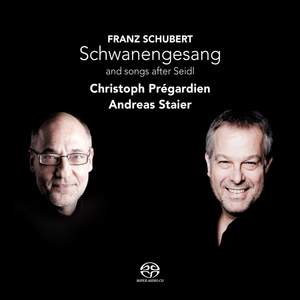
Schubert - Schwanengesang & Songs After Seidl

Schubert - Schwanengesang & Songs After Seidl


Schubert:

Herbst, D945

Schwanengesang, D957

Sehnsucht D879

Die Taubenpost, D965A (D957 No. 14)

Am Fenster, D878

Bei dir allein, D866/2

Der Wanderer an den Mond D870 (Seidl)

Das Zugenglocklein D871 (Seidl)

Im Freien D880


Christoph Prégardien (tenor) & Andreas Staier (fortepiano)

The eminent lyric tenor Christoph Prégardien is represented on disc with more than a hundred and twenty titles. His recordings of the German Romantic Lied repertoire have been highly acclaimed by public and press alike and have received many major international awards. He recently began a new long-term collaboration with Challenge Classics, the first fruit of which was a recording of Schubert’s “Schöne Müllerin” with pianist Michel Gees, (CC72292).

On this recording of another of Schubert’s great lieder cycles, “Schwanengesang”, he is joined by the highly-regarded pianist Andreas Staier.

Written in August 1828 shortly before his death, the 14 songs by Franz Schubert given the collective title of “Schwanengesang” by his publisher Tobias Haslinger are in reality made up of two sets. There are seven songs on texts by Ludwig Rellstab and six on texts by Heinrich Heine in a common manuscript along with a single Lied, Die Taubenpost, on a poem by his friend Gabriel Seidl (D 965 A). Die Taubenpost is perhaps Schubert’s last song, possibly even his last complete composition of all, although Der Hirt auf dem Felsen was apparently also written in October 1828. The Viennese poet Gabriel Seidl was the source of a whole series of poetic texts that Schubert set to music between 1826 and 1828. Some of these were solo lieder and some were polyphonic songs.

“…an outstanding performance. …deeply engaged robustly expressive singing whose rhythmic rigour and details of phrasing and articulation reveal an exciting commitment to this great cycle. …with Staier's fortepiano providing a wonderful mixing and misting of the tonal palette in songs like 'Die Stadt', the performances are also graced with an exceptionally lively and well-balanced recording.” BBC Music Magazine, January 2009 *****

“Prégardien's dulcet tenor, subtly and gracefully deployed, is heard to advantage both in these Seidl songs and in Schwanengesang. Where so many singers seem to "think" the whole collection in the minor key, as it were, Prégardien is eagerly expectant in "Liebesbotschaft" and sings a smiling, seductive "Fischermädchen". ..."Abschied" is blithely insouciant, the wistfulness of the final verse lightly touched - and how well the delicate, slightly veiled sonorities of Staier's fortepiano complement the voice, here and elsewhere. While it is absurd to speak of an outright "winner" in such a crowded field, Prégardien and the ever-illuminating Staier join Schreier, Hotter, (EMI, 10/94) Fischer-Dieskau, 1962 vintage (EMI) and Brigitte Fassbaender (DG) on my roster of indispensable Schwanengesang recordings.” Gramophone Magazine, April 2009

“Planning a CD programme around Schwanengesang is always tricky. The vastly experienced duo of Christoph Prégardien and Andreas Staier here come up with a solution as satisfying as any.
They preface the quasi-cycle with the bleak, windswept Rellstab setting Herbst, which Schubert unaccountably omitted from the Rellstab sequence that opens Schwanengesang. Then, at they end, they follow Die Taubenpost – always in danger of jarring after the Weltschmerz of the Heine group – with other, complementary, Seidl settings, ending with the blissful nocturnal homecoming of Im Freien.
Prégardien's dulcet tenor, subtly and gracefully deployed, is heard to advantage both in these Seidl songs and in Schwanengesang. Where so many singers seem to 'think' the whole collection in the minor key, as it were, Prégardien is eagerly expectant in 'Liebesbotschaft' and sings a smiling, seductive 'Fischermädchen'. His 'Ständchen', taken at an easy, mobile tempo, is likewise all caressing charm, while 'Abschied' is blithely insouciant, the wistfulness of the final verse lightly touched – and how well the delicate, slightly veiled sonorities of Staier's fortepiano complement the voice, here and elsewhere.
In the anguished Heine songs Prégardien's less extreme style than, say, Peter Schreier, is scarcely less moving, whether in the rhythmically incisive 'Der Atlas' (where the fortepiano's percussive resonance brings uncommon clarity to Schubert's quasi-orchestral textures), or an 'Am Meer' of aching tenderness, the final stab of pain all the more affecting for being understated.
'Die Stadt', taken at an unusually urgent tempo, emerges in a single grim sweep, with the fortepiano's sustaining pedal creating a mysterious haze impossible to replicate on a modern grand.
Prégardien occasionally adds discreet, graceful embellishments to his lines, especially apt in 'Ständchen'. While it is absurd to speak of an outright 'winner' in such a crowded field, Prégardien and the ever-illuminating Staier join the roster of indispensable Schwanenengesang recordings.”
Gramophone Classical Music Guide, 2010

GGramophone Magazine

Editor's Choice - April 2009

Super Audio CD

Format:

Hybrid Multi-channel

Challenge Classics - CC72302

(SACD)

$20.75

Usually despatched in 4 - 5 working days.

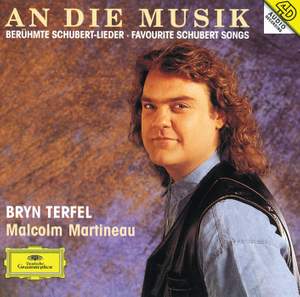
Schubert - An Die Musik

Schubert - An Die Musik


Schubert:

Gruppe aus dem Tartarus, second version, D583 (Schiller)

Litanei auf das Fest Allerseelen, D343

An die Leier, D737 (Bruchmann)

Die Forelle, D550

Lachen und Weinen, D777

Ständchen 'Leise flehen meine Lieder', D957 No. 4

Das Fischermädchen D957 No. 10

Die Taubenpost, D965A (D957 No. 14)

Meeres Stille, D216, Op. 3 No. 2 (Goethe)

Der Wanderer, D493

Erlkönig, D328

Der Tod und das Mädchen, D531

Heidenröslein, D257

Wandrers Nachtlied II 'Über allen Gipfeln ist Ruh', D768

An die Musik D547

Auf der Bruck, D853

Schäfers Klagelied, D121 (Goethe)

An Sylvia, D891

Du bist die Ruh D776 (Rückert)

An die Laute D905

Rastlose Liebe, D138

Ganymed, D544 (Goethe)

Der Musensohn, D764 (Goethe)


Bryn Terfel (bass-baritone), Malcolm Martineau (piano)

“Terfel's gift […] is a generous, individual voice, a natural feeling for German and an inborn ability to go to the heart.” Gramophone Magazine

“one of his first recordings to confirm his exceptional gift of projecting his magnetic personality with keen intensity...[he] is daring in confronting you face to face, very much as the young Fischer-Dieskau did, using the widest range of dynamics and tone.” Penguin Guide, 2010 edition ***

DG Grand Prix - 4776358

(CD)

$11.50

(Sorry, download not available in your country)

Usually despatched in 2 - 3 working days.

Schubert: Lieder Collection

Schubert: Lieder Collection


Schubert:

An die Musik D547

An Schwager Kronos, D369

Nähe des Geliebten, D162

Erlkönig, D328

Ganymed, D544 (Goethe)

Wandrers Nachtlied II 'Über allen Gipfeln ist Ruh', D768

Jägers Abendlied, Second Setting, D368

Prometheus, D674 (Goethe)

Liebesbotschaft, D957 No.1

Der Atlas, D957 No. 8

Ihr Bild, D957 No. 9

Die Stadt, D957 No. 11

Am Meer, D 957 No. 12

Die Taubenpost, D965A (D957 No. 14)


Dietrich Fischer-Dieskau (baritone), Hertha Klust (piano), Günther Weissenborn (piano)

Recorded Köln 1954

Historical Recordings - up to 25% off

Audite - AUDITE95583

(CD)

Normally: $15.50

Special: $12.40

Usually despatched in 3 - 4 working days.

Page: 

 1   2 

 Next >>

Copyright © 2002-13 Presto Classical Limited, all rights reserved.