This page lists all recordings of Symphony No. 3, by Arvo Pärt (b.1935) on CD, SACD & download (MP3 & FLAC). Generally, more recent releases are listed first, but with priority given to those that are in stock. |
Prices shown exclude VAT. (UK tax is not payable for deliveries to United States.) See Terms & Conditions for p&p rates. | |  | Arvo Pärt: CantiqueLimited Edition
| | | In stock - usually despatched within 1 working day. |
|
|
| |  |
“With Arvo Pärt the terms of comparison normally used for focusing differences between this or that recording tend to fall redundant. Pärt's mature music responds most readily to luminous textures, carefully timed silences and mastery of line, and only rarely to the more subjective impulses of dramatic conducting. Järvi's performance of the first movement suggests urgent parallels with the fraught confrontations in Nielsen's Fifth. And there's more than a hint of 'the spring water purity of Sibelius's Sixth Symphony' in the finale. Everywhere one senses the hovering spectre of early music, but this Third Symphony is the ideal stepping stone for first-timers who wish to journey from standard symphonic fare to Pärt's cloistered tintinnabulation. The more familiar tintinnabulation pieces work very well, with Järvi opting in the Cantus and Festina lente for warmer textures than some rivals, which usefully underlines Pärt's quietly cascading harmonies. There are those who will still prefer a more chaste sonority, the sort favoured on virtually all the ECM productions. But Paavo Järvi's more central approach will appeal to those who until now have heard in Pärt's music ascetic denial rather than quiet affirmation. Recommended.” Gramophone Classical Music Guide, 2010 | | | In stock - usually despatched within 1 working day. |
|
|
| |  | Arvo Pärt: Cantique
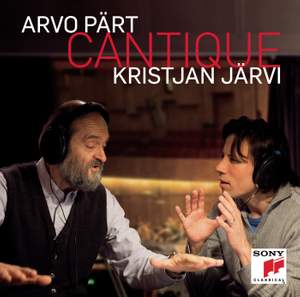
New York, NY—Sony Classical is pleased to announce a new, exclusive multi-album recording agreement with the dynamic the Estonian-born and American-raised conductor Kristjan Järvi. The new relationship launches with the September 6 (UK and worldwide) and September 14 (US) release of Cantique, featuring the music of iconic Estonian composer Arvo Pärt in celebration of his 75th birthday. Järvi leads the Rundfunk Sinfonie-Orchester Berlin and the RIAS Kammerchor. Cantique includes Pärt’s 1971 masterpiece, Symphony No. 3, plus the world premiere recordings of the orchestral and choral version of his Stabat mater (1985/2008) and Cantique des degrès (1999/2002) for choir and orchestra. The album was produced by Florian Schmidt and recorded at Haus des Rundfunks in Berlin in February 2010. Cantique represents the culmination of a lifelong friendship between Kristjan Järvi and Arvo Pärt, which has been shaped as much by their shared personal history as their shared musical life. The Järvi and Pärt families have been friends since the 1960s, when Kristjan’s father Neeme Järvi and Arvo Pärt worked together at Estonian Radio – Neeme Järvi as the conductor of the Estonian Radio and Television Symphony Orchestra, and Pärt as a recording engineer. Both families chose to emigrant from Estonia in 1980 because of continuing struggles with Soviet officials, and settled in Vienna within days of each other. Initially, they stayed at the same convent there, which was a stop for refugees. Though the Pärt family remained in Vienna, later relocating to Berlin, and the Järvis moved to the United States, the families have remained close throughout the decades. Their musical lives have remained intertwined over the years, and have crossed generations. Pärt’s Symphony No. 3 is a major symphonic masterpiece of the late 20th century and is dedicated to Neeme Järvi. In 2008, when Kristjan Järvi was the music director of the Tonkünstler-Orchester Niederösterreich in Vienna, he commissioned an orchestral and choral version of Pärt’s Stabat mater, originally written for soprano, alto, and tenor, with string trio. Järvi premiered it with that orchestra at the Großen Musikvereinssaal during the Wiener Festwochen, with Pärt in attendance. For both men, it was a moving experience to premiere the work in the city to which they both originally came as refugees. The orchestra – Rundfunk Sinfonie-Orchester Berlin – is one with which Kristjan Järvi has collaborated for more than a decade, and hails from Berlin, Pärt’s home for many years outside of Estonia. “a kinetic force on the podium” The New York Times on Kristjan Järvi “[The Stabat Mater is] an entrancing example of his "tintinnabulist" style, with arpeggiating vocal lines over another sustained vocal pitch.” The Independent, 17th September 2010 **** “Järvi has a sure feel for the music's disconcerting contrasts, of almost academic bicinia and heart-on-sleeve pseudo-Tchaikovsky...the orchestral sound is luscious and no subtlety missed: an important disc for any admirer of the composer.” Gramophone Magazine, Awards Issue 2010 “Järvi's Berlin choral and orchestral forces meet this nerve-stretching challenge superbly, achieving a vivid focus that ideally suits the music's sense of visionary concentration...And under Järvi's incisive direction, the three-movement Third Symphony comes across as [a] work of real power and drama.” Classic FM Magazine, December 2010 **** | | | Usually despatched in 3 - 4 working days. |
|
|
| |  |
| | | Usually despatched in 8 - 10 working days. |
|
|
| |  |
| | | (also available to download from $10.50) | Usually despatched in 2 - 3 working days. (Available now to download.) |
|
|
| |  | Pärt: Tabula Rasa
“The three works on this outstanding recording are representative of the three main styles through which Part (b. 1935) has progressed. Collage (1964) marks the Estonian composer's first true voice, as he eschewed his student experiments with pointillism and aleatoricism in favour of baroque and classical forms. Symphony No. 3 (1971), sumptuously accomplished here by Yuasa and the Ulster Orchestra, dates from his transitional period and the influence of medieval and Renaissance music.
"The highlight, both in terms of composition and performance, is Part's seminal 1977 composition Tabula Rasa which led to the development of his current 'tintinnabuli' style of writing. This beautifully lyrical but virtuosic concerto-style work for two violins, string orchestra and prepared piano is executed with elegance and precision by soloists Hirsch and Hatfield, accompanied by the accustomed warmth of the orchestra.” The Independent, 24th December 2000 | | | (also available to download from $6.00) | Usually despatched in 2 - 3 working days. (Available now to download.) |
|
|
| |
|