Wolf, H: Geh' Geliebter, geh' jetzt (No. 34 from Spanisches Liederbuch: Weltliche Lieder)

This page lists all recordings of Geh' Geliebter, geh' jetzt (No. 34 from Spanisches Liederbuch: Weltliche Lieder), by Hugo Wolf (1860-1903) on CD & download (MP3 & FLAC). Generally, more recent releases are listed first, but with priority given to those that are in stock.

Prices shown exclude VAT. (UK tax is not payable for deliveries to United States.)
See Terms & Conditions for p&p rates.

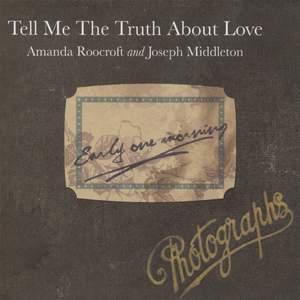
Tell me the truth about love…

Tell me the truth about love…


Barber, S:

Rain has fallen

Boulanger, L:

Vous m'avez regardé avec toute votre âme

Brahms:

Wir wandelten, wir zwei zusammen Op. 96/2

Am Sonntag Morgen Op. 49 No. 1

Du sprichst, daß ich mich täuschte, Op. 32 No. 6

Bridge:

Adoration, H 57

Chausson:

Le Charme, Op. 2 No. 2 (Silvestre)

Copland:

Heart we will forget him

Debussy:

La chevelure

Dunhill:

The Cloths of Heaven, Op. 30/3

Fauré:

Fleur jetée, Op. 39 No. 2

Grieg:

Jeg Elsker Deg, Op. 41 No. 3

Hahn, R:

Infidélité

Ireland:

The Trellis

Loewe, C:

Ich kann's nicht fassen, nicht glauben, Op. 60 No. 3

Marx:

Und gestern hat er mir Rosen gebracht

Quilter:

Love's Philosophy, Op. 3 No. 1 (Shelley)

Rachmaninov:

Summer nights Op.14 No. 5

Schoenberg:

Warnung, Op. 3 No. 3

Schubert:

Du liebst mich nicht D756 (Platen)

Schumann:

Seit ich ihn gesehen (No. 1 from Frauenliebe und Leben, Op. 42)

Strauss, R:

Nachtgang Op. 29 No. 3

Weill, K:

Je ne t'aime pas (text: Maurice Magre)

Wieniawska:

En sourdine

Wolf, H:

O wär dein Haus durchsichtig wie ein Glas

Geh' Geliebter, geh' jetzt (No. 34 from Spanisches Liederbuch: Weltliche Lieder)


Amanda Roocroft (soprano) & Joseph Middleton (piano)

Some say love's a little boy,

And some say it's a bird,

Some say it makes the world go around,

Some say that's absurd…

W.H. AUDEN

Charting the course of a love affair – in song – through the eyes of a young woman who begins by asking the universal question, Tell me the truth about love presents a programme of 19th and 20th century song.

The album takes its title from Benjamin Britten’s 1938 seductive setting of W.H. Auden’s amusing poem and tries to pin down and define the most elusive of human emotions.

The story takes us from love at first sight with Schumann’s Seit ich ihn gesehen, breathless with wonder and fervent reverance and Chausson’s Le charme which describes the quiver of excitement and the tender veneration the girl feels when the boy’s smile catches her unawares to Loewe’s Ich kann’s nicht fassen, nicht gluben to describe the lovers first encounter.

As the love story unfolds and the couple become closer, it is illustrated with music such as Strauss’s Nachtgang, Rachmaninov’s Midsummer nights and Bridge’s Adoration. However the magic is soon broken and Sunday brings deception and betrayal. The girl finds out that the young man does not love her and she bitterly awakes from her dream. The feeling of love lost is brought to life through Brahm’s Am Sonntag Morgen, Schubert’s Du liebst mich nicht and Kurt Weill’s Je ne t’aime pas.

As a postlude, Britten’s arrangement of Early one morning perfectly sums up the story of the young girl and the final message of ‘how could you use a poor maiden so?’ lingers in the ear.

Amanda Roocroft has secured an international reputation as one of Britain’s most exciting singers, in opera, concert and recital and Joseph Middleton enjoys a busy and varied career as a chamber musician and song accompanist.

“Roocroft is impassioned in outgoing songs such as Bridge's ecstatic 'Adoration', where accompanist Joseph Middleton is really able to let himself go, but she can sound strained elsewhere...The choice of songs, though, is its own strong selling point.” Gramophone Magazine, June 2013

Champs Hill Records - CHRCD040

(CD)

$15.00

In stock - usually despatched within 1 working day.

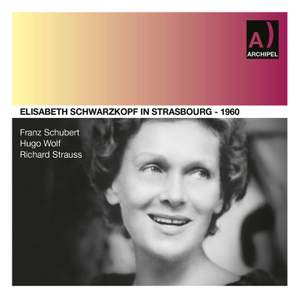
Elisabeth Schwarzkopf in Strasbourg 1960

Elisabeth Schwarzkopf in Strasbourg 1960


Mahler:

Wo die schönen Trompeten blasen (Des Knaben Wunderhorn)

Ich atmet' einen linden Duft (Rückert-Lieder)

Ich bin der Welt abhanden gekommen (Rückert-Lieder)

Recorded on 29th May 1960 in Vienna

Wiener Philharmoniker, Bruno Walter

Schubert:

An die Musik D547

Auf dem Wasser zu singen, D774

Fischerweise, D881 (Schlechta)

Rosamunde, D797: Romance 'Der Vollmond Strahlt auf Bergeshöh'n'

Liebe schwarmt auf allen Wegen, D239 No. 6 (Goethe)

Der Einsame, D800

Seligkeit D433 (Holty)

Du bist die Ruh D776 (Rückert)

Strauss, R:

Freundliche Vision, Op. 48 No. 1

Ruhe, meine Seele!, Op. 27 No. 1

Zueignung, Op. 10 No. 1

Schlechtes Wetter, Op. 69 No. 5

Wolf, H:

Herr, was trägt der Boden hier (from Spanisches Liederbuch)

St Nepomuks Vorabend (No. 20 from Goethe-Lieder)

Gebet; Nun lass uns Frieden schliessen

In dem Schatten meiner Locken (No. 2 from Spanisches Liederbuch: Weltliche Lieder)

Wiegenlied im Sommer (from Sechs Lieder für eine Frauenstimme)

Geh' Geliebter, geh' jetzt (No. 34 from Spanisches Liederbuch: Weltliche Lieder)

Mausfallen-Sprüchlein (from Lieder für eine Frauenstimme)


Elisabeth Schwarzkopf (soprano) & Jacqueline Bonneau (piano)

The legendary Elisabeth Schwarzkopf performs a recital of songs (recorded on 15th June) by Schubert, Wolf and Richard Strauss. The bonus is three songs by Mahler, performed with the Vienna Philharmonic, also recorded in 1960.

Historical Recordings - up to 25% off

Archipel Records - ARPCD0522

(CD)

Normally: $8.25

Special: $6.84

Usually despatched in 2 - 3 working days.

Lisa Della Casa sings Brahms, Schubert, Strauss, Wolf & Schumann

Lisa Della Casa sings Brahms, Schubert, Strauss, Wolf & Schumann


Brahms:

Wie Melodien zieht es mir, Op. 105 No. 1

Immer leiser wird mein Schlummer, Op. 105 No. 2

Von ewiger Liebe, Op. 43 No. 1

Ständchen, Op. 106 No. 1

Schubert:

Auf dem Wasser zu singen, D774

Im Frühling, D882

Du bist die Ruh D776 (Rückert)

Gretchen am Spinnrade, D118

Schumann:

Frauenliebe und -leben, Op. 42

Strauss, R:

Einerlei, Op. 69 No. 3

Ich wollt ein Sträusslein binden, Op. 68 No. 2

Schlechtes Wetter, Op. 69 No. 5

Befreit, Op. 39 No. 4

Wolf, H:

Der Gärtner (No. 17 from Mörike-Lieder)

Begegnung (No. 8 from Mörike-Lieder)

Geh' Geliebter, geh' jetzt (No. 34 from Spanisches Liederbuch: Weltliche Lieder)

Er ist's (No. 6 from Mörike-Lieder)


Lisa Della Casa (soprano), Karl Hudez & Sebastian Peschko (piano accompaniments)

Recorded 1957 & 1962

Testament - SBT1341

(CD)

$16.00

Usually despatched in 4 - 5 working days.

Janet Baker

Janet Baker


Haydn:

Arianna a Naxos, cantata, Hob.XXVIb/2

Schubert:

Der blinde Knabe D833

Totengräberweiss D869 (Schlechta)

Schumann:

Frauenliebe und -leben, Op. 42

Meine Rose, Op. 90 No. 2

Der Page, Op. 30 No. 2

Strauss, R:

Heimliche Aufforderung, Op. 27 No. 3

Morgen, Op. 27 No. 4

Befreit, Op. 39 No. 4

Wolf, H:

Geh' Geliebter, geh' jetzt (No. 34 from Spanisches Liederbuch: Weltliche Lieder)

Die ihr schwebet (No. 4 from Spanisches Liederbuch: Geistliche Lieder)


Janet Baker (mezzo), Paul Hamburger (piano), John Constable (piano), Geoffrey Parsons (piano)

“Although recorded on three separate occasions, and with different accompanists, this programme is fairly typical of the recitals that Dame Janet gave in the late 1960s and early 70s when she was at the absolute peak of her form. She probably wouldn't have opened with the Haydn, reserving it usually as the final item in the first half, an operatic climax to work towards. She recorded it later with Raymond Leppard, but this live version has a wonderful sense of intimacy. The recording is first rate, with marvellous presence; Baker has that ability to invest a simple phrase in the first recitative such as 'la face splenda del nostro amor' with unforgettable poignancy. In the second part, as Ariadne rails against her fate, she allows herself an almost verismo–like outburst at 'ei qui lascia in abbandono'. This cantata can sometimes seem a bit heavyweight on a recital programme, but as Baker sings it seems to grows in beauty and intensity.
Frauenliebe und –leben was the work that brought Baker early fame as a recording artist, in her recital for Saga. Later she recorded it again for EMI with Barenboim. This recording from 1968, accompanied by Geoffrey Parsons, finds her in luxurious full voice, revelling in each successive melody. It isn't preferable to the earlier Saga version with Isepp, but here she lets herself go more at certain key moments such as 'O lass im Traüme' in the third song. This cycle belonged to Janet Baker, and with the single exception of Sena Jurinac, there just isn't a singer to equal her in it.
The songs recorded in the studio with Paul Hamburger include two by Wolf, not available anywhere else in Baker's discography. 'Geh' Geliebter' is sung with typical ardour. The two Schubert and Schumann songs are fresh and lively, but it's the Strauss group that has the highest voltage. Heimliche Aufforderung doesn't really suit her, with its intoxicated ardour, but Morgen is a superb example of that hushed, rapt quality that was one of the characteristic joys of Baker's art. The final song, Befreit, achieves a dramatic thrust that suggests the theatre in the best possible sense. Admirers who already possess Baker's other versions of this material shouldn't be deterred – this is a splendid souvenir of her in the full glory of her prime. Newcomers to Baker's singing – there can't be many people under 30 who heard her live – are in for a treat.”
Gramophone Classical Music Guide, 2010

Building a Library

First Choice - June 2003

Historical Recordings - up to 25% off

BBC Legends - Singers - BBCL40492

(CD)

Normally: $15.50

Special: $11.62

(also available to download from $10.75)

Usually despatched in 2 - 3 working days. (Available now to download.)

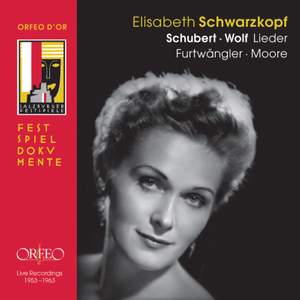
Elisabeth Schwarzkopf sings Schubert & Wolf

Elisabeth Schwarzkopf sings Schubert & Wolf


Schubert:

Vedi quanto adoro (Didone abbandonata) D510A (Metastasio)

13th August 1960

with Gerald Moore (piano)

Wandrers Nachtlied I 'Der du von dem Himmel bist', D224

13th August 1960

with Gerald Moore (piano)

Auf dem Wasser zu singen, D774

13th August 1960

with Gerald Moore (piano)

Die Liebe hat gelogen D751 (Platen)

13th August 1960

with Gerald Moore (piano)

Seligkeit D433 (Holty)

13th August 1960

with Gerald Moore (piano)

Der Einsame, D800

13th August 1960

with Gerald Moore (piano)

Die Vogel D691

13th August 1960

with Gerald Moore (piano)

Das Lied im Grünen, D917

13th August 1960

with Gerald Moore (piano)

Rosamunde, D797: Romance 'Der Vollmond Strahlt auf Bergeshöh'n'

13th August 1960

with Gerald Moore (piano)

Gretchen am Spinnrade, D118

13th August 1960

with Gerald Moore (piano)

Du bist die Ruh D776 (Rückert)

13th August 1960

with Gerald Moore (piano)

An Sylvia, D891

13th August 1960

with Gerald Moore (piano)

An mein Klavier D342 (Schubart)

13th August 1960

with Gerald Moore (piano)

Liebe schwarmt auf allen Wegen, D239 No. 6 (Goethe)

13th August 1960

with Gerald Moore (piano)

Ganymed, D544 (Goethe)

13th August 1960

with Gerald Moore (piano)

Nähe des Geliebten, D162

13th August 1960

with Gerald Moore (piano)

Fischerweise, D881 (Schlechta)

13th August 1960

with Gerald Moore (piano)

Wiegenlied, D498

13th August 1960

with Gerald Moore (piano)

An die Musik D547

13th August 1960

with Gerald Moore (piano)

Heidenröslein, D257

13th August 1960

with Gerald Moore (piano)

Ungeduld (No. 7 from Die schöne Müllerin, D795)

(encore) 7th August 1956

with Gerald Moore (piano)

Wolf, H:

Die Spröde (No. 26 from Goethe-Lieder)

12th August 1953

with Wilhelm Furtwängler (piano)

Phänomen (No. 32 from Goethe-Lieder)

12th August 1953

with Wilhelm Furtwängler (piano)

Epiphanias (No. 19 from Goethe-Lieder)

12th August 1953

with Wilhelm Furtwängler (piano)

Blumengruss (No. 24 from Goethe-Lieder)

12th August 1953

with Wilhelm Furtwängler (piano)

Anakreons Grab (No. 29 from Goethe-Lieder)

12th August 1953

with Wilhelm Furtwängler (piano)

Die Bekehrte (No. 27 from Goethe-Lieder)

12th August 1953

with Wilhelm Furtwängler (piano)

Ganymed (No. 50 from Goethe-Lieder)

27th July 1958

with Gerald Moore (piano)

Frühling übers Jahr (No. 28 from Goethe-Lieder)

27th July 1958

with Gerald Moore (piano)

Der Schäfer (No. 22 from Goethe-Lieder)

27th July 1958

with Gerald Moore (piano)

Philine (No. 8 from Goethe-Lieder)

27th July 1958

with Gerald Moore (piano)

Im Frühling (No. 13 from Mörike-Lieder)

12th August 1953

with Wilhelm Furtwängler (piano)

Elfenlied (No. 16 from Mörike-Lieder)

12th August 1953

with Wilhelm Furtwängler (piano)

Lebe wohl (No. 36 from Mörike-Lieder)

12th August 1953

with Wilhelm Furtwängler (piano)

Schlafendes Jesuskind (No. 25 from Mörike-Lieder)

12th August 1953

with Wilhelm Furtwängler (piano)

Der Genesene an die Hoffnung (No. 1 from Mörike-Lieder)

19th August 1957

with Gerald Moore (piano)

Auf eine Christblume I (No. 20 from Mörike-Lieder)

27th July 1958

with Gerald Moore (piano)

In der Frühe (No. 24 from Mörike-Lieder)

17th August 1963

with Gerald Moore (piano)

An den Schlaf (No. 29 from Mörike-Lieder)

17th August 1963

with Gerald Moore (piano)

Ein Stündlein wohl vor Tag (No. 3 from Mörike-Lieder)

17th August 1963

with Gerald Moore (piano)

Nimmersatte Liebe (No. 9 from Mörike-Lieder)

19th August 1957

with Gerald Moore (piano)

Der Knabe und das Immlein (No. 2 from Mörike-Lieder)

19th August 1957

with Gerald Moore (piano)

Storchenbotschaft (No. 48 from Mörike-Lieder)

19th August 1957

with Gerald Moore (piano)

Lied vom Winde

19th August 1957

with Gerald Moore (piano)

Selbstgeständnis (No. 52 from Mörike-Lieder)

19th August 1957

with Gerald Moore (piano)

Mausfallen-Sprüchlein (from Lieder für eine Frauenstimme)

27th July 1958

with Gerald Moore (piano)

Nachtzauber (No. 8 from Eichendorff-Lieder)

12th August 1953

with Wilhelm Furtwängler (piano)

Die Zigeunerin (No. 7 from Eichendorff-Lieder)

12th August 1953

with Wilhelm Furtwängler (piano)

Tretet ein, hoher Krieger

27th July 1958

with Gerald Moore (piano)

Singt mein Schatz wie ein Fink

27th July 1958

with Gerald Moore (piano)

Du Milchjunger Knabe

27th July 1958

with Gerald Moore (piano)

Wandl' ich in dem Morgentau

27th July 1958

with Gerald Moore (piano)

Das Köhlerweib ist trunken

27th July 1958

with Gerald Moore (piano)

Wie Glanzet der Helle Mond

27th July 1958

with Gerald Moore (piano)

Mühvoll komm ich und beladen (No. 7 from Spanisches Liederbuch: Geistliche Lieder)

19th August 1957

with Gerald Moore (piano)

Herr, was trägt der Boden hier (from Spanisches Liederbuch)

19th August 1957

with Gerald Moore (piano)

Bedeckt mich mit Blumen (No. 26 from Spanisches Liederbuch: Weltliche Lieder)

27th July 1958

with Gerald Moore (piano)

Wer tat deinem Füßlein weh? (No. 30 from Spanisches Liederbuch: Weltliche Lieder)

19th August 1957

with Gerald Moore (piano)

Klinge, klinge, mein Pandero (No. 1 from Spanisches Liederbuch: Weltliche Lieder)

19th August 1957

with Gerald Moore (piano)

Sie blasen zum Abmarsch (No. 28 from Spanisches Liederbuch: Weltliche Lieder)

19th August 1957

with Gerald Moore (piano)

Wehe Der, Die Mir Verstrickte

19th August 1957

with Gerald Moore (piano)

Trau nicht der Liebe (No. 67 from Spanisches Liederbuch: Weltliche Lieder)

17th August 1963

with Gerald Moore (piano)

Mögen alle bösen Zungen (No. 13 from Spanisches Liederbuch: Weltliche Lieder)

19th August 1957

with Gerald Moore (piano)

In dem Schatten meiner Locken (No. 2 from Spanisches Liederbuch: Weltliche Lieder)

19th August 1957

with Gerald Moore (piano)

Geh' Geliebter, geh' jetzt (No. 34 from Spanisches Liederbuch: Weltliche Lieder)

19th August 1957

with Gerald Moore (piano)

Wie lange schon war immer mein Verlangen (No. 11 from Italienisches Liederbuch)

12th August 1953

with Wilhelm Furtwängler (piano)

Was soll der Zorn, mein Schatz, der dich erhitzt? (No. 32 from Italienisches Liederbuch)

12th August 1953

with Wilhelm Furtwängler (piano)

Nein, junger Herr, so treibt man’s nicht, fürwahr (No. 12 from Italienisches Liederbuch)

12th August 1953

with Wilhelm Furtwängler (piano)

Mein Liebster hat zu Tische mich geladen (No. 25 from Italienisches Liederbuch)

12th August 1953

with Wilhelm Furtwängler (piano)

Wer rief dich denn? Wer hat dich herbestellt?

19th August 1957

with Gerald Moore (piano)

Gebet; Nun lass uns Frieden schliessen

19th August 1957

with Gerald Moore (piano)

Ich esse nun mein Brot nicht trocken mehr

19th August 1957

with Gerald Moore (piano)

Nein, junger Herr, so treibt man’s nicht, fürwahr (No. 12 from Italienisches Liederbuch)

19th August 1957

with Gerald Moore (piano)

O wär dein Haus durchsichtig wie ein Glas

19th August 1957

with Gerald Moore (piano)

Du sagst mir, dass ich keine Fürstin sei

19th August 1957

with Gerald Moore (piano)

Schweig' einmal still (No. 43 from Italienisches Liederbuch)

19th August 1957

with Gerald Moore (piano)

Verschling der Abgrund meines Liebsten Hütte

19th August 1957

with Gerald Moore (piano)

Ich hab in Penna einen Liebsten (No. 46 from Italienisches Liederbuch)

19th August 1957

with Gerald Moore (piano)


Orfeo's Salzburg series finds its culmination in a group of songs by Hugo Wolf and Franz Schubert that Elisabeth Schwarzkopf sang between 1953 and 1963, with accompanists Wilhelm Furtwängler and Gerald Moore.

Schwarzkopf’s diction and the manner in which she moulds the text in Wolf’s Spanish and Italian Songbooks have remained a benchmark to the present day, and brought them to attention properly for the first time. She also turned Schubert songs such as Gretchen am Spinnrade into self-contained mini-dramas.

Historical Recordings - up to 25% off

Orfeo - Orfeo d'Or - Salzburger Festspieldokumente - C826103D

(CD - 3 discs)

Normally: $38.75

Special: $32.93

Usually despatched in 3 - 4 working days.

Copyright © 2002-13 Presto Classical Limited, all rights reserved.