All recordingsPrices shown exclude VAT. (UK tax is not payable for deliveries to United States.) See Terms & Conditions for p&p rates. | |  | Régine Crespin in Recital
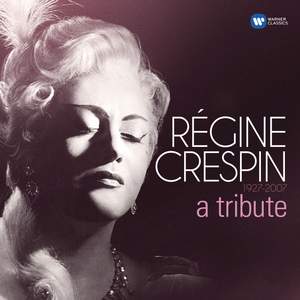
The larger-than-life Régine Crespin, made only one song recital record for Decca, of music by Schumann, Wolf, Debussy and Poulenc. This is the first time the entire recital has been made available on CD. As her career progressed, Crespin became associated with certain roles – Kundry, Sieglinde, Brünnhilde, Tosca, the Marschallin – but she was prodigiously versatile, thanks to her years in the French provinces. An intelligent singer who understood how to make the texts count, Crespin also had tremendous success in non-operatic repertory. Her 1963 Decca recording, with conductor Ernest Ansermet, of Berlioz’s Les Nuits d'été and Ravel’s Shéhérazade, is regarded as among the best available. In its original French, her candid and entertaining autobiography is called La vie et l'amour d'une femme, which is also the French translation of Schumann's song cycle Frauenliebe und -leben. Indeed, Lieder by Schumann and Wolf were important parts of her recital repertory, and she brought the same depth of meaning to their German texts as she did to her Wagnerian roles. Of course French, being her native language, evoked a most immediate and intimate response from this singer. This release marks the launch of an Eloquence series of notable recitals of songs and opera arias by some of the great voices of Decca and Deutsche Grammophon. “Seven songs by Poulenc, in pungent and marvellously characterised performances, form the highlight of this 1967 recital of Crespin in her prime. Her Wolf and Schumann are also irresistable.” BBC Music Magazine, June 2012 **** “It is difficult, indeed I find it impossible, to think of any soprano capable of singing Brünnhilde, as Régine Crespin has done, who is also capable of making a success of such a varied programme as this recital offers, but this she most certainly has achieved from start to finish. […] She has in John Wustman a pianist truly worthy of her, sensitive to every mood and nuance. […] I can give no higher praise to Crespin's singing of Debussy's Chansons de Bililis than to say it does not suffer from comparison with Maggie Teyte's. […]The balance between voice and piano is very good, and so here is everything for our delight. This is, indeed, one of the finest song recitals of recent times and I most warmly and enthusiastically recommend it” Gramophone Magazine | | | In stock - usually despatched within 1 working day. |
|
|
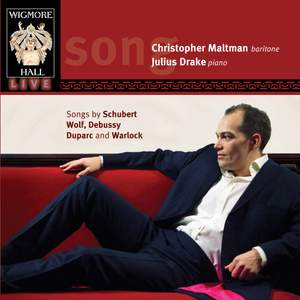
| |  | Christopher Maltman & Julius DrakeSongs by Warlock, Debussy, Duparc, Schubert and Wolf
“It's Maltman's superb breath control which gives shape and sensuous beauty to Debussy and Dupare. And, thanks to Drake's restraining pace, Warlock's Captain Stratton's Fancy' has real swagger. Flanders and Swann's little masterpiece… about the Honeysuckle and the Bindweed, ends the recital in raptuous applause.” BBC Music Magazine, February 2008 **** “Christopher Maltman… is remarkably skilful in the management of his voice, dealing wonderfully well with Debussy's high tessitura and still plumbing the depths with ease as he does at the end of "Der Wanderer" and "La vague et la cloche". Julius Drake is his perfect counterpart...” Gramophone Magazine, Janurary 2008 | | | In stock - usually despatched within 1 working day. |
|
|
| |  | Kathleen Ferrier, Vol. 21949, 1952
| |
|
| |  | Kathleen Ferrier: Arias and Songs1946-1950 Recordings
plus: Bach: St. Matthew Passion, BWV 244, Part II: Aria: Have mercy, Lord, on me (Sung in English)
Kathleen Ferrier was one of the greatest British singers of the 20th century. For ten years she enjoyed an unparallelled career, admired equally for the generous warmth and sincerity of her interpretations as for her uniquely splendid contralto voice. This reissue features twelve arias and songs that Ferrier recorded for Decca between 1946 and 1950. In addition there are eight treasurable items from a 1949 Norwegian Radio recital in Oslo, which include her only published recordings of Hugo Wolf. Mark Obert-Thorn, producer and audio restoration engineer | | | (also available to download from $9.00) | Usually despatched in 2 - 3 working days. (Available now to download.) |
|
|
| |  | Le Lied Romantique
| | | Usually despatched in 4 - 5 working days. |
|
|
| |  | Hugo Wolf: The Complete Songs Volume 1Mörike-Lieder Nos. 1-26
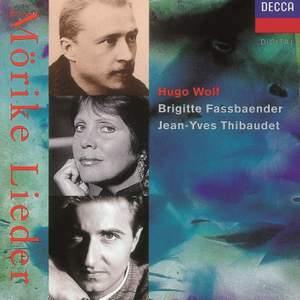
This is the first disc in a series that will be the first ever complete edition of the songs of Hugo Wolf. These performances were recorded live at the Oxford Lieder Festival (in the Holywell Music Room) on 22nd October 2010. “their performances are acutely sensitive to Wolf's musical nerve system. And, best of all, a sense of intimacy, of close confiding with the audience, really does come over - invaluable for private listening...Festival director Sholto Kynoch is a vivid and sentient accompanist.” BBC Music Magazine, September 2011 **** “Grevilius’s mezzo rises to the challenge of “Seufzer” and Daneman’s soprano brings sweetness to “Zitronenfalter im April”.” Financial Times, 25th June 2011 ** “The team of four singers is first-rate, responsive in every way, and if anything even more remarkable is the work of their pianist, Sholto Kynoch, displaying an exceptional expressive range, not only ideally agile but with the most subtle range of tone and dynamic...Altogether an impressive achievement from an enterprising new company.” Gramophone Magazine, January 2011 “Daneman, Grevelius, Gilchrist and Loges are top-flight lieder singers, with Oxford Lieder founder and pianist Sholto Kynoch offering sensitive support. Richard Stokes provides excellent notes and translations.” The Observer, 22nd May 2011 | | | (also available to download from $10.50) | Usually despatched in 2 - 3 working days. (Available now to download.) |
|
|
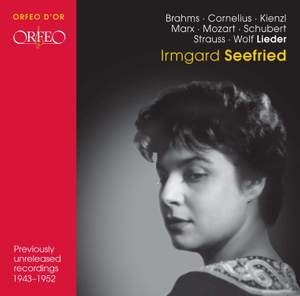
| |  | Irmgard SeefriedVienna 1943-1952
Brahms: | Die Trauernde, Op. 7 No. 5 Immer leiser wird mein Schlummer, Op. 105 No. 2 Nachtigall, Op. 97 No. 1 Wiegenlied, Op. 49 No. 4 (Lullaby) | Cornelius: | Brautlieder | Kienzl: | Maria auf dem Berge Op. 55,3 Mai | Marx: | Marienlied Erinnerung Lied eines Mädchens Zigeuner Sankta Maria | Mozart: | Sehnsucht nach dem Frühlinge, K596 | Schubert: | Die Forelle, D550 | Strauss, R: | Morgen, Op. 27 No. 4 Die Nacht, Op. 10 No. 3 Meinem Kinde, Op. 37 No. 3 Du meines Herzens Krönelein, Op. 21 No. 2 Ruhe, meine Seele!, Op. 27 No. 1 Allerseelen, Op. 10 No. 8 Schlagende Herzen Op. 29 No. 2 | Wolf, H: | Das verlassene Mägdlein (No. 7 from Mörike-Lieder) Der Gärtner (No. 17 from Mörike-Lieder) Im Frühling (No. 13 from Mörike-Lieder) |
Irmgard Seefried’s interpretation of the Composer in Strauss's Ariadne auf Naxos is said to have inspired Strauss himself to exclaim that until then he had not known how good his Composer was. She was also one of the most sought-after concert singers and lieder recitalists of her age. Not released until now, the many recordings included in the present CD attest to the richness and variety of that palette even during the early years of her career. The earliest of these recordings are Peter Cornelius's Brautlieder from the heyday of the Romantic art song, settings in which the soprano's exemplary treatment of the words and the vocal line are fully in evidence.The affinities between this cycle of six songs and the traditional German folksong offer the singer - a native of Swabia - a welcome opportunity to colour her tone even further, an approach that is also found in her recordings of songs by Mozart, Brahms,Wolf and two lesser-known composers, Wilhelm Kienzl and Joseph Marx.This compilation of Irmgard Seefried's recordings from the first ten years of her career in Vienna additionally includes some of Strauss's most popular songs, songs such as Morgen and Allerseelen that make it clear why, as we noted above, their composer held the soprano in such high regard. “A lovely collection: if you had to choose a single disc to represent Seefried in song you could not do better than this...Her personal warmth permeates the voice, and in these recordings one feels it as when she herself was part of our regular musical life half a century ago.” Gramophone Magazine, April 2010 | | | Usually despatched in 3 - 4 working days. |
|
|
| |  | Wolfgang Holzmair & Imogen CooperSongs by Hugo Wolf
Two of the world’s most seasoned Schubertians, both long associated with Wigmore Hall, come together for the next new release from Wigmore Hall Live. Live from Wigmore Hall - 19 February 2008 This recording comprises 26 of the 53 lieder that Wolf wrote on the poems of Eduard Mörike, born just seven years after Schubert in 1804, but outliving the composer nearly five decades. Reviewing the concert in Seen & Heard International stated that: “The partnership between Cooper and Holzmair is so close, it’s almost symbiotic” “Rarely have I heard so sensitive, intelligent and gloriously musical a partnership. No-one could have asked for more attentive, detailed expressions nor more complete harmony of feeling between singer and pianist … I was transfixed by the sheer artistry.” (The Independent) Wolfgang Holzmair is a native of Upper Austria, and the British pianist Imogen Cooper, whose training included a period in Vienna studying with Paul Badura-Skoda, Jörg Demus and Alfred Brendel. “Holzmair is at his best in those settings which reveal the soul's innermost questionings; he and Cooper capture the fragile ardour of 'Frage und Antwort', and the chromatic unease within 'I'm Frühling'.” BBC Music Magazine, December 2009 “…more often pleasure is virtually unalloyed, whether in the trance-like wonder of "Im Frühling", the tiptoeing delicacy of "Elfenlied" (a hard song for a man to bring off) or the deft comic timing in "Zur Warnung", evidently relished by the Wigmore Hall audience.” Gramophone Magazine, February 2010 | | | Usually despatched in 3 - 4 working days. |
|
|
| |  | Lisa Della CasaLive Recording 1957
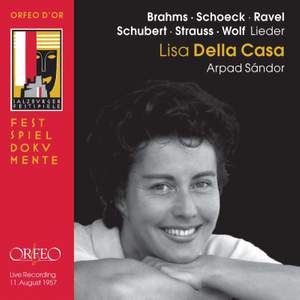
Brahms: | Wie Melodien zieht es mir, Op. 105 No. 1 Feldeinsamkeit, Op. 86 No. 2 Von ewiger Liebe, Op. 43 No. 1 Meine Liebe ist grün, Op. 63 No. 5 | Ravel: | Chanson française Chanson italienne Chanson espagnole | Schoeck: | Sieh' mich Heil'ger, wie ich bin Mit vollen Atemzügen | Schubert: | Lachen und Weinen, D777 Im Frühling, D882 Du bist die Ruh D776 (Rückert) Gretchen am Spinnrade, D118 | Strauss, R: | Der Stern, Op. 69 No. 1 Waldseligkeit, Op. 49 No. 1 Einerlei, Op. 69 No. 3 Befreit, Op. 39 No. 4 Hat gesagt - bleibt's nicht dabei, Op. 36 No. 3 Schlechtes Wetter, Op. 69 No. 5 | Wolf, H: | Der Gärtner (No. 17 from Mörike-Lieder) Er ist's (No. 6 from Mörike-Lieder) |
Although Lisa Della Casa sang in many operas in Salzburg, she gave only a single lieder recital: in 1957 in the Grosser Saal of the Mozarteum, accompanied by the Hungarian pianist Arpad Sándor, esteemed chamber music partner of musicians such as Fritz Kreisler and Jascha Heifetz.Anyone who had not expected lieder to be a speciality of this lyric soprano would soon be disabused: with the incomparable clarity and simplicity of her melodic line and her precise and unaffected articulation, Lisa Della Casa excelled with touchstones of the repertoire by Schubert and Brahms. She also honoured her compatriot Othmar Schoeck (who had died the previous spring) with her performance of two lieder from his new setting of Goethe's singspiel libretto Erwin und Elmire. She also included in her programme three of the Chansons populaires by Ravel, 1957 being the 20th anniversary of his death. Naturally, she concluded her recital with a group of lieder by Richard Strauss, the composer with whose works her name is still most associated.A unique delight made available to the modern audience thanks to this Orfeo recording. | | | Usually despatched in 3 - 4 working days. |
|
|
| |  | Christa Ludwig - Lieder RecitalDirected by Enrique Sánchez Lansch
| | A Master Class with Christa Ludwig, Part II Bonus Directed by Claus Viller | Bernstein: | I Hate Music, a cycle of five 'kid songs' | Mahler: | Ich ging mit Lust (Lieder und Gesänge aus der Jugendzeit) Rheinlegendchen (Des Knaben Wunderhorn) Das irdische Leben (Des Knaben Wunderhorn) Ich bin der Welt abhanden gekommen (Rückert-Lieder) Scheiden und Meiden (Lieder und Gesänge aus der Jugendzeit) | Schubert: | Im Abendrot, D799 Die Forelle, D550 Der Tod und das Mädchen, D531 Geheimnis, D491 (Mayrhofer) Sehnsucht, D636 (Schiller) Der Musensohn, D764 (Goethe) | Strauss, R: | Du meines Herzens Krönelein, Op. 21 No. 2 Begegnung (Meeting), AV 72 Die Nacht, Op. 10 No. 3 Morgen, Op. 27 No. 4 | Wolf, H: | Anakreons Grab (No. 29 from Goethe-Lieder) Der Gärtner (No. 17 from Mörike-Lieder) Bedeckt mich mit Blumen (No. 26 from Spanisches Liederbuch: Weltliche Lieder) In dem Schatten meiner Locken (No. 2 from Spanisches Liederbuch: Weltliche Lieder) Mein Liebster hat zu Tische mich geladen (No. 25 from Italienisches Liederbuch) Wie lange schon war immer mein Verlangen (No. 11 from Italienisches Liederbuch) |
Christa Ludwig is acknowledged as one of the twentieth century’s most explorative and complete vocal artists. Her professional singing career spanned five decades and, as a star of the international operatic stage, she made roles as diverse as Rosina, Dorabella, Cherubino, Leonore, Amneris, Eboli, Kundry, Ortrud, Clytemnestra and the Marschallin her own, excelling in soprano, mezzo and coloratura mezzo repertoire. She also established her reputation as a fine lieder singer. The intimate auditorium of the magnificent neo-baroque Volkstheater in Vienna was packed with a discerning and enthusiastic audience when Christa Ludwig gave a master class there. The intimate auditorium of the magnificent neo-baroque Volkstheater in Vienna was packed with a discerning and enthusiastic audience when Christa Ludwig gave a master class there. The young singers who took part – Valerij Serkin (tenor), Stella Grigorian (mezzo) and Marcus Pelz (baritone) – were all studying at an advanced level, with their sights set on fi nding success as professionals on the operatic stage. Christa Ludwig focused the time she spent with each singer on helping them to find the dramatic truth expressed in the aria of their choice and advising on how they could communicate this in their interpretation. The master class includes pieces by Beethoven, Bizet and Massenet and, at the end, the greatness of her art is recalled as she is seen singing Mistress Quickly in a production of Verdi’s Falstaff (1982). “Filmed in Athens in 1994, this is one of the great German mezzo's final Lieder recitals. With her voice still in fine fettle and her interpretative powers undiminished, it's an impressive token of her artistry.” BBC Music Magazine, July 2009 **** | | | Usually despatched in 2 - 3 working days. |
|
|
| |
|