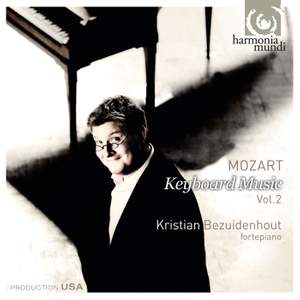
All recordingsPrices shown exclude VAT. (UK tax is not payable for deliveries to United States.) See Terms & Conditions for p&p rates. | |  | Mozart: Keyboard Music Volume 2
Kristian Bezuidenhout (fortepiano) Paul McNulty, Divisov, Czech Republic, 2008; after Anton Walter & Sohn, Vienna, c. 1802; unequal temperament - A = 430 Fortepianist Kristian Bezuidenhout continues his multi-disc survey of Mozart’s music for solo keyboard. Volume 2 features an instrument by Paul McNulty, modelled on a Viennese original by Anton Walter & Sohn (c.1802). Kristian Bezuidenhout was born in South Africa in 1979. He first gained international recognition at the age of 21 after winning the prestigious first prize as well as the audience prize in the Bruges Fortepiano Competition after studying harpsichord with Arthur Haas, fortepiano with Malcolm Bilson and continuo playing and performance practice with Paul O’Dette. During this time he gained experience as a continuo player in Baroque opera productions in the USA and Europe. He is a frequent guest artist with the Freiburger Barockorchester, the Orchestre des Champs-Élysées, Les Arts Florissants, Concerto Köln and Collegium Vocale Gent, in many instances assuming the role of guest director. He has performed with celebrated artists including Philippe Herreweghe, Christopher Hogwood, Daniel Hope and Viktoria Mullova, and he regularly gives Lied recitals with, among others, Carolyn Sampson, Mark Padmore and Jan Kobow. “Bezuidenhout is a prince of the fortepiano, making it sing in melodic phrases as no other practitioner of this intractable instrument has done in my experience.” The Times “This is Mozart rethought, unsanitised and maybe unsettling for some. But as Bezuidenhout implies, we have to move on.” Gramophone Magazine, February 2011 “Bezuidenhout promises great things, and this instalment is superb. The keyboard is perfectly scaled to the music: Bezuidenhout can give the C minor sonata (K457) full force and weight without ever sounding overblown, while the exquisite A minor rondo and B minor adagio have a gentle, unforced eloquence.” The Observer, 16th January 2011 “Any inbuilt resistance to hearing Mozart on a fortepiano rather than a concert grand quickly evaporates as the ear begins to relish the piquant colours and subtle nuances that Bezuidenhout produces...The best of it (K511, 540 and 457) sounds revolutionary while the rest cannot fail to charm.” Classic FM Magazine, February 2011 ***** “Bezuidenhout steers a wonderful, measured course through both works [Rondo and Adagio], but allows himself a bit of freedom in the two sonatas...Both are perfectly proportioned accounts, with every rhythm neatly sprung, and inflected with a splendid range of keyboard touch and colour.” The Guardian, 20th January 2011 **** “There is nothing to fault in the playing, with Bezuidenhout displaying immaculate control of the refinements of tone of a fabulous fortepiano...This is Mozart playing of such intimacy and tenderness, on an instrument able to respond with similar subtlety and nuance” International Record Review, January 2011 “Throughout, Bezuidenhout transcends the apparent limitations of his instrument — a modern copy of a Walter fortepiano — with a remarkable range of colour.” Sunday Times, 30th January 2011 **** “deeply-felt performances of some of the very greatest among the solo keyboard works...these performances leave a strong impression. Among the highlights is Bezuidenhout's expressive account of the tragic A minor Rondo K511. Elsewhere, Bezuidenhout is unfailingly imaginative with his own ornamentation. The reproduction Anton Walter pianos he uses are warm and sonorous.” BBC Music Magazine, April 2011 **** “There have been a few recordings on historical instruments made in recent decades, but Bezuidenhout rivals them all for the breadth of understanding he brings to the music, and his astonishing inflections of colour. He is able to make the fortepiano really sing – such an important aspect of Mozart’s music...this is shaping up to be a truly great cycle that does Mozart’s solo piano music the fullest justice.” bbc.co.uk, 12th April 2011 | | | In stock - usually despatched within 1 working day. |
|
|
| |  | Mozart-Contrasts: Piano Concertos Nos. 12, 13 & 26and piano works in minor keys
Mozart: | Piano Concerto No. 12 in A major, K414 Camerata Bern, Erich Hobarth Piano Concerto No. 13 in C major, K415 Camerata Bern, Erich Hobarth Piano Concerto No. 26 in D major, K537 'Coronation' Camerata Bern, Erich Hobarth Fantasia in D minor, K397 Fantasia in C minor, K475 Piano Sonata No. 8 in A minor, K310 Piano Sonata No. 14 in C minor, K457 Rondo in A minor, K511 Adagio in B minor, K540 |
| | | In stock - usually despatched within 1 working day. |
|
|
| |  | Mozart - Piano Sonatas
Michel Kiener (Piano Forte) | | | In stock - usually despatched within 1 working day. |
|
|
| |  | Mozart: Fantasias & Rondos
Mozart: | Fantasia in D minor, K397 Rondo in D major, K485 Capriccio in C major, KV. 395 Rondo in A minor, K511 March in C Major, K408 Fantasia (Prelude) & Fugue in C major, K394 Fantasia in C minor, K396 Kleiner Trauermarsch in c-moll: 'Marche funebre del Sig.r Maestro Contrapunto', K453a Adagio in B minor, K540 Minuet in D major, K355 Gigue in G Major, K574 Adagio in C major, K356 |
"2006 will surely be full of celebratory concerts and recordings dedicated to a man born 250 years ago… The recital on this disc includes Mozart's structurally more 'free' music for piano: Rondos, Fantasies, and Preludes. He inherited these forms from Johann Sebastian Bach and, perhaps more importantly, through his sons Carl Philipp and Johann Christian. The brooding opening of the great Fantasie in D minor, K397, gives way to a more light-hearted air. This piece has acquired a nineteenth-century editorial ending with no Mozartian provenance - the manuscript is incomplete. I offer an 'egarrtorial' option for the close of this little gem. Mozart originally intended the Fantasie in C minor, K396, to include a part for violin. Too little of this survives to make an adequate reconstruction. However, Abbé Maximilian Stadler (a close friend of Mozart, and a fine and interesting musician in his own right) made an admirable completion of this work for piano solo. Although the second part gives way to fantasy of perhaps a more Schubertian nature, it is an extremely fine working of Mozart's material. The more structured pieces on the disc - the Rondos, Adagios, Marches, Minuett, and Gigue - demonstrate no less imagination and depth of character. I end the programme with the Adagio in C major, K356, originally written for the Glass harmonika. I believe that using a fine original early piano can help us discover a multitude of colours in his music and bring us into Mozart's sound-world. I am very thankful he is still in our world at 250. Happy birthday!" Richard Egarr | | | In stock - usually despatched within 1 working day. |
|
|
| |  | VitusOriginal Motion-Picture Soundtrack
| | | In stock - usually despatched within 1 working day. |
|
|
| |  | Mozart - Richard Goode
“A Mozart programme such as this, which includes two of the greatest sonatas and the A minor Rondo, leaves absolutely no margin for error or insufficiency, nor indeed for anything at all approximate or generalised. It's given to very few to play Mozart as well as Richard Goode, who seems to pitch the rhetoric just right and sustain an ideal balance of strength and refinement. It's quite big playing, and the range of sonority is appropriate to the A minor Sonata, K310, in particular; no other recent recording realises so well the sharp contrasts, the cross-cut abutments of dynamics, which are such a striking feature in all three movements. Goode has a characteristic touch of urgency that has nothing to do with impetuosity or agitation of the surface, but rather with carrying the discourse forward and making us curious about what will happen next. In the presto finale, where Brendel is choppy and rather slow, Goode is exciting and articulate, wonderfully adept at getting from one thing to another. There's little to choose between these players in the composite F major Sonata, K533. Brendel is at his finest in the dark, far-reaching middle movement; both of them relish the challenge of characterising the multifariousness of the first; Goode is especially convincing in the last movement. He gives you the overview, too, often powerfully. While admiring the flux of intensities, dynamics, shapes and colours he sets before you in the Rondo, you might wonder three-quarters of the way through whether the totality was going to achieve enough weight. But the coda is to come – passionate and desolate, a close without parallel in Mozart's instrumental music – and at moments such as this you can be assured that Goode will surprise and certainly not disappoint. The shorter pieces, enterprisingly chosen, set off the great works admirably. Exceptional sound throughout – like the playing, quite out of the ordinary run.” Gramophone Classical Music Guide, 2010 “Goode gives a powerful and intense performance of the A minor Sonata, though one might feel that his tempo for the first movement is on the swift side for Mozart's 'maestoso' marking. …without doubt, this new disc gives a great deal of pleasure.” BBC Music Magazine, June 2005 **** | | | In stock - usually despatched within 1 working day. |
|
|
| |  | Mozart - Favourite Works for Piano
| | | (Sorry, download not available in your country) | In stock - usually despatched within 1 working day. |
|
|
| |  | Mami Shikimori plays Mozart, Brahms & Ravel
Noted for her expressive power and poetic insight, combined with effortless technical ability, Japanese pianist Mami Shikimori has been exciting audiences since first appearing on stage in 1996. Her playing has been described as 'electrifying' and 'a dazzling revelation' by the critics and she has performed at venues including New York's Carnegie Hall, Weill Recital Hall, London's St John's Smith Square and Queen Elizabeth Hall. She also gave a highly-acclaimed solo recital at Tokyo's Suntory Hall. This Claudio debut CD culminates in Ravel's fiendishly difficult La Valse, a transcription by the composer himself. “Shikimori is a strong and sensitive player, excellently so in Brahms's F minor Sonata, and dazzlingly accurate in Ravel's La valse.” BBC Music Magazine, May 2013 **** | | | Usually despatched in 2 - 3 working days. |
|
|
| |  | Mami Shikimori plays Mozart, Brahms & Ravel
Noted for her expressive power and poetic insight, combined with effortless technical ability, Japanese pianist Mami Shikimori has been exciting audiences since first appearing on stage in 1996. Her playing has been described as 'electrifying' and 'a dazzling revelation' by the critics and she has performed at venues including New York's Carnegie Hall, Weill Recital Hall, London's St John's Smith Square and Queen Elizabeth Hall. She also gave a highly-acclaimed solo recital at Tokyo's Suntory Hall. This Claudio debut CD culminates in Ravel's fiendishly difficult La Valse, a transcription by the composer himself. | | | Usually despatched in 2 - 3 working days. |
|
|
| |  | Peter Katin: 50 Years of Music Making
| | | Usually despatched in 4 - 5 working days. |
|
|
| |
|