All recordingsPrices shown exclude VAT. (UK tax is not payable for deliveries to United States.) See Terms & Conditions for p&p rates. | |  | Hummel - Masses Volume 2
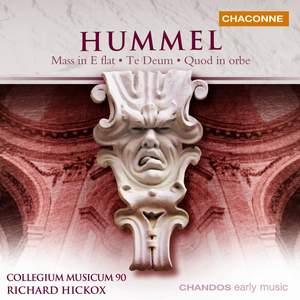
“The second in Richard Hickox's Hummel Mass edition concentrates on works written soon after Hummel was appointed Konzertmeister to Prince Esterházy in 1804. Hummel was keen – the Mass was completed four months before the September deadline. In his booklet-note David Wyn Jones suggests the composer may have been trying to pre-empt his potential rival, Johann Fuchs, who was nominally in charge of church music for the prince. The result has a winning freshness. As in the first disc, Hickox captures the joy of Hummel's inspiration, with clean attack and fine diction from chorus and soloists. That clarity extends to the superb setting of the Te Deum, written at high speed to celebrate peace with Napoleon in 1805. Each section of the elaborate text is strikingly characterised without holding up the urgency established in the opening fanfares. The graduale Quod quod inurbe is another fine, neglected work. The Blackheath Concert Hall recording is full and clear: this is shaping up to be an outstanding series.” Gramophone Classical Music Guide, 2010 | | | (also available to download from $10.50) | In stock - usually despatched within 1 working day. |
|
|
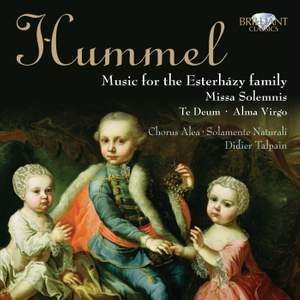
| |  | Hummel: Sacred music for the Esterházy family
Johann Nepomuk Hummel, friend, rival in love and contemporary of Beethoven, pupil of Mozart, Haydn and Salieri, is best known today for his early concerto for trumpet (1803). This work clearly displays Hummel’s skill in balancing the new valve trumpet against the orchestra, and his concerto exhibits his easy gift for melody and striking effects. He was however one of the greatest pianists of the early 19th century (to many, second only to Beethoven), and his piano playing technique and compositional style had a huge influence upon Chopin. His 7 piano concertos form a link from those of Mozart to the romantic concertos of Chopin, Mendelssohn and Schumann. In 1804 Hummel took over the position of concertmaster to Prince Nikolaus Esterhazy, Haydn’s old position. Haydn had supported his one time pupil’s candidacy. Hummel continued his teacher’s work by composing 5 masses and shorter works for the princely family, and the his masses follow on directly from Haydn’s last six great settings. Hummel’s masses are impressive works, and can hold their own in the company of the masterpieces by Haydn, Schubert and later Bruckner. Hummel’s skill with the orchestra is apparent at every turn and these works are brilliantly written for the choir, soloists and orchestra alike. Recording made in 2007. Period instruments. Comprehensive booklet essay and sung texts. Unusual repertoire of appeal to listeners who like Mozart, Haydn and Beethoven masses. | | | Usually despatched in 4 - 5 working days. |
|
|
| |  |
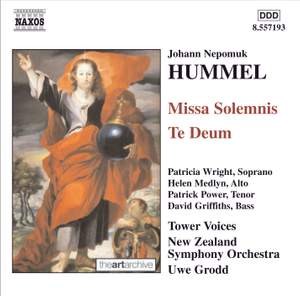
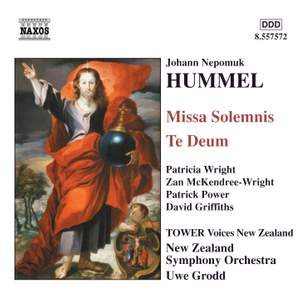
“This, the longest of Hummel's five Masses, is another invigorating example, coupled with an electrifying setting of the Te Deum. Both were written in 1806 and feature martial reminders that this was the period of the Napoleonic Wars. The Te Deum opens with a rousing march, and with one or two relaxed passages for contrast – illustrating this long and varied prayer-text – continues in a single span. It ends with a brisk and triumphant fugato, quite different from the sombre close most often heard in Anglican settings. It's a delight. Uwe Grodd draws an exhilarating performance from his forces. The performance of the Mass is equally successful. The grandeur of the writing is established in the slow introduction to the Kyrie, leading to a brisk main Allegro (following Haydn's lively practice in Kyries) in a rhythmic triple time. The martial flavour of the writing is evident from the Gloria's opening fanfares and continues into the Credo, until a sharp change of key to a warm A major brings a relaxed and lyrical setting of 'Et incarnatus', followed by the clashing discords of the 'Crucifixus'. 'Et resurrexit' restores the military mood. One moment to relish comes after the last of the calls of 'Credo' on 'Et vitam venturi' (track 4, 9'09") with two rising scale passages clearly intended to send you up to Heaven in their exhilaration. Brodd opts to use his admirable soloists throughout the Benedictus, even though the autograph suggests otherwise. It works very well, with imitative writing for the soloists set against the four-square tread of the orchestra. With the Agnus Dei Hummel at last writes a meditative movement, slow and hushed, which develops into chromatic writing in a minor key, before the 'Dona nobis pacem', as in Haydn's masses, brings a joyful close. Grodd inspires vigorous playing and singing from his forces, who are freshly and cleanly recorded.” Gramophone Classical Music Guide, 2010 | | | (also available to download from $6.00) | Usually despatched in 2 - 3 working days. (Available now to download.) |
|
|
| |
|